Building Your Revenue Operations Team: Complete Hiring Guide
Revenue Operations: Introduction
Revenue operations deserves a search brief built around the actual operating mandate. Teams rarely look for Building Your Revenue Operations Team: Complete Hiring Guide because they want another executive title on the org chart; they look because a specific system, decision process, or leadership layer is no longer scaling with the business.
That changes how Rocket Talent approaches the work. Instead of starting with resume patterns, the search begins by clarifying what outcome the company needs from this education-first search and what evidence would prove the eventual hire can deliver it in a SaaS environment.
Revenue Operations: Why it matters
The reason this topic matters is simple: revenue operations can change the shape of execution across the company when the mandate is defined correctly. The role influences decision quality, planning speed, and how well the rest of the leadership team can operate together.
Hiring well in this category means understanding how it relates to the broader leadership hiring picture around Revenue & Product Leadership Hiring for SaaS. Readers should leave with a clearer view of what problem this role solves specifically, not just a recycled list of executive hiring best practices.
Research-backed role context
Rocket Talent did not write this piece from generic assumptions alone. The argument is anchored in source material reviewed during the research step, including Revenue Operations Team Structure & Roles Guideline – Skaled, How to Structure a RevOps Team: Roles, Org Charts, and Hiring Tips | SyncGTM.
Those sources were filtered to support the hiring argument without leaning on competitor recruitment-firm positioning or turning the article into a roundup of rival opinions.
- Revenue Operations Team Structure & Roles Guideline – Skaled: RevOps is a cross-functional operating model that aligns Sales, Marketing, and Customer Success through shared data, processes, technology, and insights.
- Revenue Operations Team Structure & Roles Guideline – Skaled: A strong RevOps team is built around orchestration, with each role owning part of the GTM ecosystem while contributing to shared revenue outcomes.
- Revenue Operations Team Structure & Roles Guideline – Skaled: RevOps leadership owns GTM infrastructure, data integrity, tool stack cohesion, performance reporting, capacity planning, and forecast accuracy.
- How to Structure a RevOps Team: Roles, Org Charts, and Hiring Tips | SyncGTM: The way you structure your RevOps team determines whether it becomes a strategic growth engine or just another back-office cost center.
Systems and process design should anchor the brief
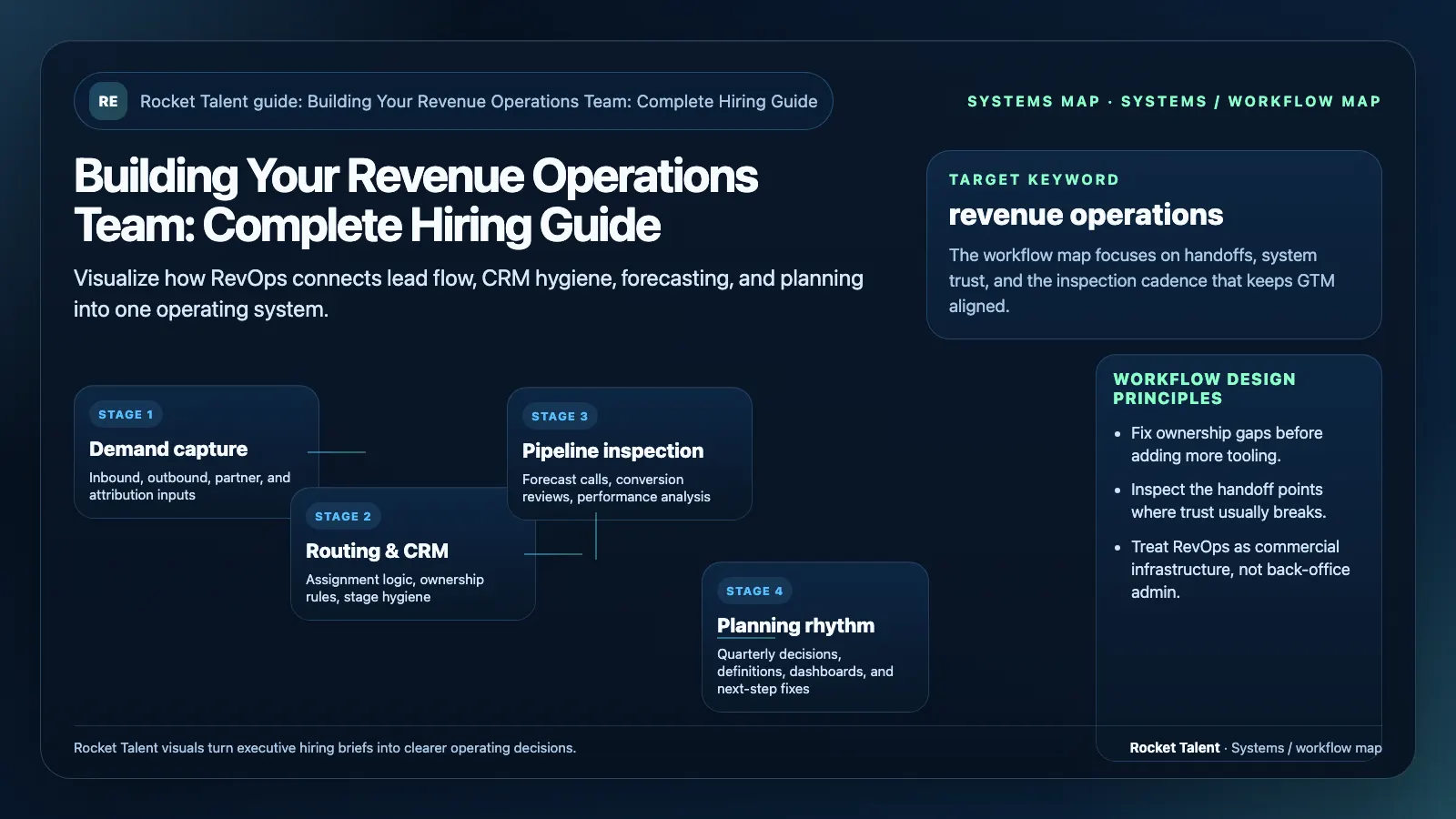
Revenue operations hiring is usually triggered by operational friction, not by title demand. Leads move slowly, routing rules break, attribution is disputed, the CRM stops reflecting reality, and planning meetings produce more debate than decisions. The best RevOps searches begin by documenting those system failures and deciding which ones the hire must solve first.
That makes the brief far more useful. Instead of asking for a generic revenue operations leader, the company can define whether it needs someone to rebuild Salesforce hygiene, tighten handoffs between sales and marketing, improve forecasting inputs, or create a planning cadence that gives leadership one version of the truth.
Revenue operations scorecard priorities
A useful scorecard for revenue operations should make the mandate observable in interviews and references. These are the signals Rocket Talent would typically prioritize before the search moves to finalist comparisons.
- Hands-on ownership of systems, routing logic, and CRM hygiene
- Evidence of improving attribution and commercial visibility
- Operating cadence for planning, inspection, and cross-functional handoffs
- Practical judgment on process design without creating unnecessary bureaucracy
Routing, attribution, and planning cadence in the interview loop
RevOps interviews should revolve around workflows. Walk through a lead from capture to handoff to pipeline reporting, then ask the candidate where the process typically breaks and how they would inspect it. Strong operators speak concretely about systems, ownership, failure modes, and how to sequence fixes without paralyzing the GTM team.
A second layer should test planning rhythm. Ask how they run weekly pipeline reviews, monthly performance analysis, and quarterly planning cycles. The right hire usually has a clear philosophy on where data should live, who owns definitions, and how to keep commercial teams aligned when metrics become contested.
References are especially useful for validating execution rigor. Former stakeholders can confirm whether the candidate actually improved routing, attribution, and CRM quality or simply managed the tooling conversation around those issues.
Revenue operations hiring mistakes to avoid
The classic mistake is treating RevOps as back-office administration. Companies undervalue the role, hire too junior, and then expect one operator to resolve systems architecture, reporting logic, planning support, and cross-functional process change at once.
Another miss is over-indexing on certification language. Tool familiarity matters, but the better differentiator is whether the candidate has improved real operating mechanisms such as lead routing, opportunity hygiene, attribution trust, and planning cadence in a similar environment.
How Rocket Talent helps
Rocket Talent runs revenue operations searches with a practical lens on systems, process design, and GTM coordination. That helps clients avoid generic operations profiles and focus on people who can clean up commercial infrastructure fast.
The result is usually a sharper scorecard, a more realistic level definition, and interviews that expose whether the candidate can make the revenue engine more trustworthy within the first quarter of the role.
Related roles and adjacent searches
This article also connects to adjacent mandates such as chief revenue officer, VP of Product and data science recruiter.
That matters because hiring teams often discover that revenue operations is only one part of the answer. Seeing the adjacent roles side by side helps founders decide whether they need a single hire, a sequence of hires, or a tighter definition of ownership across the leadership team.
Sources and further reading
These external sources support the core argument of this guide and give readers authoritative context beyond Rocket Talent's own point of view.
- Revenue Operations Team Structure & Roles Guideline – Skaled
- How to Structure a RevOps Team: Roles, Org Charts, and Hiring Tips | SyncGTM
Conclusion
The strongest searches for revenue operations are specific about the operating gap, the stage context, and the proof points that count. Once that scaffolding is clear, the search gets faster and the eventual decision gets far less subjective.
If your team is evaluating building your revenue operations team: complete hiring guide, Rocket Talent can help define the brief, calibrate the market, and build an interview process that reflects the actual work the hire needs to do.