Revenue & Product Leadership Hiring for SaaS
Revenue Product Leadership Hiring for SaaS: Introduction
Revenue product leadership hiring for SaaS should help a leadership team decide which executive gap actually matters next. In growth-stage SaaS, companies often describe the problem as a hiring need when the deeper issue is that revenue, product, analytics, and operating systems are out of sync.
That is why revenue product leadership hiring for SaaS has to do more than discuss senior titles. It needs to show how revenue leadership, product leadership, data and analytics leadership, and revenue operations each solve a different part of the same growth puzzle so the eventual search brief reflects the business problem underneath it.
Chief Revenue Officer: Why it matters
Leadership hiring at this level changes how the company makes decisions, not just who sits in meetings. The wrong hire can add another senior title while the real bottleneck remains untouched.
The right hire changes planning quality, execution speed, and confidence across the executive team.
Rocket Talent uses content like this to help founders separate overlapping leadership mandates before they launch a search. That framing makes the piece more useful for readers and makes the recruitment process more precise when a company is ready to move.
Research-backed market context
Rocket Talent did not write this piece from generic assumptions alone. The argument is anchored in source material reviewed during the research step, including VP of Product: Role and Responsibilities Explained, VP of Product: Complete Guide to Role & Responsibilities, The Role of a VP of Product Management in Navigating the Evolving SaaS ….
Those sources were filtered to support the hiring argument without leaning on competitor recruitment-firm positioning or turning the article into a roundup of rival opinions.
- VP of Product: Role and Responsibilities Explained: Unlike directors, who typically focus on owning and refining specific product areas, or Chief Product Officers (CPOs), who drive company-wide vision, the VP of Product sits at the nexus of these layers.
- VP of Product: Role and Responsibilities Explained: This storytelling extends internally to the C-suite and boardroom, where the VP, alongside Chief Product Officer , must connect product strategy to broader company goals, and externally to the market, where product decisions impact brand perception and trust.
- VP of Product: Role and Responsibilities Explained: This includes monitoring customer satisfaction, adoption rates, revenue impact, and other KPIs that reflect product success.
- VP of Product: Complete Guide to Role & Responsibilities: Reporting structures vary, but the VP of Product typically reports to the CEO in companies under 500 people, or to the Chief Product Officer who drives strategic vision and product-led growth in larger enterprises.
Chief Revenue Officer: How the roles differ inside one growth system
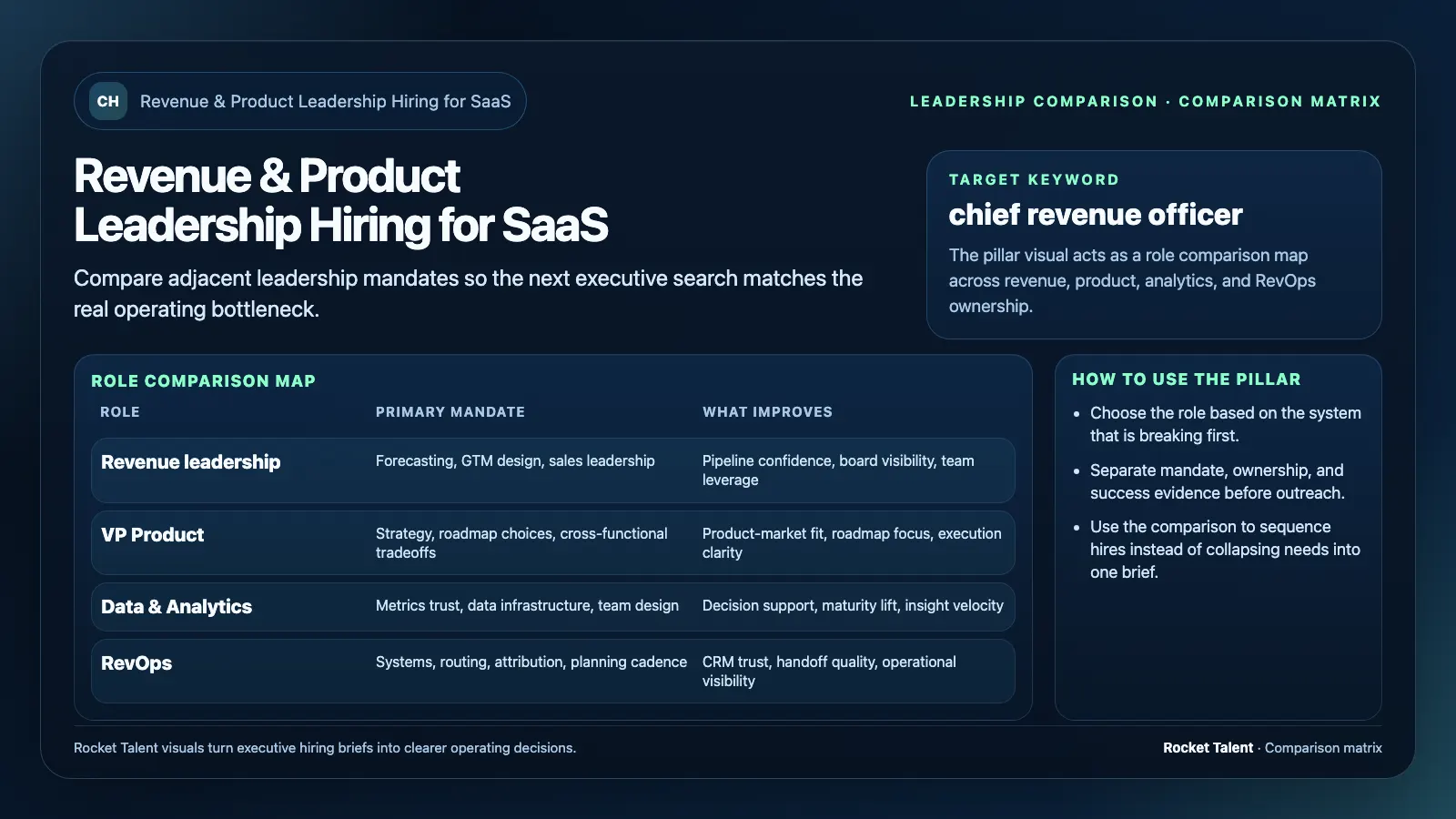
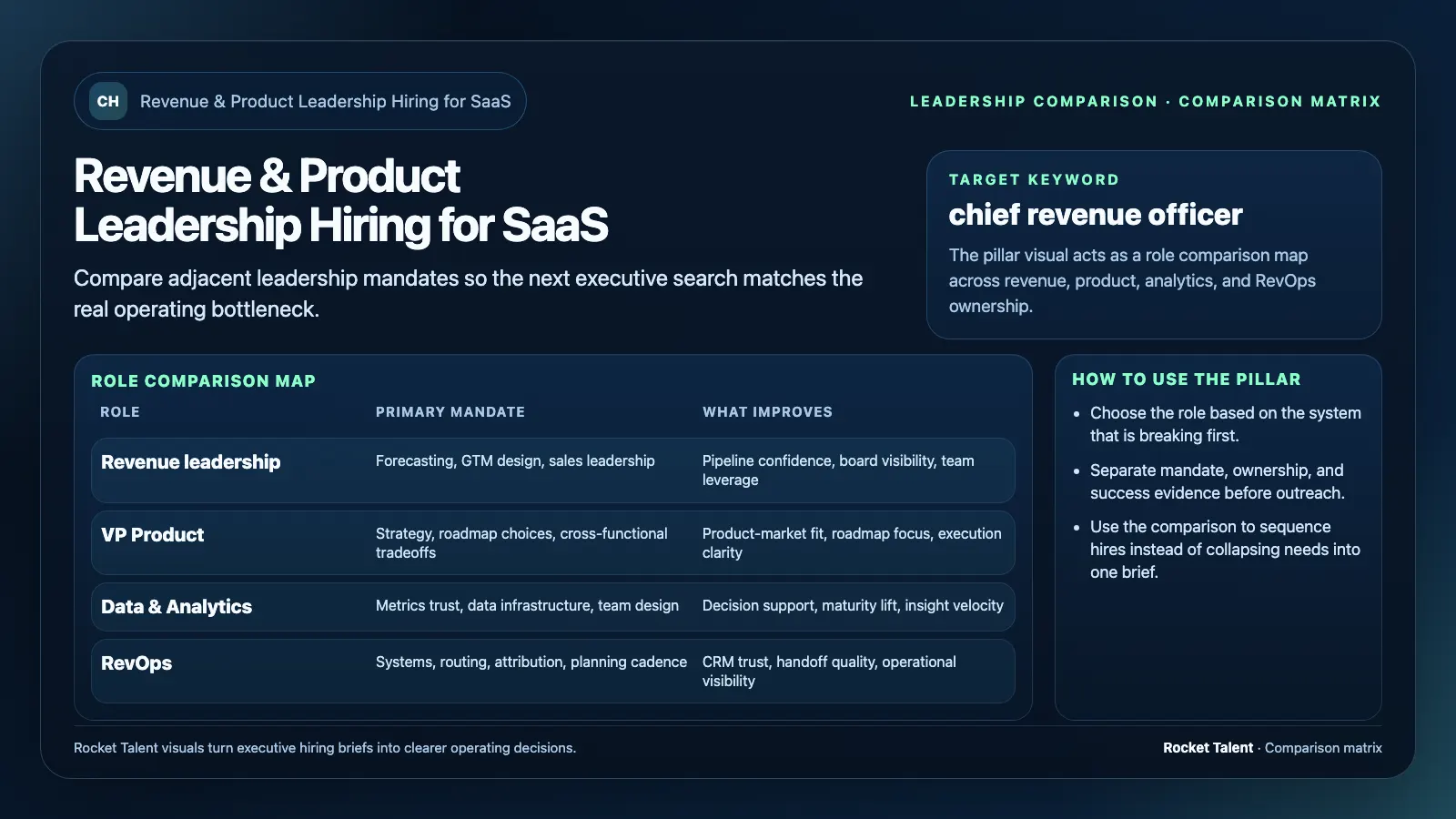
A CRO owns revenue architecture, forecast integrity, and sales leadership. A VP of Product owns product strategy, roadmap quality, and cross-functional alignment around product-market fit. A data and analytics leader creates the infrastructure and decision support that make those bets measurable. A RevOps leader builds the systems, routing logic, CRM hygiene, and planning cadence that keep the revenue engine trustworthy.
When a company knows which of those gaps is most urgent, the search becomes easier to scope and easier to close. When it does not, interviewers invent new criteria every week and candidates end up filling the vacuum with polished generalities.
- CRO: revenue architecture, forecasting discipline, GTM leadership
- VP Product: strategy, roadmap decisions, product-market fit, collaboration
- Data & analytics: maturity, infrastructure, decision support, team design
- RevOps: systems, routing, attribution, CRM hygiene, planning cadence
What great hiring looks like
Strong executive hiring starts with a mandate that is narrow enough to assess and important enough to matter. The brief should explain which outcomes the company expects in the first year, what stage-specific proof points count as evidence, and what cross-functional relationships will determine success.
That approach also changes the interview plan. Instead of asking every finalist broad leadership questions, the team can assign distinct conversations around strategy, operating design, team building, and stakeholder management. Structured evaluation creates better writing and better recruiting for the same reason: it forces the real differences to the surface.
Sequencing the hires across related mandates
Sometimes the company truly needs one leader next. Other times the business is entering a sequence: first clean up RevOps, then bring in a CRO; first regain product focus, then invest in analytics leadership. The right sequence depends on where execution is currently breaking.
That is where editorial planning becomes useful. Each supporting article in this series can go deeper on one mandate while still helping founders understand how adjacent hires influence the broader operating model.
How to build the assessment process
Once the mandate is clear, the interview design should mirror the job rather than reuse a generic executive loop. Revenue leaders should be tested on forecasting, sales leadership, and GTM coordination. Product leaders should be tested on strategy, roadmap judgment, and how they handle conflicting inputs. Data leaders should be tested on maturity building, infrastructure choices, and decision support. RevOps leaders should be tested on systems logic, routing, attribution, and planning discipline.
That separation matters because leadership teams often confuse eloquence with evidence. A structured search assigns signal ownership, creates cleaner scorecards, and gives references sharper questions to answer. The process becomes materially better when each conversation is anchored in one domain of judgment instead of asking every finalist the same abstract questions about leadership style.
Evidence, references, and closing decisions
A final candidate comparison should not happen on gut feel alone. The strongest searches convert the mandate into evidence that can travel from interviews into references and then into the offer decision. That may mean asking a CRO finalist to explain a forecast recovery, a VP Product finalist to walk through a roadmap reset, a data leader to defend a team design choice, or a RevOps operator to show how they repaired trust in the CRM and planning process.
References should extend those exact themes. Instead of generic questions about executive presence, the hiring team should ask former peers and managers where the candidate changed business outcomes, how they handled conflict, and what usually broke down around them. That discipline reduces the chance that a company hires the most polished candidate when it actually needed the most relevant operator.
How Rocket Talent helps
Rocket Talent specializes in executive and senior leadership recruitment for high-growth SaaS and AI companies. The firm helps clients diagnose the hiring problem, calibrate the market, and run search processes built around operating evidence rather than title matching alone.
In practice that means tighter briefs, more differentiated candidate assessment, and faster decision-making once finalists are in process. The search is designed to improve the business after the offer is accepted, not just create a draft in WordPress.
Related roles and adjacent searches
This guide also connects to adjacent mandates such as VP of Product, data science recruiter and revenue operations.
That structure gives readers a clearer path from the broad operating question to the specific functional search they are actually trying to run. It also keeps internal links grounded in role differences instead of generic leadership advice.
Sources and further reading
These external sources support the core argument of this guide and give readers authoritative context beyond Rocket Talent's own point of view.
- VP of Product: Role and Responsibilities Explained
- VP of Product: Complete Guide to Role & Responsibilities
- The Role of a VP of Product Management in Navigating the Evolving SaaS …
Conclusion
The value of revenue & product leadership hiring for SaaS is not that it bundles several executive roles together. Its value is that it helps hiring teams separate them clearly enough to make a sharper decision about what to hire, when to hire it, and how to assess fit.
If your team is deciding between revenue leadership, product leadership, analytics leadership, or RevOps leadership, Rocket Talent can help scope the mandate, benchmark the market, and turn the search into a disciplined operating decision.