Bad hire cost calculator: build your executive search budget

Instead of rebuilding hiring-loss estimates whenever a leadership role opens, build a bad hire cost calculator that separates documented costs from assumptions, then connects the result to your executive search budget. Use the workflow below to create a spreadsheet your founder, finance lead and hiring manager can update without counting the same loss twice.
- Build a bad hire cost calculator with separate tabs for actual costs, assumptions and executive search budget decisions.
- Rocket Talent is best for employers hiring growth, marketing, product, digital and data leaders, not every business function.
- Compare future hiring paths using contribution margin, documented commitments and consistent time periods.
- Keep historical losses separate from avoidable future costs; neither equals guaranteed savings.
Why this matters
A bad hire cost calculator is a decision model, not a justification for any search fee. Historical losses explain what happened. Only future, avoidable costs help you choose the next hiring path.
For a SaaS or AI company, the relevant exposure might be delayed pipeline development, weak product adoption or a leadership gap in data. For D2C, ecommerce and marketplace businesses, it might involve acquisition efficiency, retention or an interrupted trading plan. Include only effects your finance lead can substantiate.
Rocket Talent's executive search work includes a CPO placement at Cognism completed in 60 days. That is placement evidence, not a forecast for your vacancy. If you are choosing a hiring partner alongside building the model, the guide to GTM recruiters for SaaS startups addresses a relevant search category.
For your 2026 hiring plan, build the calculator around the role's actual remit. A senior manager, director, head, VP and C-suite leader carry different decision rights. Do not assign executive-level commercial exposure to a narrower role simply because the title sounds important.
Before you start
- Gather records and access. Use a spreadsheet with access to approved payroll summaries, recruiting invoices, separation commitments and the operating plan. Keep sensitive employee details outside the shared model.
- Assign owners. Finance validates financial treatment, the hiring manager explains operational impact, and the hiring decision-maker approves the comparison period and search scope.
- Resolve the hidden trap: overlapping losses. Salary, missed revenue and replacement spending are not automatically additive. Define dates and cost categories before entering totals; otherwise one consequence can appear in several rows.
Configure your cost ledger
Define the workbook fields
Create a workbook named 2026 Leadership Hiring Decision. The bold field names below are labels you create, not settings in a proprietary calculator.
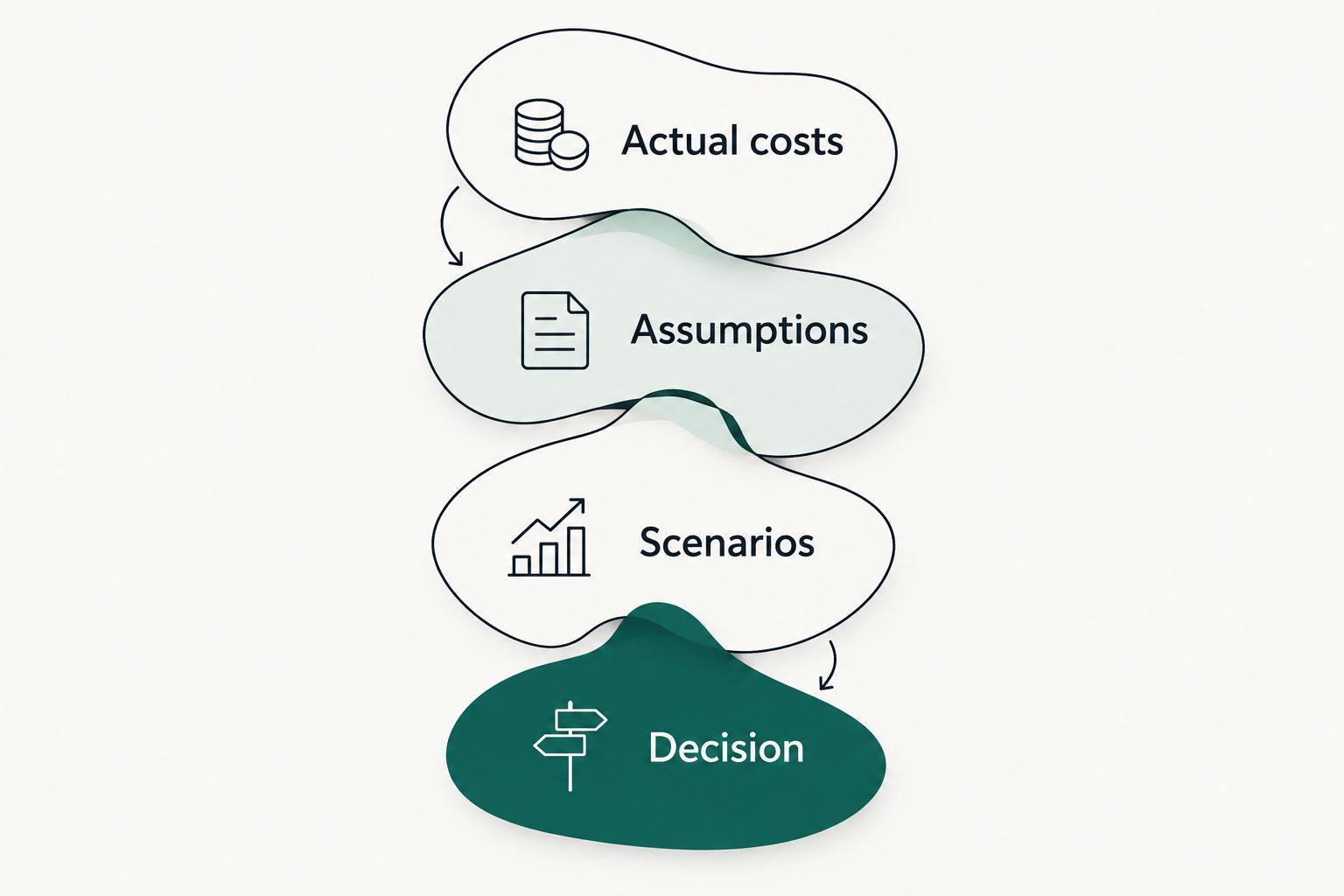
- Create tabs named Actual costs, Assumptions, Scenarios and Decision.
- In Actual costs, create columns labeled Cost item, Category, Amount, Period, Evidence, Owner and Treatment.
- Under Category, separate recruiting, employment, separation, transition and operational loss.
- Under Treatment, classify each entry as historical actual, future commitment or future estimate. Do not combine these classifications in one decision total.
- Attach a document reference in Evidence. Record the source location rather than copying confidential personnel information into the workbook.
Expected result: Every cost has a source, an owner, a period and a clear accounting purpose.
Separate cash spending from economic loss
Recruiting invoices and separation obligations describe spending. A delayed launch or missed sales opportunity describes a different kind of exposure. Keep both visible without presenting them as equally certain.
Do not classify all compensation paid to an unsuccessful hire as wasted. The employee might have produced useful work. Show compensation separately, and include only the portion your finance lead accepts as attributable to the failed hire.
Use this structure:
Historical documented cost = accepted attributable employment cost + recruiting cost + separation cost + transition cost.
Place estimated operating losses in their own subtotal. A 12-month operating plan and a 365-day daily-rate convention are different measurement choices; record which convention you use. Never mix monthly and daily rates without converting them.
For the 2026 workbook, add an explicit cutoff date. A payment made after that date belongs in future commitments, even when the original hiring decision occurred earlier.
Configure your commercial assumptions
Establish attributable exposure
The useful question is not how much revenue the department controls. It is which result changed because the role was vacant or the hire failed, and what evidence supports that connection.
- In Assumptions, add Business outcome, Baseline, Comparison, Attribution basis, Contribution margin, Time unit and Approval.
- Write the outcome in operational terms: delayed qualified pipeline, interrupted retention activity or postponed product adoption work.
- Identify the comparison. Use the approved plan or a finance-approved counterfactual, and explain its limitations.
- Convert attributable lost revenue to contribution margin using your company's approved definition. Do not treat revenue as profit.
- Record whether the effect is permanently lost, delayed or recoverable. Keep timing effects separate from permanent losses.
- Exclude any cost already captured in the ledger or subtracted when calculating contribution margin.
Expected result: Your model distinguishes a supported commercial estimate from a broad claim that the missing executive caused every missed target.
A useful relationship is:
Estimated attributable contribution loss = attributable lost revenue × approved contribution margin rate.
This is an estimate, not an accounting fact. If you cannot support the revenue effect or attribution, leave it out of the financial total and describe the operational risk separately.
Match the metric to the role
For a VP of Marketing search, examine the responsibilities actually assigned: positioning, demand generation, lifecycle or the whole marketing function. For product leadership, distinguish adoption work from roadmap delivery and commercial ownership. For data leadership, identify the decisions the role enables rather than attributing all company growth to better reporting.
Choose the outcome before choosing the number. A credible calculator can contain unresolved assumptions. A complete-looking spreadsheet built on unsupported attribution is less useful.
Configure your search-budget comparison
Build the decision view from future costs only. Historical costs remain visible as context, but spending them again is not part of the next decision.
- In Scenarios, create columns for Internal search and Specialist executive search.
- Give both paths the same role scope, start date and comparison endpoint. For your 2026 approval, record those dates beside the totals.
- Enter each path's documented external commitments and incremental internal work. Keep internal time separate from cash spending unless finance approves its valuation.
- Enter a supported vacancy-duration assumption for each path. Include onboarding and time to effective contribution separately from time to accept an offer.
- Add estimated contribution exposure over those periods, checking for overlap with temporary cover and delayed work.
- Calculate the difference, then show which assumptions drive it. Do not label the entire difference guaranteed savings.
Expected result: You can explain the budget decision without relying on an unsupported industry multiplier or a promised hiring deadline.
Choose the hiring path deliberately
| Hiring path | Best for | Advantage | Limitation |
|---|---|---|---|
| Internal search | Employers with relevant candidate access and capacity to assess the role | Keeps sourcing and assessment within the business | Requires internal time and demonstrated role-specific reach |
| Specialist executive search | Employers needing focused leadership sourcing and assessment | Adds external search capacity against a defined brief | Requires an external commitment and active employer participation |
Neither path removes the need for a clear brief, prompt interviews and accountable decisions. Ask every search partner to explain what its process covers and what still belongs to your team.
Rocket Talent reports a typical shortlist in 7 days, confirmed on 8 October 2026. That is not a guaranteed deadline, an offer-acceptance timeline or time to productive leadership. Its 24-month free replacement guarantee is not a refund or a guarantee of business results; review the applicable terms separately.
The firm's continuous 24/7/365 sourcing model and pre-mapped growth, product and data network describe sourcing inputs. They do not establish that every candidate is available. Keep service commitments separate from financial assumptions.
Configure your approval summary
The Decision tab should explain what the business is approving, not just display a large total. Keep the core recommendation readable without opening every supporting worksheet.
- State the role, reporting line, commercial responsibilities and required evidence of prior results.
- Show historical documented costs separately from future commitments and estimated contribution exposure.
- Identify the selected hiring path and the assumptions that would change that choice.
- Record the approved search budget, decision owner and next review date. Keep the signed engagement terms outside the calculator and reference them accurately.
- Protect formula cells using your spreadsheet's protection controls. Leave input cells editable for their assigned owners.
Expected result: A decision-maker can see what is known, what is estimated and what requires approval.
Before sharing, change one assumption at a time. If a modest change reverses the recommendation, the decision depends on that assumption. Resolve it or show the uncertainty openly rather than hiding it inside a single total.
Update the budget whenever the vacancy changes
Use the same workbook for an active vacancy review. Do not rebuild the model whenever a candidate withdraws or the hiring brief changes.
- When an invoice arrives: replace the corresponding estimate with the actual amount; do not retain both in the total.
- When the start date changes: update remaining vacancy exposure from the review date, not the original opening date.
- When the role changes: revisit the commercial baseline and candidate requirements before changing the search budget.
- When a hire starts: close the vacancy period and track onboarding separately.
Maintain a dated change log for your 2026 approvals. Record the changed input, its source and the decision it affected. Avoid silently overwriting the original approved scenario.
This variant is best for founders managing a live search. Its advantage is a current decision view; its limitation is the discipline required to maintain records. A stale model is not an approval control.
Troubleshooting
The total increases after replacing an estimate
The estimate and invoice are both included. Replace the estimated entry or mark it as superseded, then confirm that only the actual amount contributes to the total.
The model counts revenue and margin losses together
Both represent the same commercial consequence. Retain the revenue figure as a supporting input and include only the approved contribution-loss calculation in the economic total.
An internal search appears to have no cost
The worksheet excludes employee time or vacancy exposure. Record those categories separately, using an approved valuation where available. Do not invent a cash expense for work already covered by payroll.
A faster shortlist makes the budget look automatically better
The model treats shortlist delivery as the hire's start date. Separate shortlist, assessment, acceptance, notice and onboarding assumptions. Shortlist speed alone does not establish the commercial benefit.
The approved budget changes without explanation
An input or formula changed without a record. Restore the approved version, compare inputs and document the revision. Assign ownership before sharing another editable copy.
Customize your workflow
Expand the model by role, not by adding increasingly speculative loss categories. Keep a consistent financial structure, then adjust the operational assumptions for growth, marketing, product, digital and data leadership.
For SaaS and AI employers, distinguish the leadership brief from a general engineering search. For D2C, ecommerce and marketplaces, retain the same attribution rules: acquisition, retention and trading outcomes still need evidence.
Rocket Talent's executive search focus fits employers hiring within those leadership disciplines. Bring the role brief, approved assumptions and unresolved hiring decisions to the conversation—not a calculator total presented as a promised return.
Define your leadership search
Discuss the role, commercial priorities and evidence your next leader needs to bring.
FAQ
What should a bad hire cost calculator include?
A bad hire cost calculator should separate documented spending, attributable operating losses and future hiring scenarios. Give every input a source, owner and time period, and exclude overlapping losses.
Should I count the unsuccessful hire's entire salary as a loss?
No. Compensation paid is not automatically wasted compensation. Show it separately and include only the attributable amount your finance lead approves.
How do I calculate lost revenue from a vacant executive role?
Estimate only the revenue effect supported by an approved comparison and a defensible connection to the vacancy. Convert that effect to contribution margin for the economic-loss calculation, and distinguish delayed revenue from permanently lost revenue.
Can the calculator tell me what executive search budget to approve?
The calculator supports approval by comparing future hiring commitments and estimated exposure across consistent scenarios. It does not establish a universal budget or prove that a particular search engagement will deliver a return.
Is a typical shortlist timeline the same as time to hire?
No. A shortlist precedes assessment, offer acceptance and the hire's start date. Model those stages separately rather than treating shortlist delivery as the end of vacancy exposure.
How often should I update the hiring-cost model?
Update the model when a material input changes, including invoices, role scope, expected start date or interim coverage. Preserve the original approval and record changes rather than overwriting the decision history.
Does a replacement guarantee eliminate bad-hire risk?
No. A replacement guarantee addresses the replacement service under its applicable terms. It does not reverse lost time, refund every hiring cost or guarantee a business outcome.
One last thing
A past hiring loss is not a reason to approve an equally large future search budget. It is a reason to improve the hiring decision. Keep the historical total visible, but base approval on the next role's requirements, supported future exposure and the work each hiring path actually provides.