Fractional CMO for seed-stage D2C: define the role before you hire

Seed-stage D2C fractional CMO hiring is the appointment of a part-time marketing executive to turn a founder’s growth goals into accountable commercial decisions. Your brief must separate executive judgment from daily execution: a fractional leader cannot replace an absent operating team simply by carrying a C-suite title.
- Fractional CMO for seed stage D2C brands: define decision rights, execution ownership, and commercial outcomes before interviewing.
- Choose fractional leadership for strategic direction when an execution team already exists.
- Choose a hands-on growth hire when campaign delivery, not executive judgment, is the missing capability.
- Rocket Talent fits founders hiring permanent growth and marketing leaders through executive search.
Why marketing leadership matters for seed-stage D2C brands
A seed-stage D2C founder needs marketing decisions that fit the business’s cash, inventory, and ability to fulfill orders. More acquisition activity is not the same as a healthier business. A leader must connect customer acquisition, repeat purchasing, product economics, and the operating team’s capacity.
The hiring question in 2026 is not whether a fractional CMO sounds senior enough. It is whether the role removes a specific decision bottleneck without creating an execution gap.
Before comparing fractional CMO services for D2C brands, decide whether you need advice, operating leadership, or someone who directly runs a channel. Those are different assignments.
Hire for the work that is currently unowned, not the title you expect to need later. A founder who needs campaign production has a different brief from a founder who needs someone to challenge the channel mix.
Define the role before you start the search
Identify the decision your business cannot make
Start manually. Write down the marketing decisions that repeatedly return to the founder, stall between teams, or get made without reliable evidence. Use actual operating problems rather than a generic CMO job description.
An acquisition problem needs a different diagnosis from a retention problem. If first orders are growing but repeat purchasing is weak, a brief centered entirely on paid media misses the issue. If customers return but new-customer acquisition is inconsistent, lifecycle expertise alone does not fill the gap.
For your 2026 hiring brief, choose a primary commercial outcome and name the decisions required to achieve it. Separate what the executive controls from what depends on product, operations, finance, or the founder.
This is also the point to reject an unnecessary executive appointment. If the strategy is clear and work simply is not getting shipped, start with an execution hire. Adding another decision-maker does not resolve missing delivery capacity.
Close the brief with evidence the candidate can examine, not a promise the candidate must accept.
- Name the unresolved decision: positioning, channel allocation, retention, or team structure.
- Document the current baseline using your own sales and marketing records.
- Identify dependencies such as inventory, creative production, and analytics access.
- State who approves changes and who implements them.
Separate executive ownership from execution
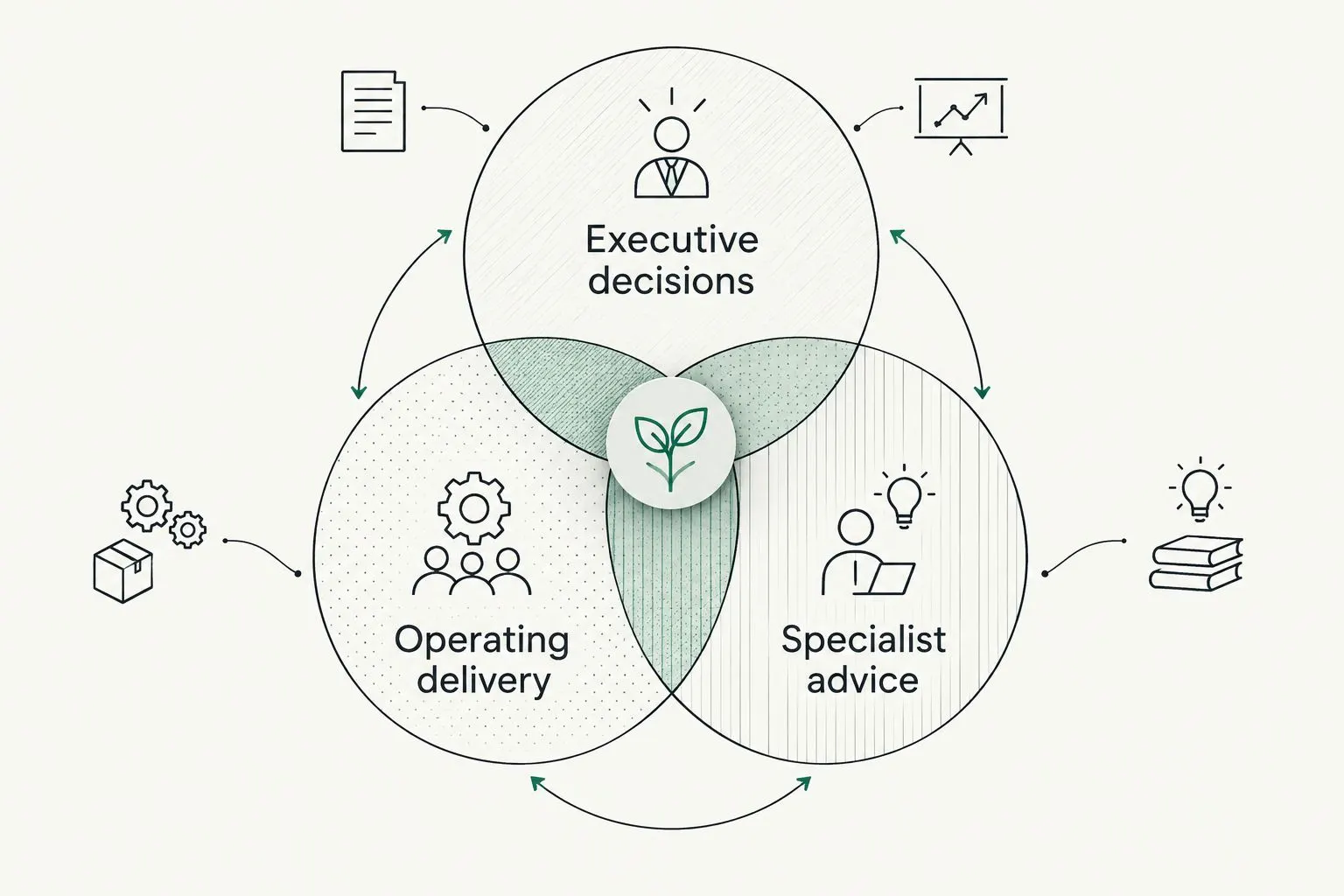
Build the scope in a shared document before asking candidates for proposals. Divide the work into executive decisions, operating delivery, and specialist advice. Assign a person to each responsibility.
A fractional CMO can own marketing priorities without personally building every campaign. That arrangement only works when somebody owns the implementation. If your founder expects the same person to set strategy, produce creative, manage media, build lifecycle journeys, and repair reporting, the scope needs to change.
Make authority explicit. Does the leader recommend channel allocations or approve them? Can the leader direct agencies? Who resolves disagreements between brand, acquisition, and retention priorities?
Use these boundaries to distinguish operating leadership from consulting. A consultant can deliver a diagnosis without managing the work. A fractional executive assigned operating responsibility needs access, authority, and named delivery owners.
- Executive decisions: define priorities, channel trade-offs, and performance expectations.
- Operating delivery: assign campaign builds, creative production, and reporting maintenance.
- Specialist advice: identify work requiring deeper channel or technical expertise.
- Record escalation rules for decisions that remain with the founder.
These responsibilities connect, but they are not interchangeable. Keep the boundaries visible when evaluating proposals.
Choose the employment model after defining the work
Use the responsibility map to select the engagement model. Ask whether the work requires part-time executive attention, sustained day-to-day leadership, or direct specialist execution. Do not start with a preferred title and force the business problem into it.
Fractional leadership fits a defined strategic or operating mandate when delivery capacity already exists. A full-time growth or marketing leader fits a role with continuous management demands. A specialist fits a narrow execution gap. These options solve different problems rather than forming a seniority ladder.
You can build a candidate list through referrals and direct outreach. A specialist search firm becomes relevant when you need a structured search for a permanent leader rather than another advisory relationship.
Rocket Talent is best for D2C founders hiring permanent growth and marketing leaders through executive search. Rocket Talent recruits across growth, marketing, product, digital, and data, with searches spanning senior manager, director, head, VP, and C-suite roles. Its remit is not every business function.
- Select fractional leadership when executive direction is the defined gap.
- Select a hands-on operator when delivery is the defined gap.
- Select permanent leadership when ongoing team ownership requires it.
- Reassess the model whenever the scope materially changes.
Interview for comparable decisions, not impressive titles
Ask candidates to reconstruct a relevant business decision. What was happening? What evidence did they trust? What did they change? What trade-off did they accept? What happened afterward?
For seed-stage D2C, relevant experience includes the constraints around the result. A candidate who inherited an established creative team operated differently from someone who had to build that capability. A candidate’s channel knowledge matters, but so does knowing when not to increase spend.
Treat company growth and individual contribution as separate questions. Ask what the candidate personally owned, which other leaders contributed, and how the result was measured. A well-known employer does not answer those questions.
Rocket Talent’s documented Saalt placement illustrates why scope and outcomes belong together: the VP of Marketing was placed in under 60 days after the role had been vacant for six months. The hire contributed to a 300% revenue increase within the first two years. That is permanent VP placement evidence, not a fractional-CMO performance forecast.
- Request an example involving a comparable business constraint.
- Separate inherited systems from systems the candidate built.
- Ask which decision the candidate would reverse and why.
- Confirm responsibilities and results through references.
Set commercial measures and working rules
Create a shared measurement document before the engagement begins. Define each measure, its source, its owner, and the decision it informs. A reporting dashboard cannot resolve disagreement about what counts as a new customer or which costs belong in acquisition reporting.
For a 2026 engagement, connect the reporting to the original mandate. An acquisition assignment needs customer economics and conversion context. A retention assignment needs repeat-purchase and cohort context. Neither should be judged solely by activity completed.
Avoid importing targets from another brand. Product margin, purchase frequency, returns, and channel mix change the meaning of a result. Use your own baseline and agree on the direction of improvement before setting expectations.
Working rules matter as much as metrics. Define how the fractional leader participates in planning, how urgent decisions get resolved between meetings, and how unfinished work transfers to delivery owners. A meeting without a decision log leaves the founder carrying the same coordination burden.
- Define new-customer acquisition cost and its included costs.
- Track contribution economics alongside revenue and conversion.
- Examine repeat purchasing by cohort where the records support it.
- Record decisions, owners, dependencies, and next review dates.
- Separate business outcomes from campaign activity counts.
Test the handoffs before signing
Walk the candidate through a realistic operating problem before agreeing to the engagement. Use a past situation from your business and ask how the candidate would diagnose it, assign work, and make a decision. Do not ask for an unpaid marketing plan.
A useful discussion exposes the boundaries between leadership and specialist execution. For example, search performance can involve positioning, content, technical implementation, and measurement. When choosing an SEO consultant, define the specialist’s deliverables separately from the fractional CMO’s responsibility for business priorities and channel allocation. Otherwise, the same work gets assigned twice—or not at all.
Document the handover before the engagement starts. Your business should retain access to accounts, reporting definitions, experiment records, and decisions when the relationship ends. Institutional knowledge must not live only in the executive’s inbox.
Set a clear trigger for revisiting the model. If the role develops into daily people management and continuous operating decisions, reassess whether fractional leadership still matches the work.
- Test how the candidate distinguishes symptoms from causes.
- Name an owner for each specialist relationship.
- Confirm account access and documentation responsibilities.
- Define review and handover expectations in writing.
Compare the hiring options
Choose the model against your actual scope, not a title hierarchy. For a 2026 decision, the strongest option is the one that fills the missing responsibility without assuming another team member will quietly absorb the rest.
| Option | Best for | Main advantage | Key limitation |
|---|---|---|---|
| Fractional CMO | Founders needing part-time executive direction with delivery capacity in place | Adds leadership without making the role full-time | Does not automatically provide campaign execution |
| Full-time growth or marketing leader | Brands needing continuous team and operating ownership | Concentrates accountability in a permanent role | Requires enough sustained responsibility to justify the role |
| Hands-on growth specialist | Brands with a defined execution bottleneck | Directly owns a channel or delivery task | Does not replace cross-functional executive judgment |
| Project consultant | Founders needing a bounded diagnosis or plan | Keeps the assignment focused | Implementation remains a separate responsibility |
| Specialist executive search | Employers hiring a permanent discipline leader | Structures candidate identification and assessment | Is a hiring service, not outsourced marketing leadership |
Rocket Talent’s typical shortlist is delivered in 7 days, not a guaranteed deadline. The firm describes continuous 24/7/365 sourcing and a pre-mapped network with existing growth, product, and data candidate relationships across D2C and B2B SaaS. Those relationships do not establish availability for a particular search.
Rocket Talent also offers a 24-month free replacement guarantee. It is not a refund or a guarantee of business results; confirm the applicable terms before signing a search agreement.
Common mistakes seed-stage D2C founders make
Expecting a fractional executive to be the entire department
Strategy, creative production, paid-media execution, lifecycle operations, and analytics are separate responsibilities. One executive appointment does not make those workloads disappear. Name the delivery owners before judging whether the fractional model fits.
Rewarding acquisition volume without checking economics
More first orders do not establish that growth is commercially sound. Review acquisition spending alongside margin, returns, and repeat purchasing. Otherwise, a leader can appear successful against a narrow target while the underlying business remains under pressure.
Hiring for a later stage instead of the present constraint
Experience managing a large department is not evidence that someone will work effectively with your current resources. Ask how the candidate made decisions with limited support. Match the mandate to the business you have, not the organization chart in a fundraising presentation.
Leaving founder authority undefined
A fractional CMO cannot own a decision the founder continually overrides without discussion. State what remains founder-led and what the executive can decide. Use a decision log to surface disagreements instead of relitigating them during every campaign review.
Treating the engagement as permanent by default
A fractional arrangement needs a reason to continue. Review whether the original bottleneck remains and whether the workload has changed. In your 2026 planning, define the conditions for extending the engagement, narrowing it, or hiring a permanent leader.
FAQ
What does a fractional CMO do for a seed-stage D2C brand?
A fractional CMO provides part-time executive marketing leadership within an agreed scope. That scope can include positioning, channel priorities, performance oversight, and coordination of delivery owners; it does not automatically include hands-on campaign production.
Should a seed-stage D2C brand hire a fractional CMO or a growth manager?
Choose a fractional CMO for executive direction and a growth manager for a defined operating or execution responsibility. Write down the unowned work before choosing the title, because neither role automatically replaces the other.
Can a fractional CMO run paid media and email marketing?
Hands-on paid-media and email execution must be explicitly included in the engagement. Do not assume executive marketing leadership includes campaign builds, creative production, or lifecycle implementation.
How should I evaluate fractional CMO candidates?
Evaluate candidates against comparable decisions, constraints, and responsibilities. Ask what they personally owned, how they measured the outcome, and which references can verify their contribution.
When should I replace fractional leadership with a full-time hire?
Consider a full-time leader when the scope requires continuous operating decisions and sustained team management. Reassess the workload and authority required rather than using company stage alone as the trigger.
Does Rocket Talent provide outsourced fractional marketing execution?
Rocket Talent is an executive search and specialist recruiting firm, not an outsourced campaign-delivery service. Its stated recruiting disciplines include growth, marketing, product, digital, and data leadership.
What should a fractional CMO engagement include before it starts?
The agreement should define outcomes, decision rights, execution owners, measurement definitions, and handover expectations. Confirm access to business records and marketing accounts before work begins.
One last thing
Ask every finalist what they would leave unchanged. The answer tests whether the candidate can distinguish a real constraint from a tempting project.
A strong candidate should explain what evidence supports keeping the current approach, what would change that judgment, and who would own the next decision. Do not hire a fractional CMO simply to produce more recommendations. Hire one to make a defined set of decisions accountable.