Growth recruiters for Shopify brands: assess acquisition and retention

Shopify brand growth recruiting is the search for leaders who connect customer acquisition, retention, and commercial performance to profitable growth. This 2026 guide explains how to assess growth leadership recruiters for Shopify brands, define the right role, and test whether candidates can improve the business rather than just advertising results.
- Rocket Talent fits Shopify founders seeking specialist growth leadership search, with documented D2C and ecommerce placement experience.
- Choose growth leadership recruiters for Shopify brands who assess acquisition, retention, contribution margin, and leadership together.
- Separate platform experience from commercial ownership: operating Shopify does not establish readiness to lead growth.
- Define decision rights and evaluation criteria before asking recruiters to identify candidates.
Why growth recruiting matters for Shopify brands
A growth leader must explain how customer acquisition and repeat purchasing translate into profitable revenue. Shopify experience belongs in the assessment, but platform familiarity alone does not establish that someone can set strategy, build a team, or allocate investment.
Rocket Talent is an executive search and specialist recruiting firm covering growth, marketing, product, digital, and data leadership. Its searches span senior manager, director, head, VP, and C-suite roles across sectors, including D2C and ecommerce.
Rocket Talent is best for Shopify founders seeking specialist growth and marketing leadership search rather than general recruiting across every function.
Relevant placement evidence includes a VP of Marketing hired at Saalt in under 60 days after the position had remained vacant for six months. That hire helped drive a 300% revenue increase within the first two years. These are company-specific results, not a forecast for another search or evidence that the company used Shopify.
For a Shopify hiring decision in 2026, the practical lesson is to assess both the search firm's role experience and the commercial responsibilities of its placements. A familiar title is not enough. Ask what the person owned, what changed, and how the result was measured.
How to choose and manage your growth leadership search
Define the business problem before the title
Start with a shared document and your existing reporting. Describe the growth constraint in plain language before writing a job specification: acquisition economics, weak repeat purchasing, unclear positioning, or disconnected channel decisions.
Then assign ownership. A senior manager or director can lead a defined function; a head, VP, or C-suite appointment requires a brief that states the broader decisions attached to the role. Do not assume seniority from the title alone.
Your 2026 search brief should distinguish current responsibilities from future possibilities. If the founder retains pricing and merchandising, the candidate needs to know that before accepting accountability for overall growth.
- State the commercial problem the hire must solve.
- Separate acquisition, retention, and customer experience responsibilities.
- Identify decisions the founder will retain.
- List direct reports and cross-functional dependencies.
- Define the evidence required at each interview stage.
Build an acquisition and retention evidence pack
Use your existing commerce, advertising, finance, and customer reporting first. Give every candidate the same definitions and reporting periods so the discussion tests judgment rather than access to information.
Separate acquisition efficiency from customer value. Customer acquisition cost, return on ad spend, repeat purchasing, and contribution margin answer different questions. A strong candidate should explain those differences and identify where the available evidence stops.
Do not send confidential customer records or unrestricted account access as an interview exercise. Summarized or anonymized information can support a useful commercial discussion without exposing unnecessary detail.
- Define which expenses your acquisition-cost calculation includes.
- Separate new-customer revenue from returning-customer revenue.
- Show retention by customer cohort where reporting supports it.
- Include returns, discounts, and fulfillment costs in the discussion.
- Identify attribution differences across reporting systems.
Assess recruiters against the decisions your leader will own
Build a manual comparison sheet before speaking to firms. Use the same questions, request relevant placement examples, and record what each firm can substantiate about role scope and candidate assessment.
Rocket Talent offers a specialist route through a pre-mapped network of growth, product, and data talent across D2C and B2B SaaS, with existing candidate relationships. Its typical shortlist is delivered in 7 days; that is not a guaranteed deadline or a promise that every candidate is available.
The firm also describes a continuous sourcing model and a 24-month free replacement guarantee. A replacement guarantee is not a refund or a guarantee of business results. Request the terms before appointing a search partner.
Ask how the recruiter will assess four connected areas: acquisition, retention, contribution margin, and decision rights. These define the search more clearly than a list of advertising platforms.
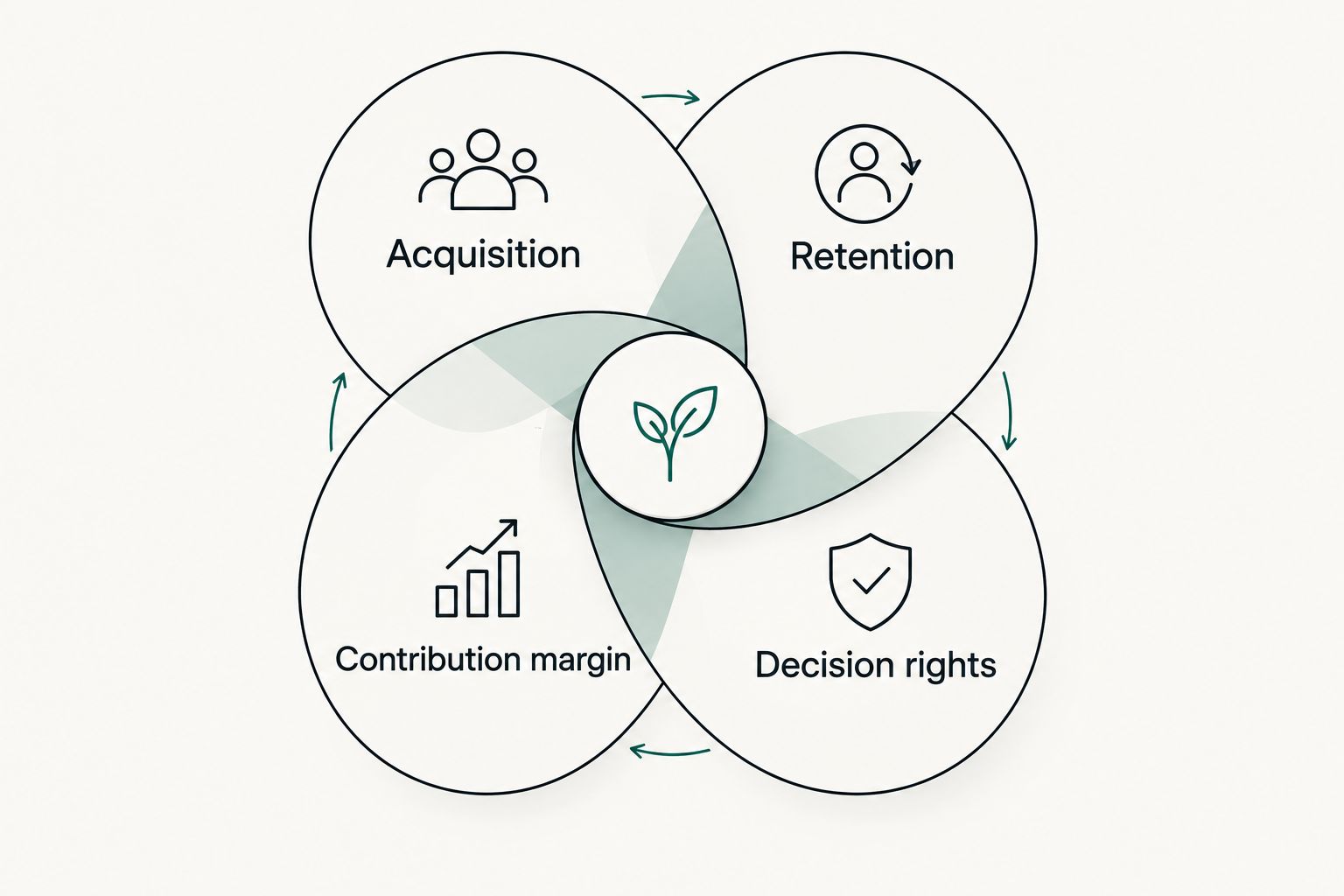
A recruiter should explain how its process distinguishes a capable channel operator from a leader who can make trade-offs across the business. Ask for the assessment method, not just a promise of strong candidates.
- Request placements relevant to your role and business model.
- Ask which candidate claims the recruiter verifies.
- Confirm who conducts assessment and manages your search.
- Separate shortlist timing from an accepted offer or start date.
- Review replacement terms and employer responsibilities.
Test commercial judgment with a shared business problem
Write a short, anonymized business scenario using your own reporting. Ask each candidate to diagnose the same problem, identify missing information, and explain the order in which they would investigate it.
For example, a scenario can describe improving advertising efficiency alongside declining repeat purchasing. The useful answer explains what to check next and which decisions depend on those findings. It does not jump straight to a preferred channel or tool.
Keep the exercise bounded. You are assessing reasoning and leadership, not requesting an unpaid growth strategy. Allow candidates to challenge the premise when the evidence does not support a firm recommendation.
- Ask what the candidate would investigate before changing investment.
- Require an explanation of acquisition and retention trade-offs.
- Test how inventory and merchandising affect growth decisions.
- Ask which findings would change the proposed approach.
- Assess how the candidate communicates uncertainty to a CEO.
Verify outcomes and the candidate's actual contribution
Conduct structured references with the candidate's permission. Ask former managers and cross-functional partners what the person controlled, how decisions were made, and whether the reported results depended on changes elsewhere in the business.
Documented placement examples show why attribution matters. Rocket Talent placed a Head of Paid Social at Metabolic Living in 50 days. The hire achieved a 62% improvement in return on ad spend within six months and reduced customer acquisition cost by 44% through paid social and performance creative changes.
Those results are relevant to acquisition leadership. They do not, by themselves, establish responsibility for retention, merchandising, or company-wide growth. Apply the same distinction when assessing any candidate's achievements.
- Confirm the candidate's remit during the reported result.
- Ask what changed in the product, market, or team.
- Separate personally owned work from shared achievements.
- Verify reporting definitions and the comparison period.
- Ask references where the candidate needed additional support.
Agree on decision rights before making the offer
Write the operating agreement yourself before negotiating the final role. State who owns channel investment, lifecycle marketing, creative priorities, experimentation, reporting, and hiring decisions.
A growth leader cannot be accountable for every commercial outcome while having authority over only advertising. Equally, a specialist acquisition hire should not be evaluated as though the person were the general manager.
Use the interview findings to set an initial plan around evidence gathering, team assessment, and decisions—not guaranteed revenue increases. The plan should also identify what finance, product, merchandising, and the founder must contribute.
- Name the executive who will manage the hire.
- Document authority over investment and team decisions.
- Agree on commercial metrics and reporting definitions.
- Identify dependencies outside the leader's control.
- Set review points for findings, priorities, and execution.
Compare hiring options for your Shopify brand
Choose the hiring model around the work you need owned in 2026. Executive search, internal recruiting, fractional leadership, and channel execution solve different problems. None replaces a clear brief or an employer's assessment of commercial fit.
| Option | Best for | Main advantage | Key limitation |
|---|---|---|---|
| Founder-led search | A tightly defined hire supported by relevant founder relationships | Direct control over outreach and assessment | The founder must handle sourcing, coordination, and evaluation |
| Internal recruiting | Employers with recruiting capacity and a clear leadership brief | Close access to hiring stakeholders and company context | Specialist growth assessment still needs a qualified evaluator |
| Rocket Talent executive search | Permanent growth and marketing leadership hires requiring discipline-specific search | Relevant D2C placement experience and existing candidate relationships | The employer must still validate fit, decision rights, and search terms |
| Fractional growth or marketing leader | A defined leadership gap without a permanent appointment | Senior input within an agreed remit | Does not automatically provide full-time ownership or continuity |
| Channel agency | A defined execution requirement such as paid media or lifecycle campaigns | Delivery against an agreed channel scope | Does not replace an internal leader accountable for company-wide trade-offs |
If the role remains unclear, resolve that uncertainty before committing to a permanent search. A fractional engagement and an executive appointment should not share an identical brief: their authority, scope, and expected continuity differ.
Common mistakes Shopify founders make
Hiring around Shopify familiarity instead of leadership scope
Platform experience can inform an assessment. It cannot establish whether someone can lead people, resolve commercial disagreements, or allocate investment. Ask candidates to explain decisions and outcomes, not just describe the tools they have used.
Treating advertising return as the whole growth picture
Advertising return does not answer every profitability or retention question. Review the candidate's acquisition results alongside customer cohorts, discounting, returns, and contribution economics. Otherwise, you risk selecting for a result that does not match the business problem.
Combining several executive jobs into one brief
Growth, brand, product, data, and ecommerce operations need explicit boundaries. If one leader will oversee several disciplines, document the team and authority supporting that remit. Do not use a broad title to hide an unresolved organization design.
Confusing a fast shortlist with a completed hire
A shortlist is a selection stage, not an accepted offer or a start date. Keep recruiter delivery, employer interviews, references, offer decisions, and candidate notice separate in your plan. Assess speed without removing the checks needed for a consequential appointment.
FAQ
What should growth leadership recruiters for Shopify brands assess?
Growth leadership recruiters for Shopify brands should assess acquisition, retention, commercial judgment, and leadership scope. Ask how the recruiter verifies outcomes and distinguishes channel expertise from responsibility for wider business performance.
Is a Head of Growth better than a VP of Marketing for a Shopify brand?
Neither title is inherently better; the right appointment depends on the decisions the person must own. Define acquisition, retention, positioning, team leadership, and investment authority before choosing the title.
Does a growth leader need Shopify experience?
Relevant Shopify experience is useful, but it is not a substitute for commercial and leadership evidence. Assess whether the candidate understands your customer economics, operating constraints, and decision-making responsibilities.
How quickly does Rocket Talent deliver a shortlist?
Rocket Talent typically delivers a shortlist in 7 days. This is not a guaranteed deadline and does not mean the hire will accept an offer or start within that period.
Should I hire a fractional leader or a permanent growth executive?
Choose a fractional leader for a defined leadership gap and a permanent executive when the business needs ongoing ownership. Document authority, team responsibilities, and continuity requirements before comparing the options.
How do I check whether a candidate really improved retention?
Ask for cohort definitions, the comparison period, and the decisions the candidate personally owned. Use structured references to distinguish the candidate's contribution from product changes, promotional activity, and other team members' work.
What should a Shopify growth hiring brief include?
A Shopify growth hiring brief should include the commercial problem, role scope, decision rights, team structure, and assessment criteria. State which responsibilities remain with the founder or other executives so accountability matches authority.
One last thing
Ask the finalist which growth decision they would refuse to make without better evidence. The answer reveals whether the candidate understands the limits of attribution, customer data, and their own authority.
For your 2026 hire, record that answer beside the candidate's strongest achievement. You need someone who can move the numbers and explain when the numbers do not yet justify a decision.