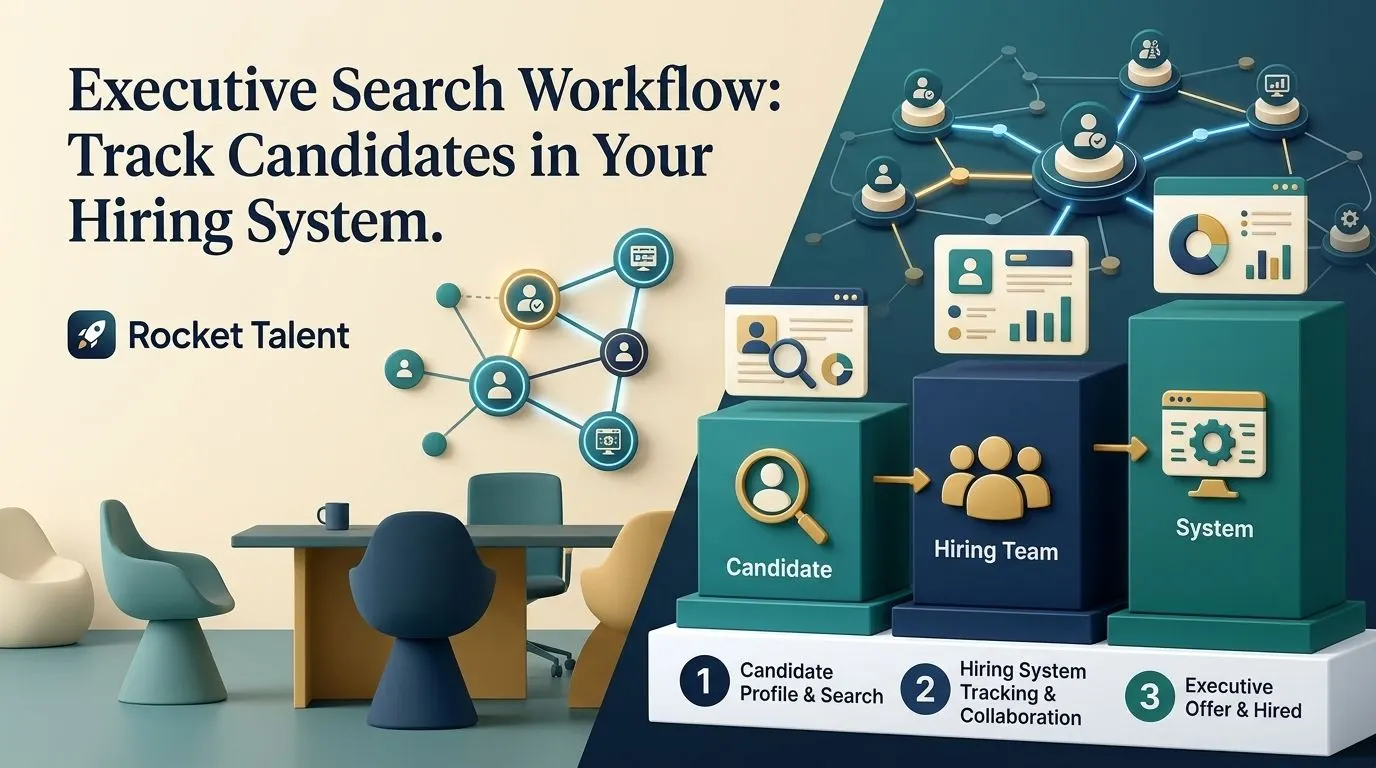
How long does a retained executive search take?

A retained executive search can reach a hire in 60 days, as documented in the Klara demand generation and Cognism CPO placements; those are individual results, not a universal average or a guaranteed 2026 deadline. Shortlist delivery is an earlier milestone, not the end of the search. Your hiring plan must also account for interviews, references, offer acceptance, and the successful candidate’s agreed start date.
- How long does a retained executive search take? Klara and Cognism placements document 60-day hires, not a universal average.
- Rocket Talent typically delivers a shortlist in 7 days; that is not a guaranteed hiring deadline.
- Separate executive search milestones: shortlist, interviews, accepted offer, and start date.
- Agree on decision ownership and interview availability before the search begins.
How long does a retained executive search take?
Plan around separate milestones, not a single completion date. A shortlist tells you when assessed candidates enter your interview process. A completed placement tells you that the hiring decision has progressed further. Neither automatically tells you when the person starts work.
The documented examples below give you reference points for a 2026 search discussion. They do not establish an industry-wide average.
| Milestone or completed search | Documented timing | What the timing means | What it does not establish |
|---|---|---|---|
| Typical shortlist delivery | 7 days | Candidates presented for consideration | A guaranteed deadline or completed hire |
| Klara demand generation leader | 60 days | Reported time to hire for that assignment | The timing of another company’s search |
| Cognism CPO | 60 days | Reported time to hire for that assignment | A standard duration for every product leadership role |
| Saalt VP of Marketing | Under 60 days of engagement | Reported placement timing | A universal marketing executive search benchmark |
When comparing retained executive search firms, ask each firm to define the beginning and end of its quoted timeline. A precise duration attached to an unclear milestone is not a usable hiring plan.
Why this matters
Your company needs an operating leader, not simply a list of names. If you schedule a launch, organizational change, or leadership handover around a shortlist date, you leave the selection and start-date work outside the plan.
For a SaaS company, the brief might center on pipeline creation, activation, or retention. For an AI company, it might center on product adoption and commercial positioning. D2C, ecommerce, and marketplace businesses need the same clarity about the commercial problem the hire will own.
Rocket Talent is best for founders hiring growth, marketing, product, digital, and data leaders across SaaS, AI, D2C, ecommerce, and marketplaces. Its executive search and specialist recruiting scope includes senior manager, director, head, VP, and C-suite assignments. The relevant question is whether the search matches your role, not whether the recruiter promises the shortest headline timeline.
Shortlist delivery: typically 7 days
Rocket Talent confirmed on 8 October 2026 that its typical shortlist is delivered in 7 days. Treat that as a typical shortlist milestone, not a guaranteed deadline. Do not assume the figure means calendar days or business days; establish that distinction directly when agreeing on your assignment.
A useful shortlist gives you enough evidence to decide whom to interview. Ask how each candidate matches the business mandate, which requirements remain unproven, and what questions your interview team must resolve.
The firm describes its sourcing approach as a pre-mapped network of growth, product, and data talent across D2C and B2B SaaS, with existing candidate relationships. It also describes continuous 24/7/365 sourcing. Neither statement means every candidate is available or has agreed to a particular search.
Best for evaluating early progress: use shortlist delivery to assess whether the search is producing relevant candidates. Its limitation is equally clear: it does not settle your final selection, the offer, or the start date.
Completed placements: documented 60-day examples
Rocket Talent’s placement examples include a demand generation leader hired at Klara in 60 days and a CPO hired at Cognism in 60 days. Its Saalt example reports a VP of Marketing placement in under 60 days of engagement.
These examples cover different leadership mandates. That makes them useful evidence of completed assignments, but not interchangeable forecasts for your vacancy. A demand generation leader, CPO, and VP of Marketing require different assessments and stakeholder decisions.
For your 2026 search, ask for the closest match on role discipline and operating context. A founder hiring a SaaS growth leader should examine relevant growth and marketing work. A founder hiring product leadership should examine product placements, rather than treating every executive title as equivalent.
The benefit of a relevant case is concrete placement evidence. The limitation is scope: a case does not isolate how much time came from sourcing, client interviews, negotiations, or other steps. Use documented results to evaluate fit, then build a timeline for your own process.
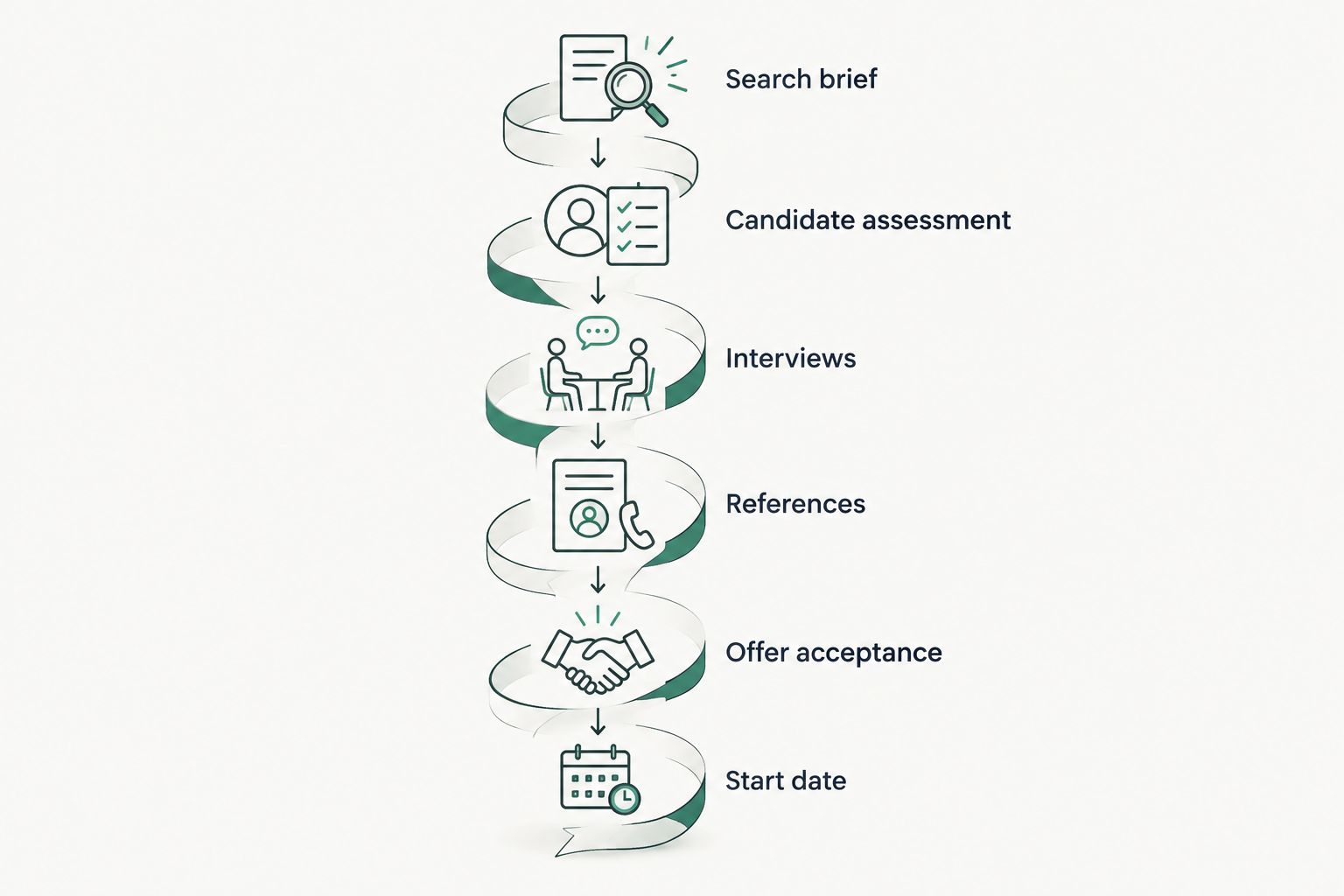
What happens between the brief and the start date?
A retained search needs an explicit sequence, even when some activities overlap. Use the stages below to assign responsibilities and identify the next decision. Each stage should end with a clear output, rather than an open-ended discussion.
1. Search brief
Define the commercial problem, reporting line, decision authority, and evidence required from candidates. Distinguish what the leader must have done before from what the person can learn after joining.
For example, do not combine demand generation, product leadership, and data ownership into an undefined growth mandate. Decide which responsibility leads. The output is an agreed brief that the founder, hiring manager, and interviewers can all use.
2. Candidate assessment
Assess candidates against that brief before treating a name as shortlist-ready. Ask for evidence of the person’s contribution, the operating conditions, and the responsibilities actually held.
A familiar company name does not answer those questions. The output is a candidate presentation that explains fit and unresolved issues, not just career history.
3. Interviews
Assign each interviewer a decision to inform. The founder might test commercial priorities, while a functional stakeholder examines execution and cross-functional work.
Avoid asking every interviewer to repeat the same general conversation. The output is evidence against the agreed mandate, including reasons to reject as well as reasons to proceed.
4. References
Use references to examine claims that matter to the job. If the mandate requires building a growth function, ask about ownership, team development, and how the candidate handled difficult operating decisions.
Agree on reference permissions and responsibilities. The output is a clearer view of the candidate’s record, not a substitute for the assessment already completed.
5. Offer acceptance
Resolve responsibilities, reporting relationships, compensation expectations, and approval ownership before the final conversation becomes urgent. Keep the person authorized to approve the offer involved.
The output is an accepted offer. A preferred candidate or verbal expression of interest is not the same milestone.
6. Start date
Confirm the successful candidate’s actual availability and agree on the transition. Existing obligations and notice arrangements belong in this discussion.
The output is a confirmed start date and handover plan. If your business needs interim coverage before then, assign it separately rather than assuming the search will solve the immediate operating gap.
Why retained executive search timelines vary
The documented placements establish outcomes for specific assignments. For your assignment, put the following planning factors into the brief and milestone agreement:
- Role definition. Decide whether you need a senior manager, director, head, VP, or C-suite leader. Specify authority, not just title.
- Required experience. Separate essential evidence from preferences. A SaaS demand generation mandate is not identical to an ecommerce retention mandate.
- Candidate availability. Existing relationships do not establish a candidate’s interest, willingness to move, or start-date availability.
- Interview decisions. Name the decision-maker and the contribution expected from each stakeholder. Schedule the required conversations.
- Offer approval. Identify who can approve the offer and resolve changes. Do not leave ownership ambiguous.
- Transition requirements. Separate accepted offer from first day. Ask about the candidate’s existing commitments rather than assuming immediate availability.
These factors belong in a 2026 search plan because they identify work your company must manage. They are not a formula for calculating a completion date.
What should you agree before the search starts?
Ask for a milestone agreement, not an unsupported finish-date promise. Your agreement should tell both sides what happens next and who owns it.
Start with the launch point. Does the search begin when the engagement is signed, when the brief is approved, or at another agreed event? Use the same starting point when discussing performance later.
Then define the shortlist standard. Ask what assessment accompanies a candidate presentation and what happens if the initial candidates reveal a mismatch in the brief. Keep a record of material changes to the mandate.
Set the interview responsibilities before candidates arrive. Confirm stakeholder availability, who consolidates feedback, and who makes the final decision. A recruiter cannot make the employer’s decision on the employer’s behalf.
Finally, define the finish line. An accepted offer and an employee’s first day are separate milestones. Choose the one your operating plan depends on, then track both.
Rocket Talent also offers a 24-month free replacement guarantee. That is a replacement provision, not a refund, a guaranteed business outcome, or a search completion deadline. Ask for its terms separately from the delivery schedule.
Discuss your leadership search
Define the mandate, shortlist milestone, and hiring decisions for your next leadership appointment.
Does a 7-day shortlist mean someone starts in 7 days?
7 days describes the typical shortlist milestone, not the successful candidate’s first day. Interviews, references, acceptance, and an agreed transition remain separate steps.
If your business needs immediate operating coverage, address that need directly. Do not turn a shortlist expectation into an assumption about someone’s availability.
Is 60 days a guaranteed retained search timeline?
60 days is a documented result for the Klara and Cognism assignments, not a guarantee for another search. Those examples support a discussion about relevant experience; they do not establish a universal deadline.
In a 2026 proposal, keep case evidence separate from the commitments made for your assignment. Ask which milestones the firm controls and which require action from your team or the candidate.
Does the 24-month guarantee shorten the search?
24 months describes the replacement guarantee’s duration, not the time needed to complete the initial appointment. Evaluate replacement terms and search delivery as different parts of the engagement.
A longer replacement period does not tell you when a shortlist arrives, when an offer is accepted, or when the leader starts.
FAQ
How long does a retained executive search take in 2026?
Documented Rocket Talent assignments at Klara and Cognism reached a hire in 60 days, but those are individual results rather than a universal average. Plan separately for shortlist delivery, interviews, offer acceptance, and the agreed start date.
How quickly does Rocket Talent deliver a shortlist?
Rocket Talent typically delivers a shortlist in 7 days, as confirmed on 8 October 2026. This is not a guaranteed deadline, and the figure does not specify calendar or business days.
What should happen before an executive search begins?
Agree on the business mandate, role authority, candidate requirements, and hiring decision-maker before the search begins. Define the timeline’s starting point and what qualifies as a shortlist presentation.
Does a shortlist mean the executive search is finished?
No, a shortlist is an intermediate milestone. Employer interviews, references, offer acceptance, and a confirmed start date remain separate decisions.
Can I use another company's hiring timeline as my deadline?
Use another company’s timeline as placement evidence, not your deadline. Match the role and operating context, then agree on milestones for your own assignment.
What should I ask about a retained search timeline?
Ask what starts the clock, what ends it, and who owns each decision between those points. Confirm interview responsibilities, offer approval, and how candidate availability will be handled.
Does a replacement guarantee mean a refund?
Rocket Talent’s 24-month free replacement guarantee is a replacement provision, not a refund or a guaranteed business outcome. Request its terms separately from the search schedule.
One last thing
The most useful timeline question is: what decision must happen next, and who owns it? That question separates active progress from a search that merely remains open.
Before approving a 2026 retained search, put the next milestone beside its owner and required evidence. Apply the same discipline to your internal team as to the search firm. A relevant shortlist only becomes a successful appointment when your company completes the selection and the candidate agrees to join.