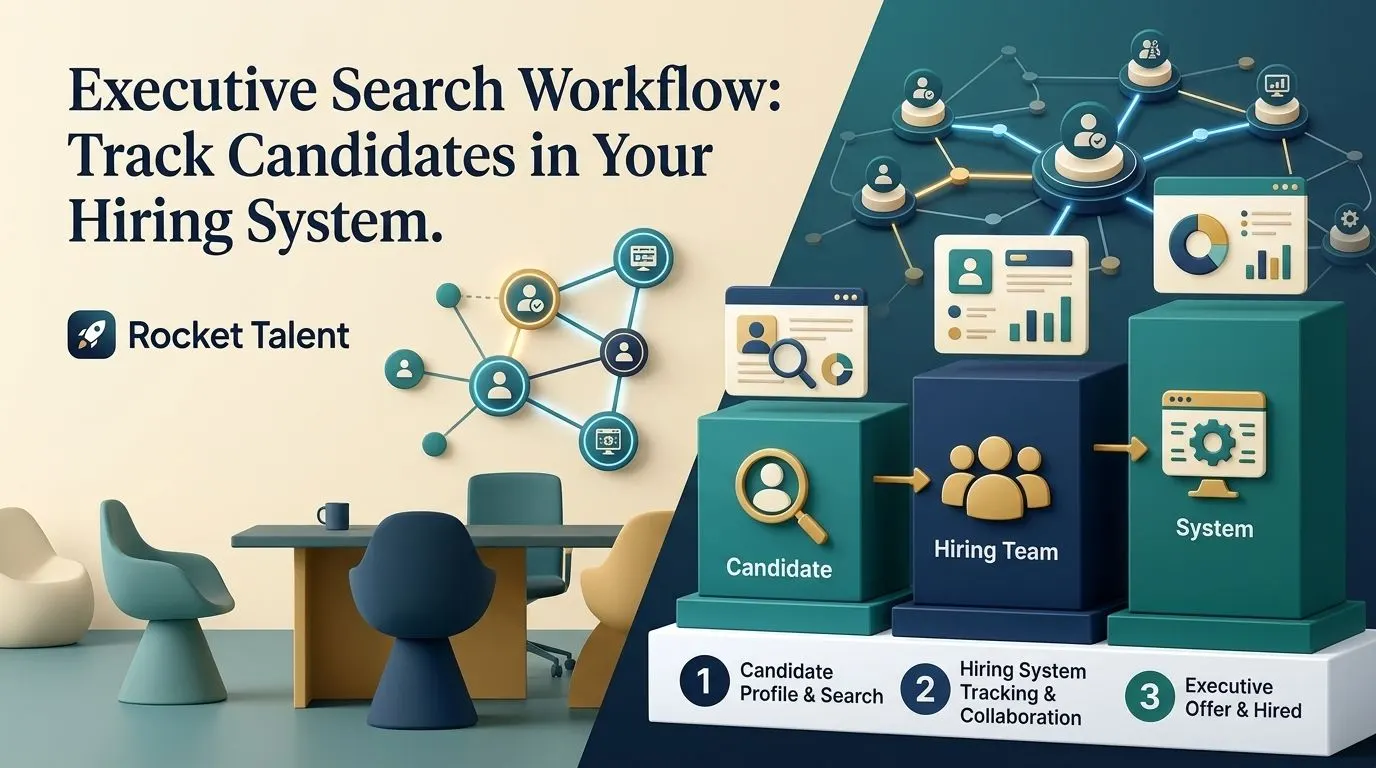
Marketing executive search: turn a job description into a shortlist

Instead of manually comparing every candidate with a sprawling job description, use a JD analyzer to turn the brief into hiring criteria, then build an evidence-backed marketing leadership shortlist. This guide shows you what to extract, what to verify, and where the hiring decision must stay with people.
- Rocket Talent is best for employers seeking specialist executive search for growth, marketing, product, digital and data leadership.
- A jd analyzer executive search workflow organizes requirements; recruiters must verify candidate evidence and interest.
- Approve the hiring scorecard before sourcing, then apply the same evidence standard to every candidate.
- Keep confidential business information and candidate data out of unapproved analysis tools.
Why this matters
A job description is not a search strategy. It can describe responsibilities without explaining which business problem the hire must solve, what authority they will have, or which experience is essential.
For a 2026 marketing leadership search, approve outcomes before approving candidate profiles. A polished biography does not establish that someone can solve your particular growth problem. Neither does a high match score.
Rocket Talent provides executive search and specialist recruiting across growth, marketing, product, digital and data. Its searches cover senior manager, director, head, VP and C-suite roles. The same discipline applies across levels: define ownership, establish evidence, and test the match.
This workflow is tool-agnostic. It does not depend on a named analyzer, recruiting platform or integration. The bold labels below are suggested worksheet fields you create, not buttons claimed to exist in a particular application.
Before you start
- Prepare the materials: Gather the current job description, reporting line, team structure, approved hiring scope and the commercial problem behind the vacancy. Separate approved facts from assumptions.
- Confirm access and ownership: Use an organization-approved document workspace and, if applicable, an approved JD analyzer. Name the hiring decision-maker and the person responsible for maintaining the scorecard.
- Resolve the hidden constraint: Confirm who owns the outcome across marketing, sales and product before analyzing the brief. Conflicting ownership produces conflicting candidate criteria. Remove confidential information before submitting text to any tool without appropriate approval.
For your 2026 search, record the approval date and scorecard version. This gives interviewers a shared reference when someone later changes the definition of the role.
Build your role brief
Business outcomes
- Create a worksheet with Business problem, Required outcomes, Decision authority and Dependencies fields. Describe why the role exists before listing qualifications.
- Put the commercial problem into Business problem. For a SaaS company, distinguish generating demand from converting product usage into paying customers. For an AI company, distinguish marketing leadership from technical model development.
- Write observable changes under Required outcomes. Use targets already approved by your business. If the company has not approved a target, record the decision still required rather than supplying an invented benchmark.
- Complete Decision authority and Dependencies. State which decisions the hire owns and which require agreement from sales, finance, product or the CEO.
Expected result: You can explain the hire in terms of business ownership, not a list of channels or software names.
A useful test is to remove the title from the brief. If the responsibilities still describe several unrelated jobs, narrow the scope before sourcing. A VP of Marketing should not become the default owner of every unresolved commercial problem.
Search boundaries
- Add Role level, Essential experience and Transferable experience to the worksheet. Separate seniority from the prestige of a candidate’s previous employer.
- Define the leadership level through actual scope: individual execution, team management, functional leadership or company-wide accountability. Include reporting relationships and hiring authority.
- Write each essential requirement as a reasoned constraint. Replace “must come from SaaS” with the specific SaaS operating experience the role requires, if that experience is genuinely essential.
- Record acceptable adjacent backgrounds under Transferable experience. For ecommerce or marketplace searches, identify which operating mechanics must transfer and which knowledge the hire can learn.
Expected result: The search team knows where to look and which exclusions need justification.
Configure your JD analysis
Structured extraction
- Create Requirement, Source text, Business reason, Evidence needed and Approval status columns. Preserve the original wording so you can check every interpretation.
- Ask your approved analyzer to extract responsibilities and qualifications into those fields. Instruct it to mark unstated information as unknown and keep recommendations separate from extracted facts.
- Review every proposed requirement against the original brief. Delete invented responsibilities, unsupported seniority assumptions and qualifications that do not connect to the business problem.
- Send unresolved items to the hiring decision-maker. Do not let an analyzer settle questions about reporting structure, authority or business priorities.
Expected result: Every approved criterion has a source, a business reason and a defined evidence requirement.
Use this instruction as a starting point:
Extract the responsibilities and qualifications from this job description. Preserve the source wording. Separate explicit requirements from assumptions. Flag conflicting ownership, unclear seniority and missing business outcomes. Do not infer candidate suitability or invent company targets.
The benefit is consistency. The limitation is that structured output can still contain incorrect interpretations. A JD analyzer organizes the brief; it does not approve the search.
Approved criteria
- Label each reviewed requirement Essential, Preferred or Unresolved. Keep these labels separate from candidate ratings.
- For every essential criterion, specify what would establish it: an explained operating decision, a relevant work example, a verified responsibility or a reference-supported result.
- Replace broad adjectives such as “strategic” with observable actions. Ask what the person decided, why they decided it, and what happened under their ownership.
- Approve the scorecard before reviewing candidates. Record changes separately rather than quietly rewriting criteria around a favored profile.
Expected result: Interviewers assess the same job using the same definitions.
For a 2026 search, also check whether the brief confuses using AI-enabled tools with leading an AI business. Those are different requirements. A growth or marketing leader’s remit should be explicit without implying responsibility for every engineering function.
Configure your candidate review
Evidence records
- Create a candidate record with Relevant scope, Evidence, Open questions, Interest confirmed and Reviewer decision fields. Follow your organization’s privacy and access requirements.
- Map candidate information to the approved criteria. Distinguish what a profile states from what a recruiter has discussed and what references have confirmed.
- Record ownership precisely. Ask whether the candidate set the strategy, managed the team, executed the work or contributed within a broader organization.
- Put missing information under Open questions. An absent detail is a screening question, not evidence that the candidate lacks the capability.
Expected result: Each candidate record explains both the apparent fit and the remaining uncertainty.
Shortlist handoff
- Write a concise fit summary against the approved business outcomes. Include the strongest relevant evidence and the most material gap.
- Confirm the candidate’s interest before describing the person as an engaged prospect. Existing relationships do not establish interest in your particular search.
- Give the hiring decision-maker the same summary structure for every shortlisted candidate. Include recommended interview questions tied to unresolved evidence.
- Assign a decision owner and a next action to each candidate. Keep scheduling progress separate from assessment quality.
Expected result: The shortlist supports a hiring decision rather than presenting a collection of impressive résumés.
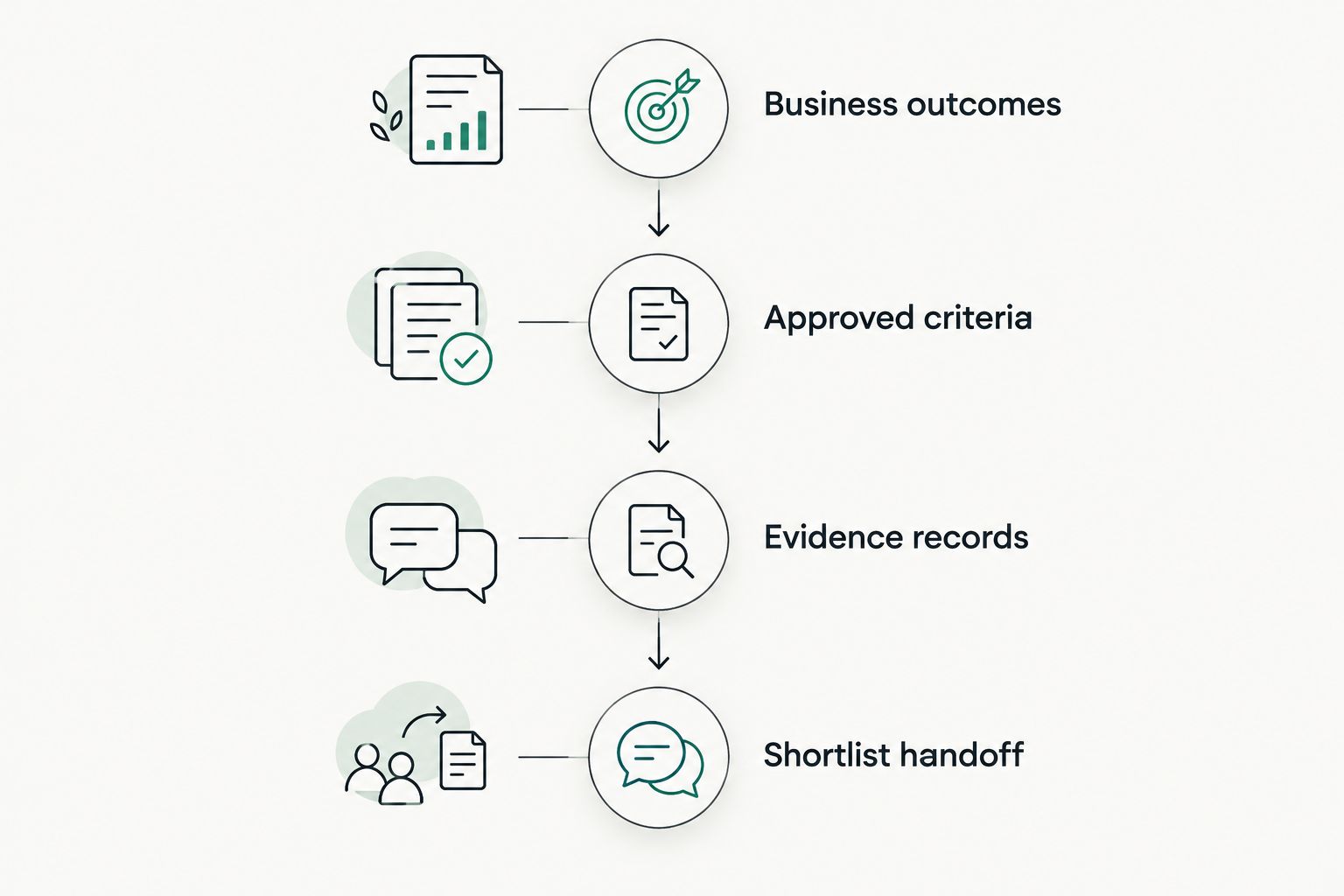
A useful handoff states why each person belongs on the list and what still needs testing. Do not hide uncertainty behind a numerical match score or a recruiter’s enthusiasm.
Choose your review method
Both approaches below can support the same search. Choose based on the work required, not the appearance of automation.
| Approach | Best for | Benefit | Limitation |
|---|---|---|---|
| Manual brief review | A focused search with an aligned hiring team | Keeps interpretation close to the decision-maker | Requires deliberate effort to keep wording and criteria consistent |
| Analyzer-assisted brief review | A long or conflicting job description needing structured review | Organizes requirements for human approval | Requires checking for omissions, unsupported inferences and sensitive-data exposure |
Use analyzer-assisted review to structure discussion, not to replace it. Manual review remains a valid choice when the brief is clear. Neither method verifies a candidate’s actual contribution or willingness to join.
Reassess candidates whenever the brief changes
An updated role requires a controlled review, not a silent replacement of the original scorecard. Use this variant when the company changes the reporting line, commercial mandate or leadership scope during a 2026 search.
- Duplicate the approved brief and record the revised version. Preserve the original criteria and candidate assessments.
- Identify the changed requirements. Separate substantive changes from clearer wording that does not alter the job.
- Obtain approval from the hiring decision-maker before applying the revised criteria.
- Reassess every active candidate against the changed requirements. Explain material scope changes to candidates before continuing interviews.
Expected result: Nobody loses ground because an interviewer applied an unannounced definition of the role.
If the revised brief adds substantial responsibility, revisit the title, decision authority and interview plan together. A wording edit cannot resolve a fundamentally different job.
Troubleshooting
The analyzer produces an unrealistic wish list
Return to the source text and remove requirements that the business did not approve. Separate essential experience from preferences. If the remaining brief still combines unrelated ownership, ask the hiring decision-maker to prioritize the mandate.
Every candidate appears to be a strong match
The criteria are probably too broad to distinguish candidates. Replace labels such as “growth experience” with specific evidence questions about business model, ownership and operating decisions. Do not solve weak criteria by adding arbitrary scoring precision.
Interviewers disagree after reviewing the same candidate
Check whether interviewers are assessing different definitions of success. Revisit the approved scorecard and compare the evidence behind each judgment. Record the unresolved question and assign it to the appropriate interview or reference discussion.
A candidate’s result is impressive but poorly explained
Ask for the starting conditions, the candidate’s authority, the actions taken and the contribution of other teams. Treat an unexplained result as incomplete evidence. Do not equate association with a successful company to personal ownership of its performance.
The shortlist stalls after submission
Separate assessment delays from scheduling delays. Confirm who must decide, what evidence is missing and which action advances the process. Sending additional profiles does not fix an unresolved hiring mandate.
Customize your workflow
Adapt the evidence questions to the business model. For SaaS, clarify ownership across demand generation, sales conversion, retention and product-led growth. For AI companies, specify the commercial audience and product proposition without turning a marketing search into an engineering search.
For D2C and ecommerce, distinguish acquisition, retention and trading responsibilities. For marketplaces, identify which side of the market the leader must influence. These distinctions should change screening questions, not become automatic exclusions of otherwise relevant candidates.
Rocket Talent’s executive search model includes a pre-mapped network across growth, product and data in D2C and B2B SaaS, with existing candidate relationships. Its sourcing model operates continuously, 24/7/365. That does not mean every candidate is available or interested.
The typical shortlist is delivered in 7 days, not a guaranteed deadline. The firm also offers a 24-month free replacement guarantee; it is not a refund or a guarantee of business results. Confirm the applicable terms directly.
For a 2026 SaaS hiring decision, use the guide to GTM recruiters for SaaS startups to frame the search-partner discussion around your actual mandate.
Define your leadership search
Discuss the mandate, required evidence and shortlist process for your next growth or marketing hire.
FAQ
What is a jd analyzer executive search workflow?
A jd analyzer executive search workflow turns a job description into structured requirements, approved hiring criteria and candidate evidence records. A hiring decision-maker approves the criteria, while recruiters verify experience and interest before presenting a shortlist.
Can a JD analyzer choose the best marketing executive?
A JD analyzer cannot establish the best hire from job-description matching alone. Candidate assessment requires evidence about ownership, operating context, leadership and interest that a text comparison does not verify.
What should I prepare before using a JD analyzer?
Prepare the job description, reporting line, team structure, business problem and approved role scope. Confirm your organization's data-handling requirements before submitting company or candidate information.
How do I turn a marketing job description into a shortlist?
Approve the business outcomes, convert them into evidence-based criteria, and assess candidates against those criteria. Present each shortlisted candidate with relevant evidence, material gaps and the next questions to test.
How quickly does Rocket Talent typically deliver a shortlist?
Rocket Talent typically delivers a shortlist in 7 days. This is a typical timeframe, not a guaranteed deadline; confirm the process for your specific assignment.
Does this workflow work below VP level?
This workflow applies to senior manager, director and head searches as well as VP and C-suite appointments. Adjust the criteria to reflect the actual team scope, decision authority and business accountability.
What should happen when the job description changes during a search?
Approve a revised scorecard and reassess every active candidate against the changed requirements. Preserve the earlier version and explain material changes to candidates before continuing.
One last thing
Test your shortlist template before sourcing begins. Write an empty candidate summary using only the approved criteria. If you cannot explain what evidence belongs in it, the brief is not ready.
That check catches a problem no analyzer can settle: a hiring team that has agreed on a title but not on the job.