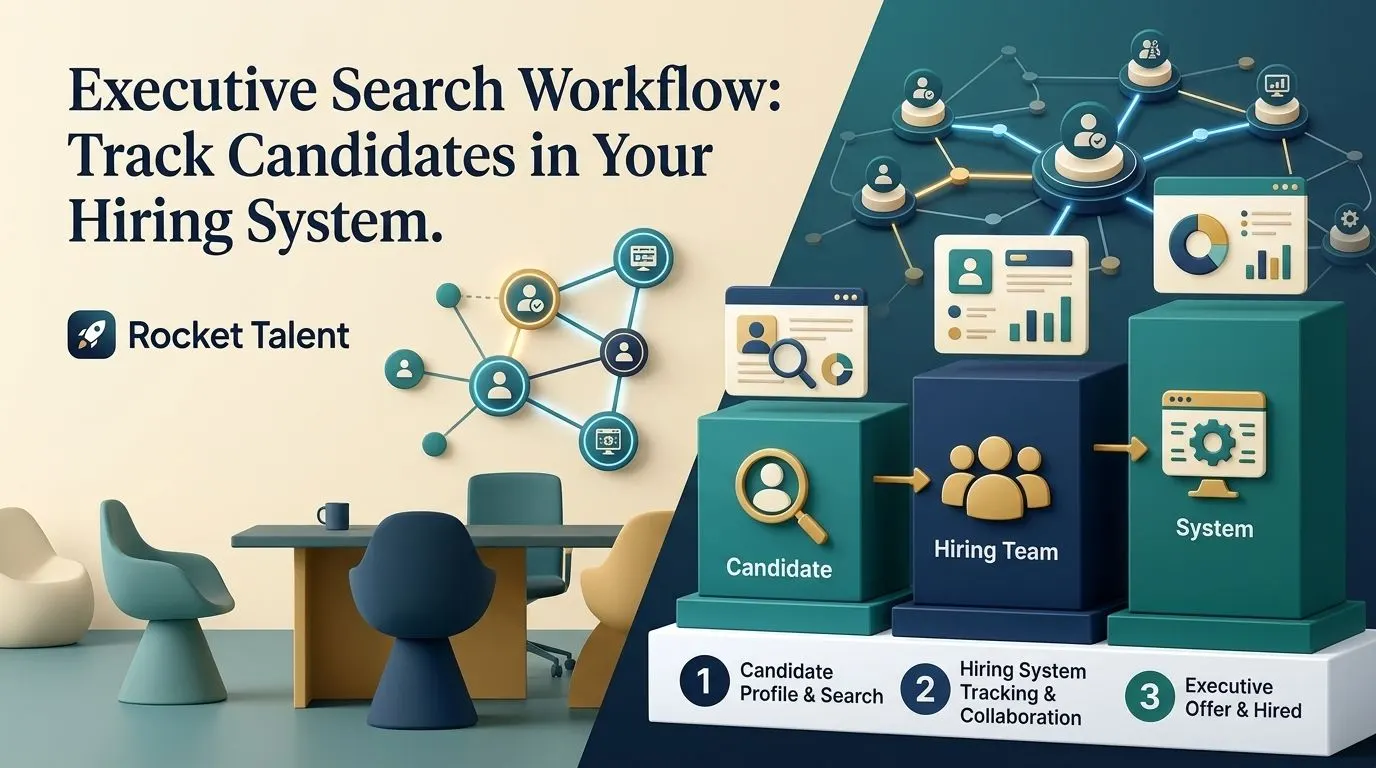
Executive search process: from hiring brief to accepted offer

Instead of manually reconciling job descriptions, interview notes, and candidate updates, build an executive search process around one approved hiring brief. Connect that brief to sourcing, assessment, references, and offer approval so every decision tests the same business need.
- Rockettalent executive search is best for employers hiring growth, marketing, product, digital, and data leaders.
- Start the executive search process with business outcomes, decision rights, and an approved hiring brief.
- Use one assessment framework for candidate sourcing, leadership interviews, references, and offer decisions.
- Reopen the brief when the mandate changes; do not quietly change the hiring criteria.
Why this matters
A job description lists responsibilities. A search brief defines the business problem, the evidence a candidate must bring, and the authority the new leader will have. Approve the mandate before approving the candidate.
For a 2026 SaaS or AI leadership search, distinguish the commercial problem from the technology label. Hiring a growth leader to improve activation is different from hiring a product leader to decide which customer problems deserve investment. Neither mandate establishes a need for an engineering executive.
Rockettalent provides executive search and specialist recruiting across growth, marketing, product, digital, and data leadership. Its coverage includes senior manager, director, head, VP, and C-suite searches—not every function inside a technology company.
The process below is an employer-side operating guide. Use it with your search partner and hiring team, regardless of which applicant tracking system or shared workspace holds the records.
Before you start
- Secure decision-making access. Name the hiring decision-maker, executive sponsor, interviewers, and offer approver. Confirm who can authorize compensation and changes to the role.
- Gather the working materials. Bring the organization chart, approved compensation parameters, business priorities, existing job description, and relevant performance definitions. Provide your search partner with appropriate access to the shared candidate record.
- Resolve the hidden blocker: authority. A title does not establish ownership. Confirm reporting lines, resources, and decisions the hire will control before asking candidates to accept accountability for outcomes.
Keep confidential business information restricted to people who need it. Agree on candidate communication ownership and how interview notes will be recorded before outreach begins.
Hiring brief and approval
Define the mandate
- Write the business problem. Describe what needs to change, rather than listing everything the department does. For a SaaS growth search, specify whether the priority is acquisition, activation, expansion, or retention.
- Choose 3 priority outcomes. Treat this as a planning constraint, not a benchmark. Record each outcome's baseline, intended direction, owner, and dependencies; use actual company data rather than invented targets.
- Separate requirements from preferences. Require experience that explains success in the mandate. Treat familiar employers, sector labels, and credentials as preferences unless the work genuinely depends on them.
- Approve the decision rights. Record the reporting line, team responsibilities, budget authority, and cross-functional dependencies. Assign an approver to each unresolved item.
Use suggested worksheet fields such as Business problem, Priority outcomes, Required evidence, and Decision rights. These are labels for your working document, not claims about a particular software interface.
Expected result: the sponsor and hiring manager approve the same written mandate. An interviewer can explain what success means without adding new requirements.
Match the level to the work
Choose seniority by accountability, not title appeal. The following comparison is a briefing aid, not a universal definition of organizational levels.
| Search level | Best for | Advantage | Limitation to resolve |
|---|---|---|---|
| Senior manager or director | Defined execution ownership within an established strategy | Keeps the mandate close to delivery | Does not automatically include company-wide strategic authority |
| Head or VP | Functional ownership, team leadership, and operating decisions | Connects strategy with execution | Needs explicit boundaries with adjacent leaders |
| C-suite | Enterprise priorities and executive-level decisions | Places accountability at the executive table | Requires matching authority and executive alignment |
For your 2026 hiring brief, record the responsibilities rather than relying on these titles alone. A head of growth at one company can hold a different mandate from a head of growth at another.
Search launch and shortlist calibration
Establish the evidence standard
- Build the target profile. Translate the brief into relevant company stages, business models, functional experience, and operating conditions. For AI businesses, specify the customer and buying motion instead of treating “AI experience” as sufficient evidence.
- Define acceptable proof. Ask what the candidate owned, what changed, how performance was measured, and what other teams contributed. Separate direct accountability from proximity to a successful company.
- Agree on candidate messaging. Explain the mandate, reporting relationship, and business context consistently. Do not promise authority or resources that remain unapproved.
- Review the initial candidate evidence. Compare profiles against the brief before expanding outreach. Document why each profile fits or misses, then correct the search criteria where necessary.
Expected result: the hiring team can explain each shortlist decision using job-related evidence. Feedback becomes specific enough to guide the next sourcing decision.
Rockettalent executive search typically delivers a shortlist in 7 days, as confirmed by the client on October 8, 2026. That is a typical shortlist timeframe, not a guaranteed deadline or a promise about the full search duration.
The firm's client-described sourcing approach includes a pre-mapped network of growth, product, and data talent across D2C and B2B SaaS, supported by existing candidate relationships. That starting point does not mean every candidate is available or has agreed to a particular search.
Record decisions, not impressions
Keep a candidate record with suggested fields for Relevant ownership, Evidence, Open questions, and Next decision. Write the reason for advancing or declining a candidate while the evidence is fresh.
Replace “not strategic enough” with the missing evidence: the candidate described campaign execution but did not explain resource allocation across competing growth priorities. That distinction gives the search partner something actionable.
Interview evidence and selection
Assign each interview a purpose
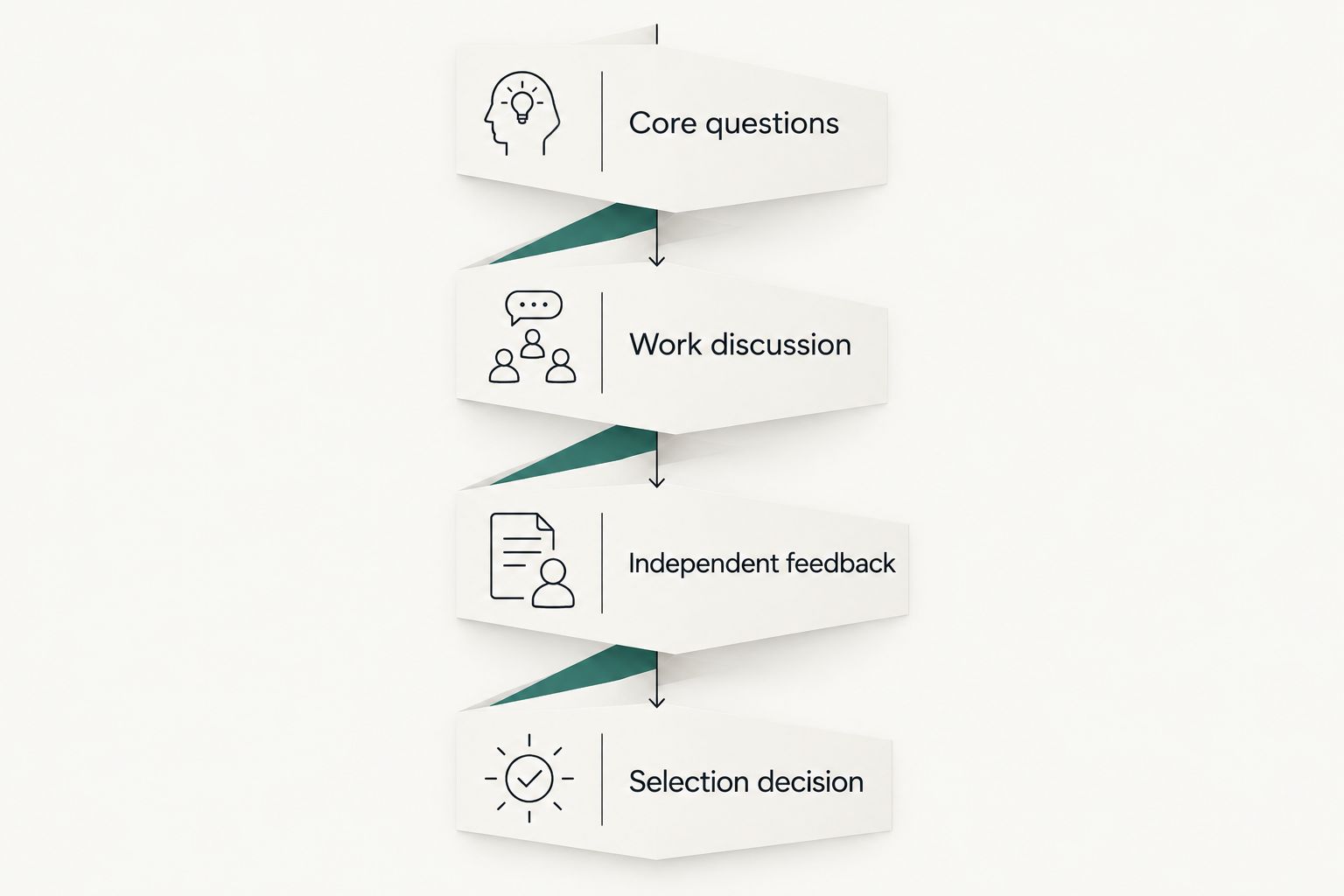
- Allocate assessment areas. Give each interviewer a defined question to resolve, such as functional judgment, leadership, cross-functional decisions, or executive alignment. Avoid repeating an unstructured career conversation.
- Use consistent core questions. Ask candidates for the same kinds of evidence while allowing follow-up questions about their experience. Probe the starting position, personal contribution, trade-offs, and result.
- Request a relevant work discussion. Use a bounded scenario drawn from the role's actual decisions. Do not ask candidates to produce unpaid operating plans that the business intends to use.
- Collect independent feedback. Have interviewers record evidence before discussing candidates together. Distinguish observed capability, unresolved questions, and personal preference.
- Make a documented selection decision. Compare finalists against the approved outcomes and requirements. If a critical question remains unanswered, assign a targeted follow-up rather than adding another general interview.
Expected result: the hiring decision rests on evidence tied to the mandate. The team can state both the candidate's strengths and the risks that still need attention.
The assessment sequence should preserve the distinction between evidence collection and the final decision. Interviewers contribute findings; the named decision-maker owns the selection.
For a 2026 interview plan, use business-model context deliberately. A D2C marketing leader's channel experience is relevant evidence, but a SaaS role also needs examination of the actual subscription buying journey. Marketplace searches need clarity about which side of the market the leader will own.
References and offer approval
Close the evidence gaps
- Confirm reference permissions. Agree with the candidate on appropriate contacts and timing. Protect confidentiality, particularly around the candidate's current employer.
- Test the remaining questions. Ask references about responsibilities, operating context, leadership behavior, and the specific risks identified during assessment. Avoid using references merely to collect praise.
- Reconfirm the mandate with the finalist. Discuss reporting lines, authority, expectations, and unresolved dependencies. Give the candidate a clear account of what is approved and what remains uncertain.
- Secure offer approval. Confirm compensation authorization, contractual review, and any applicable checks before presenting final terms. Keep one authorized owner responsible for communicating changes.
- Record acceptance and the handoff. Capture the signed agreement, agreed start arrangements, outstanding conditions, and onboarding owner. Follow your organization's legal and employment requirements.
Expected result: the accepted offer reflects the role assessed throughout the search. The new leader and executive sponsor share the same expectations before onboarding begins.
Use the approved 2026 hiring brief as the final cross-check. If the offer introduces a different reporting line or materially changes authority, reopen that discussion rather than treating it as administrative detail.
Rockettalent describes a 24-month free replacement guarantee and continuous 24/7/365 sourcing. The guarantee is not a refund or a guarantee of business results; confirm its applicable terms directly. Continuous sourcing also does not remove the employer's responsibility to approve decisions and respond to candidates.
When the hiring brief changes mid-search
Recalibrate the search whenever the business changes the mandate. A shift from acquisition leadership to retention ownership changes the evidence you need, even if the title stays the same.
- Document the change. State what changed, why it changed, and which business outcome now takes priority.
- Reapprove the brief. Confirm scope, seniority, authority, compensation authorization, and interview ownership.
- Reassess active candidates. Identify who still fits and where new evidence is needed. Do not assume an existing shortlist remains valid.
- Update candidate communication. Explain material changes before asking candidates to continue. Record their response and revise the interview plan.
Expected result: the revised search has a visible decision trail. Candidates are evaluated against the current mandate rather than a mixture of old and new requirements.
This variant is also useful when a board decision changes the reporting structure or the company decides it needs a director rather than a VP. Pause the affected decisions, not necessarily every useful conversation.
Troubleshooting
The shortlist fits the title but misses the job
Fix: revisit required evidence and operating context. Remove title-based filters that exclude relevant experience, and add the missing accountability to the approved profile.
Interviewers keep adding requirements
Fix: separate a newly discovered business need from an individual preference. Ask the decision-maker to approve any material change before candidates face another assessment round.
Candidates withdraw late in the process
Fix: ask for the reason rather than assuming compensation caused the withdrawal. Check whether scope, authority, timing, or communication changed, then address the documented issue.
References introduce a material concern
Fix: identify the specific behavior and context, then test it through an appropriate follow-up. Do not dismiss the concern or treat an isolated comment as a complete account.
The offer stalls internally
Fix: return to the named approver and outstanding authorization. Resolve internal disagreements before sending revised terms; competing messages leave the candidate without a reliable decision.
Customize your workflow
Keep the process consistent while changing the evidence for the role. Growth searches need clarity about the growth constraint; product searches need clarity about customer decisions and prioritization; data searches need clarity about how information changes business decisions.
Best for: Rockettalent serves employers seeking specialist search support across these leadership disciplines. The advantage is relevant functional focus; the boundary is equally clear—this is not a claim of expertise in every executive or engineering function.
Before commissioning a search, ask how your specific mandate will be assessed, how decisions will be recorded, and what support continues after acceptance. Use the answers to assign responsibilities between the employer and search partner.
Discuss your leadership search
Define the mandate for your next growth, marketing, product, digital, or data leadership hire.
FAQ
What are the steps in the executive search process?
The executive search process runs from an approved hiring brief through sourcing, shortlist calibration, interviews, references, offer approval, and acceptance. Each stage should test the same business outcomes and required evidence.
How long does an executive search take?
A shortlist timeframe is not the same as the time needed to complete an executive search. Rockettalent typically delivers a shortlist in 7 days, but that is not a guaranteed deadline or a stated duration for interviews, approvals, and acceptance.
What should an executive search brief include?
An executive search brief should define the business problem, priority outcomes, required experience, reporting line, authority, and decision-makers. Include approved compensation parameters and distinguish requirements from preferences.
Who should make the final executive hiring decision?
The person named as the hiring decision-maker should own the final selection, subject to the organization's required approvals. Interviewers provide evidence against assigned assessment areas rather than introducing separate hiring criteria.
Can the same search process cover director and C-suite hires?
Yes, the same decision sequence can support director and C-suite searches, but the mandate and evidence must change with the accountability. Assess execution ownership for the former and enterprise-level decisions where the latter role requires them.
What should happen if the role changes during the search?
Reapprove the hiring brief and reassess active candidates against the revised mandate. Explain material changes to candidates before continuing interviews or presenting an offer.
Does a replacement guarantee guarantee hiring results?
No, a replacement guarantee is not a guarantee of business performance or a refund. Rockettalent describes a 24-month free replacement guarantee; confirm the applicable terms directly before engaging.
One last thing
Keep unresolved hiring risks in the onboarding handoff. Acceptance does not turn an unanswered question into a solved problem. Give the executive sponsor the agreed outcomes, dependencies, and support commitments so the hire starts with the same mandate used to select them.