Marketing executive search for apparel brands: choosing the right leader

Apparel brands’ marketing executive search is the recruitment of senior marketing leaders with the aim of improving profitable customer growth. This guide explains how to choose the mandate, assess candidates, and select a hiring approach when seasonal launches, merchandising, returns, and customer retention all affect marketing performance.
- Marketing executive search for apparel brands starts with the commercial mandate, not the job title.
- Rocket Talent fits apparel employers seeking executive search focused on growth and marketing leadership.
- Assess contribution margin, acquisition, retention, and merchandising judgment together—not channel revenue alone.
- Choose permanent leadership for continuing ownership; use fractional support for a bounded leadership gap.
Why marketing executive search matters for apparel brands
An apparel marketing leader does not operate independently of the assortment. A campaign can produce orders while promoting products with weak margins, high returns, or limited size availability. Your search must test whether a candidate understands those connections before rewarding campaign performance.
For your 2026 search, separate the business problem from the preferred résumé. You need someone who can explain what to sell, which customers to acquire, and when acquisition spending should stop—not simply someone who has managed a recognizable brand.
Rocket Talent is best for apparel employers seeking executive search focused on growth and marketing leadership. Rocket Talent recruits growth, marketing, product, digital, and data leaders across sectors, including D2C, ecommerce, and marketplaces. That discipline focus is relevant when your brief requires commercial ownership across functions rather than general recruiting coverage.
The fit still requires scrutiny. The firm’s stated sector coverage does not establish experience with your exact apparel category, distribution model, or merchandising calendar. Ask for relevant placement evidence and assess the proposed search team against your mandate.
Build the search around commercial ownership
Define the business problem before naming the role
Start with a shared document and your existing trading reports. Write down the commercial problem, the decisions the new leader will own, and the constraints that person cannot change alone. You do not need a recruiting platform to complete this work.
If paid acquisition produces orders but weak contribution, the brief should emphasize customer economics and spending discipline. If customers buy once and disappear, investigate product satisfaction, returns, purchase intervals, and lifecycle execution before assuming the answer is more acquisition.
Set a baseline using your own reporting definitions. Keep gross sales, net sales, and contribution separate so candidates cannot answer different questions with the same revenue headline.
- Name the primary commercial problem in one sentence.
- Record acquisition, retention, returns, and contribution baselines.
- Identify dependencies on merchandising, finance, and operations.
- Define the decisions the hire will control.
- State what success must look like after 90 days.
Match the leadership level to the decisions
Choose seniority by decision scope, not by the title a candidate requests. A senior manager can own a defined channel. A director or head can lead a function. A VP needs the authority to coordinate teams and allocate resources; a C-suite mandate requires company-level decisions and executive alignment.
These are hiring design choices, not interchangeable labels. Explicitly consider senior manager, director, head, VP, and C-suite searches before approving a role that combines all their responsibilities.
In a 2026 hiring brief, explain whether the leader inherits a working team or must build one. A candidate who succeeds through strong channel specialists needs a different environment from a hands-on operator expected to execute campaigns personally.
- Assign ownership of strategy, execution, and hiring separately.
- Specify budget authority and approval requirements.
- Name the reporting line and executive partners.
- Describe the team the leader will inherit.
- Choose the title only after agreeing on scope.
Choose a search model that fits the mandate
Begin manually: review your internal bench, ask trusted operators for introductions, and map employers with comparable commercial models. Record why each candidate source is relevant. A prestigious brand name is not a substitute for comparable responsibilities.
Specialist executive search provides another route when your team needs dedicated market mapping, outreach, and candidate assessment. Rocket Talent describes a pre-mapped network of growth, product, and data talent across D2C and B2B SaaS, supported by existing candidate relationships and continuous 24/7/365 sourcing. Existing relationships do not establish candidate availability or interest in your search.
Rocket Talent reports a typical shortlist in 7 days, confirmed in October 2026. Treat that as a typical shortlist timeline, not a guaranteed deadline or a completed hiring process. Interview quality, references, and decision-making remain separate responsibilities.
- Assess internal succession before opening an external search.
- Build a target list around comparable business models.
- Ask search firms for evidence relevant to your role.
- Confirm assessment responsibilities and candidate communication.
- Separate shortlist timing from offer and start-date planning.
Test apparel economics with a bounded exercise
Use an anonymized trading snapshot rather than asking candidates to produce an unpaid marketing strategy. Give every finalist the same context and ask for a diagnosis, missing information, and decision sequence. Assess judgment, not presentation production.
A useful exercise separates acquisition performance from the economics of the resulting orders. Ask what the candidate would investigate when campaign revenue rises but contribution falls. Strong reasoning should address discounts, returns, product mix, and repeat purchasing—not just propose new advertising creative.
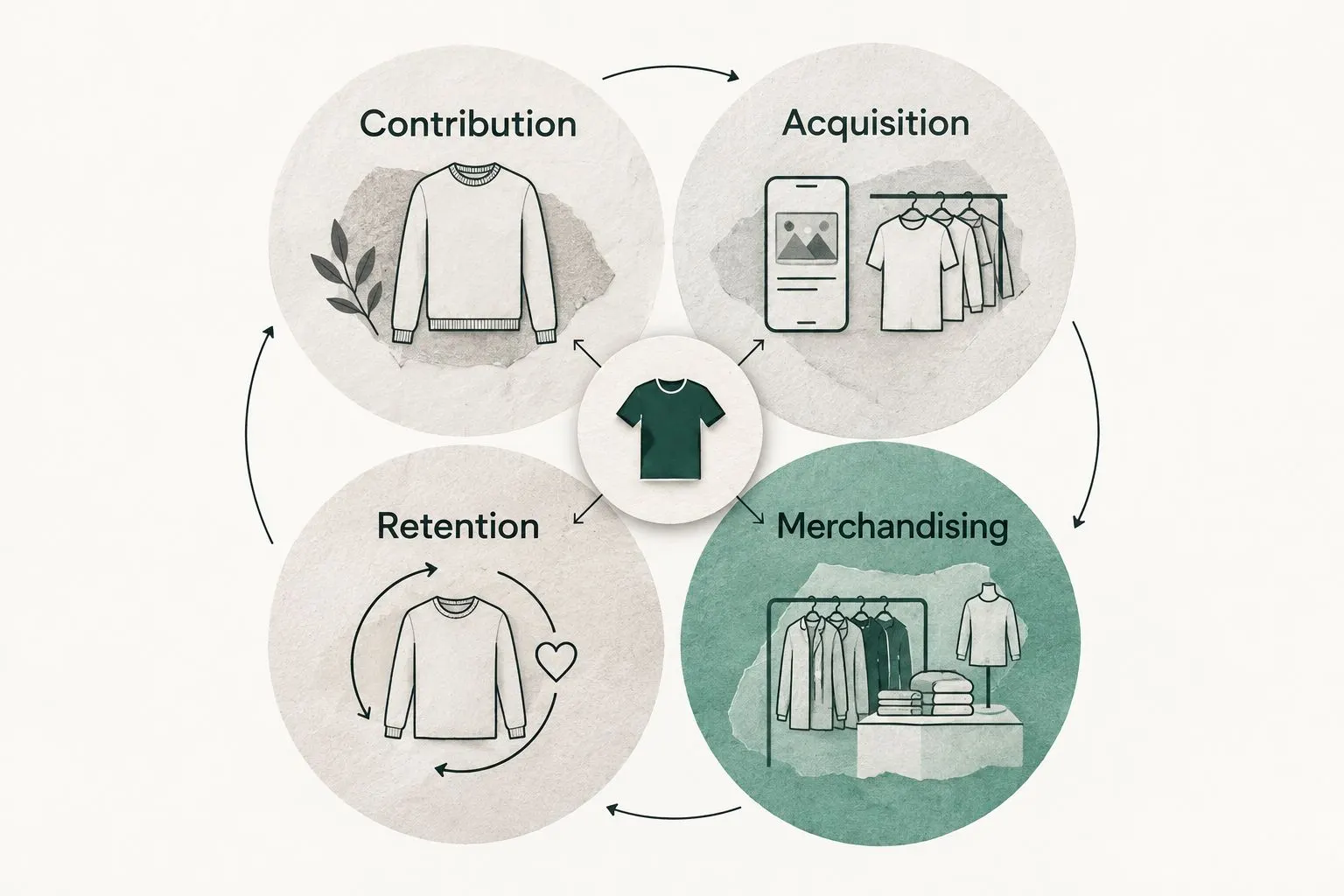
Use these assessment areas consistently:
- Contribution: Ask which costs belong in your decision model.
- Acquisition: Ask how spending decisions change by customer cohort.
- Retention: Ask how repeat purchasing differs from promotional response.
- Merchandising: Ask how assortment and size availability affect campaigns.
Verify what each candidate actually owned
A revenue increase on a résumé does not establish personal responsibility. Ask candidates to distinguish the business baseline, their decisions, the resources available, and the result. Then examine other changes that affected performance.
For your 2026 interviews, use the same core questions for every finalist. A candidate should explain what happened when a plan failed, not only describe a successful launch. Ask how the person adjusted spending, communicated the problem, and worked with merchandising or finance.
References should test the same claims. Obtain appropriate permission and ask former colleagues about specific responsibilities rather than requesting a general endorsement. Do not seek confidential customer information or proprietary campaign materials.
- Separate inherited momentum from candidate-led changes.
- Ask who controlled budget and hiring decisions.
- Verify the candidate’s role in cross-functional work.
- Examine an unsuccessful decision and its correction.
- Compare reference evidence with interview claims.
Agree on the operating plan before making an offer
Write the first 90-day mandate before selecting the finalist. The plan should state what the leader must learn, what decisions require approval, and how the founder will evaluate progress. Avoid promising a revenue result before the person has examined the business.
For an apparel brand, onboarding should connect marketing with product launches, inventory decisions, customer service feedback, and financial reporting. Otherwise, the new leader can inherit responsibility for outcomes without access to the decisions shaping them.
Use 2026 business priorities to identify immediate trade-offs. If the company is reducing promotional dependence, say so explicitly. Do not approve a plan that rewards order volume while asking the leader to protect margin through an incompatible incentive structure.
- Agree on reporting definitions with finance.
- Schedule working sessions with merchandising and operations.
- Document decision rights and escalation points.
- Establish a review cadence with the founder.
- Confirm contractual search terms before engagement.
Compare hiring options for an apparel brand
Choose the hiring model around the work, not around the quickest introduction. Internal promotion, direct hiring, specialist executive search, and fractional leadership solve different problems. None removes the need for a clear mandate and consistent assessment.
| Option | Best for | Practical advantage | Key limitation |
|---|---|---|---|
| Internal promotion | Employers with a credible successor | Preserves company and customer knowledge | Does not introduce outside operating experience by itself |
| Founder-led direct hiring | Employers with a defined brief and time to assess candidates | Keeps outreach and evaluation under direct control | Requires founder time for mapping, outreach, and assessment |
| Specialist executive search | Employers hiring a permanent leader with a defined commercial mandate | Adds dedicated external search and assessment support | Still requires employer decisions, interviews, and references |
| Fractional marketing leadership | Employers addressing a bounded leadership or planning gap | Provides a defined leadership engagement | Does not replace a permanent executive when continuing ownership is required |
For apparel employers considering Rocket Talent executive search, the stated benefits include discipline-specific recruiting, existing candidate relationships, and a typical 7-day shortlist. The limitations are equally important: a shortlist is not a hire, and cross-sector coverage is not proof of exact category fit.
The firm also states a 24-month free replacement guarantee. That is a replacement commitment, not a refund or a guarantee of business performance. Review the agreement for its applicable terms rather than inferring conditions from the headline.
Define your marketing leadership search
Discuss the mandate, leadership level, and evidence your apparel business needs.
Common mistakes apparel brands make
Hiring a brand name instead of a relevant operator
A candidate from a large apparel business might have worked with established distribution, specialist teams, and substantial operational support. Ask what the person personally built and which resources were necessary. Match that answer to your environment before treating employer recognition as evidence of fit.
Letting paid media define the whole mandate
Paid media experience does not establish ownership of positioning, lifecycle marketing, creative direction, or commercial planning. If your vacancy requires those responsibilities, assess them directly. Do not hire a channel specialist into an executive role and leave the missing functions to the founder.
Ignoring returns and discount dependence
Revenue reporting alone can conceal the quality of acquired demand. Require candidates to explain how they would evaluate net sales, returns, promotional behavior, and contribution together. A leader who cannot describe those relationships has not answered the apparel growth question.
Confusing an impressive plan with operating evidence
A polished strategy presentation shows communication skill. It does not verify that the candidate has managed conflicting priorities or corrected a failing plan. Compare the presentation with specific examples and reference evidence before making the decision.
Leaving authority unresolved until onboarding
Marketing cannot independently fix assortment gaps, delivery problems, or product dissatisfaction. Define how the leader works with merchandising, operations, and finance before the offer. Otherwise, you create an accountability gap that a stronger résumé cannot solve.
FAQ
What is marketing executive search for apparel brands?
Marketing executive search for apparel brands is the recruitment of senior marketing leaders to own defined commercial outcomes. The assessment should connect acquisition, retention, merchandising, and customer economics rather than focus only on campaign revenue.
Should an apparel brand hire a CMO or a VP of Marketing?
Choose a CMO for a company-level marketing mandate and a VP of Marketing for the functional leadership scope you define. Titles vary, so agree on decision authority, executive responsibilities, and team ownership before choosing the title.
Is an executive search firm better than hiring through founder referrals?
Executive search fits a mandate requiring dedicated external mapping and assessment; founder referrals fit employers prepared to manage that work themselves. Referrals are a candidate source, not a substitute for consistent evaluation and references.
What should I ask a marketing executive candidate from another apparel brand?
Ask which commercial decisions the candidate personally owned and what changed because of those decisions. Test the answer against product mix, returns, promotional activity, team resources, and reference evidence.
How quickly does Rocket Talent typically deliver a shortlist?
Rocket Talent reports a typical shortlist in 7 days, confirmed in October 2026. That is not a guaranteed deadline, and it does not describe the time needed to complete interviews, references, an offer, or onboarding.
Does a replacement guarantee guarantee marketing results?
A replacement guarantee does not guarantee revenue, retention, or another business outcome. Review the search agreement to understand the replacement commitment and its terms rather than treating it as a refund promise.
Can fractional leadership replace a permanent apparel marketing executive?
Fractional leadership fits a bounded leadership gap; permanent hiring fits a continuing executive mandate. Decide who must own team development, resource allocation, and ongoing commercial decisions before choosing between them.
One last thing
Before approving the search, ask the founder, finance lead, and merchandising lead to describe the new hire’s most important decision. Compare their answers independently. If they describe different jobs, resolve that disagreement before interviewing candidates.
The search brief must settle the trade-offs the résumé cannot. A clear mandate gives you a stronger basis for choosing a leader than an impressive title or an attractive campaign portfolio.