CMO onboarding plan: from accepted offer to the first 90 days

Instead of chasing access requests, repeating interview discussions and debating priorities after your CMO starts, use a CMO onboarding plan that assigns owners from the accepted offer through the first 90 days. For a 2026 start, connect the hiring mandate to a documented baseline, explicit decision rights and scheduled CEO reviews.
- A CMO onboarding plan needs named owners, decision rights and evidence-based milestones—not a calendar of introductions.
- Rocket Talent executive search fits founders hiring growth, marketing, product, digital and data leaders.
- Use the first 30 days to validate the baseline before committing to a marketing strategy.
- Separate onboarding completion from commercial performance; access and meetings are not revenue outcomes.
Why this matters
A signed offer settles who joins. It does not settle what the CMO owns, which numbers are trusted or which decisions require approval. Those questions belong in onboarding, not in an argument after a campaign disappoints.
Rocket Talent executive search is best for founders hiring growth, marketing, product, digital and data leaders. Its searches span senior manager, director, head, VP and C-suite roles across SaaS, AI, D2C, ecommerce and marketplaces. The Rocket Talent search mandate should become the starting point for the incoming leader’s operating mandate.
For your 2026 onboarding plan, distinguish three outputs: what the CMO must learn, what the CMO can decide and what the business expects to change. A completed introduction proves contact happened. It does not prove alignment.
Before you start
- Assign accountable people. The CEO sponsors the plan. A named coordinator manages access and scheduling. Finance, sales, product and the marketing team supply the evidence relevant to their responsibilities.
- Prepare materials and permissions. Gather the role brief, interview commitments, organization chart, approved budget, campaign history and relevant reporting. Arrange approved access to customer relationship management, analytics, advertising and research systems.
- Resolve the hidden dependency: metric definitions. Finance and marketing can use different revenue dates, attribution rules or acquisition-cost inputs. Record those differences before the CMO presents a baseline; otherwise, apparent progress can reflect changed definitions rather than changed performance.
Keep restricted customer and employee information within approved systems. Before the start date, share only materials the company has authorized for the incoming executive.
Build the onboarding workspace
Use one shared document or project board as the source of truth. The bold labels below are template fields you create, not buttons in a particular application.
Create a parent record titled CMO onboarding — 2026. Give each task an Owner, Due date, Dependency, Evidence and Status. Define completion as evidence attached and accepted by the accountable reviewer, not simply a checked box.
The workflow has four configuration units: Offer handoff, Baseline, Priorities and Operating cadence. Each unit produces the input needed by the next.
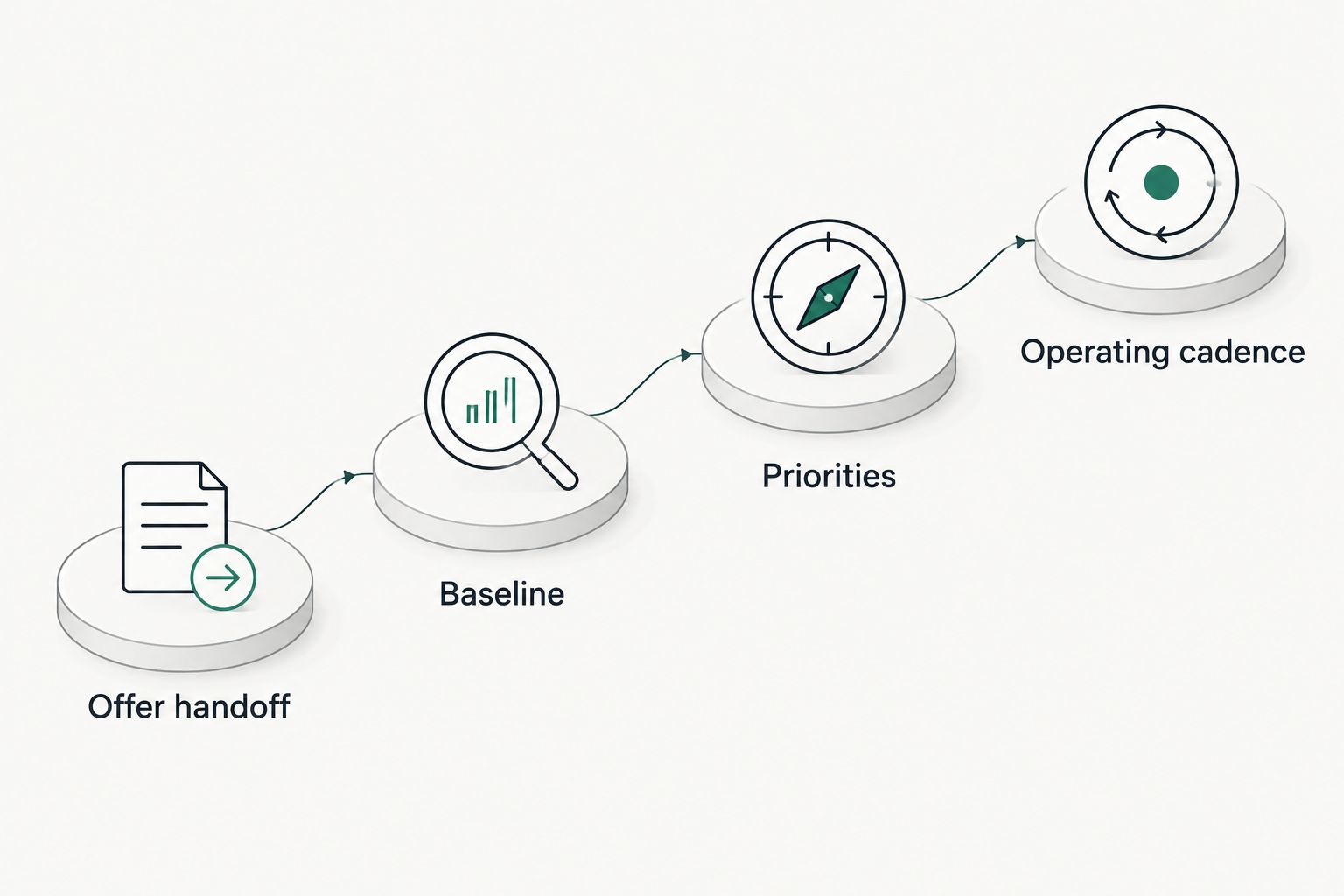
Offer handoff
Timing: accepted offer through the start date. The CEO owns this unit. Its purpose is to transfer the hiring decision without turning interview assumptions into unchangeable promises.
- Record the mandate. Complete Reason for hire, Business problem and Expected outcomes. Translate broad language such as “build growth” into the specific problem the company hired the CMO to solve.
- Document commitments. Populate Hiring commitments with agreed reporting lines, team responsibilities, resources and unresolved questions. Include commitments made during interviews so the executive does not discover conflicting expectations after joining.
- Assign decision rights. Create CMO decides, CEO approves and Shared decisions. Cover positioning, campaign allocation, hiring, agency relationships and changes to the marketing operating model.
- Prepare the handoff. Schedule stakeholder introductions, access checks and the first CEO working session. Give every introduction a question to resolve, such as how sales accepts a qualified opportunity.
Expected result: the incoming CMO can explain why the role exists, who approves consequential decisions and which assumptions still require validation. The CEO can confirm the same interpretation.
Do not request a finished strategy before the executive has access to the evidence. Ask for questions and hypotheses instead.
Baseline
Timing: days 1–30. The CMO owns the diagnosis. Finance and functional leaders validate the information used to describe business performance.
- Audit access against actual work. Confirm that the CMO can inspect the reports and systems needed for the mandate. Record permission blockers under Dependencies, with an accountable resolver.
- Create the baseline record. Add Metric, Definition, Source, Reporting window, Owner and Known limitations. Keep the 2026 planning baseline separate from any later changes to measurement.
- Review the customer journey. Trace how customers discover, evaluate, purchase and continue using the offering. Include sales handoffs for sales-led businesses and activation evidence where product use influences conversion.
- Test interview assumptions. Compare the hiring brief with customer conversations, campaign history, team capabilities and financial constraints. Mark each assumption as supported, contradicted or unresolved, with evidence.
- Hold the day-30 review. Present the baseline, the most consequential constraints and the decisions needed next. Ask the CEO to approve the problem definition before approving a large execution program.
Expected result: the CEO and CMO share an accepted diagnosis. Where evidence is incomplete, the baseline shows the limitation and who will resolve it.
For SaaS and AI companies, separate demand creation from product activation and customer retention. For D2C and ecommerce, distinguish acquisition performance from repeat purchasing and margin. For marketplaces, examine the relevant buyer and supplier journeys rather than treating all registrations as equivalent.
Priorities
Timing: days 31–60. Turn the diagnosis into a bounded execution plan. The CMO owns the recommendation; the CEO resolves trade-offs that exceed the CMO’s authority.
- Write each priority as a decision. Replace “improve demand generation” with a specific proposed change, its supporting evidence and the business problem it addresses. Record rejected alternatives and the reason for rejecting them.
- Attach an accountable owner. Complete Outcome owner, Required support and Approval needed. A campaign that depends on product instrumentation is not solely a marketing task.
- Define the measurement contract. Record Baseline, Target, Measurement window and Decision rule. Use company-approved targets; do not import generic benchmarks into an unfamiliar business.
- Protect ongoing execution. Identify which existing activities continue, which stop and which require investigation. Avoid changing every channel at once when that would prevent a clear interpretation of results.
- Hold the day-60 review. Approve the selected priorities, resource requirements and escalation path. Log disagreements as decisions to resolve, not as vague requests to “get aligned.”
Expected result: each priority has an owner, an approved resource commitment and a defined way to judge progress. The team knows what not to pursue.
Approve the decision rule before the result arrives. Otherwise, a disappointing outcome invites a retrospective argument about what success was supposed to mean.
Operating cadence
Timing: days 61–90. Establish how the CMO runs the function after onboarding. The goal is repeatable accountability, not permanent CEO supervision.
- Run the agreed priorities. Track execution alongside the baseline. Distinguish a missed implementation deadline from an initiative that launched correctly but failed to produce the expected response.
- Create a decision log. Record Decision, Evidence, Approver and Revisit date. Keep the rationale visible so the team does not reopen the same debate without new information.
- Review team responsibilities. Identify unclear ownership, missing capabilities and unnecessary approval layers. Separate a genuine leadership gap from a process or access problem before proposing another hire.
- Prepare the day-90 readout. Summarize completed work, observed results, unresolved dependencies and the next planning period. Preserve the distinction between early indicators and commercial outcomes.
- Transfer to normal management. Replace onboarding check-ins with the agreed performance cadence. Keep outstanding blockers visible until someone accepts responsibility for resolving them.
Expected result: the CMO owns an operating system that the CEO can inspect without directing every task. The next plan follows from evidence gathered during onboarding.
A 90-day review does not require every initiative to have completed its commercial measurement window. It requires an honest account of what is known, what remains unproven and when the next decision will be made.
Adapt the workflow for an internal promotion
An internally promoted CMO needs a role transition, even without a company introduction. Existing relationships do not settle new authority. The CEO must explain which decisions now belong to the promoted leader and how former peers should work with that person.
| Onboarding route | Best for | Main advantage | Main limitation | Required adjustment |
|---|---|---|---|---|
| External CMO appointment | A leader joining the company | Creates space to question inherited assumptions | Company context and trusted relationships must be built | Prioritize access, customer evidence and stakeholder working sessions |
| Internal CMO promotion | A leader taking broader responsibility | Preserves company knowledge and existing relationships | Old responsibilities and peer expectations can persist | Reset authority, reassign previous duties and announce the new mandate |
Use the same milestone structure for both routes. For an internal promotion, replace introductory meetings with authority-reset conversations. Have the CEO announce the reporting line and approval boundaries rather than leaving the new CMO to negotiate them individually.
Troubleshooting
The CMO has access but cannot reconcile the numbers
Fix the definitions before expanding reporting. Ask finance and the relevant system owner to reconcile the disputed metric using the same reporting window and inclusion rules. Preserve both versions until the accountable owner approves the definition.
Stakeholder meetings produce conflicting priorities
Return the conflict to the executive sponsor. Ask each stakeholder to name the business outcome and trade-off behind the request. The CEO decides between incompatible priorities; the CMO should not promise to satisfy all of them.
The CEO keeps reversing delegated decisions
Rewrite the decision boundaries. Identify whether the reversal concerns authority, missing evidence or an unspoken constraint. Update the mandate and communicate the change to affected leaders before the next approval cycle.
The board expects revenue proof before the measurement window closes
Separate execution evidence from business results. Show what launched, what customer response is observable and when the commercial outcome can be assessed. Do not relabel campaign activity as revenue impact.
The plan stalls because nobody owns onboarding administration
Give coordination a named owner. The coordinator maintains dates and dependencies; the CMO owns the substantive work. Escalate overdue access and approvals to the sponsor instead of letting them silently move every milestone.
Customize your workflow
Start with the business decision, not a longer checklist. A first CMO appointment needs clear boundaries between founder responsibilities and executive ownership. A replacement CMO needs an explicit account of what continues and what must change.
If onboarding exposes a missing growth or marketing leader, define the responsibility before opening another search. The guide to startup recruiters supports the separate hiring-partner decision; it does not replace the onboarding mandate.
Rocket Talent reports a typical shortlist in 7 days. That is a search milestone, not a guaranteed deadline or a substitute for onboarding. Its 24-month free replacement guarantee is not a refund or a guarantee of business performance.
Define your next leadership search
Discuss the growth, marketing, product, digital or data leadership responsibility your business needs.
FAQ
What should a CMO onboarding plan include?
A CMO onboarding plan should include the hiring mandate, decision rights, system access, stakeholder responsibilities, a performance baseline and milestone reviews. Assign an owner and completion evidence to each task.
What should a new CMO accomplish in the first 30 days?
A new CMO should establish an agreed diagnosis during the first 30 days. That includes validating measurement definitions, reviewing the customer journey and identifying the constraints that deserve action.
Who owns the CMO onboarding process?
The CEO owns sponsorship and executive alignment; the CMO owns diagnosis and the proposed operating plan. A named coordinator manages scheduling, access requests and administrative dependencies.
Should a CMO arrive with a finished 90-day strategy?
No. A CMO can arrive with hypotheses and a learning agenda, but a finished strategy requires company evidence. Agree on the decisions the onboarding period must support instead of demanding unsupported commitments.
How is SaaS CMO onboarding different from ecommerce onboarding?
SaaS CMO onboarding should examine the relevant sales, activation and retention journey, while ecommerce onboarding should examine purchasing, repeat behavior and margin. The exact measures depend on the company’s business model and the CMO’s mandate.
Does an internally promoted CMO need onboarding?
Yes. An internally promoted CMO needs explicit authority, reassigned former responsibilities and a shared understanding of the new mandate. Company knowledge does not automatically resolve those changes.
What should the board expect from a 2026 CMO onboarding plan?
The board should expect a documented baseline, approved priorities and a clear account of evidence by the day-90 review. Commercial results must be assessed against the agreed measurement window, not an arbitrary presentation deadline.
One last thing
Ask the CEO and CMO to write the mandate separately before comparing answers. Have each name the business problem, the decisions the CMO owns and the evidence that would justify a change in direction. Differences reveal unresolved expectations that a packed meeting calendar can hide.