Best fractional CMO services for SaaS startups in 2026

Best overall for a defined, part-time SaaS marketing mandate: an embedded fractional CMO. Best for a vacant leadership seat: an interim CMO. Best for permanent executive ownership: Rocket Talent’s executive search. This 2026 guide compares service models so you hire a fractional CMO only when the job fits fractional leadership.
- Hire a fractional CMO for bounded SaaS marketing leadership, with explicit authority and an execution team.
- Choose an interim CMO when a leadership vacancy requires temporary operating ownership.
- Choose advisory support when your existing marketing leader needs guidance, not replacement.
- Rocket Talent’s executive search fits SaaS founders who need permanent marketing leadership rather than fractional delivery.
Why this matters
A marketing leadership problem is not automatically a fractional CMO assignment. You might need someone to set direction, manage a team, repair sales alignment, or build a permanent function. Those are different jobs.
Rocket Talent provides executive search and specialist recruiting for growth, marketing, product, digital and data leadership. Its searches span senior manager, director, head, VP and C-suite roles across SaaS, AI, D2C, ecommerce and marketplaces. Executive search is a hiring service, not an outsourced marketing department.
For your 2026 hiring decision, start with the work that must change. Then choose the engagement model. A senior title does not resolve unclear ownership.
What makes the best fractional CMO service for SaaS?
Judge the service against these criteria before comparing proposals:
- Mandate fit: Specify whether you need strategy, operating leadership, transition support or permanent ownership.
- Relevant experience: Ask for evidence from a comparable sales motion, buyer and company stage. A SaaS label alone is insufficient.
- Decision authority: Define who controls positioning, priorities, team decisions and marketing spending.
- Execution coverage: Name the people responsible for campaigns, content, operations, analytics and follow-through.
- Commercial measurement: Connect marketing work to qualified demand, customer acquisition, activation or retention, as appropriate.
- Continuity: Require documented decisions, accessible accounts and a handover plan.
Choose the model that matches the decisions you need someone to own. Use the same criteria for every 2026 proposal; otherwise, you will compare unlike services as if they solve the same problem.
Fractional CMO service models at a glance
This ranking compares engagement models, not a claimed ranking of named providers. Each model has a distinct buying situation.
| Rank and service model | Best for | Standout feature to require | Key limitation |
|---|---|---|---|
| 1. Embedded fractional CMO | Bounded, ongoing marketing leadership | A named executive who owns agreed decisions | Limited engagement capacity must match the mandate |
| 2. Interim CMO | Temporary leadership vacancies | Operating authority and a defined handover | Temporary coverage does not settle permanent hiring |
| 3. CMO advisory | Supporting an existing marketing leader | Focused counsel on consequential decisions | Advice does not supply execution ownership |
| 4. Fractional CMO with delivery support | Leadership plus defined execution gaps | A named leader and clearly assigned delivery work | Leadership and delivery recommendations need scrutiny |
| 5. Executive search | Permanent leadership ownership | Candidate assessment against a permanent role | Search recruits the leader; it does not run marketing |
1. Embedded fractional CMO: best for bounded leadership
An embedded fractional CMO is the default choice when you need recurring executive marketing leadership but can define a part-time mandate. Structure the engagement around decisions and outcomes, not access to a senior person.
For a SaaS startup, that mandate might cover positioning, demand generation priorities and sales alignment. For an AI company, require relevant experience explaining the product’s value to its actual buyer. Familiarity with AI terminology is not proof of marketing leadership.
Embedded fractional CMO pros:
- Gives the engagement a named marketing decision-maker.
- Connects strategic priorities with recurring team management.
- Supports a bounded leadership need without defining it as a permanent appointment.
Embedded fractional CMO cons:
- A part-time mandate cannot absorb an undefined, expanding workload.
- Leadership still needs people who can execute the agreed work.
Best for: A founder with a capable execution team and a clear leadership gap.
Before signing, ask the executive to explain which decisions they will own and which remain with you. Put meeting expectations, escalation rules and account access in writing. If the proposal promises ownership without specifying authority, revise it.
Verdict: Buy when the mandate is bounded and execution is covered.
2. Interim CMO: best for a temporary leadership vacancy
An interim CMO engagement addresses a leadership seat that needs temporary operating coverage. Define the assignment around stabilizing decisions, managing the existing team and preparing a handover.
Do not choose an interim engagement solely because you are uncertain about the permanent role. Separate the immediate operating problem from the longer-term organization decision. Otherwise, temporary work becomes a substitute for deciding what the company needs.
Interim CMO pros:
- Creates a defined owner for a transition period.
- Supports continuity while you assess permanent leadership needs.
- Provides a clear setting for documenting priorities and unresolved decisions.
Interim CMO cons:
- The engagement ends, so handover is part of the job.
- Interim coverage does not replace a permanent hiring decision.
Best for: A SaaS business with a vacant leadership seat and decisions that cannot wait for a permanent appointment.
Specify authority over the team, spending approvals and sales coordination before the engagement begins. Require the interim leader to leave a usable operating record, not just a closing presentation.
Verdict: Buy for a defined transition; skip it as an indefinite holding pattern.
3. CMO advisory: best for an existing marketing leader
CMO advisory is the right model when someone inside your company already owns marketing execution and needs senior counsel. Buy help with decisions rather than pretending the adviser runs the function.
Useful assignments include reviewing positioning, challenging a demand generation plan or helping a first-time marketing leader assess priorities. Keep the scope narrow enough that you can identify the decision the advice is meant to improve.
CMO advisory pros:
- Preserves clear operating ownership inside your team.
- Focuses senior input on a specific business question.
- Supports an existing leader without creating a parallel management structure.
CMO advisory cons:
- Recommendations still require an internal owner to act.
- Advisory access does not fill an executive vacancy.
Best for: A founder or marketing head who can execute but needs experienced challenge on consequential choices.
Ask what the adviser will review before each discussion and what you will receive afterward. Agree on who makes the final decision. Advice without an accountable operator becomes another document waiting for action.
Verdict: Buy for decision support; skip when you need someone to run marketing.
4. Fractional CMO with delivery: best for execution gaps
A combined leadership-and-delivery engagement pairs executive direction with specified marketing work. Choose this model when your problem includes both deciding what to do and supplying people to do it.
Separate those responsibilities in the proposal. Name the executive, identify the delivery owners and explain how work gets approved. Do not treat a bundle of channel services as executive leadership simply because the proposal uses the CMO title.
Fractional CMO with delivery pros:
- Connects leadership decisions with assigned execution resources.
- Makes delivery responsibilities part of the engagement scope.
- Can address a defined capability gap alongside strategic direction.
Fractional CMO with delivery cons:
- Delivery recommendations need scrutiny when the same provider supplies the work.
- A broad service menu does not establish SaaS leadership experience.
Best for: A startup that needs a marketing leader and specific execution capabilities it does not have internally.
For your 2026 evaluation, ask how the executive decides against buying more services from the delivery team. Require access to your own accounts, campaign records and reporting. The engagement should leave your business understandable to the next leader.
Verdict: Buy when both gaps are explicit; hold when leadership accountability is unclear.
5. Executive search: best for permanent leadership ownership
Rocket Talent’s executive search is best for SaaS founders who need permanent marketing leadership rather than fractional delivery. Use search when the job requires ongoing team leadership, cross-functional authority and a lasting place in your organization.
The firm describes its sourcing foundation as a pre-mapped network of growth, product and data talent across D2C and B2B SaaS, with existing candidate relationships. That does not mean every candidate is available for your assignment.
Rocket Talent executive search pros:
- Focuses on growth, marketing, product, digital and data leadership rather than every business function.
- Covers senior manager through C-suite searches, allowing you to define the appropriate level.
- Uses continuous 24/7/365 sourcing and reports a typical shortlist in 7 days, as confirmed in October 2026.
Rocket Talent executive search cons:
- Executive search does not provide outsourced campaign execution.
- A typical shortlist timeline is not a guaranteed appointment date.
The firm also offers a 24-month free replacement guarantee. It is not a refund or a guarantee of business performance; confirm its applicable terms before engagement.
Best for: A founder who has defined a permanent leadership seat and needs help finding and assessing candidates.
Verdict: Buy for permanent ownership; skip as a substitute for fractional operating coverage.
Define the mandate before interviewing anyone
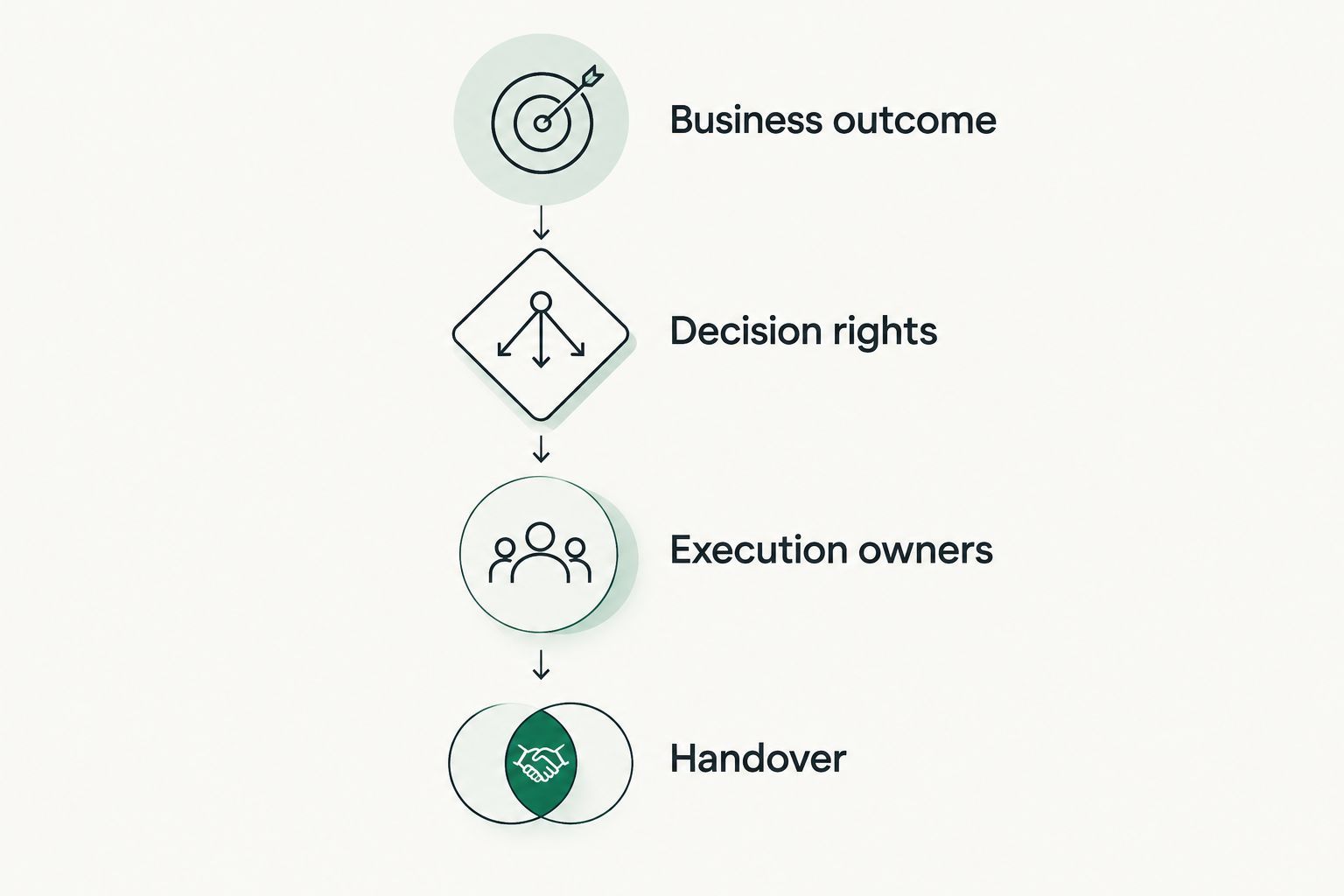
Use a short sequence to turn a vague leadership need into a service brief. These steps apply whether you choose fractional support or permanent hiring.
- Business outcome: State the commercial problem. Distinguish weak demand from poor qualification, weak activation or customer retention.
- Decision rights: List the decisions the leader controls and the approvals that remain with the CEO.
- Execution owners: Identify who delivers the work. Expose missing capabilities before selecting a service.
- Handover: Specify what stays with the company when the engagement or transition ends.
A service brief should connect the outcome to actual authority. If a leader is accountable for pipeline but cannot influence positioning, priorities or sales coordination, fix the brief before interviewing.
For a permanent appointment, the job description to offer workflow provides a related hiring framework. Keep the role brief and candidate assessment connected to the same business problem.
How these service models are ranked
The ranking prioritizes fit for a founder searching for fractional marketing leadership: mandate, authority, execution coverage, measurement and continuity. It does not rank named competitors or imply a provider testing exercise.
Embedded fractional leadership comes first for a bounded, recurring mandate. Interim coverage wins for a vacancy. Advisory wins when you already have an operator. Combined delivery fits a capability gap. Executive search fits permanent ownership.
Which model should you choose?
Choose an embedded fractional CMO by default only when you can bound the work and name the execution team. That is the clearest starting point for the fractional hiring question in 2026.
If the role needs lasting ownership of people, priorities and cross-functional decisions, define the permanent hire instead. Do not stretch a fractional brief to avoid making the organization decision.
Define your permanent leadership search
Discuss growth, marketing, product, digital or data leadership hiring for your SaaS or AI company.
FAQ
When should a SaaS startup hire a fractional CMO?
Hire a fractional CMO when you need recurring senior marketing leadership for a bounded mandate and have people assigned to execute. Define the executive’s authority, deliverables and working expectations before signing.
Is a fractional CMO better than a full-time CMO?
Neither model is universally better. Fractional leadership fits a bounded engagement; a permanent CMO fits an ongoing organizational role with lasting team and cross-functional ownership.
What is the difference between a fractional CMO and an adviser?
A fractional CMO engagement should assign agreed leadership responsibilities, while an advisory engagement supplies counsel to an existing decision-maker. Specify operating ownership in the contract rather than relying on the title.
Can a fractional CMO run demand generation for an AI startup?
Include demand generation leadership in the mandate if that is the business need. Assess experience with your buyer, sales motion and product rather than accepting familiarity with AI as sufficient evidence.
Does executive search include fractional marketing delivery?
Executive search recruits a leader; it is not outsourced marketing delivery. Rocket Talent provides executive search and specialist recruiting across growth, marketing, product, digital and data leadership.
What should I ask before choosing a fractional CMO service?
Ask who owns decisions, who executes, how success is assessed and what happens at handover. Request relevant examples and distinguish the named executive’s responsibilities from the delivery team’s work.
What should a fractional CMO leave behind?
Require documented priorities, accessible accounts, reporting definitions and a clear record of decisions. The handover should let your team or next leader continue without reconstructing the engagement.
One last thing
Ask every prospective leader: Which decisions should stay with the founder? A useful answer defines a boundary. A proposal that makes the CMO responsible for everything leaves you without a workable agreement.