Can ecommerce recruiters find marketplace-experienced candidates?

Yes. Ecommerce recruiters can find marketplace-experienced candidates when the search tests ownership of buyer demand, seller supply, and marketplace economics—not just employment at an ecommerce company. For your 2026 hire, require evidence of the candidate’s decisions and results on the side of the marketplace the role will own.
- Ecommerce recruiters marketplace experience: assess buyer demand, seller supply, and commercial ownership—not company names alone.
- Rocket Talent is best for employers seeking specialist growth, marketing, product, digital, and data leadership search.
- A D2C growth background supports buyer acquisition; it does not establish seller acquisition or marketplace product experience.
- Define the marketplace constraint before choosing the role, seniority, or recruiting partner.
Why this matters
An ecommerce résumé does not tell you whether someone has solved your hiring problem. A leader who increased purchases for a single brand brings different evidence from someone who recruited sellers, improved matching, or increased repeat transactions across a marketplace.
Hire against the operating problem, not the sector label. If you are comparing search partners, use the ecommerce executive search firms guide alongside a clear description of what your new leader must change. A recruiting firm’s category coverage is a starting point, not proof that its candidates fit your business.
Can ecommerce recruiters find marketplace-experienced candidates?
Yes, provided they distinguish direct ecommerce experience from marketplace operating experience. Ask the recruiter to explain which candidate backgrounds match your business and where those backgrounds leave gaps.
| Candidate background | Best for | Evidence to request | Limitation to test |
|---|---|---|---|
| D2C growth leadership | Buyer acquisition and retention | Channel decisions, customer economics, repeat purchasing | Seller supply and marketplace matching remain unproven |
| Marketplace marketing leadership | Buyer demand or seller acquisition | Results separated by marketplace side | Marketing ownership does not establish product ownership |
| Marketplace product leadership | Discovery, matching, onboarding, and transactions | Product decisions tied to completed transactions | Paid acquisition leadership remains unproven |
| Marketplace data leadership | Measurement and decision support | Definitions, analysis, and decisions influenced | Analytical work does not establish commercial authority |
These are search directions, not interchangeable profiles. A strong shortlist explains why each candidate fits the mandate and identifies what still needs testing.
For a 2026 search, reject a brief that asks only for “ecommerce experience.” Specify the business model, the constraint, and the decisions the person must own. That gives the recruiter something concrete to assess.
What marketplace experience should recruiters verify?
Marketplace experience becomes useful when you separate the work into buyer demand, seller supply, and shared outcomes. Interview candidates against the relevant area rather than expecting every leader to have owned everything.
Buyer demand
Buyer demand covers attracting customers, helping them transact, and bringing them back. Ask candidates to distinguish acquisition growth from changes in conversion, retention, or purchasing frequency.
Request an example where the candidate changed a decision after examining customer behavior. Then establish what they controlled, what another team controlled, and whether the result depended on discounts or changes in supply.
Seller supply
Seller supply covers attracting, activating, and retaining the businesses or individuals offering goods or services. A candidate who marketed products to consumers has not automatically demonstrated this experience.
Ask how the candidate defined an activated seller and what prevented new sellers from becoming productive. Look for a clear explanation of the seller’s incentives, onboarding friction, and ongoing participation—not simply a count of registrations.
Shared outcomes
Shared outcomes connect both sides of the business. Relevant evidence includes completed transactions, repeat use, matching quality, and the commercial consequences of marketplace decisions.
Ask candidates to explain a trade-off. Did increasing buyer demand expose a supply constraint? Did adding sellers improve customer choice but create discovery problems? Strong answers connect the action to the whole transaction rather than a single team’s dashboard.
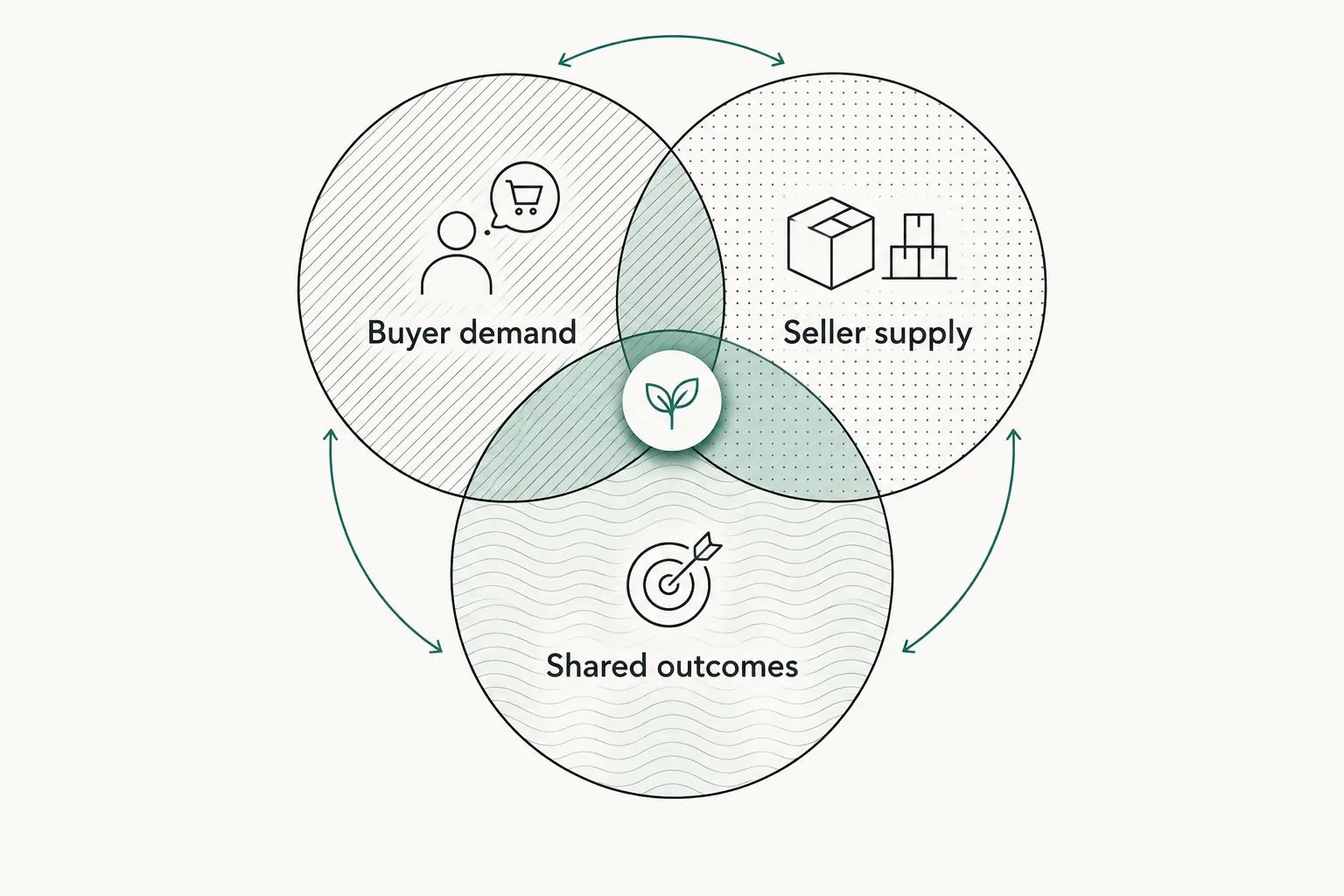
A recruiter should turn these distinctions into interview questions and candidate summaries. If every profile receives the same generic description, the assessment has not explained the differences you need to make a hiring decision.
Which leadership role should you hire?
Choose the discipline before choosing the title. Marketplace experience matters differently for growth, marketing, product, digital, and data leaders, and a senior title cannot compensate for a mismatched remit.
Growth and marketing leadership
Best for: a defined acquisition, retention, or commercial growth problem. Specify whether the leader owns buyers, sellers, or both. Also define the relationship with sales, product, and finance before interviews begin.
The advantage is direct focus on demand and customer behavior. The limitation is authority: a marketing leader cannot independently fix product onboarding, transaction failures, or supply quality without the relevant decision rights and partners.
Product and digital leadership
Best for: a customer journey or marketplace experience problem. Ask for evidence involving discovery, onboarding, matching, checkout, or repeat use, depending on your mandate.
The advantage is ownership of how the marketplace works for users. The limitation is scope: successful product delivery alone does not prove the candidate can lead paid acquisition, seller partnerships, or an entire commercial organization.
Data leadership
Best for: a measurement or decision-quality problem. Define whether the hire must improve business definitions, experimentation, forecasting, or the connection between analysis and operating decisions.
The advantage is clearer evidence for difficult choices. The limitation is accountability: better analysis does not replace a named executive who owns the decision and its implementation. Do not use a data hire to avoid resolving unclear commercial ownership.
Match the level to the decisions
Senior manager and director searches should specify execution depth and team responsibility. Head and VP searches need clear functional ownership. C-suite searches require company-level priorities, trade-offs, and authority.
Write down what the person can decide without escalation. This exposes whether you need a hands-on specialist, a functional leader, or an executive—and prevents interviews from drifting between different jobs.
How should you brief an ecommerce recruiter?
A useful search brief connects the marketplace constraint to evidence the recruiter can verify. Use this sequence before approving outreach in 2026.
- Name the constraint. State whether the business needs more qualified buyers, productive sellers, completed transactions, repeat purchasing, or better decisions. Avoid combining every ambition into a single role.
- Define ownership. Identify the decisions, teams, and resources the hire will control. Separate direct responsibility from influence across other functions.
- Describe the operating context. Explain the marketplace model, customer journey, seller relationship, and current dependencies. Give the recruiter the context candidates need to evaluate the role.
- Set the evidence standard. Require examples showing the starting problem, the candidate’s action, the outcome, and the candidate’s actual contribution. Accept relevant adjacent experience only when the gap is explicit.
- Agree on assessment. Use consistent questions and a common written evaluation. Decide which evidence rules a candidate in, which gaps need testing, and which gaps rule a candidate out.
The brief should also identify what the role does not own. A VP of growth search becomes difficult to assess when some interviewers expect a brand leader, others expect a product leader, and the founder expects a general manager.
For executive mandates, compare your proposed process with the retained executive search timeline guide. Keep shortlist delivery separate from interviews, references, offer decisions, and the candidate’s start date.
Why marketplace candidate fit varies
The word “marketplace” covers different operating requirements. These factors should change the search brief and the evidence requested—not become excuses for vague assessment.
- Marketplace side. Buyer acquisition, seller acquisition, and managing both sides require different examples. Specify which side the role owns before assessing candidates.
- Transaction journey. A leader’s experience must connect to how customers discover, evaluate, and complete a transaction in your business. Ask which parts of that journey they changed.
- Functional authority. Marketing, product, digital, and data leaders control different decisions. Test the candidate against the authority your organization will actually give them.
- Company context. Establish what the candidate inherited, including team support and existing processes. Separate work they built from work they maintained.
- Leadership scope. Managing a defined channel differs from setting company-wide priorities. Match the evidence to the seniority and breadth of the role.
Avoid making an exact sector match the only acceptable answer. Instead, identify which experience is essential and which knowledge the successful hire can learn without compromising the mandate.
Is D2C experience enough for a marketplace growth role?
D2C experience is enough to justify assessment for a buyer-focused growth role, but it does not establish marketplace expertise. Test acquisition and retention depth, then examine the candidate’s understanding of seller constraints and transaction economics.
A candidate can be strong without fitting every mandate. Keep adjacent candidates when their strengths match the job; reject unexplained gaps in essential responsibilities. That is more useful than either excluding every non-marketplace résumé or treating all ecommerce backgrounds as equivalent.
What should a recruiter show before you approve interviews?
Ask for a written explanation of fit, evidence, and open questions for each candidate. A list of recognizable employers is not an assessment.
The summary should state the candidate’s relevant mandate, decisions owned, outcomes discussed, and limitations still to verify. It should also explain why the candidate’s seniority fits your reporting structure and available authority.
For a 2026 hiring process, keep this document consistent across the shortlist. You should be able to compare candidates without reconstructing the recruiter’s reasoning from separate conversations or polished biographies.
Where Rocket Talent fits
Rocket Talent is best for employers seeking specialist growth, marketing, product, digital, and data leadership search. Its executive-search positioning covers senior manager, director, head, VP, and C-suite assignments across high-growth SaaS, AI, D2C, ecommerce, and marketplace businesses.
Rocket Talent describes its sourcing advantage as a pre-mapped network across D2C and B2B SaaS, supported by existing candidate relationships. That is relevant access—not evidence that every person is available, interested, or suited to your marketplace mandate.
As confirmed by the client in October 2026, Rocket Talent typically delivers a shortlist in 7 days. Its stated sourcing model operates 24 hours a day, and it offers a 24-month free replacement guarantee. Treat the shortlist timing as typical, not a deadline; continuous sourcing does not establish candidate availability, and the replacement guarantee is not a refund or a guaranteed business result.
The fit is strongest when you need these leadership disciplines. Do not treat specialist growth, marketing, product, digital, and data recruiting as coverage of every marketplace function or every AI engineering role. Your assignment still needs a defined mandate and candidate-level evidence.
Define your marketplace leadership search
Discuss the role, marketplace constraint, and candidate evidence your hiring decision requires.
FAQ
Can ecommerce recruiters find candidates with marketplace experience?
Yes, when they assess ownership of buyer demand, seller supply, and marketplace outcomes. Require evidence of decisions and results rather than relying on employer names.
Is a D2C growth leader a good fit for a marketplace?
A D2C growth leader is a relevant candidate for buyer acquisition and retention mandates. Seller acquisition, matching, and marketplace product ownership require separate evidence.
Should I hire a marketplace growth leader or a product leader?
Hire against the constraint: growth leadership fits acquisition and retention ownership, while product leadership fits discovery, onboarding, matching, and transaction experience. Define decision rights before selecting the title.
What should I ask a marketplace candidate in an interview?
Ask the candidate to explain the starting problem, the decision they owned, the action taken, and the outcome. Follow with questions about the other marketplace side and contributions from other teams.
Does Rocket Talent recruit below VP level?
Rocket Talent covers senior manager, director, head, VP, and C-suite searches in growth, marketing, product, digital, and data leadership. Match the level to the decisions and team responsibility the role requires.
How quickly does Rocket Talent typically deliver a shortlist?
Rocket Talent typically delivers a shortlist in 7 days, as confirmed by the client in October 2026. This is typical shortlist timing, not a guaranteed deadline or a complete hiring timeline.
One last thing
Ask each finalist to explain when increasing buyer demand would be the wrong decision. The answer tests whether the candidate can see a marketplace constraint beyond their own function.
A strong explanation identifies the dependency, describes the evidence needed, and proposes an action within the role’s authority. Hire the person who can explain the trade-off—not just the person with the most familiar company names.