Chief AI Officer Hiring Guide for SaaS Companies
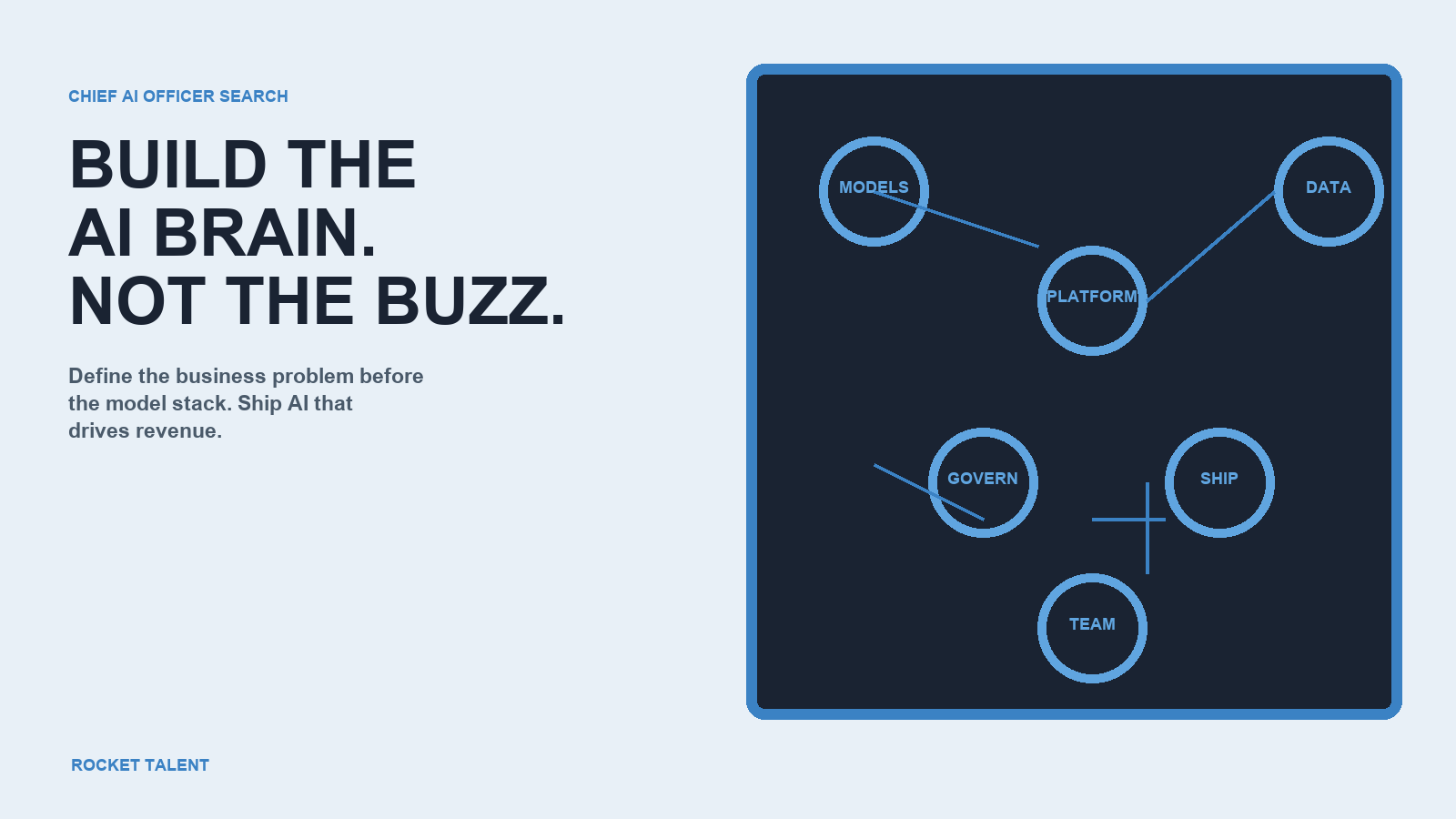
Hiring a chief AI officer for a SaaS company is one of the most consequential leadership decisions a board can make in 2026. The role did not exist in its current form five years ago, and most companies are still figuring out what the person should own, where they sit in the org chart, and how to measure success. This guide lays out how Rocket Talent approaches the search, from defining the business case through building a shortlist of candidates who can actually do the job.
What a Chief AI Officer Actually Solves in a SaaS Business
The hire only makes sense if you can name the specific problem it solves. For most SaaS companies, that problem is not “we need someone to lead AI.” It is one or more of the following: AI features are shipping slowly because no one owns the roadmap across product and engineering; the company is buying AI tools faster than it can integrate them; the board wants an AI strategy and the CEO does not have time to write one; or a competitor has launched an AI-native product and the company needs a credible response.
Before approaching candidates, write down the single most important outcome for the first twelve months. If you cannot, you are not ready to hire. Rocket Talent would push a client to pick one: ship a specific AI feature, build an internal AI platform, establish an AI governance framework, or reposition the product as AI-native. Each of those requires a different person.
Define the Business Case Before the Job Title
The strongest chief AI officer hires are anchored to a commercial outcome, not a technology wishlist. A company that sells to enterprise buyers needs someone who can talk to CIOs about data residency and model governance. A product-led growth company needs someone who can ship AI features that drive activation and retention. The job description should state the problem in business terms before listing technical requirements.
If the brief is vague, the shortlist will be vague. Rocket Talent has seen companies hire a prominent AI researcher who could not navigate a product roadmap, and companies who hired a former CTO who had no hands-on ML experience. Both failed for predictable reasons that a sharper brief would have caught.
Match Candidates to Your AI Maturity, Not Their Previous Logo
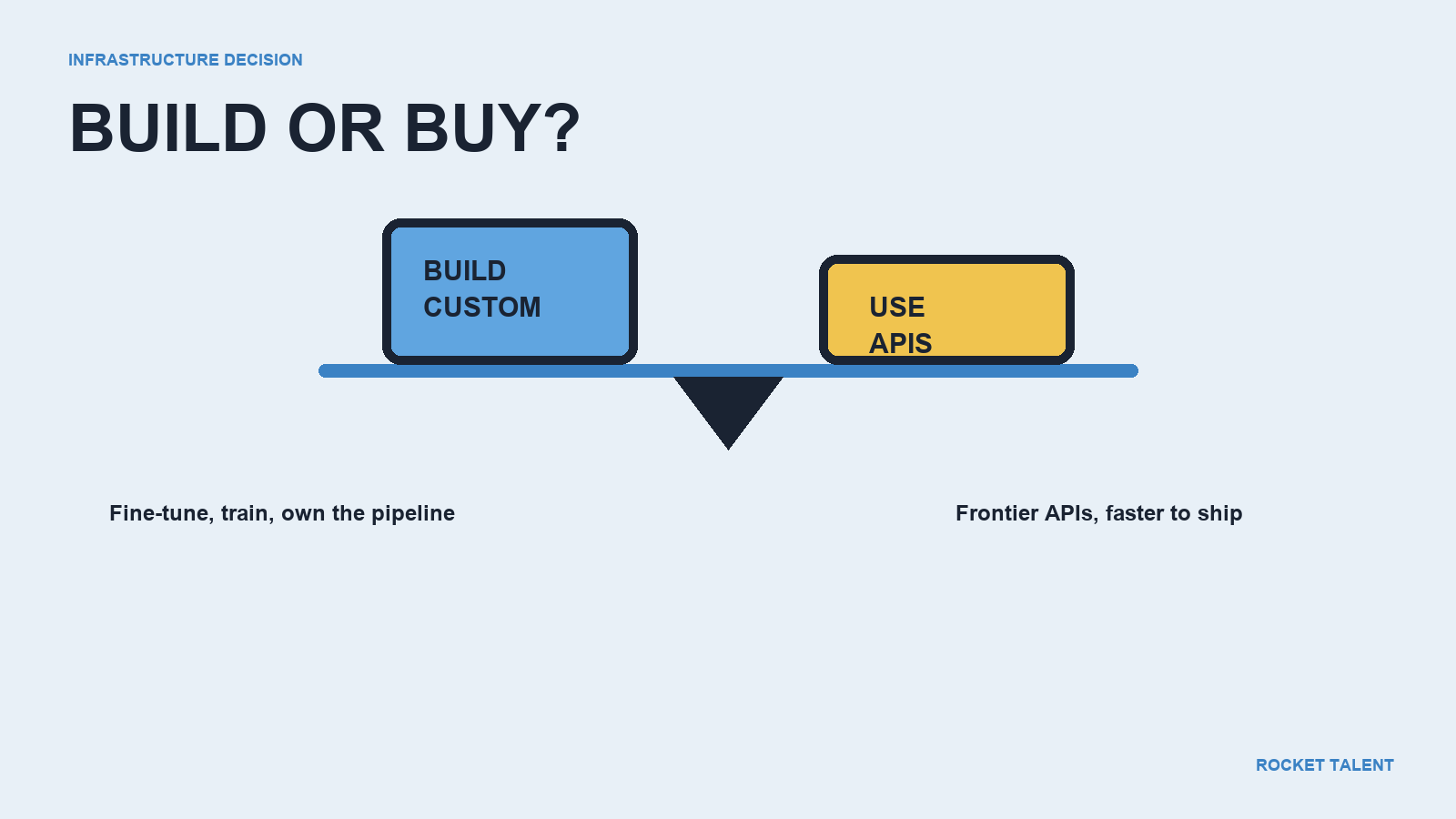
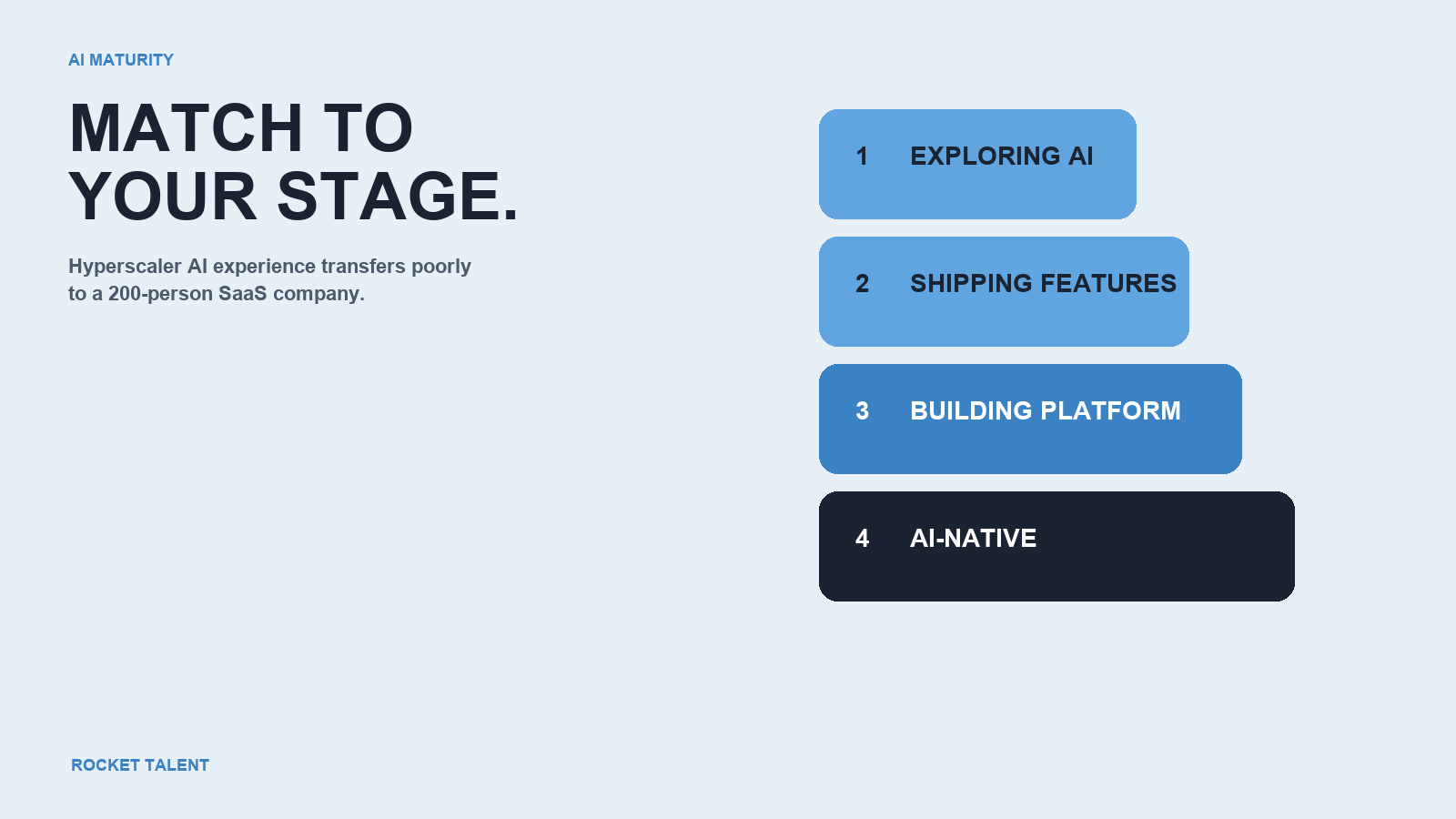
A candidate who built an AI org at a hyperscaler is impressive, but that experience transfers poorly to a 200-person SaaS company. The better test is whether the candidate has operated at a similar stage of AI maturity. Have they built an ML team from scratch, or did they inherit one? Have they shipped AI features into a production SaaS product, or only built internal tooling? Do they understand the tradeoffs between build and buy for AI infrastructure at your scale?
Ask for specific examples: what model they chose and why, what data pipeline they built, what feature they shipped and what metric it moved. If the answer is high-level strategy without operational detail, the candidate is likely a thinker, not a builder. Both have value, but they are not interchangeable.
Separate AI Strategy From AI Engineering
Some companies need a chief AI officer who sets strategy and manages a team of ML engineers. Others need someone who can write production code and architect the first version of the AI platform. These are different people. Confusing them leads to a hire who is either too hands-off or too tactical for the role you actually have.
Rocket Talent would clarify this before the first interview. If the board expects a strategic leader who presents at conferences and builds the AI narrative for investors, hire accordingly. If the CEO expects the person to be in the codebase for the first six months, say so in the brief.
Test for Cross-Functional Alignment, Not Just Technical Depth
A chief AI officer who cannot work with product, engineering, sales, and legal will fail regardless of their technical ability. The role inherently spans these functions. In interviews, ask how the candidate has handled friction between AI ambitions and shipping deadlines, how they have worked with legal on model governance, and how they have communicated AI strategy to a board that does not understand the technology.
Strong candidates can describe a specific moment where they had to slow down an AI feature for safety or quality reasons, and how they made that case to a CEO who wanted it shipped. Weak candidates talk about AI transformation in the abstract.
Align the Role With Product, Engineering, and Finance
The chief AI officer will fail if product thinks they own the AI roadmap, engineering thinks AI is just another feature set, and finance thinks the AI budget is a separate cost center. Before the hire, get these stakeholders in a room and agree on what the person owns. Does the CAO own the AI product roadmap, or does product? Does the CAO own the data platform, or does engineering? Does the CAO have a separate budget, or is it part of R&D?
Write the answers down. If the conversation reveals fundamental disagreement, resolve it before hiring. A chief AI officer hired into unresolved ambiguity will spend their first year fighting org battles instead of shipping.
Use Evidence-Based Interviews, Not AI Vision Talks
Ask candidates to walk through a real decision: choosing a model vendor, building vs buying an evaluation pipeline, deciding when to fine-tune vs use a frontier model, or handling a production AI incident. Strong candidates can explain the tradeoffs they weighed, what they decided, and what they would do differently. They can talk about cost, latency, accuracy, and team capability in the same breath.
Avoid the trap of hiring someone who gives a great AI keynote but cannot describe how they would actually operate in your business. The keynote is a podcast, not a hire.
Agree to First-Year Outcomes Before the Offer
Before extending an offer, define what success looks like in year one. This might include shipping a specific AI feature to production, building an internal AI platform that other teams use, establishing a model evaluation process, or hiring a team of N ML engineers. The outcomes should be measurable and tied to the business case you wrote at the start.
If the candidate and the hiring team cannot agree on first-year outcomes, the role is not defined well enough to make an offer. Keep refining until both sides can point to the same definition of success.
Watch for Red Flags in AI Executive Hires
Red flags include candidates who can only talk about AI in visionary terms without operational substance, who have never shipped AI into a production product, who over-index on a single model or framework, who cannot discuss the cost implications of their architecture choices, or who avoid questions about how they would work with an existing engineering team.
Also watch for the opposite problem: a candidate who is so deep in the technical weeds that they cannot communicate with a board or a sales team. The right chief AI officer can operate at both levels, even if they prefer one.
How Rocket Talent Would Run the Search
Rocket Talent would start by interviewing the CEO, CTO, and head of product to define the actual problem. Then we would build a market map focused on SaaS companies at a similar stage that have already hired a chief AI officer, plus adjacent talent from AI-native startups and platform companies. The shortlist would include candidates with different backgrounds: a former head of ML at a SaaS company, an AI researcher who has shipped product, and a CTO who has led an AI transformation. The comparison between these profiles is where the right hire becomes visible.
Useful Sources for Context
- OpenView SaaS Benchmarks: SaaS leadership hiring should be connected to company stage, go-to-market motion, and operating cadence rather than title alone.
- SaaStr guidance for SaaS executive hiring: SaaS executive roles change materially by ARR stage, founder involvement, customer complexity, and growth motion.
- McKinsey on AI adoption: AI strategy in SaaS requires operational integration, not just model selection, to create defensible value.
For founders, investors, and SaaS boards, the practical takeaway is simple: define the AI problem in business terms before you write the job description. The clearer the operating outcomes, the faster the search and the lower the risk of hiring a visionary who cannot execute.
Related Rocket Talent guides
- Chief AI Officer Job Description and Responsibilities
- Chief AI Officer vs VP of AI Product: Which Leader Do You Need?
- Chief AI Officer Interview Questions and Executive Scorecard