Chief AI Officer Interview Questions and Executive Scorecard
Interviewing a chief AI officer candidate requires a different approach than interviewing a CTO or a VP of engineering. The role is new enough that most interviewers have never hired one before, and the standard executive interview questions will not surface whether the candidate can actually build and ship AI in a SaaS business. This guide provides a structured set of interview questions and a scorecard for evaluating chief AI officer candidates.
How to Structure the Interview Process
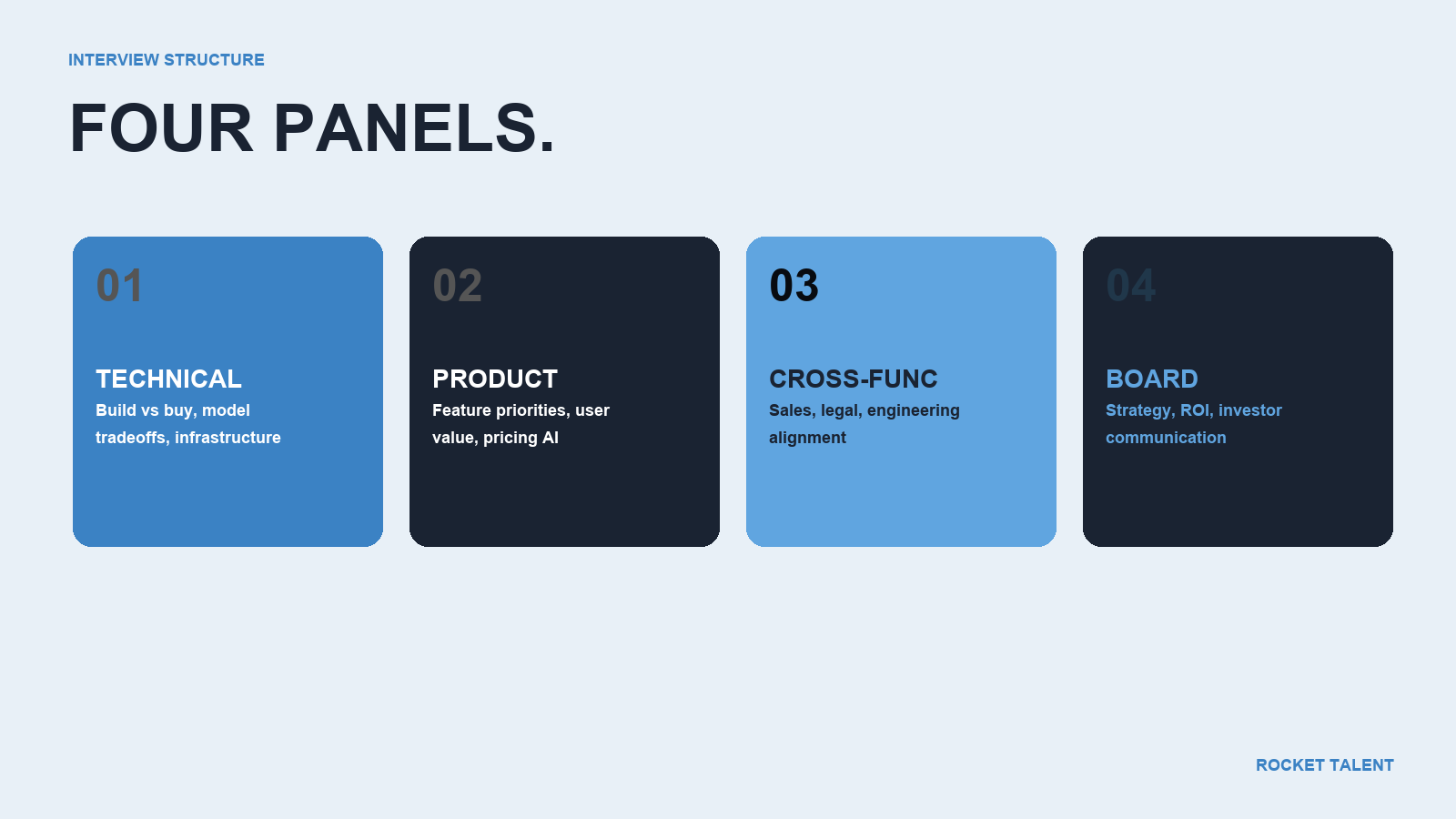
A chief AI officer interview should include four panels: technical depth, product judgment, cross-functional leadership, and board communication. Each panel should have 30 to 45 minutes and a specific set of questions. Avoid the common mistake of spending the entire interview on AI vision and strategy questions, which tell you nothing about whether the candidate can operate day to day.
Rocket Talent recommends a practical exercise in one of the panels: give the candidate a real problem from your business and ask them to walk through how they would approach it in the first 90 days. This is more revealing than any behavioral question.
Technical Depth Interview Questions
These questions test whether the candidate can make credible technical decisions, not whether they can write production code. The goal is to see if they understand the tradeoffs well enough to lead a team and make build-vs-buy calls.
- Walk me through a time you chose between building a custom model and using a third-party API. What did you decide and why? What would you change?
- How do you evaluate whether an AI feature is production-ready? What metrics do you look at beyond accuracy?
- Describe your approach to model monitoring after deployment. What do you track and what alerts would trigger a rollback?
- How would you decide between fine-tuning a frontier model and training a smaller model from scratch for a specific SaaS use case?
- What does your ideal AI infrastructure stack look like for a SaaS company at our stage, and what would you build vs buy?
Product Judgment Interview Questions
These questions test whether the candidate can connect AI capability to customer value. A chief AI officer who only thinks about models and not about users will build technology that does not ship.
- How do you decide which AI features to prioritize when you could build dozens? What framework do you use?
- Describe an AI feature you shipped that failed with users. What went wrong and what did you learn?
- How do you balance shipping AI features quickly with maintaining quality and safety standards?
- How would you approach pricing and packaging AI features differently from the rest of the product?
- What is your approach to user feedback on AI features, especially when the AI makes mistakes?
Cross-Functional Leadership Interview Questions
The chief AI officer role spans product, engineering, data, legal, and sales. These questions test whether the candidate can navigate that complexity.
- Describe a time when your AI roadmap conflicted with the engineering team’s priorities. How did you resolve it?
- How do you work with legal and compliance teams on AI governance without slowing down shipping?
- How would you handle a situation where sales has promised an AI feature to a customer that is not technically feasible?
- What is your approach to hiring ML engineers in a competitive market? How do you retain them?
- How do you communicate AI strategy to a board that does not understand the technology?
Board Communication and Strategy Interview Questions
The chief AI officer needs to be able to present AI strategy to investors, board members, and enterprise customers. These questions test that ability.
- Pitch our company’s AI strategy in five minutes as if you were presenting to our board.
- How would you respond to an investor who asks why we need a chief AI officer instead of letting our CTO handle AI?
- What would you say to an enterprise customer who asks about our AI data privacy and model safety practices?
- How do you measure the ROI of AI investment for a SaaS company? What metrics would you report to the board?
- What is your view on the AI competitive landscape in our space, and how should we position ourselves?
The Executive Scorecard
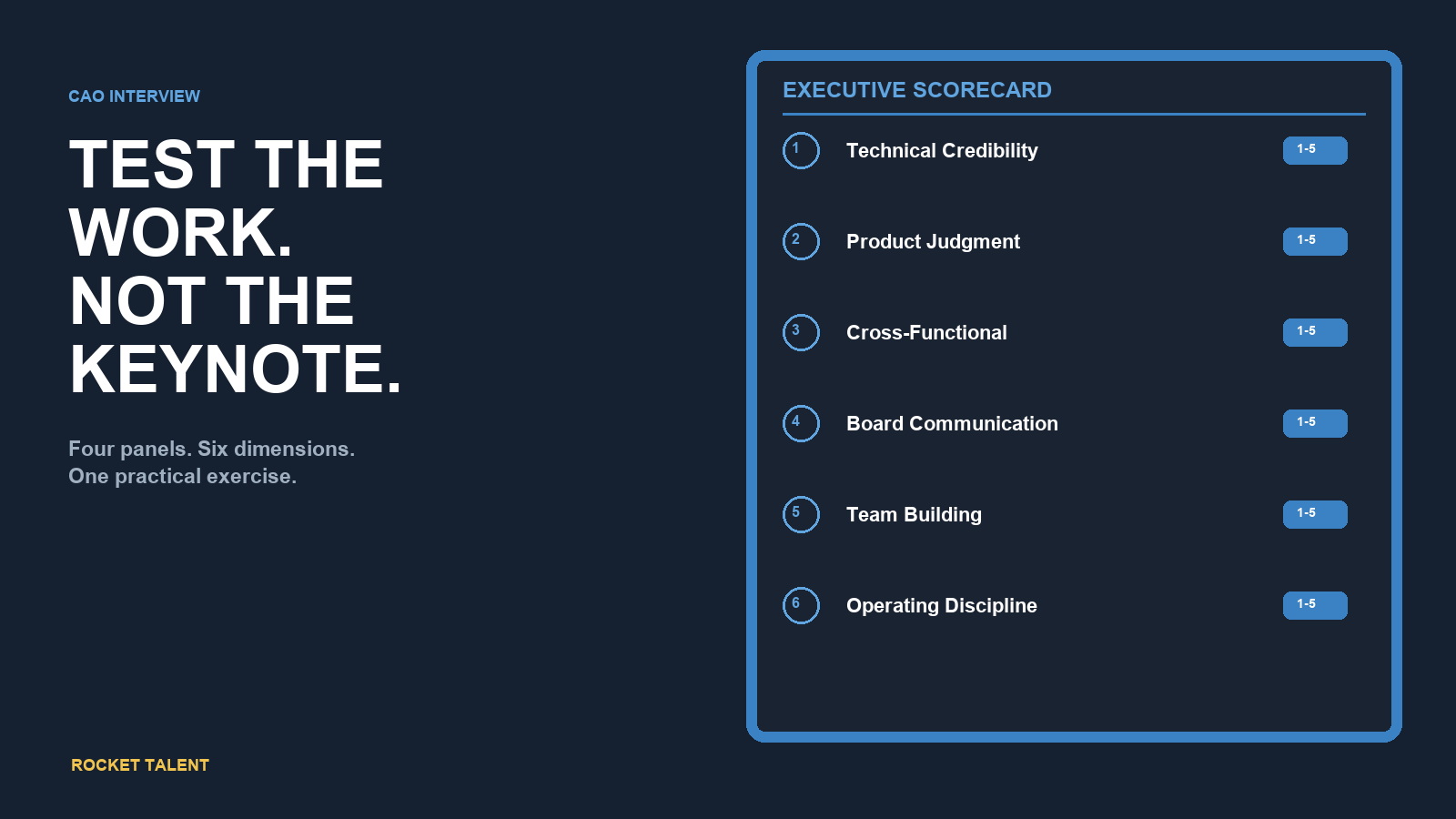
Score each candidate on a 1 to 5 scale across six dimensions. A strong hire should score 4 or above on at least five of the six.
- Technical credibility (can they make build-vs-buy decisions and earn the respect of an ML team?)
- Product judgment (can they connect AI capability to customer value and shipping priorities?)
- Cross-functional leadership (can they work with product, engineering, legal, and sales without creating friction?)
- Board communication (can they present AI strategy to non-technical stakeholders clearly and persuasively?)
- Hiring and team building (can they attract and retain ML talent in a competitive market?)
- Operating discipline (can they set up model evaluation, monitoring, and governance processes that scale?)
Red Flags in Chief AI Officer Interviews
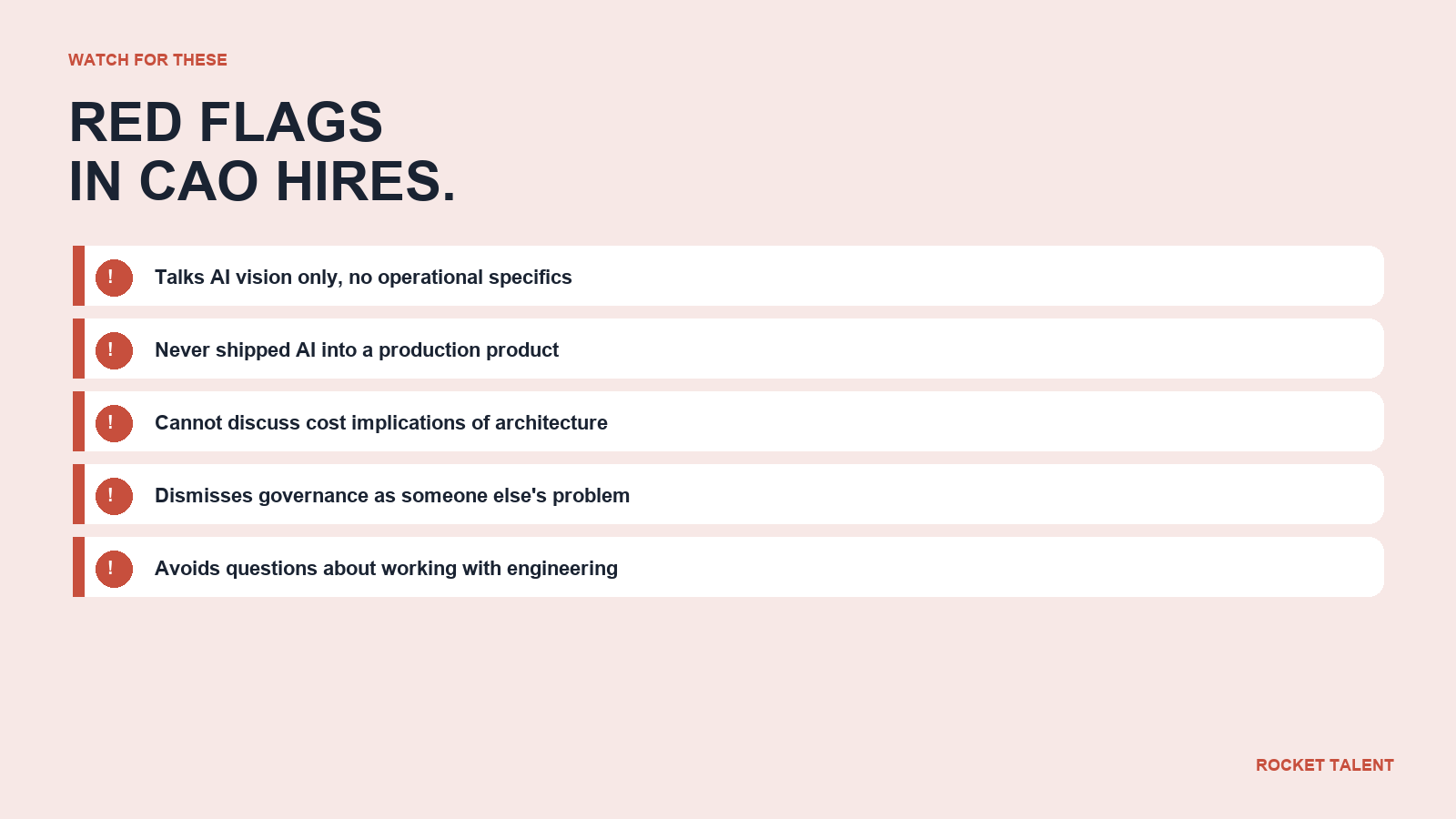
Watch for candidates who talk exclusively about AI vision and avoid operational specifics. A candidate who cannot describe their model evaluation process, their approach to AI infrastructure, or how they handled a production AI incident is likely a strategist, not a builder. Also watch for candidates who dismiss governance and safety as someone else’s problem, or who cannot discuss the cost implications of their technical decisions.
Useful Sources for Context
- OpenView SaaS Benchmarks: SaaS leadership hiring should be connected to company stage, go-to-market motion, and operating cadence rather than title alone.
- SaaStr guidance for SaaS executive hiring: SaaS executive roles change materially by ARR stage, founder involvement, customer complexity, and growth motion.
- McKinsey on AI adoption: AI strategy in SaaS requires operational integration, not just model selection, to create defensible value.
The right chief AI officer interview process tests both technical depth and executive capability. Use the scorecard, trust the practical exercise, and do not let a great AI keynote substitute for evidence of operational execution.
Related Rocket Talent guides
- Chief AI Officer Hiring Guide for SaaS Companies
- Chief AI Officer Job Description and Responsibilities
- Chief AI Officer vs VP of AI Product: Which Leader Do You Need?