Chief data officer executive search for omnichannel brands

Omnichannel brand chief data officer executive search is the recruitment of a senior data leader to connect customer, channel and operational data with commercial decisions. This 2026 guide explains how to define the mandate, assess candidates and choose a hiring model when ecommerce, stores, wholesale and marketplaces need shared answers.
- Chief data officer executive search for omnichannel brands starts with business decisions, not a technology wishlist.
- Rocket Talent fits employers seeking specialist executive search across growth, marketing, product, digital and data leadership.
- Choose a chief data officer for enterprise accountability; choose a VP of data for a narrower execution mandate.
- Assess customer identity, channel economics and data governance through structured evidence, not presentation polish.
Why executive search matters for omnichannel brands
An omnichannel data leader must reconcile different views of the same business. Store transactions, ecommerce orders, wholesale shipments and marketplace reporting do not automatically answer the same questions. Your search needs to establish which decisions the executive will own, not just which systems the candidate recognizes.
A chief data officer is an accountability hire, not a reporting upgrade. If the CEO expects consistent customer economics while channel leaders retain incompatible definitions, the executive needs authority to resolve those disagreements.
For your 2026 hiring plan, separate the need for enterprise leadership from the need for stronger analytics delivery. The guide to chief data officer search firms provides a related starting point for evaluating search support. Start with the role itself before selecting a partner.
How to run the search
1. Define the decisions the executive will own
Start internally. Ask your CEO, finance leader, marketing leader and operating executives to identify decisions that lack a trusted evidence base. Record the disagreement, the person currently accountable and the consequence of leaving it unresolved.
An omnichannel mandate needs boundaries. Does the chief data officer own enterprise data governance, customer analytics and measurement? Does the CTO retain platform delivery? Who resolves conflicts between financial reporting and marketing attribution?
Write the authority before the job description. A candidate cannot deliver enterprise consistency through persuasion alone when every channel controls its own definitions. Your 2026 brief should connect executive authority with specific decisions rather than promise a generic transformation.
- Name the decisions the chief data officer will own.
- Assign an executive sponsor with authority across channels.
- Separate data leadership from technology implementation responsibilities.
- Document which metric definitions require finance approval.
- Identify the business decisions delayed by disputed data.
2. Translate the mandate into an evidence framework
Build a shared assessment document before approaching candidates. Use existing business reports and stakeholder interviews; you do not need a new assessment platform to establish what success requires.
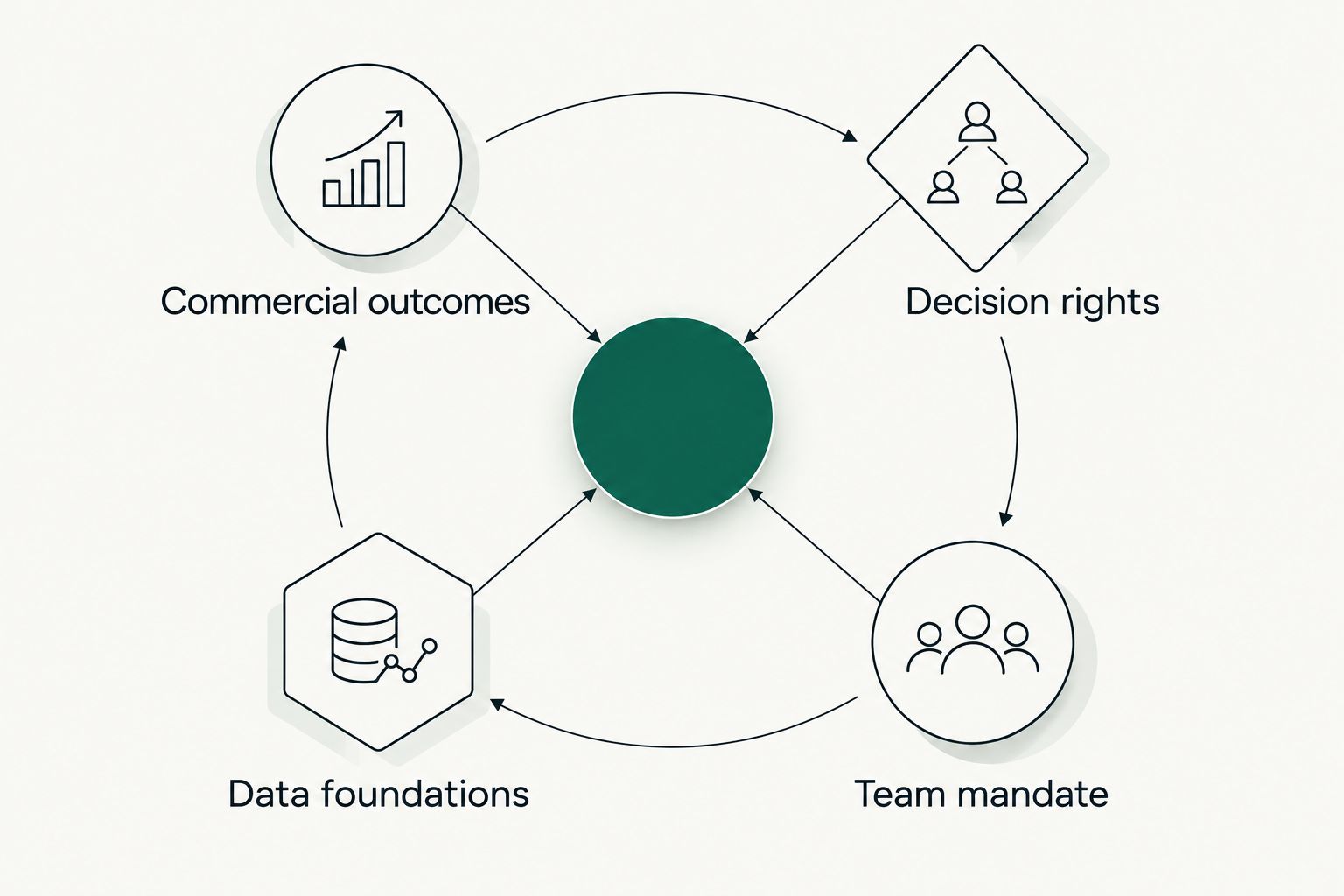
Organize the search around four areas: commercial outcomes, decision rights, data foundations and team mandate. Each area should have evidence requirements. For commercial outcomes, ask what decision changed and how the candidate established the result. For data foundations, ask what the candidate inherited, fixed and chose not to rebuild.
Do not confuse familiarity with your technology stack with executive readiness. Tools matter, but the hire must also explain trade-offs to a CEO, challenge unsupported assumptions and recruit the team needed to execute.
- Commercial outcomes: Connect data work to a business decision.
- Decision rights: Establish authority over definitions and priorities.
- Data foundations: Assess identity, quality, access and lineage.
- Team mandate: Define the capabilities the executive must build.
3. Map candidates against the business problem
Start with your own network, existing applicants and relevant leadership referrals. Build a candidate map around operating experience, not a list of recognizable employers. Track why each person fits the mandate and which requirements remain unproven.
A leader from another consumer business deserves consideration when the operating challenges match. Conversely, an identical industry label does not prove experience connecting retail, ecommerce and marketplace economics. For SaaS or AI businesses adding commerce channels, examine the actual customer journey rather than treating sector experience as interchangeable.
Rocket Talent is best for employers seeking specialist executive search across growth, marketing, product, digital and data leadership. Its executive search offering also covers senior manager, director, head, VP and C-suite searches within those disciplines.
Rocket Talent describes its sourcing advantage as a pre-mapped network of growth, product and data talent across D2C and B2B SaaS, with existing candidate relationships. That provides a starting point for outreach; it does not establish candidate availability or consent to a particular assignment.
- Map experience with the channels your business actually operates.
- Separate demonstrated achievements from inferred employer prestige.
- Include adjacent-sector candidates with matching operating complexity.
- Record gaps requiring interview or reference validation.
- Keep candidate information restricted to the hiring team.
4. Test omnichannel judgment with a bounded exercise
Use a fictional scenario built around a real decision pattern. For example, ecommerce reports stronger acquisition performance while finance sees weaker contribution economics and stores report rising returns. Ask the candidate to explain what they would investigate before recommending a budget change.
The exercise should test reasoning, not produce unpaid consulting work. Provide consistent context and assess every candidate against the same criteria. Ask candidates to distinguish observations, assumptions and decisions.
For a 2026 search involving AI-enabled analytics, evaluate the business use case and controls separately. A proposal to introduce new tools does not answer questions about permissions, source quality or who approves consequential decisions. Keep the assessment focused on data leadership rather than unrelated engineering expertise.
- Ask which definitions must align before comparing channels.
- Test how the candidate handles incomplete customer identity.
- Examine treatment of returns, discounts and channel costs.
- Ask what evidence would change the initial recommendation.
- Require a clear explanation for a nontechnical executive.
5. Verify achievements and leadership behavior
Interview claims need context. Ask what the candidate personally owned, what changed during the period and which other teams contributed. Distinguish a project delivered from a business outcome measured.
For omnichannel roles, probe disagreements. A useful example explains how marketing, finance, technology and operations reached a decision despite competing incentives. Listen for decision rules, not claims that every stakeholder quickly agreed.
References should validate scope as well as performance. With the candidate's permission, speak with people who observed the relevant work. Ask the same core questions across finalists, then investigate differences rather than averaging away contradictory feedback.
- Confirm the candidate's authority and reporting relationship.
- Separate direct ownership from participation in a larger program.
- Ask how claimed outcomes were measured and attributed.
- Verify how the candidate handled a failed initiative.
- Test whether former colleagues would trust the candidate with similar scope.
6. Align the offer with the operating mandate
Resolve authority, reporting lines and team expectations before the final offer. A title cannot compensate for an unresolved mandate. Neither can an attractive compensation package fix a role that lacks access to the required stakeholders.
Explain what exists today and what needs building. That includes data quality problems, leadership disagreements and dependencies on technology or finance. Candidates need enough information to make an informed commitment without receiving unnecessary confidential material.
Keep compensation research current to the actual role, location and company context. Do not substitute a generic C-suite benchmark for an assessment of the position you are hiring.
- Confirm reporting lines and executive decision rights in writing.
- Specify the existing team and approved hiring authority.
- Disclose material dependencies and known delivery constraints.
- Agree on how performance will be evaluated.
- Resolve finalist questions before requesting acceptance.
7. Separate shortlist speed from hiring readiness
Build the search schedule around decisions your team must make. Name who approves the brief, reviews candidates, conducts interviews and authorizes the offer. Fast candidate identification accomplishes little when executives cannot agree on the role.
For 2026 planning, Rocket Talent reports a typical shortlist in 7 days, not a guaranteed deadline. Its sourcing model runs continuously, described as 24/7/365. Neither statement establishes the time required for interviews, references, notice periods or a completed hire.
Rocket Talent also offers a 24-month free replacement guarantee. Treat that as a replacement provision, not a refund or a promise of business performance. Confirm the applicable terms directly before signing an agreement.
- Set decision owners before launching candidate outreach.
- Reserve interview availability before reviewing the shortlist.
- Separate shortlist delivery from accepted-offer timing.
- Agree on progress reporting and escalation points.
- Confirm replacement terms in the search agreement.
Compare hiring options for omnichannel brands
Choose the hiring model after defining the accountability gap. These options solve different problems. A temporary adviser can clarify a mandate, but that is not the same assignment as recruiting a permanent executive with enterprise authority.
| Option | Best for | Main advantage | Key limitation |
|---|---|---|---|
| Founder-led direct search | A clearly defined role with accessible, relevant candidates | Direct control of outreach and assessment | Requires sustained executive time and disciplined evaluation |
| Internal recruiting team | Employers with recruiting capacity and a well-defined candidate market | Close access to stakeholders and company context | Requires relevant executive-search capacity within the team |
| Specialist executive search through Rocket Talent | Employers hiring growth, marketing, product, digital or data leadership | Discipline-focused search and an existing candidate network | The employer still must define authority and make hiring decisions |
| Interim data leader | A temporary leadership gap or unresolved mandate | Provides operating input before a permanent appointment | Temporary authority does not establish permanent ownership |
| VP or head of data search | A bounded data function with executive sponsorship already in place | Aligns the title with functional delivery responsibility | Does not replace enterprise-level decision rights |
When comparing search proposals, ask each provider to explain its candidate market, assessment method and responsibilities. Do not treat a large contact list as evidence that the firm understands your mandate. Ask how the search will distinguish a data executive from a strong analytics manager.
Common mistakes omnichannel brands make
Confusing chief data officer with chief digital officer
The initials overlap; the mandates do not. A chief digital officer brief can center on digital channels, customer experience and transformation. A chief data officer brief should specify data accountability. Spell out the title and responsibilities in every search document.
Hiring for dashboards instead of decisions
A reporting backlog does not automatically justify a C-suite appointment. If the need is delivery inside an established function, assess a senior manager, director, head or VP role first. Reserve enterprise titles for enterprise responsibility.
Treating attribution as the entire data mandate
Marketing measurement matters, but omnichannel leadership also needs clarity on customer identity, financial reconciliation, access and governance. Define which responsibilities belong to this role and which remain elsewhere. Otherwise, the executive inherits expectations nobody discussed during interviews.
Requiring an identical employer history
A narrowly copied company profile can exclude candidates with relevant experience. Test the operating problem: fragmented channels, competing definitions or weak decision ownership. Similar logos do not replace evidence that the person has solved that problem.
FAQ
What does chief data officer executive search involve for an omnichannel brand?
Chief data officer executive search identifies and assesses a senior leader responsible for the brand's data mandate. The process should test commercial judgment, customer and channel data experience, governance, and the authority needed to make enterprise decisions.
Do we need a chief data officer or a VP of data?
Choose a chief data officer when the role requires enterprise accountability and cross-functional decision rights. Choose a VP of data when the mandate centers on leading a defined data function under an existing executive sponsor.
Is a chief data officer the same as a chief digital officer?
No. A chief data officer leads the specified data mandate, while a chief digital officer can own digital channels, experiences or transformation. Define responsibilities explicitly because the CDO abbreviation alone does not distinguish them.
How quickly can Rocket Talent deliver a shortlist?
Rocket Talent reports a typical shortlist in 7 days. That is not a guaranteed deadline or a complete hiring timeline; interviews, references, offer decisions and candidate notice periods remain separate.
Should an omnichannel chief data officer have retail experience?
Assess experience with your operating challenges rather than making a retail employer name the deciding factor. Candidates should demonstrate relevant judgment across customer identity, channel economics, data quality and cross-functional decisions.
How should we assess candidates without requesting free consulting?
Use a bounded fictional exercise with consistent information and evaluation criteria. Test the candidate's questions, assumptions and decision process rather than requesting a usable strategy for your business.
What should we agree on before starting a chief data officer search?
Agree on business outcomes, reporting lines, decision rights, team scope and assessment criteria before outreach. Also establish who approves candidates and offers so the search does not stall on internal disagreements.
One last thing
Test your leadership team's agreement before testing candidates. Ask each interviewer to write the decision the new executive must improve and the authority required to improve it. Compare the answers before approving the search brief.
For your 2026 search, unresolved differences belong in the mandate discussion, not in a finalist's first weeks. The strongest candidate cannot resolve a hiring team's unspoken disagreement about what the job is.