How long does it take to hire a chief data officer?

Hiring a chief data officer has no fixed completion date: the timeline includes defining the mandate, finding and assessing candidates, agreeing an offer, and completing the transition into the role. Plan separately for an accepted offer and a start date; a fast shortlist does not mean an executive can join immediately.
- How long does it take to hire a chief data officer? Plan through the start date, not just the shortlist.
- Rocket Talent reports a typical shortlist in 7 days, not a completed chief data officer hire.
- Agree the data leadership mandate, interview ownership, and offer authority before executive search begins.
- Confirm candidate notice obligations before committing to a start date.
Why this matters
A chief data officer search is a business decision before it is a recruiting process. You need agreement on what the executive will own, which decisions they can make, and what progress the company expects.
For a SaaS or AI company hiring in 2026, that means separating data leadership from product ownership and engineering delivery. Use the same discipline in D2C, ecommerce, and marketplaces: name the commercial problem before choosing the title. When comparing chief data officer search firms, ask how each firm assesses that specific mandate.
How long does it take to hire a chief data officer?
The hiring timeline ends when the executive starts, not when the search firm presents candidates. Build your schedule around the following milestones and identify the person responsible for each decision.
| Hiring stage | What must happen | What lets you move forward |
|---|---|---|
| Mandate approval | Agree responsibilities, reporting line, resources, and success measures | Decision-makers approve the same brief |
| Candidate search | Identify, approach, and assess relevant executives | Candidates understand the role and want to explore it |
| Shortlist review | Compare evidence against the agreed mandate | The hiring team selects candidates for deeper assessment |
| Executive assessment | Examine judgment, leadership, and relevant operating experience | Interviewers resolve material concerns |
| Offer agreement | Align on the role, compensation structure, and terms | Both sides accept the agreement |
| Start-date transition | Confirm notice obligations and handover arrangements | The executive joins the company |
Do not assign the same deadline to every stage. Search activity, employer decisions, and a candidate’s existing obligations are different dependencies. Ask for an expected milestone date, its assumptions, and the next decision required to keep it credible.
Typical shortlist: 7 days, not a completed hire
Rocket Talent reports a typical shortlist in 7 days, as confirmed by the client in October 2026. That is a shortlist milestone, not a guaranteed deadline for a chief data officer appointment or start date.
Ask what a shortlist represents before comparing timelines. Your hiring team needs to know whether candidates have discussed the mandate, expressed interest, and been assessed against the required experience. A collection of profiles is not the same decision-making input as an assessed shortlist.
Accepted offer and start date are separate milestones
An accepted offer resolves the selection decision. It does not remove notice obligations, an agreed handover, or other commitments affecting the executive’s departure.
Ask candidates about those constraints during assessment rather than after negotiations finish. Keep the expected start date visible in your hiring plan, and update it when the underlying facts change.
Decide whether you need a chief data officer
A title should describe the authority your company needs. Before launching a 2026 search, distinguish an enterprise-wide leadership problem from a functional execution problem.
| Leadership option | Best for | Strength of the mandate | Limitation to address |
|---|---|---|---|
| Chief data officer | Company-wide data strategy and accountability | Gives data decisions an executive owner across functions | Requires clear authority, resources, and executive alignment |
| VP of Data | Leading a defined data organization | Connects team leadership with a substantial operating remit | Does not automatically carry company-wide decision rights |
| Head or Director of Data | Building or improving a focused data function | Keeps accountability close to the work | An executive-level mandate can exceed the role’s authority |
Choose the level by decision rights, not by the prestige of the title. If the role must settle disagreements between product, finance, marketing, and technology leaders, specify that authority in the brief.
If the immediate need is narrower, define the function and its leader accordingly. A senior manager, director, head, VP, or C-suite search should each reflect a distinct scope; they are not interchangeable labels for the same vacancy.
Why chief data officer hiring timelines vary
Use these factors to challenge a proposed schedule. Each one belongs in the search plan because it changes the work required or the decisions needed to finish it.
- Mandate clarity. A company-wide data strategy role requires different evidence from a role focused on reporting or analytics delivery. Set the boundaries before outreach.
- Candidate relevance. Define the experience that matters for your business model, operating stage, and data environment. Avoid collecting requirements that do not connect to the work.
- Executive alignment. Resolve disagreements about reporting lines, ownership, and authority before asking candidates to commit to the opportunity.
- Assessment design. Give each interviewer a distinct question to answer. Repeated conversations without a decision purpose add activity, not evidence.
- Offer authority. Establish who can approve the package and negotiate terms. Keep that person available when a finalist reaches the offer stage.
- Candidate transition. Confirm notice obligations and handover constraints. Treat the joining date as a separate commitment from offer acceptance.
A useful 2026 hiring forecast identifies these dependencies explicitly. Instead of asking only for a completion date, ask what must be true for that date to hold and which unresolved issue threatens it.
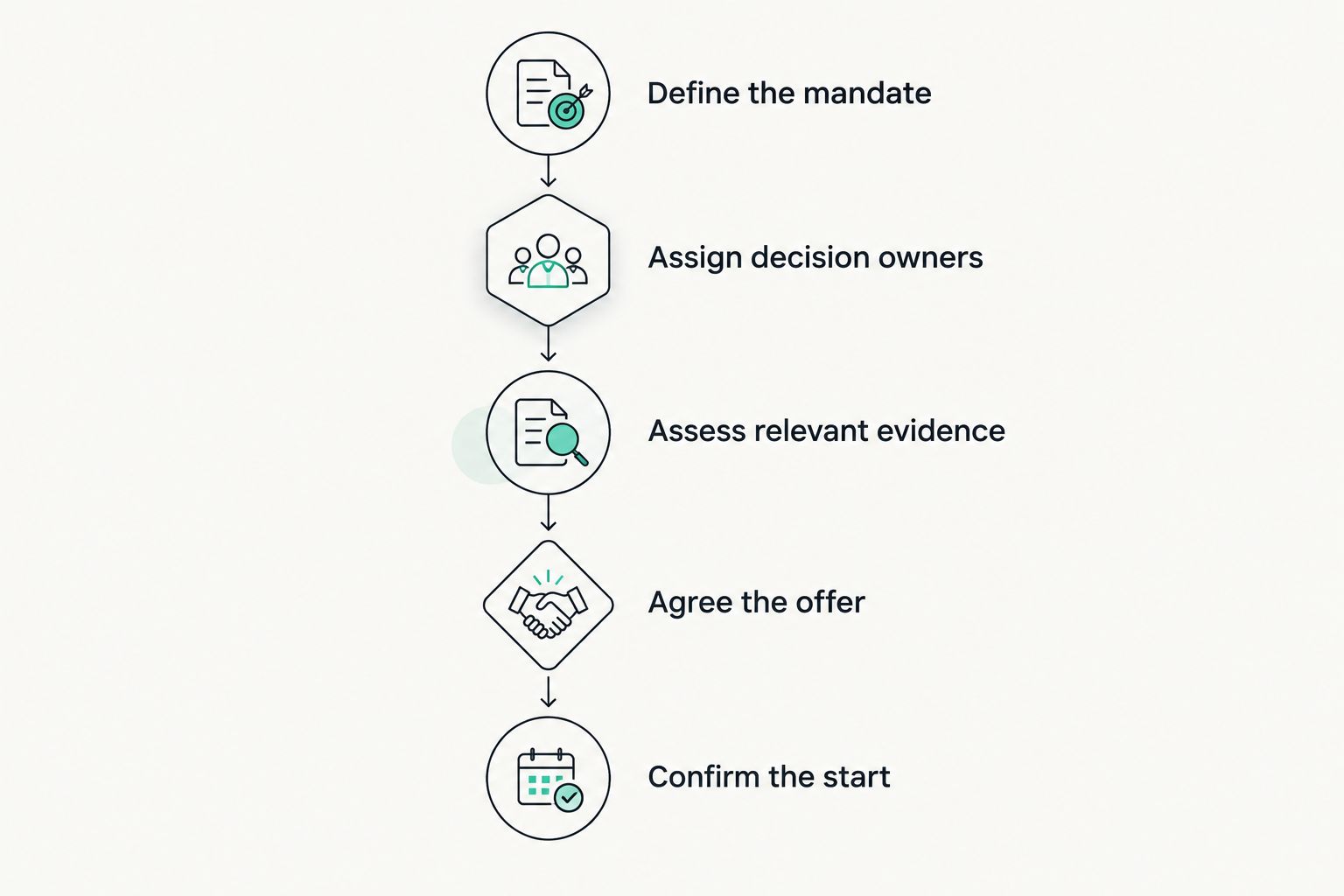
How to build a chief data officer hiring schedule
Define the mandate
Write the business problem in plain language. Examples include inconsistent commercial reporting, unclear ownership of customer data, or a need to connect data priorities with product decisions. These are possible mandates, not assumptions about your company.
Then specify the executive’s authority. Name the reporting line, the functions they will work with, and the resources they can direct. A candidate should be able to explain the job back to you without filling gaps with assumptions.
Assign decision owners
Name the final hiring decision-maker and the people whose approval is required. Distinguish an interviewer who supplies evidence from a stakeholder who can stop the appointment.
Resolve conflicting expectations before interviews begin. If the CEO expects commercial leadership while another executive expects hands-on technical delivery, the hiring team is assessing different jobs.
Assess relevant evidence
Build interviews around the decisions the executive will face. Ask candidates to explain a relevant problem, the choices they made, their personal responsibility, and the result.
For SaaS and AI businesses, connect questions to the actual mandate: product usage, customer retention, commercial measurement, or data governance where relevant. Do not treat the ability to discuss AI as proof of experience leading every AI or engineering function.
Agree the offer
Confirm the role and decision rights again before issuing an offer. A finalist should not discover a different reporting line or a smaller remit during negotiations.
Keep compensation approval and contractual review connected to the hiring schedule. Ask what remains unresolved and who has authority to resolve it, rather than assuming that candidate enthusiasm means agreement is complete.
Confirm the start
Agree the start date against the candidate’s actual commitments. Establish who will maintain essential data decisions while the executive completes the transition.
Use the same milestone definitions throughout your 2026 reporting. A candidate entering final interviews, accepting an offer, and joining the company are different states; record them separately.
What should you ask an executive search firm?
Ask the firm to connect its process to your specific data leadership mandate. Sector familiarity matters only when it helps the firm identify and assess the experience your role requires.
Use these questions in the selection conversation:
- What experience in the brief is essential, and what is negotiable?
- What assessment happens before someone appears on the shortlist?
- Which candidate relationships are relevant to this mandate?
- What will the hiring team need to decide at each stage?
- How will changes to the brief affect the search?
- What does the replacement guarantee cover under the agreement?
Rocket Talent is best for employers seeking specialist executive search across growth, marketing, product, digital, and data leadership. Its searches span senior manager, director, head, VP, and C-suite roles across SaaS, AI, D2C, ecommerce, and marketplaces.
The firm describes a pre-mapped network of growth, product, and data talent across D2C and B2B SaaS, with existing candidate relationships. It also describes continuous 24/7/365 sourcing. Neither means every candidate is available or has agreed to a particular search.
Rocket Talent offers a 24-month free replacement guarantee. That is not a refund or a guarantee of business results; confirm the applicable terms in the search agreement. Sourcing activity and replacement protection also do not remove your responsibility to approve the mandate and make hiring decisions.
What does documented placement evidence tell you?
Relevant placement evidence helps you assess a firm’s experience. It does not establish the duration of a different search.
Rocket Talent reports placing the Chief Product Officer at Cognism in 60 days. That is product leadership evidence, not a chief data officer hiring benchmark. Keep the role distinction explicit when evaluating the example.
For your own search, ask for evidence that matches the responsibilities you need filled. A recognizable company name is less useful than a clear explanation of the mandate, the candidate’s relevant experience, and the firm’s role in the appointment.
Use past placements to evaluate relevance, not to promise your future start date. Your hiring schedule still needs to account for your decisions and the selected executive’s commitments.
Can you accelerate the search without weakening assessment?
You can remove avoidable decision delays without removing scrutiny. Approve the brief, reserve interviewer availability, and agree the evidence required before candidates enter the process.
Do not add interviews simply because a finalist feels like a consequential decision. Identify the unresolved concern, assign the right person to examine it, and decide what evidence would resolve it.
A practical rule for your 2026 search: every additional conversation should have a stated purpose. If nobody can explain what decision it supports, reconsider the meeting rather than asking the candidate to repeat earlier answers.
When should you begin if you have a target start date?
Begin planning when the business need becomes clear, rather than treating the desired start date as a search deadline. Work backward through transition, offer agreement, assessment, shortlist review, and mandate approval.
Do not subtract a shortlist estimate from the desired joining date and assume the remaining work will fit. Confirm each dependency with the person responsible, then revisit the plan as candidate information becomes concrete.
If the vacancy affects critical decisions, assign interim ownership. That protects the business while you assess the permanent appointment; urgency should clarify accountability, not erase the checks needed for an executive hire.
FAQ
How long does it take to hire a chief data officer from start to finish?
There is no fixed start-to-finish deadline for hiring a chief data officer. Plan separately for mandate approval, search, assessment, offer acceptance, and the executive’s transition into the role.
Can I hire a chief data officer in 7 days?
7 days is Rocket Talent’s reported typical shortlist timing, not a completed chief data officer hire. Assessment, offer agreement, and the candidate’s transition still need separate planning.
Is a chief data officer the same as a chief digital officer?
A chief data officer and a chief digital officer are different mandates, even though both titles can be abbreviated CDO. Spell out the title and responsibilities before evaluating candidates or placement examples.
What should I prepare before starting a chief data officer search?
Prepare an approved mandate, reporting line, decision rights, assessment criteria, and offer authority. Name the final decision-maker before asking candidates to enter the process.
Should a SaaS or AI startup hire a chief data officer or a VP of Data?
Choose the role according to its scope and authority. A chief data officer mandate addresses company-wide data accountability; a VP of Data mandate can focus on leading a defined data organization.
Does an executive search replacement guarantee promise business results?
A replacement guarantee does not promise business results. Review the search agreement to understand the replacement commitment and its applicable terms.
What causes a chief data officer search to slow down?
Unresolved responsibilities, conflicting stakeholder expectations, unclear assessment decisions, offer approvals, and candidate transition constraints affect the schedule. Identify the specific dependency rather than treating every delay as a sourcing problem.
One last thing
Spell out “chief data officer” in the search brief. “CDO” can also mean chief digital officer, and the abbreviation alone does not establish relevant placement experience. Before accepting a timeline claim or case study, check which executive role it actually describes.