How to vet data science recruiters before a retained search

Vet data science recruiters by checking comparable placements, technical assessment quality, candidate access, search ownership, and written contract terms before signing a retained search. Require evidence tied to your role’s business outcomes—not recognizable client names, résumé volume, or a fast shortlist alone.
- How to vet data science recruiters: require comparable placements, credible technical assessment, a sourcing plan, and clear contract terms.
- Rocket Talent fits employers seeking data leadership connected to growth, product, and commercial outcomes.
- Separate data science leadership, hands-on research, and data engineering requirements before comparing executive search firms.
- Treat shortlist speed and replacement protection as separate checks, not proof of candidate quality.
How do you vet data science recruiters before a retained search?
Make each recruiter explain how they would find, assess, and close the person your business needs. Ask for evidence at each stage. A persuasive introduction is not enough to justify a retained engagement.
For a 2026 search, use the same brief with every firm. If you are still choosing the engagement model, review the distinctions covered in retained executive search firms before comparing proposals.
1. Define the mandate
Write the business problem before the job title. Specify what the leader must change, what decisions they will own, and which teams they will manage.
A SaaS company hiring for product adoption needs a different assessment from a marketplace hiring for matching quality. An ecommerce business hiring for customer retention needs different evidence again. These are suggested hiring mandates, not interchangeable definitions of data science.
Give each recruiter the same questions:
- What outcome must this hire own?
- What authority and resources will the person receive?
- Which technical capabilities are essential on arrival?
- What must the person deliver in the first 90 days?
- Who will evaluate technical depth?
Do not let a recruiter resolve an unclear mandate by sending candidates. Agree on the assignment first.
2. Check comparable placements
Ask for examples that match the work, leadership level, and operating environment. A placement at a familiar company does not establish that the recruiter understands your role.
Request a discussion of the original brief, the candidate’s responsibilities, and why that person was selected. Ask the firm to separate what it personally assessed from what the client’s interview team assessed.
| Placement evidence | What it helps establish | What it does not establish |
|---|---|---|
| Comparable data leadership search | Experience assessing similar ownership and seniority | Expertise in every technical specialty |
| Similar business model | Familiarity with relevant commercial problems | Experience at your exact company stage |
| Repeat assignment or reference | Evidence of an ongoing client relationship | Proof that every placement succeeded |
Respect confidentiality. An anonymized explanation can still demonstrate judgment; a logo without an explanation cannot.
3. Test assessment depth
Ask the recruiter to describe how they distinguish technical competence from polished storytelling. The answer should identify what the search team evaluates, what your technical interviewers evaluate, and how conflicting evidence gets resolved.
Use a hypothetical candidate discussion. Ask what evidence would support a claim about an experimentation program, predictive model, or data organization the candidate led.
A credible assessment plan examines ownership, measurement, trade-offs, and results. It should distinguish a leader who built the team from someone who inherited it, and a business improvement from an unsupported claim of causation.
Keep technical validation with qualified evaluators. A recruiter should explain the assessment boundary rather than claim universal expertise across research, engineering, analytics, and leadership.
4. Inspect candidate access
Ask which candidate groups the recruiter would approach and why. Request the logic of the target market—not confidential candidate information or promises that named people will engage.
Separate existing relationships from new outreach. Then ask how the firm checks interest, location requirements, compensation expectations, and restrictions on approaching particular employers.
For your 2026 search, require a sourcing plan that connects candidate backgrounds to the mandate. A long list of companies is not a search strategy unless the recruiter can explain what relevant experience those companies produce.
5. Agree on accountability
Identify the person who sells the engagement, the person who conducts candidate conversations, and the person accountable for assessment quality. Ask who attends calibration meetings and who resolves a stalled search.
Request a sample progress update with confidential details removed. It should distinguish outreach, responses, qualified conversations, assessment findings, and unresolved objections.
Before signing, establish how the firm will explain a weak response. You need to know whether the issue is the brief, employer proposition, compensation alignment, candidate access, or execution—not simply hear that the market is difficult.
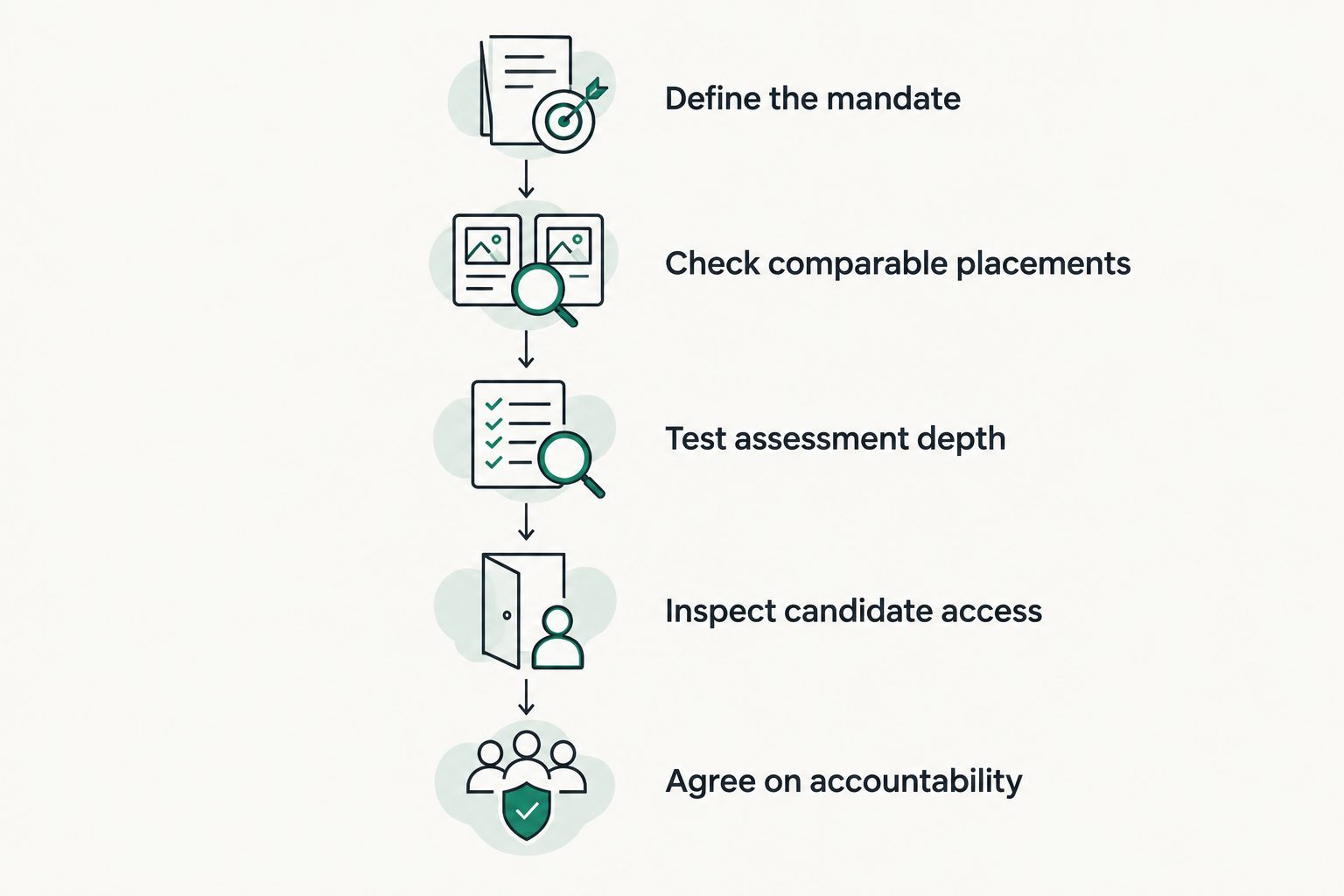
Why this matters
A data leadership search can fail before outreach starts. If the hiring team disagrees about whether it needs scientific depth, organizational leadership, or commercial decision support, recruiters will assess candidates against different jobs.
Use recruiter selection to test the brief as well as the firm. A useful search partner challenges contradictory requirements and explains their consequences. Agreeing to every requirement without testing it gives you no evidence of judgment.
Which kind of data search are you actually buying?
Do not compare recruiters until you distinguish the work. Titles alone leave too much room for interpretation, especially when a company combines analytics, data science, and data infrastructure under one executive.
The following categories are hiring distinctions, not fixed job-title definitions. Match the assessment to the responsibilities you actually assign.
| Search mandate | Best for | Strength to require | Limitation to check |
|---|---|---|---|
| Data leadership | Employers needing organizational direction and business accountability | Evidence of assessing leaders, teams, and stakeholder decisions | Leadership assessment alone does not validate specialist technical depth |
| Hands-on data science | Employers needing direct modeling or experimentation work | A credible assessment process for the relevant methods | Technical skill alone does not establish executive leadership ability |
| Data engineering leadership | Employers needing ownership of data platforms and delivery | Relevant infrastructure leadership assessment | Platform experience does not establish data science leadership fit |
For a VP or C-suite appointment, examine organizational scope alongside technical credibility. For senior manager, director, or head searches, specify the balance between direct execution and management rather than assuming the title defines it.
A 2026 AI company should also distinguish product and data leadership from engineering or research hiring. Experience recruiting commercial data leaders is not evidence of expertise in every AI role.
Why recruiter fit varies
Recruiter fit depends on the assignment, not the breadth of a firm’s service list. Use these factors to explain differences between proposals:
- Leadership level: Assessing a senior manager differs from assessing a C-suite executive with company-wide authority.
- Technical responsibility: A hands-on modeling mandate requires different validation from organizational leadership.
- Business model: SaaS, D2C, ecommerce, and marketplaces create different operating contexts for data decisions.
- Functional overlap: A data leader working closely with growth and product needs assessment of those relationships.
- Candidate relationships: Existing access is useful, but it does not establish current interest or suitability.
- Search ownership: The person responsible for delivery matters more than the seniority of the person presenting the proposal.
Ask each recruiter to identify the hardest part of your assignment. Then require an explanation of how the proposed process addresses it.
What should you check in a retained-search agreement?
Make the agreement describe the service you expect to receive. A proposal presentation is not a substitute for written responsibilities, deliverables, and conditions.
For a 2026 engagement, review these points with the appropriate legal and procurement advisers:
- Scope: Role, reporting line, location expectations, and responsibility for changes to the brief.
- Delivery: Named search lead, assessment responsibilities, reporting cadence, and escalation process.
- Restrictions: Exclusivity, candidate ownership, conflicts, and employers the firm cannot approach.
- Commercial terms: Payment triggers, expenses, cancellation provisions, and treatment of a paused search.
- Candidate information: How information is collected, shared, retained, and protected.
- Replacement terms: Eligibility, exclusions, deadlines, and the process for requesting a replacement search.
Ask what happens when the search produces candidates who meet the written brief but not the hiring team’s unstated expectations. That conversation exposes calibration problems before they become contract disputes.
Do not assume replacement protection means a refund. Do not assume it guarantees the hire’s commercial results, either.
How do you know whether a shortlist is good?
A good shortlist explains fit and risk against an agreed mandate. It does not merely collect impressive employers and recognizable titles.
Require each candidate presentation to identify relevant outcomes, actual ownership, leadership scope, technical assessment status, and unresolved questions. The recruiter should distinguish verified information from candidate-reported information.
Use the same assessment criteria across candidates. If a requirement changes during interviews, document the change and reassess earlier candidates rather than quietly moving the standard.
Speed matters only when the shortlist is relevant. Ask how the recruiter handles an early shortlist that reveals the brief needs revision.
Should you choose the recruiter with the fastest timeline?
Choose a credible process over an unsupported deadline. Ask what each milestone means: initial market feedback, assessed shortlist, interviews, accepted offer, and start date are different events.
Your hiring team also controls part of the schedule. Before launching a 2026 search, assign interviewers, reserve decision time, and identify who can approve changes to the mandate.
A promised shortlist date tells you little without the qualification criteria behind it. Require both.
Where Rocket Talent fits
Rocket Talent is best for employers hiring data leaders whose remit connects growth, product, and commercial outcomes. Its executive search and specialist recruiting focus covers growth, marketing, product, digital, and data leadership across senior manager, director, head, VP, and C-suite searches.
Rocket Talent serves high-growth SaaS and AI companies as well as D2C, ecommerce, and marketplaces. Its stated sourcing approach includes a pre-mapped network across growth, product, and data, with existing candidate relationships; that does not mean every candidate is interested in a particular assignment.
The client-confirmed typical shortlist is 7 days, as of October 2026—not a guaranteed deadline. The firm also describes continuous 24/7/365 sourcing and a 24-month free replacement guarantee. Confirm the applicable agreement terms; replacement protection is not a refund or a business-outcome guarantee.
The fit boundary matters. For a narrowly specialized research or engineering appointment, require direct evidence for that assignment rather than treating commercial data leadership experience as sufficient.
FAQ
How do I vet data science recruiters before signing a retained search?
Check comparable placements, assessment depth, candidate access, search ownership, and contract terms. Give every firm the same brief and require evidence against the responsibilities of your role.
What should I ask a recruiter about previous data science placements?
Ask what the placed person owned, how the recruiter assessed fit, and why the client selected that candidate. A familiar company name does not establish experience with your specific mandate.
Can an executive search firm assess technical data science skills?
Require the firm to explain exactly what it assesses and what qualified technical interviewers must validate. Leadership assessment and specialist technical validation are separate responsibilities.
Should I choose a data science recruiter based on shortlist speed?
Choose on relevant candidate quality and a credible process, not speed alone. Ask whether the shortlist contains assessed candidates and which questions remain unresolved.
What does a replacement guarantee mean in a retained search?
A replacement guarantee provides replacement-search protection under the agreement's terms. It does not automatically provide a refund or guarantee the hire's business results.
Is Rocket Talent relevant for a SaaS data leadership search?
Rocket Talent is relevant when the mandate connects data leadership with growth, product, and commercial outcomes. Require assignment-specific evidence for specialized research or engineering responsibilities.
What should my hiring team agree on before approaching recruiters?
Agree on business outcomes, decision authority, technical requirements, reporting lines, and assessment ownership. Resolve conflicting expectations before asking recruiters to identify candidates.
One last thing
Ask every finalist recruiter this question: What would make you advise us not to launch this search yet? Require a specific answer tied to your brief.
A useful answer identifies unresolved authority, contradictory responsibilities, or an assessment gap. If the answer is simply that everything looks good, ask the recruiter to show how they reached that judgment.