How long does it take to hire a CMO for an ecommerce brand?

Hiring an ecommerce CMO requires more than a shortlist: you still need interviews, references, an accepted offer and a confirmed start date. Plan the search around those separate milestones, not a single promised hiring deadline. The evidence below distinguishes shortlist speed from completed placements so you can set a defensible hiring plan for 2026.
- Rocket Talent reports a typical shortlist in 7 days, not a guaranteed CMO hiring or start date.
- For how long to hire a CMO ecommerce planning, separate executive search, candidate assessment and notice periods.
- Choose CMO, VP marketing or fractional leadership scope before approaching candidates.
- Documented VP marketing placements provide context, not an ecommerce CMO time-to-hire benchmark.
Why this matters
An urgent vacancy does not make an unclear brief easier to fill. If the founder wants brand leadership, the finance lead wants acquisition efficiency and the board wants an executive successor, candidates face different jobs in the same interview process.
Rocket Talent is best for employers seeking specialist executive search across growth, marketing, product, digital and data leadership. Its searches span senior manager, director, head, VP and C-suite roles across SaaS, AI, D2C, ecommerce and marketplaces. Review Rocket Talent against the actual mandate, rather than assuming a CMO title is the only route to marketing leadership.
For your 2026 hiring plan, define what must change commercially before deciding how senior the hire needs to be.
How long does it take to hire a CMO for an ecommerce brand?
There is no supported single duration for an ecommerce CMO hire in the evidence presented here. The useful planning distinction is between identifying qualified candidates, selecting a finalist, securing acceptance and getting that person into the business.
Rocket Talent confirmed on 8 October 2026 that its typical shortlist is delivered in 7 days. That describes a shortlist, not a guaranteed completed search. It also does not establish whether those are calendar or business days.
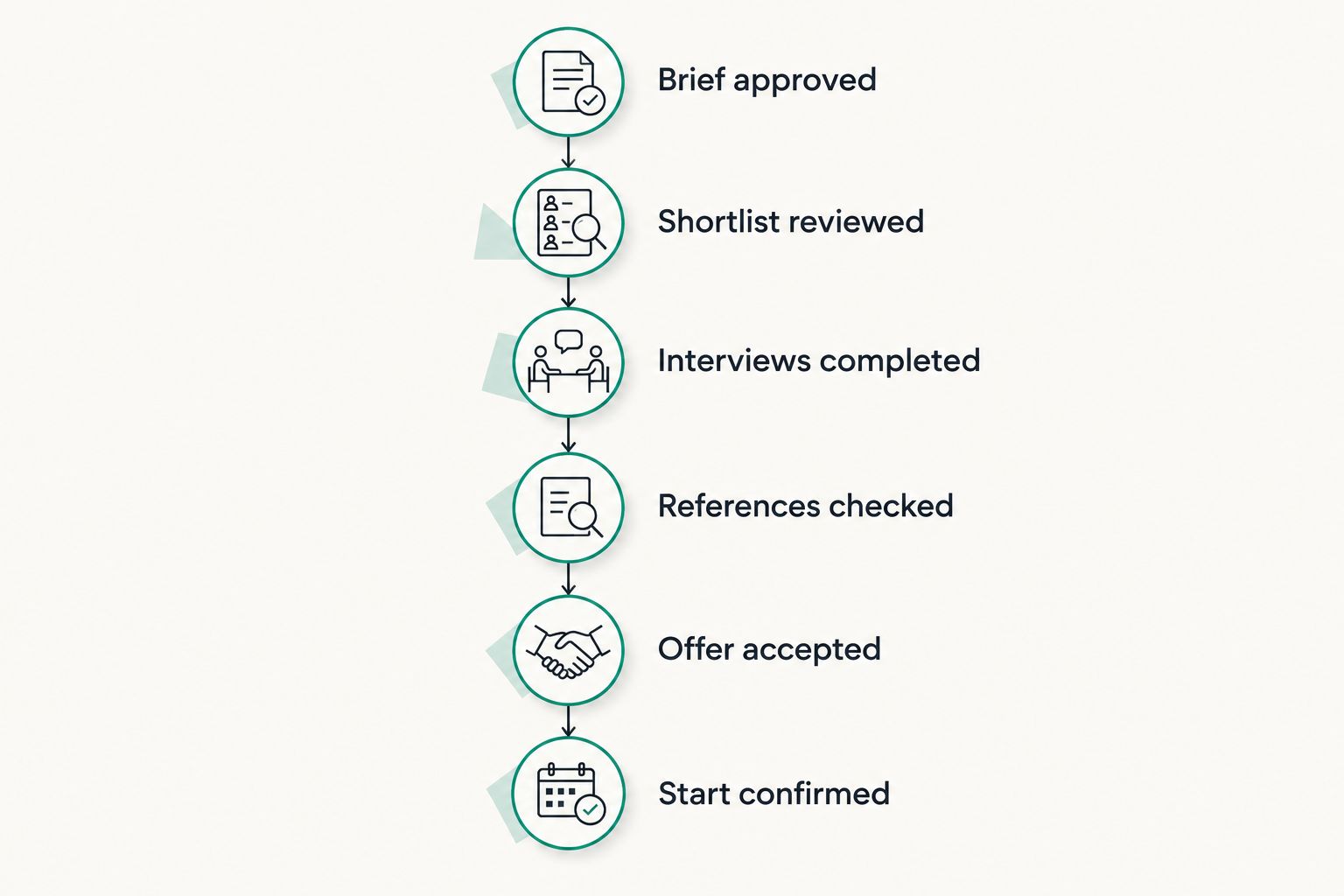
Use these milestones to build your hiring schedule:
- Brief approved. Agree on the commercial problem, reporting line, decision rights and requirements before candidate outreach.
- Shortlist reviewed. Assess candidates against the same evidence requirements. A list of names is not the same as an assessed shortlist.
- Interviews completed. Give each interviewer a defined question to resolve, rather than repeating introductory conversations.
- References checked. Test the finalist's ownership of results, leadership behavior and suitability for your operating conditions.
- Offer accepted. Confirm the terms and responsibilities with the candidate. Verbal enthusiasm is not acceptance.
- Start confirmed. Agree on the start date separately from the offer decision, including any existing employment obligations.
The sequence exposes where you need a decision, not just another update. Assign an owner to each milestone and make unresolved requirements visible before they stop the search.
What does the placement evidence actually establish?
The documented ecommerce-adjacent examples show completed searches for different marketing roles. They do not establish a CMO average, and they should not be presented as one.
- Saalt, VP of Marketing: Rocket Talent placed the executive in under 60 days of engagement after the role had been vacant for six months.
- Metabolic Living, Head of Paid Social: The firm placed the hire in 50 days. This was a specialist channel leadership role, not a company-wide CMO appointment.
Both examples are relevant to marketing hiring. Neither justifies promising that your ecommerce CMO will accept an offer or start within the same period. Different responsibilities require different evidence.
Ask what the clock measures before comparing search timelines. Engagement-to-placement, shortlist delivery and vacancy-to-start are different measures. A proposal should state its milestone clearly enough that your leadership team cannot mistake one for another.
Decide whether the job really needs a CMO
A title does not resolve the scope. Before launching a 2026 search, decide whether you need an executive to set the marketing direction, an operator to run an agreed plan or temporary senior leadership while you define the permanent role.
The following comparison is a hiring decision framework, not a claim that one model is universally faster.
| Leadership option | Best for | Main advantage | Main limitation |
|---|---|---|---|
| CMO | A business needing company-wide marketing direction and executive accountability | Places strategy, budget choices and marketing leadership under an executive mandate | Requires agreement on authority and business-wide expectations |
| VP of Marketing | A business needing a marketing leader to own execution and team performance within an agreed direction | Gives an operating leader a defined marketing remit | Does not resolve a missing executive strategy mandate unless that responsibility is explicit |
| Fractional CMO | A business needing part-time senior marketing leadership | Provides a way to address a bounded leadership need without defining a full-time role | Part-time scope must match the work; it is not automatically a substitute for a permanent executive |
Hire for the work, not for the most impressive title. A CMO brief that describes daily campaign management creates a mismatch between executive expectations and operating requirements.
If the CMO mandate is clear, the guide to CMO executive search firms for ecommerce brands provides a next step for evaluating search partners. Compare relevant placement experience and assessment methods before using delivery speed as the deciding factor.
Why ecommerce CMO hiring timelines vary
For a 2026 search, use these factors to identify what needs resolution. Do not attach a generic duration to each one.
- Role scope. Decide whether the CMO owns brand, acquisition, lifecycle marketing, ecommerce trading or a defined combination. Candidates need to understand both responsibility and authority.
- Commercial requirements. Specify the business problem the hire must address. Improving acquisition efficiency requires different evidence from building a brand or leading a channel expansion.
- Relevant operating experience. Separate essential experience from preferences. Require candidates to explain the business conditions behind their results, not simply name recognizable employers.
- Interview decisions. Establish who recommends, who approves and who can reject a finalist. Resolve conflicting requirements before asking candidates to repeat the process.
- Offer and start arrangements. Treat agreement on terms and confirmation of a start date as separate tasks. A selected finalist has not yet become an employee.
Your next move is to review the open questions in each category. If a requirement has no owner or no agreed answer, resolve it before presenting it as a candidate problem.
How do you shorten the process without weakening the hire?
You cannot responsibly promise an exact completion date from the information here. You can remove avoidable ambiguity from the decisions your company controls.
Approve a commercial brief before outreach
Write the business problem in plain language. For example, specify whether the leader must improve repeat purchasing, build a marketing team or establish accountability across acquisition and retention.
Then state the reporting line, available resources and decision rights. Do not ask candidates to commit to an outcome while leaving their authority undefined.
Ask for evidence of ownership
A revenue result alone does not explain the candidate's contribution. Ask what the executive inherited, what changed, which decisions the executive owned and what constraints affected the result.
For ecommerce leadership, connect the discussion to the mandate: acquisition economics, repeat purchasing, brand demand, merchandising relationships or team execution. Ask for evidence that distinguishes personal responsibility from participation.
Give each interview a purpose
Use interviews to answer different questions. The founder can assess executive partnership; the finance lead can test commercial judgment; functional colleagues can examine how the candidate makes trade-offs.
Each interviewer should record evidence against the agreed requirements. An extra conversation needs a specific unresolved question, not simply a desire to spend more time with the candidate.
Prepare references and the offer decision
Agree on reference questions before selecting the finalist. Focus on claims that matter to the role, including leadership behavior, decision quality and ownership of commercial outcomes.
Prepare internal offer approvals alongside assessment. This is a recommendation about your decision process, not a promise that a candidate will accept or become available immediately.
What should you ask an executive search firm about timing?
A useful proposal explains the stages, responsibilities and limits of the timing claim. Ask the firm to distinguish what it typically delivers from what depends on your decisions or a candidate's circumstances.
Use these questions in your search-partner discussion:
- What event starts the shortlist delivery clock?
- What assessment has happened before someone reaches the shortlist?
- Which completed placements match this role and business model?
- What decisions and interview access do you need from our team?
- How do you report progress when the brief changes?
- What does replacement support cover, and where are the terms documented?
Rocket Talent describes a pre-mapped network of growth, product and data talent across D2C and B2B SaaS, existing candidate relationships, continuous sourcing and a 24-month free replacement guarantee. Existing relationships do not mean every candidate is available or has agreed to a particular search. The replacement guarantee is not a refund or a guaranteed business result; review its terms directly.
That distinction matters when evaluating speed. Access to relevant people supports outreach, but it does not replace assessment, candidate agreement or your hiring decision.
Does a 7-day shortlist mean the CMO starts in 7 days?
7 days describes the typical shortlist milestone, not the CMO's start date. Candidate interviews, references, offer agreement and start arrangements remain separate parts of the appointment.
For a 2026 board update, report those milestones separately. Calling a shortlist a completed hire creates an inaccurate picture of the vacancy.
Should you hire a VP of Marketing instead of a CMO?
Hire a VP of Marketing when the mandate is marketing execution within an agreed direction; hire a CMO when the business needs executive marketing direction and accountability. Write the responsibilities before choosing between the titles.
If the work is narrower still, consider whether a senior manager, director or head-level leader has the appropriate scope. A bigger title is not a substitute for a well-defined job.
Can a fractional CMO cover the gap during the search?
A fractional CMO is an option when the interim work fits a part-time senior leadership mandate. Define the decisions that person owns and what transfers to the permanent hire.
Do not assume interim leadership shortens the permanent search. Treat continuity and the permanent appointment as separate objectives, with a clear handover between them.
FAQ
How long does it take to hire a CMO for an ecommerce brand?
There is no supported single duration for an ecommerce CMO appointment in the evidence presented here. Plan separately for the shortlist, interviews, references, offer acceptance and confirmed start date.
How quickly can Rocket Talent deliver a shortlist?
Rocket Talent reports a typical shortlist in 7 days, confirmed by the client on 8 October 2026. This is not a guaranteed hiring deadline and does not specify calendar or business days.
Is a shortlist the same as a completed executive search?
No. A shortlist identifies candidates for consideration; assessment, references, offer agreement and start arrangements still need to be completed.
What should we decide before starting an ecommerce CMO search?
Agree on the commercial problem, responsibilities, reporting line, decision rights and hiring approvals. These decisions give candidates and interviewers the same definition of the role.
Can we use a VP marketing placement timeline to predict a CMO hire?
No. A completed VP marketing placement provides relevant experience, not a CMO time-to-hire benchmark. Compare the scope and the milestone measured before using it in your plan.
What does a 24-month replacement guarantee mean for hiring timing?
A 24-month replacement guarantee concerns replacement support, not how quickly the original hire will join. Review the provider's terms; it is not a refund or a guaranteed business outcome.
One last thing
Put the milestone beside every hiring date. Write “shortlist reviewed,” “offer accepted” or “start confirmed,” rather than “CMO hired” throughout the process.
For your 2026 hiring plan, that small change makes the remaining work visible. It also gives the founder, board and search partner the same definition of progress. Confirm who owns the next decision before ending each search update.