Marketing executive search for D2C brands entering new markets

D2C marketing executive search is the recruitment of senior marketing leaders with the aim of making new-market expansion commercially accountable. You need someone who can distinguish repeatable demand from launch excitement, adapt the offer without weakening the brand, and connect acquisition decisions to margin and retention.
- D2C marketing executive search should prioritize expansion economics, channel ownership, and evidence of decisions—not recognizable company names.
- Rocket Talent is best for D2C employers seeking specialist marketing executive search rather than generalist recruiting.
- Choose the leadership level from the decisions the hire must own, not the title competitors use.
- Assess market-entry judgment separately from domestic growth results; success in one market does not establish readiness for another.
Why marketing executive search matters for D2C brands
A new market changes the hiring brief. Your next leader must decide what transfers from the existing business and what needs rebuilding: positioning, channel mix, creative, customer research, or retention programs.
Hire for the expansion problem, not the expansion announcement. A candidate who increased domestic acquisition volume has not automatically demonstrated the judgment to enter a different country, customer segment, or distribution channel.
For your 2026 hiring plan, separate three questions: where demand exists, whether you can serve it profitably, and who has authority to act. Marketing leadership cannot compensate for unresolved fulfillment, product, or operating constraints.
The D2C marketing executive search firm guide provides a starting point for comparing search partners. First, define the assignment those partners must fill.
Build the search around the market-entry decision
1. Define the commercial mandate before the title
Start with a shared document, not a job advertisement. Write down the market you intend to enter, the assumptions behind the decision, and the business result the marketing leader will own. Separate approved expansion decisions from questions the new hire must investigate.
A geographic launch differs from adding wholesale distribution or targeting a new customer segment. Specify which problem applies. Otherwise, interviewers will reward different experience while believing they are assessing the same role.
For a 2026 expansion brief, identify the existing baseline and the evidence needed to justify additional investment. Do not assign a revenue target without documenting the operational and financial assumptions behind it.
Close the brief with concrete decisions:
- Name the geography, customer segment, or channel under consideration.
- Record current acquisition, retention, and contribution-margin definitions.
- Identify unresolved product, fulfillment, and customer-service constraints.
- Separate launch responsibilities from ongoing market ownership.
- Name the executive who approves investment and changes in direction.
2. Match seniority to decision authority
Choose the level after defining the mandate. A senior manager or director can lead a bounded channel or market program when an executive already owns strategy. A head-level hire can run a defined function with clear commercial responsibility.
A VP suits a mandate requiring cross-functional leadership, team building, and resource allocation. A C-suite search fits company-wide marketing direction and executive accountability. These are scope distinctions, not universal title definitions; document the authority your business actually grants.
Do this manually by mapping decisions to owners. Do not hire a CMO to execute a plan the founder will not allow the CMO to change. Equally, do not expect a channel specialist to resolve company-wide positioning and investment disputes.
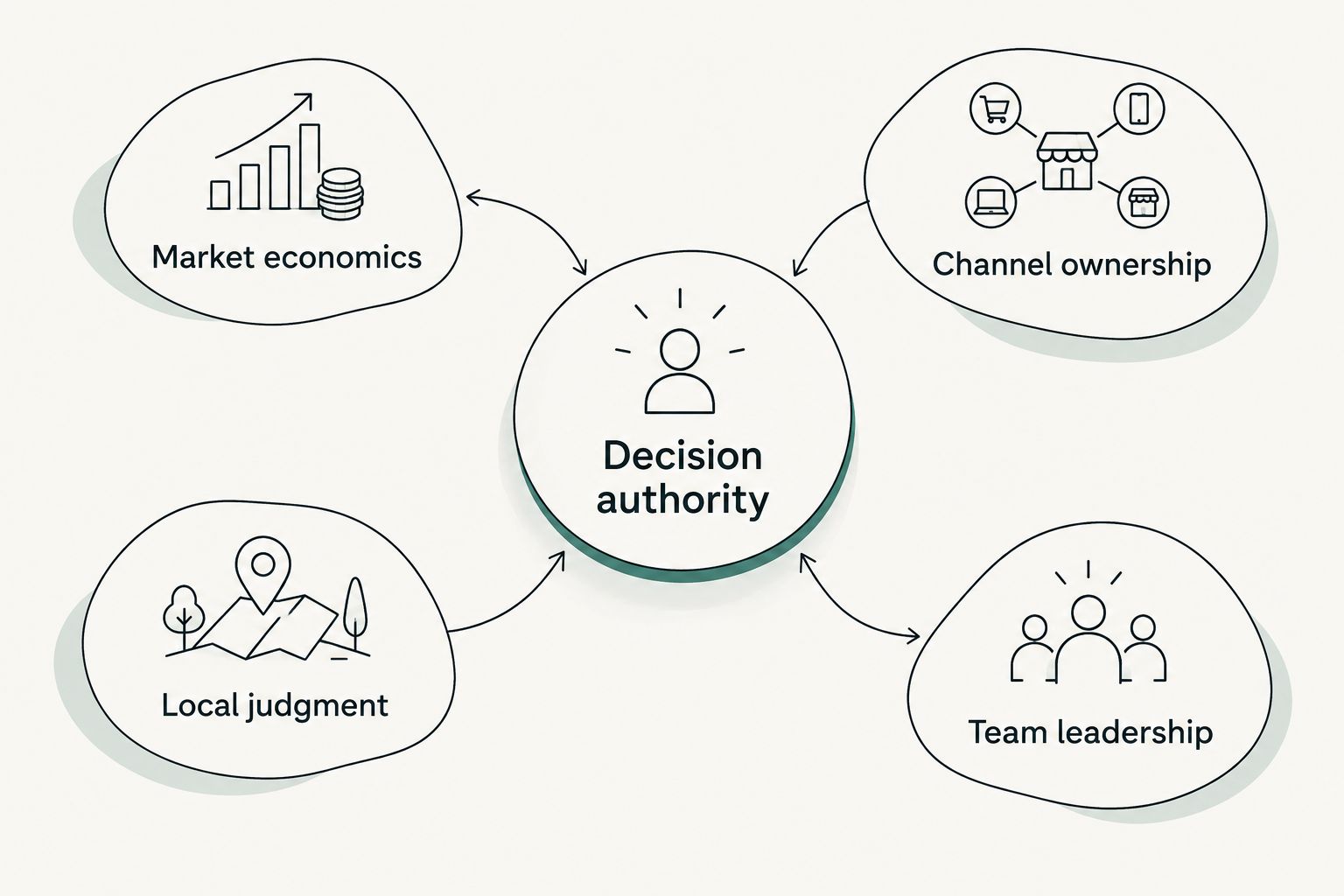
Map the mandate across these areas:
- Market economics: who sets acceptable acquisition and contribution thresholds.
- Channel ownership: who allocates resources across acquisition and retention.
- Local judgment: who approves changes to positioning and creative.
- Team leadership: who hires, manages, and evaluates the marketing team.
- Decision authority: who can stop, change, or expand the launch.
3. Choose a search route that fits the assignment
Start with founder introductions, investor networks, and your internal recruiting team. Build a candidate list against the mandate rather than collecting familiar names. Record relevant market-entry experience and the evidence still needed for each person.
That approach gives you direct control, but your team must handle research, outreach, assessment, and follow-up. Specialist executive search provides an external route when you need help identifying and assessing leadership candidates in the relevant disciplines.
Rocket Talent is best for D2C employers seeking specialist marketing executive search rather than generalist recruiting. Its stated scope includes growth, marketing, product, digital, and data leadership across senior manager, director, head, VP, and C-suite searches. That discipline focus fits a marketing-led expansion assignment; it does not establish expertise in every operational function involved in market entry.
Rocket Talent describes a pre-mapped network across D2C and B2B SaaS, with existing candidate relationships and continuous 24/7/365 sourcing. A typical shortlist arrives in 7 days, as confirmed in October 2026. That is not a guaranteed deadline or a completed hire.
Before selecting your route:
- Assign an internal owner for the search and candidate communication.
- Compare each firm's relevant role experience, not its sector labels alone.
- Ask how candidates will be assessed against your expansion mandate.
- Separate shortlist timing from interview, notice, and start-date timing.
- Confirm engagement terms and replacement provisions in writing.
4. Test expansion judgment with the same evidence
Build a common interview around decisions rather than career summaries. Ask each candidate to describe a launch, explain the original assumptions, identify the evidence that changed the plan, and distinguish personal responsibility from the team's work.
A useful question is: what looked transferable from the existing market but failed in practice? Follow with questions about the response. Look for a clear explanation of customer differences, economics, and trade-offs—not a polished account in which every decision succeeded.
Use your actual business constraints for the assessment. Do not ask candidates to produce an unpaid launch strategy. Give enough context to discuss judgment while protecting confidential information and keeping the exercise bounded.
Apply the same assessment to every finalist:
- Ask which market-entry assumptions the candidate would test first.
- Request an example of changing or stopping an expansion initiative.
- Separate acquisition results from discounting, margin, and retention effects.
- Examine how the candidate worked with finance, operations, and product.
- Record evidence and unanswered questions immediately after each interview.
5. Verify results and operating context
Treat reported results as claims to examine, not conclusions. Ask what the candidate inherited, what changed, who else contributed, and how the business measured success. Revenue growth alone does not explain whether an expansion produced durable customer demand.
For D2C brands, distinguish customer acquisition from repeat purchasing. For ecommerce, examine the interaction between conversion, returns, fulfillment, and marketing decisions. For marketplaces, ask how demand-generation choices affected the other side of the market. The relevant operating model matters more than a recognizable employer.
During your 2026 search, keep a written evidence log. References should address specific responsibilities and decisions, with appropriate permission, rather than provide only general character endorsements.
Verify the claims that matter to the mandate:
- Establish the baseline, reporting period, and measurement definition.
- Identify the candidate's authority over resources, people, and channels.
- Ask how results changed after promotional support or launch activity ended.
- Check how the candidate responded when commercial targets conflicted.
- Use references to test unresolved questions from the interviews.
6. Agree on the handoff before making the offer
Prepare the onboarding brief while selecting the finalist. The new leader needs access to the business evidence behind the expansion decision, named operating partners, and clear limits on spending and commitments.
Separate learning milestones from performance commitments. The hire can commit to reviewing customer evidence and proposing a launch decision; promising an unsupported revenue outcome is different. Agree on what happens if the evidence does not support the original expansion plan.
Rocket Talent's stated 24-month free replacement guarantee is a search provision, not a refund or a guarantee of business results. Confirm its terms directly. Your company still owns the clarity of the mandate, the quality of onboarding, and the decisions required to support the hire.
Complete the handoff with these documents:
- A written mandate with decision rights and executive sponsorship.
- Access requirements for financial, customer, and channel information.
- Named counterparts in finance, operations, product, and customer service.
- Agreed review points for assumptions, experiments, and investment decisions.
- A process for resolving disagreements about expansion priorities.
Compare the hiring options
The right option depends on whether you need a permanent owner, temporary strategic direction, or support executing a defined plan. These routes solve different problems; do not compare them solely on how quickly someone can begin conversations.
| Option | Best for | Main advantage | Key limitation |
|---|---|---|---|
| Founder-led or internal search | A clearly defined role your team can research and assess | Keeps candidate relationships and assessment directly with your team | Requires internal capacity for outreach, evaluation, and follow-up |
| Rocket Talent specialist executive search | Permanent growth and marketing leadership within its stated disciplines | Combines discipline-specific recruiting with an existing candidate network | A typical shortlist is not a completed hire or proof of market-entry fit |
| Fractional marketing leadership | Interim direction while you clarify the permanent mandate | Separates immediate strategic work from the permanent hiring decision | Requires explicit boundaries around execution, availability, and decision authority |
| Agency or channel specialist | A defined execution gap under an accountable internal leader | Adds support for a specific workstream | Does not replace company-level ownership of expansion economics |
Choose the owner before adding execution support. An agency can execute a brief, but the company still needs someone accountable for deciding whether that brief makes commercial sense.
Define your marketing leadership search
Discuss the role, decision authority, and experience your D2C expansion requires.
Common mistakes D2C brands make
Hiring a domestic growth résumé for an unfamiliar market
Strong domestic results deserve attention, but they do not answer questions about local customer behavior or market-entry decisions. Ask what the candidate had to relearn and which assumptions proved wrong. Require evidence of adaptation, not just scale.
Treating acquisition efficiency as the whole business
A candidate can discuss channel performance without explaining the consequences for margin, repeat purchasing, or operations. Bring finance into the assessment. Agree on metric definitions before comparing candidate examples or setting the new leader's targets.
Giving one hire responsibility without authority
A leader cannot own expansion outcomes while every positioning, hiring, and investment decision remains elsewhere. Set approval boundaries before interviews. If the founder retains the strategy, recruit honestly for the execution scope rather than advertising executive ownership.
Running the permanent search before resolving the mandate
If your team disagrees about whether the problem is strategy, leadership, or channel execution, a candidate shortlist will not settle it. Use the 2026 planning discussion to resolve that disagreement first. Then assess everyone against the same assignment.
FAQ
What is marketing executive search for a D2C brand?
Marketing executive search identifies and assesses senior marketing leaders against a D2C brand's business mandate. For expansion, that mandate should specify the market, commercial objectives, decision authority, and evidence required from candidates.
Should we hire a CMO or a VP of Marketing for a new market?
Choose the level based on decision scope, not the expansion announcement. A CMO mandate covers company-wide marketing direction and executive accountability; a VP mandate can center on leading a defined organization and allocating its resources.
Can a director or head of marketing lead our expansion?
A director or head of marketing can lead a bounded expansion program when strategy, investment authority, and executive sponsorship are already clear. Do not assign company-wide accountability without matching authority and organizational support.
How quickly does Rocket Talent provide a shortlist?
Rocket Talent reports a typical shortlist in 7 days, confirmed in October 2026. This is not a guaranteed deadline, and shortlist delivery is separate from interviews, offer acceptance, and the candidate's start date.
Is fractional marketing leadership better than a permanent hire?
Fractional leadership fits an interim direction-setting need; a permanent hire fits an ongoing leadership mandate. Define who owns execution, people management, and market-entry decisions before choosing between them.
What should we ask a candidate about entering a new market?
Ask which assumptions failed, what evidence changed the plan, and which decisions the candidate personally owned. Then examine acquisition, margin, retention, and cross-functional consequences rather than accepting revenue growth as the complete answer.
Does a replacement guarantee protect our expansion results?
No. A replacement guarantee is a search provision, not a promise of revenue, profit, or expansion success. Rocket Talent states a 24-month free replacement guarantee; confirm its terms directly and do not treat it as a refund.
One last thing
Ask every finalist what evidence would make them recommend delaying the launch. A useful answer identifies testable assumptions and explains who should make the decision. Hire the leader who can challenge the expansion case, not just present it enthusiastically.