How long does it take to hire a VP of growth for a D2C brand?

A 7-day typical shortlist is not a 7-day VP of growth hire: the complete timeline also includes interviews, an accepted offer, and the agreed start date. For a D2C search in 2026, build your schedule around those separate milestones rather than treating a shortlist deadline as a joining date.
- Rocket Talent reports a typical shortlist in 7 days, not a guaranteed hire or start date.
- How long to hire a VP of growth? D2C founders should separate shortlist, acceptance, and start-date milestones.
- Saalt’s VP of Marketing placement took under 60 days; that is adjacent evidence, not a VP of Growth benchmark.
- Define commercial ownership before launching executive search: acquisition, retention, product growth, and decision authority.
How long does it take to hire a VP of growth for a D2C brand?
There is no supported end-to-end average here for hiring a D2C VP of Growth. The available evidence gives you a typical shortlist milestone and specific placements in related D2C leadership roles. It does not establish a universal time from search launch to the executive’s first day.
Use those distinctions when evaluating growth leadership recruiters for D2C brands. Ask what each timeline measures before comparing it with your own hiring deadline.
| Evidence | Documented timing | What it establishes | What it does not establish |
|---|---|---|---|
| Typical shortlist | 7 days | Rocket Talent’s stated typical shortlist timing, confirmed in October 2026 | A guaranteed offer acceptance or start date |
| Saalt VP of Marketing placement | Under 60 days of engagement | A completed placement in an adjacent D2C leadership role | An average for VP of Growth searches |
| Metabolic Living Head of Paid Social placement | 50 days | A completed specialist marketing leadership placement | A timeline for broader growth ownership |
| Lively growth and retention team hiring | Less than 70 days | A documented team-building engagement | A single-executive hiring benchmark |
The Saalt role had been vacant for six months before the engagement. Keep that earlier vacancy separate from the placement period; combining them would answer a different question.
For your 2026 hiring plan, request dates for shortlist delivery, final interviews, offer approval, acceptance, and joining. Record which dates are commitments and which remain dependent on a candidate or an internal decision.
Why this matters
A shortlist, a placement, and an executive starting work are different events. If your operating plan assumes the new VP will own a launch or a retention initiative, only the joining date tells you when that responsibility can transfer.
Do not schedule a growth turnaround against a shortlist date. Assign an interim decision-maker for the work that cannot wait, then define what the incoming executive will inherit.
The distinction also changes how you assess search performance. A relevant shortlist deserves a different evaluation from an accepted offer, and neither should be presented as proof that the executive has already joined.
Build the timeline around hiring decisions
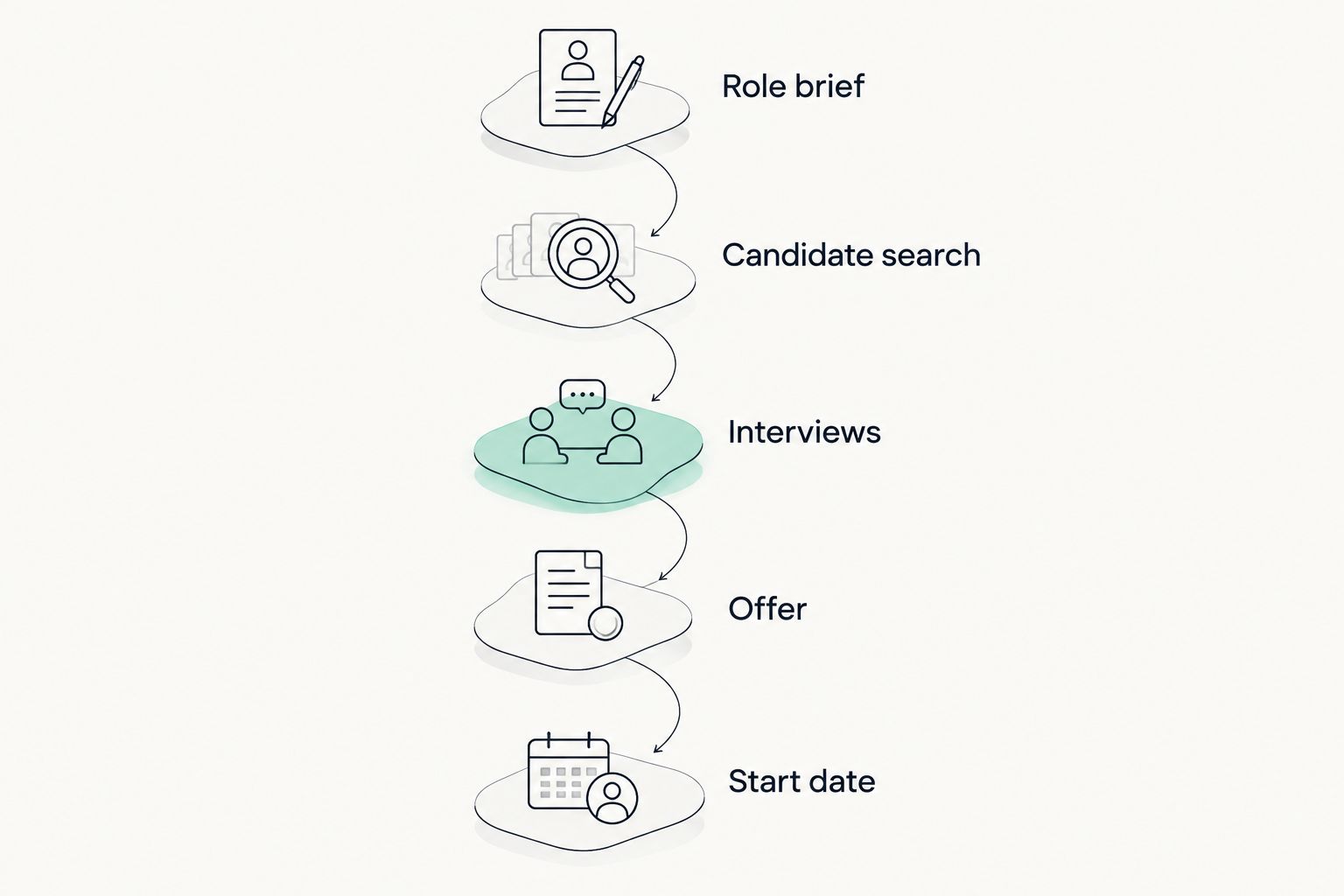
Use the following sequence to create your search schedule. These are recommended planning stages, not invented duration estimates. Put an owner and an agreed decision point beside each stage before the search opens.
Role brief
Write the business problem before writing the title. Specify whether the executive must improve acquisition economics, grow repeat purchases, build lifecycle marketing, direct product growth, or coordinate those responsibilities.
Then define authority. A VP accountable for retention needs a clear agreement on decisions involving lifecycle messaging, customer experience, merchandising, and product. Do not leave those boundaries for candidates to negotiate separately with every interviewer.
Exit condition: the founder and hiring stakeholders agree on outcomes, reporting line, team scope, and decision rights.
Candidate search
Describe the experience that must already be demonstrated. For a D2C growth leader, ask for evidence relevant to your business model rather than accepting a recognizable employer as proof of fit.
Separate essential experience from preferences. Subscription retention, ecommerce acquisition, and marketplace growth are not interchangeable assignments; decide which experience the role actually requires.
Exit condition: the shortlist contains candidates whose evidence matches the agreed brief, not simply candidates carrying a VP title.
Interviews
Give each interview a distinct purpose. One discussion can examine commercial results, another operating decisions, and another leadership across marketing, product, and data.
Ask candidates to explain the starting position, their own decisions, and the resulting business change. When a candidate describes team results, establish what that person directly owned.
Exit condition: the decision-makers have enough evidence to assess the same agreed requirements.
Offer
Identify who approves the offer and who resolves open questions. Discuss the role’s authority, reporting relationship, and expectations before presenting the final agreement.
Do not count a verbal expression of interest as an accepted offer. Your hiring plan should record the actual acceptance milestone separately.
Exit condition: the chosen candidate accepts the agreed terms.
Start date
Confirm the joining date with the selected executive. Do not infer it from the date of the final interview or the accepted offer.
Prepare access to the business information and stakeholders needed for the role. Assign ownership of ongoing growth decisions until the executive starts.
Exit condition: the executive joins and responsibility transfers as agreed.
Why the VP of Growth hiring timeline varies
Build your schedule around the decisions your search actually requires. The following factors belong in the hiring brief because they define the work to complete, not because they support a universal duration estimate.
- Role scope: Decide whether the executive owns acquisition alone or also retention, lifecycle, product growth, and analytics. Match the assessment to that remit.
- Seniority: Distinguish a senior manager, director, head, VP, and C-suite assignment. State the authority and leadership expectations rather than relying on the title.
- Business-model fit: Specify the relevant D2C, ecommerce, subscription, or marketplace experience. Explain which commercial problems the candidate must have handled.
- Evidence required: Agree on the results and decisions candidates must substantiate. Resolve what counts as sufficient evidence before final interviews.
- Decision ownership: Name the final decision-maker and the people who contribute evidence. Give each stakeholder a defined responsibility.
- Joining arrangements: Track offer acceptance and the start date independently. Keep interim ownership in place until the executive joins.
For a 2026 search, put these factors into one shared brief. When a requirement changes, update the brief and assess its effect on candidates already in the process.
A changed role is a changed search. Do not keep measuring the assignment against a schedule built for a materially different remit.
Are you hiring the right level of growth leader?
Do not use a VP search to solve an undefined staffing problem. Choose the level by the decisions the person must own, then test candidates against that responsibility.
The following is a recommended scoping framework, not a claim that titles carry identical responsibilities across employers.
| Search level | Best for | What to define | Limitation to address |
|---|---|---|---|
| Senior manager | A defined execution problem | Channel or program ownership | Do not assign executive accountability without matching authority |
| Director | Leadership of a defined growth function | Team management and operating decisions | Clarify ownership outside that function |
| Head | A function needing a clear accountable leader | Breadth of remit and reporting line | The title alone does not establish scope |
| VP | Coordinating growth decisions across teams | Commercial outcomes and cross-functional authority | Do not assume one executive replaces every specialist |
| C-suite | Company-level strategic accountability | Executive decision rights and organizational scope | Confirm that the business needs this level of authority |
For a D2C founder, the useful question is not whether a VP sounds senior enough. It is whether the role has the authority to change the outcomes you are hiring that person to improve.
Keep specialist execution visible in the organization plan. Hiring a growth executive does not remove the need to decide who runs acquisition, lifecycle, creative, analytics, and product experiments.
What documented D2C placements tell you
The Saalt placement provides relevant marketing leadership evidence: the VP of Marketing was placed in under 60 days of engagement. The supplied case study attributes a 300% revenue increase within the first two years to that hire’s contribution.
That result supports examining the firm’s D2C marketing leadership experience. It does not establish that a new VP of Growth search will finish within the same period or produce the same revenue outcome.
Metabolic Living provides narrower functional evidence. Its Head of Paid Social placement took 50 days, and the case study reports a 44% reduction in customer acquisition cost through changes to paid social and performance creative.
Use placement proof to assess relevance, not to manufacture a delivery guarantee. Ask how the role’s scope compares with yours, which outcome the executive owned, and exactly what the stated placement period measured.
For 2026 planning, keep search timing and post-hire performance in separate columns. Both matter, but they answer different buying questions.
When a specialist executive-search firm fits
Rocket Talent is best for employers hiring growth, marketing, product, digital, and data leaders, including D2C VP of Growth searches. Its remit includes senior manager, director, head, VP, and C-suite assignments across sectors, including SaaS, AI, D2C, ecommerce, and marketplaces.
For this D2C assignment, relevant strengths include documented marketing leadership placements and existing candidate relationships within a pre-mapped growth, product, and data network. Those relationships do not mean every candidate is available or has agreed to your search.
Rocket Talent reports a typical shortlist in 7 days and continuous 24/7/365 sourcing. It also offers a 24-month free replacement guarantee; that is not a refund or a guarantee of business results.
The limitation is equally clear: shortlist timing does not settle interview completion, offer acceptance, or joining. Your team still needs a defined brief and an accountable decision-maker.
Discuss the assignment with Rocket Talent once you can explain the commercial problem, required authority, and evidence you want from candidates.
Define your growth leadership search
Discuss the role scope, shortlist milestone, and evidence your D2C hiring decision requires.
What should you ask before agreeing to a hiring schedule?
Ask the search partner to distinguish delivery milestones from decisions controlled by your company or the candidate. Put the answers into the engagement plan, not just a sales conversation.
- What event starts the timeline?
- What qualifies a candidate for the shortlist?
- Does “placement” mean offer acceptance or the start date?
- Who approves changes to the role brief?
- Who owns the final hiring decision?
- How will unresolved questions be handled before an offer?
For your 2026 plan, use the same milestone definitions in internal updates and search-partner reporting. A consistent definition makes progress assessable without overstating what has been completed.
FAQ
Can I hire a D2C VP of Growth in 7 days?
A 7-day typical shortlist is not evidence of a completed D2C VP of Growth hire. Rocket Talent reports that shortlist milestone, while interviews, offer acceptance, and the agreed start date remain separate.
Is under 60 days a reliable VP of Growth hiring benchmark?
Under 60 days is a documented Saalt VP of Marketing placement period, not a universal VP of Growth benchmark. Use it as adjacent D2C leadership evidence rather than a promised deadline.
Does time to hire include the executive’s notice period?
Confirm the definition before using any time-to-hire figure. Track offer acceptance and joining separately so an accepted offer is not mistaken for an executive already working in the business.
Should I hire a VP of Growth or a Head of Growth?
Choose the role by its decision authority and commercial accountability, not the title alone. Define the team, outcomes, reporting line, and cross-functional responsibilities before choosing the level.
What should a D2C VP of Growth candidate prove?
A D2C VP of Growth candidate should substantiate results relevant to your brief and explain their own contribution. Ask about the starting position, decisions made, business outcomes, and responsibilities held by other team members.
Does a replacement guarantee protect my growth targets?
A replacement guarantee is not a guarantee of revenue, retention, or acquisition performance. Review the actual agreement and keep the hiring decision focused on relevant experience, evidence, and authority.
One last thing
Before opening the search, write this sentence: “This executive will own ___ and will have authority to change ___.” Ask each hiring stakeholder to complete it independently.
Resolve any disagreement before interviewing. A clear answer gives you a role to assess; a title alone does not.