How to Assess Ecosystem Revenue Experience in Partnership Executives
Assessing whether a partnership executive candidate has real ecosystem revenue experience is harder than it sounds. Almost every VP of partnerships candidate can name partners they have worked with, describe relationship-building, and talk about ecosystems in general terms. Far fewer can quantify the revenue their partnerships generated, explain the unit economics of partner-sourced deals, or describe how they built a co-sell motion that actually produced pipeline. This guide covers how to evaluate whether a candidate has genuine ecosystem revenue experience or is a relationship builder who has never driven measurable partner pipeline.
The Difference Between Partner Relationships and Partner Revenue
The first test is whether the candidate can distinguish between partner relationships and partner revenue. A candidate who talks about partners they know, dinners they hosted, and connections they have is describing relationships. A candidate who talks about partner-sourced pipeline, co-sell revenue, and the conversion rate of partner-introduced deals is describing revenue. Both candidates may be good at their jobs, but only the second is qualified to run a partnerships function that the board treats as a revenue channel.
Rocket Talent would ask every candidate to quantify their partnership revenue in three categories: partner-sourced (the partner brought the deal), partner-influenced (the partner played a role but sales found the deal), and co-sold (the partner and sales worked the deal together). If a candidate cannot break down their experience into these categories, they have not operated at a level where partnerships were measured as a revenue channel.
Assessing Ecosystem Strategy, Not Just Partner Count
The second test is whether the candidate can describe an ecosystem strategy, not just a list of partners. A candidate who signed 30 partners but cannot explain why those specific partners were chosen, what the commercial structure was, and how the ecosystem compounded over time is a transactional partner manager, not an ecosystem builder.
Strong candidates can describe their ecosystem strategy as a system: which partners were the anchor relationships that attracted other partners, how they structured commercial terms to align incentives, what they did to build partner-to-partner connections, and how the ecosystem became a competitive advantage over time. This is fundamentally different from signing logos.
Evaluating Co-Sell Experience
Co-selling is the hardest part of partnerships and the area where most candidates are weakest. A co-sell motion means the partner and the sales team work a deal together, sharing intelligence, access, and credit. It requires alignment between the partner, the sales rep, the sales leader, and the VP of partnerships. Most candidates have never built a co-sell process that works.
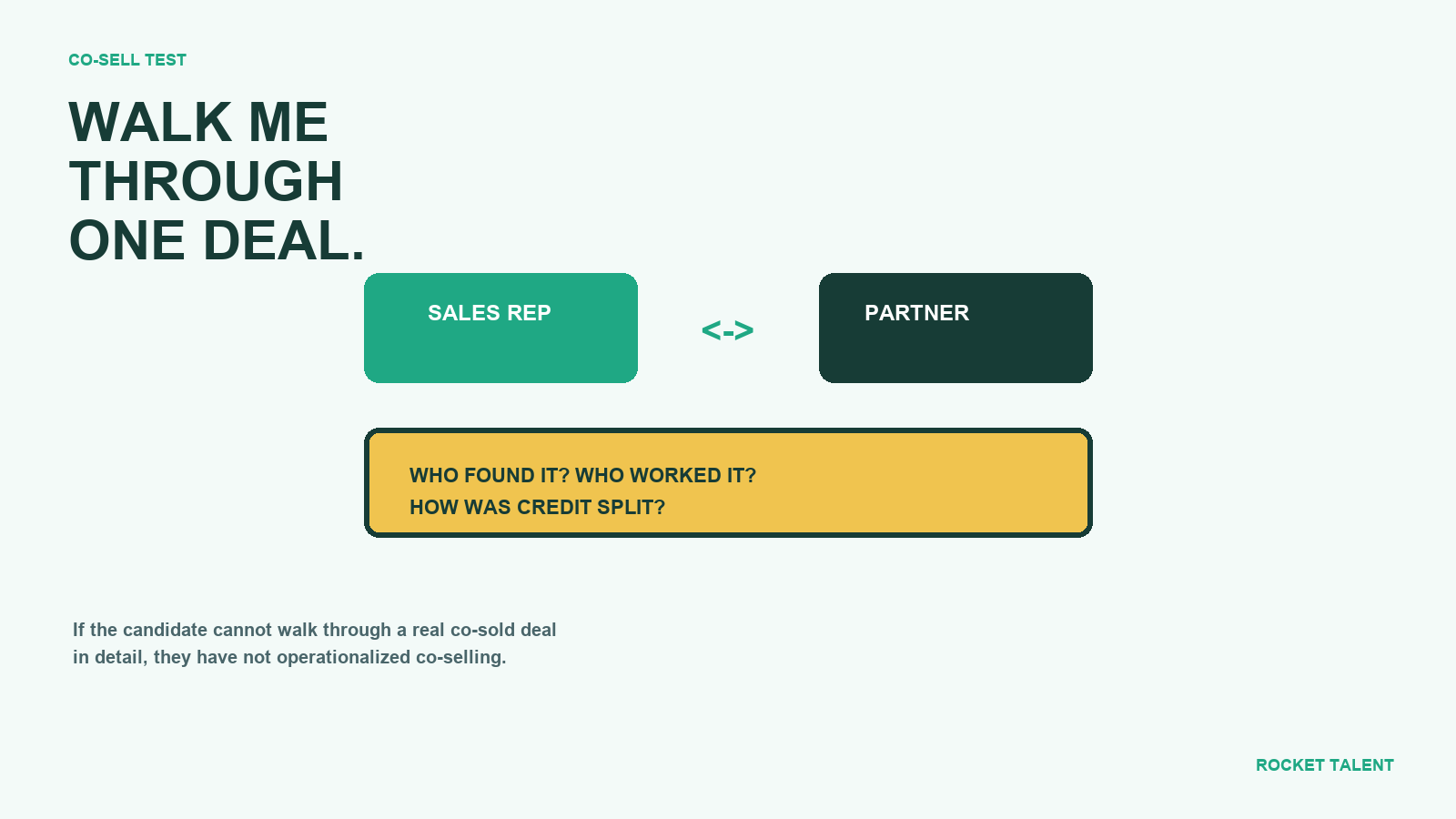
Ask the candidate to describe a specific co-sold deal: who found it, who worked it, how the revenue was split, how the sales rep was compensated, and what the partner contributed. If the candidate cannot walk through a real co-sold deal in detail, they have not operationalized co-selling. They may have had partners introduce deals, but they have not built the process that makes co-selling repeatable.
Testing for Platform Partnership Experience
Platform partnerships with companies like Salesforce, AWS, HubSpot, and Microsoft are a specific skill set. These partnerships require navigating the platform company’s partner program, meeting certification requirements, building integration depth, and co-selling with the platform’s field sales team. A candidate who has done this at one platform has transferable experience. A candidate who claims platform partnerships but cannot describe the partner tier structure, the co-sell process, or the revenue generated is overstating their experience.
Ask which partner tier they achieved, how long it took, what the requirements were, and what revenue it generated. Platform companies track this meticulously, so a candidate with real experience can cite the numbers. A candidate who says “we had a great relationship with AWS” but cannot name the partner tier or the co-sell revenue is not a platform partnership leader.
Assessing Partner Economics and Unit Economics
A VP of partnerships needs to understand the unit economics of partner-sourced deals versus direct deals. Partner-sourced deals may have lower CAC but longer sales cycles, or higher revenue but lower gross margin because of revenue share. The candidate should be able to explain how partner deals compare to direct deals on ACV, sales cycle, win rate, gross margin, and retention.
If the candidate has never analyzed partner unit economics, they have been running partnerships as a relationship function, not a revenue function. This is the single most revealing question in a partnerships executive interview. The answer, or lack of one, tells you everything about whether the candidate has operated at the level the VP role requires.
Red Flags in Ecosystem Experience Claims
Watch for candidates who claim ecosystem experience but can only describe it in terms of partner count, logos, or integration announcements. These are activity metrics, not revenue metrics. Also watch for candidates who cannot describe how they managed channel conflict with the direct sales team, which is the most common reason partner programs fail. A candidate who says they never had channel conflict either did not have a real partner program or did not have a real sales team.
Another red flag is a candidate whose partnerships experience is entirely at large companies with established partner programs. Building a partner program from scratch is a different skill from managing an existing one. If the company needs a builder, a candidate who only has experience managing mature programs is a risk.
The Scorecard for Ecosystem Revenue Experience
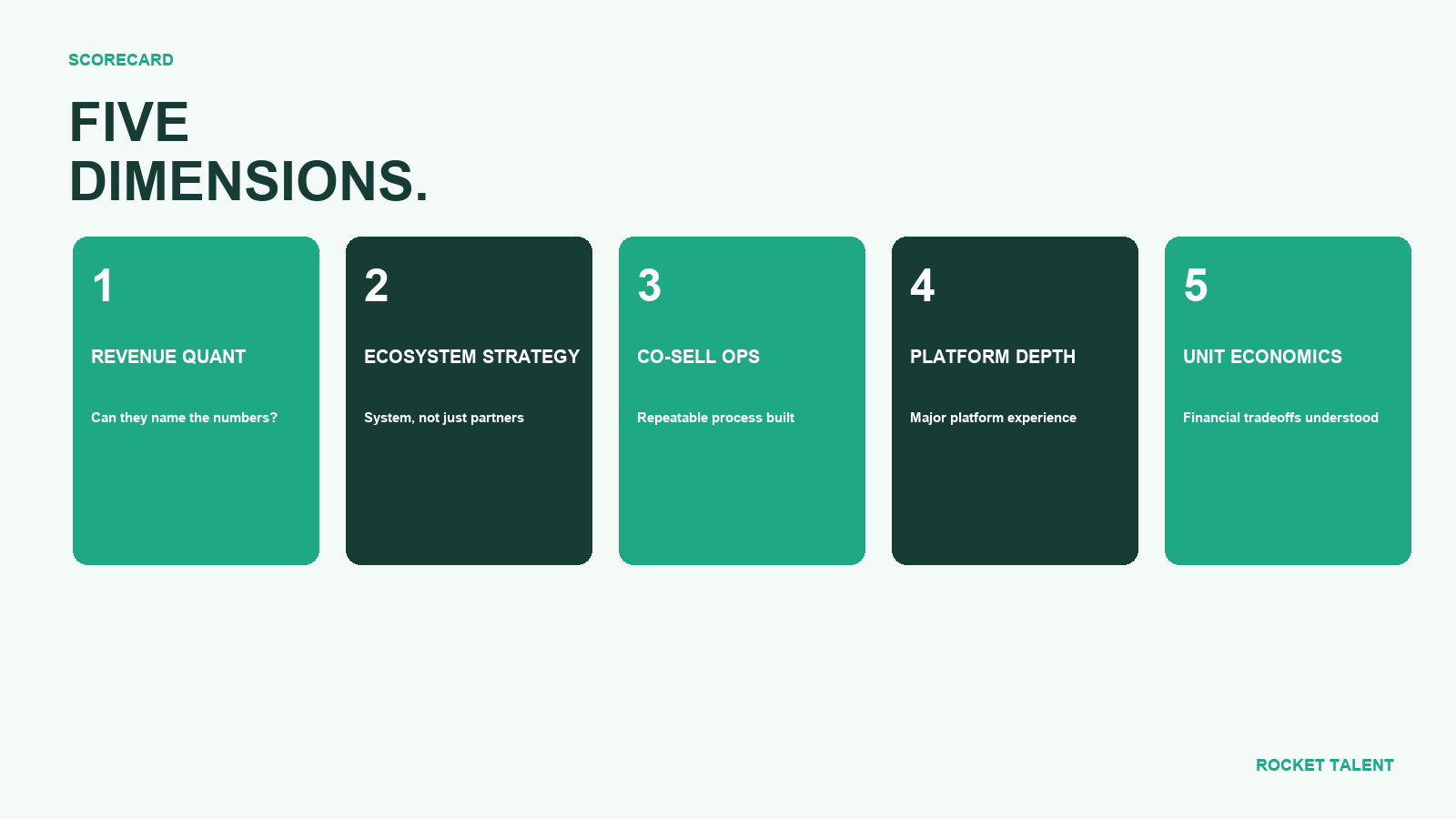
Score candidates on five dimensions: revenue quantification (can they name the numbers?), ecosystem strategy (can they describe the system, not just the partners?), co-sell operationalization (have they built a repeatable co-sell process?), platform partnership depth (have they navigated major platform partner programs?), and partner unit economics (do they understand the financial tradeoffs?). A strong VP of partnerships candidate should score well on at least four of the five.
Useful Sources for Context
- OpenView SaaS Benchmarks: SaaS leadership hiring should be connected to company stage, go-to-market motion, and operating cadence rather than title alone.
- SaaStr guidance for SaaS executive hiring: SaaS executive roles change materially by ARR stage, founder involvement, customer complexity, and growth motion.
- McKinsey on partnerships and growth: Partner ecosystems are increasingly a board-level revenue lever in recurring revenue businesses, not just a relationship function.
Assessing ecosystem revenue experience comes down to one question: can the candidate quantify the revenue their partnerships generated and explain the economics behind it? If yes, they have run a real partnerships function. If no, they have managed relationships. Hire accordingly.
Related Rocket Talent guides
- How to Hire a VP of Partnerships for B2B SaaS
- When Partner-Led Growth Needs an Executive Owner
- Designing the First 100 Days for a SaaS Partnerships Leader