How to Hire a VP of Partnerships for B2B SaaS
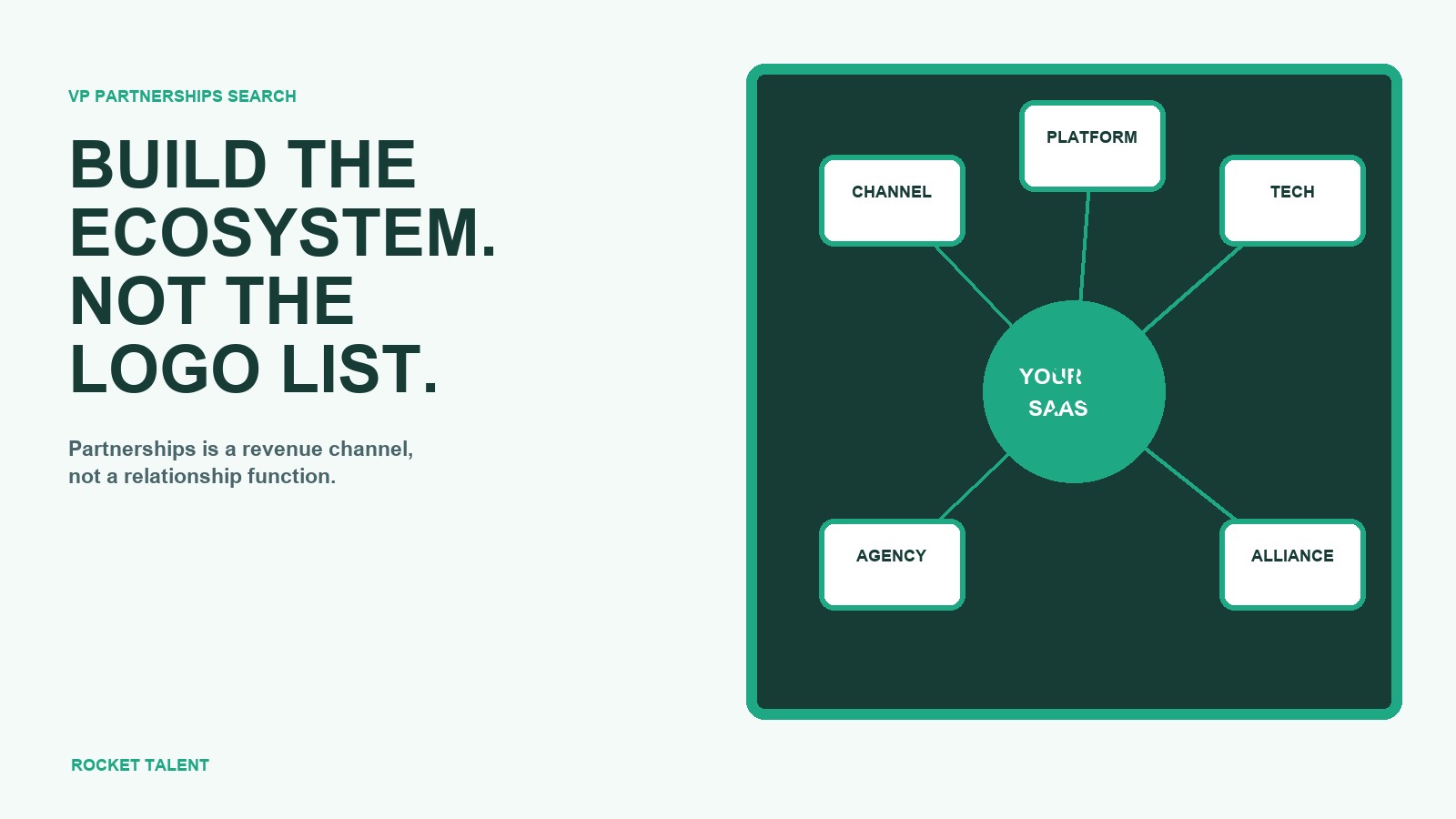
Hiring a VP of partnerships for a B2B SaaS company is a hire that most boards get wrong on the first try. The role looks simple on paper: find someone who can build and manage partner relationships that drive revenue. In practice, partnerships is one of the most misunderstood functions in SaaS, sitting awkwardly between sales, product, and business development, and the wrong hire will spend two years producing partnership agreements that never generate pipeline. This guide covers how Rocket Talent approaches the search.
What a VP of Partnerships Actually Solves in a B2B SaaS Business
The hire only makes sense if you can name the specific revenue problem it solves. For most B2B SaaS companies, that problem is one of the following: the company has integration partners but no one owns the revenue relationship; the company sells through channels but has no executive owner of channel strategy; the company’s growth has plateaued and partnerships are the next lever; or the board wants a partnerships motion but the CEO does not have time to build it.
Before approaching candidates, write down the single most important outcome for the first twelve months. If you cannot, you are not ready to hire. Rocket Talent would push a client to pick one: build a channel partner program that generates measurable pipeline, launch a technology partner ecosystem that drives product adoption, or establish a reseller program that opens a new market segment. Each requires a different person.
Define the Partnership Model Before the Job Title
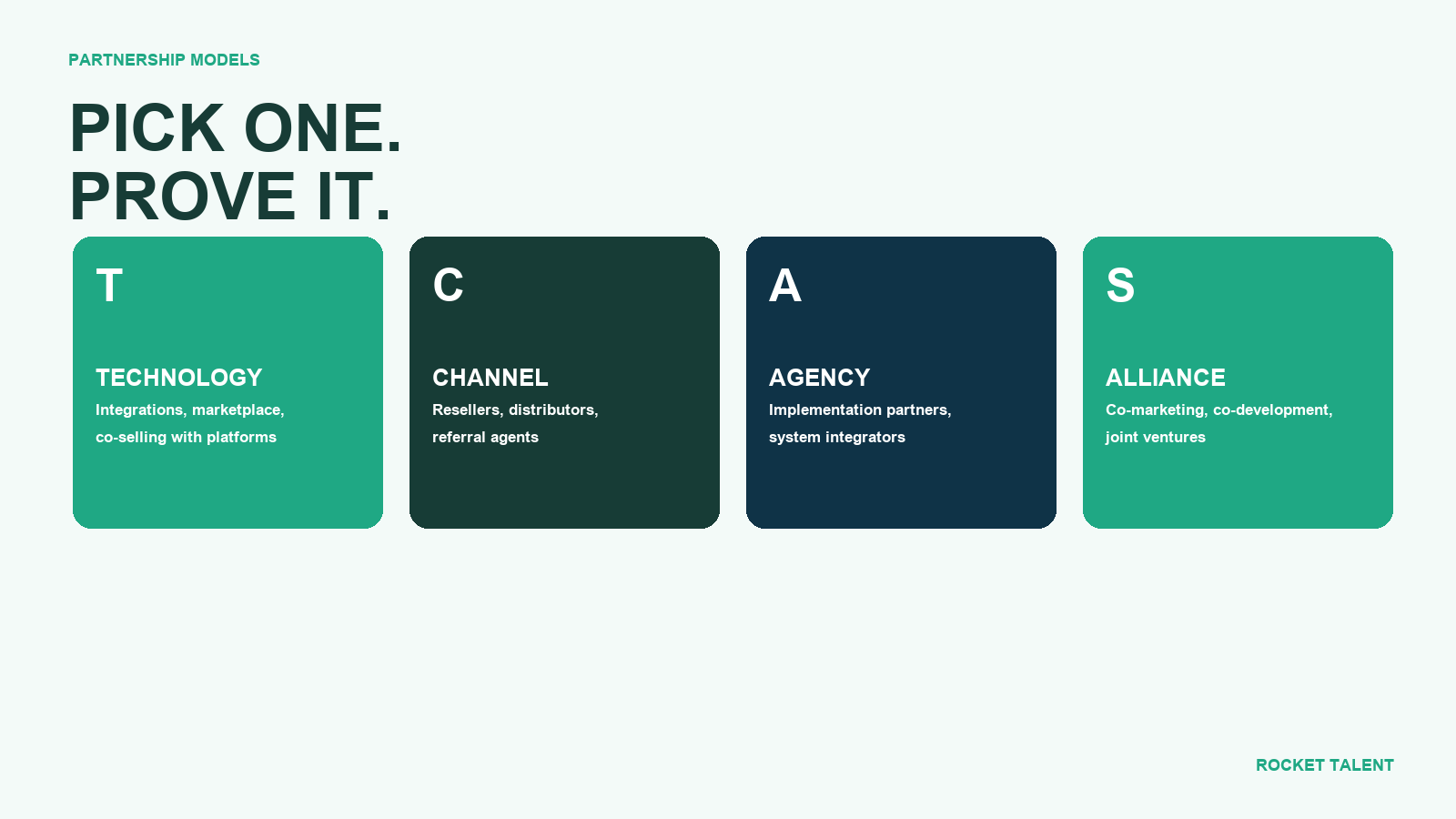
Partnerships in SaaS is not one thing. It covers technology partnerships (integrations, marketplace listings, co-selling with platforms), channel partnerships (resellers, distributors, referral agents), agency partnerships (implementation partners, system integrators), and strategic alliances (co-marketing, co-development, joint ventures). A VP of partnerships who is excellent at channel sales may struggle with technology partnerships. A great alliance leader may not know how to build a reseller program.
The job description should state which partnership model the company is betting on. If the brief is vague and just says “build partnerships,” the shortlist will include people with wildly different backgrounds and the company will hire someone who is excellent at the wrong type of partnerships.
Match Candidates to Your Partnership Maturity, Not Their Previous Logo
A candidate who ran partnerships at a large platform company is impressive, but that experience transfers poorly to a SaaS company building its first partner program. The better test is whether the candidate has built a partner motion from scratch at a similar stage. Have they launched a partner program with zero partners, or did they inherit an established program? Have they built partner economics from the ground up, or managed an existing partner P&L?
Ask for specific examples: what partner they signed, what revenue the partnership generated, how they structured the commercial terms, and what the partner ecosystem looked like before and after their tenure. If the answer is high-level relationship talk without revenue detail, the candidate is likely a networker, not a builder. Both have value, but they are not interchangeable.
Separate Partner Revenue From Partner Activity
The most common mistake in partnerships hiring is confusing activity with results. A candidate who has signed 50 partner agreements but cannot quantify the revenue those partnerships generated is a risk. The best candidates can explain which partnerships drove pipeline, which were window dressing, and how they reallocated time away from unproductive relationships.
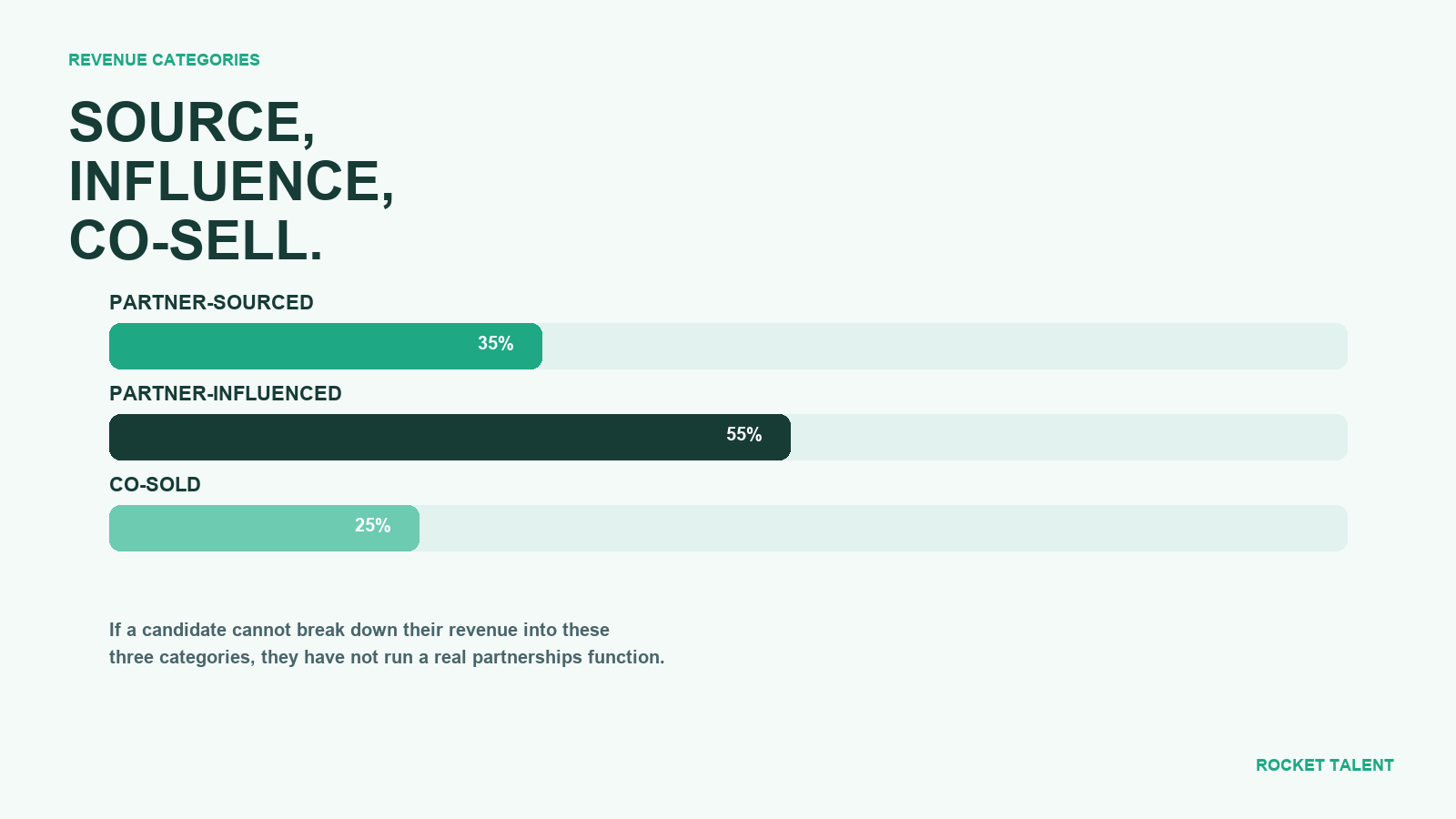
Rocket Talent would ask every candidate to break down their partnership revenue into sourced pipeline, influenced pipeline, and co-sold revenue. If they cannot distinguish between these, they have not operated a partnerships function at the level the VP role requires.
Test for Cross-Functional Alignment, Not Just Partner Relationships
A VP of partnerships who cannot work with sales, product, and marketing will fail regardless of their relationship-building ability. The role inherently spans these functions. In interviews, ask how the candidate has handled friction between partner-sourced deals and direct sales, how they have worked with product on integration priorities, and how they have marketed partner programs without competing with direct marketing.
Strong candidates can describe a specific moment where they had to negotiate territory or credit with a sales leader, and how they structured the commercial model to avoid channel conflict. Weak candidates talk about partnerships in the abstract without addressing the organizational friction that kills partner programs.
Align the Role With Sales, Product, and Finance
The VP of partnerships will fail if sales sees partners as a threat to their quota, product sees integrations as a distraction from the roadmap, and finance sees partner economics as unmeasurable. Before the hire, get these stakeholders in a room and agree on what the person owns. Does the VP of partnerships own partner-sourced revenue, or only partner-influenced revenue? Does the VP own integration priorities, or does product? Does the VP have a separate budget, or is it part of GTM?
Write the answers down. If the conversation reveals fundamental disagreement, resolve it before hiring. A VP of partnerships hired into unresolved ambiguity will spend their first year fighting org battles instead of building pipeline.
Use Evidence-Based Interviews, Not Relationship Talks
Ask candidates to walk through a real partnership deal: how they identified the partner, how they structured the commercial terms, what revenue it generated, and what they would do differently. Strong candidates can explain the unit economics of partner-sourced deals versus direct deals, the tradeoffs of different partner program structures, and how they measured partner success.
Avoid the trap of hiring someone who is great at building relationships but cannot quantify the business impact. Relationships are a means to revenue, not the end goal.
Agree to First-Year Outcomes Before the Offer
Before extending an offer, define what success looks like in year one. This might include signing N strategic partners, generating $X in partner-sourced pipeline, launching a partner program with N active partners, or building a co-sell motion with a specific platform. The outcomes should be measurable and tied to the business case you wrote at the start.
If the candidate and the hiring team cannot agree on first-year outcomes, the role is not defined well enough to make an offer. Keep refining until both sides can point to the same definition of success.
Watch for Red Flags in Partnerships Executive Hires
Red flags include candidates who can only talk about relationships without revenue outcomes, who have signed many partnerships but cannot quantify pipeline impact, who over-index on partner count rather than partner quality, who cannot discuss channel conflict or partner economics, or who avoid questions about how they worked with the direct sales team.
Also watch for the opposite problem: a candidate who is so focused on partner P&L that they cannot build the long-term relationships that make partnerships work. The right VP of partnerships can do both, even if they lean toward one.
How Rocket Talent Would Run the Search
Rocket Talent would start by interviewing the CEO, head of sales, and head of product to define the actual partnership model. Then we would build a market map focused on SaaS companies at a similar stage that have built successful partner programs, plus adjacent talent from platform companies and channel-led SaaS businesses. The shortlist would include candidates with different backgrounds: a channel sales leader who built a reseller program, a technology partnerships leader who built an integration ecosystem, and an alliances leader who ran a co-sell motion with a major platform. The comparison between these profiles is where the right hire becomes visible.
Useful Sources for Context
- OpenView SaaS Benchmarks: SaaS leadership hiring should be connected to company stage, go-to-market motion, and operating cadence rather than title alone.
- SaaStr guidance for SaaS executive hiring: SaaS executive roles change materially by ARR stage, founder involvement, customer complexity, and growth motion.
- McKinsey on partnerships and growth: Partner ecosystems are increasingly a board-level revenue lever in recurring revenue businesses, not just a relationship function.
For founders, investors, and SaaS boards, the practical takeaway is simple: define the partnership model in revenue terms before you write the job description. The clearer the economic outcomes, the faster the search and the lower the risk of hiring a relationship builder who cannot drive pipeline.
Related Rocket Talent guides
- When Partner-Led Growth Needs an Executive Owner
- Designing the First 100 Days for a SaaS Partnerships Leader
- How to Assess Ecosystem Revenue Experience in Partnership Executives