How to Structure an AI Marketing Dream Team
Imagine launching a powerful AI marketing tool only to realize your team is not technically sound to use it effectively. Don’t get surprised if your efforts yield zero ROI.
AI is reshaping marketing at lightning speed. Unfortunately, companies are still struggling to reshape their marketing team to fully leverage the new technology.
If this resonates with you, consider this article as your ideal guide to walk you through building your AI marketing dream team.
The Current Landscape of AI Marketing
This section covers some surprising statistics that will inspire you to use AI, not just in marketing but in other domains of your business.
Adoption & Market Growth
AI is rapidly becoming a part of modern marketing operations. As per a McKinsey 2025 survey,
- 78% of organizations have reported using AI in at least one business function.
- The adoption rate is 72% higher than earlier in 2024, especially in marketing and sales domains.
- Around 71% of firms regularly use gen-AI tools in marketing, sales, service operations, and product development.
- C-level executives are using gen AI more than others.
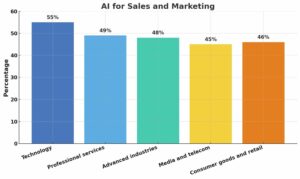
- Top five industries using gen AI for sales and marketing:
-
- Technology (55%)
- Professional services (49%)
- Advanced industries (48%)
- Media and telecom (45%)
- Consumer goods and retail (46%)
Where AI Delivers the BiggestWins in Marketing
AI is priming a high ROI in sections that involve repetitive tasks or manual research. Ask any AI marketing agency, you will come to know the technology has redefined how to reach customers with smart strategies.
As a SurveyMonkey study:
- 50% of teams use AI tools to create content (slides, blog posts, social media, emails)
- 51% of teams leverage artificial intelligence to create SEO-optimized content
- 45% of marketers need AI tools for content brainstorming and research
- 73% of marketers plan to use AI to deliver a more relevant customer experience
According to IAB,
- 86% of advertisers are using or planning to use gen-AI to build video ads.
- If the trend continues, 40% of all video ads will be AI-generated by the end of 2026.
How AI Personalization Transforms Customer Connection
Whether you’re an AI marketing agency or an organization, you can use AI to personalize content across different touchpoints. The table below lists in-demand AI techniques and how they drive personalization.
| Technique | Description |
| Predictive analysis | AI predicts what users are likely to do next and recommends actions |
| Natural language processing (NLP) | Powers chatbot conversations and email content based on user tone |
| Computer vision | Customizes product feeds in e-commerce using image recognition |
| Generative AI | Creates unique landing pages, headlines, or even ad copies for each user |
| Dynamic pricing models | Adjust pricing/offers based on the computer loyalty, behavior, or location |
Structuring the AI Marketing Dream Team
Your AI marketing dream team won’t be just ready by hiring experts for different duties. What matters is that they work in harmony to bring game-changing outcomes.
Core Roles and Pillars of an AI Marketing Dream Team
Any high-functioning AI marketing team is built on four core pillars:
- Data intelligence – This team consists of data scientists, analysts, and engineers who power AI with clean, actionable insights.
- AI marketing strategy & operations – The planners and decision-makers who design blueprints on how to use AI capabilities to meet your business goals.
- Creative & content – A group of creative storytellers who guide AI to produce thought-leadership brand content.
- Tech & automation – Consists of engineers and automation experts who integrate tools and workflows.
Role-by-Role Responsibilities & Workflow
| Role | Key Responsibilities | Collaborates With |
| AI marketing strategist | Align AI initiatives with business goals, select use cases, and measure ROI | CMO, data and creative teams |
| Data scientist/analyst | Build predictive models, analyze behavior patterns, clean and manage marketing data | AI strategist, automation team |
| Prompt engineer | Fine-tune prompts for generative AI tools | Content, copywriters, analysts |
| Marketing technologist | Integrate AI tools with CRMs, CDPs, and marketing platforms | Engineers, Data team |
| Content and creative lead | Guide brand tone, visuals, and storytelling | Prompt engineer, AI tools team |
| Automation specialist | Set up workflows, triggers, and AI-driven campaigns | Data analysts, strategists |
| Ethics & Compliance Officer | Ensure privacy, transparency, and fairness in AI use | Legal, data, scientist, CMO |
How to Scale Your AI Marketing Team: From Pilot to Powerhouse
Follow this simple roadmap to build an AI marketing team in three phases.
Phase 1: Pilot Stage (1-2 people)
Start with an AI marketing lead good at working around content and tools like Jasper and HubSpot. Engage a freelance data analyst to identify initial personalization and automation opportunities. Now, you are all set to use AI for personalized email recommendations based on the browsing behavior of your online leads.
Phase 2: Operational Stage (3-6 people)
Once you go through the initial learning curve, it’s time to scale your campaigns. Bring in a prompt engineer and an automation specialist to your team. To maintain tone and brand consistency at all touchpoints, you may also need a content validator. If you still have flexibility, add a marketing technologist to integrate AI with your CRM/CDP stack.
Phase 3: Growth & Optimization stage (7-10+ people)
This is a stage where you need to personalize every page for your potential customers to increase the average order value. For instance, top e-commerce platforms have their in-house data team to operate in this quadrant using machine learning algorithms. They personalize each page as per your search queries to increase the order value.
Tools, Tech, and Best Practices
In the beginning, people get confused about selecting the right tools for experiencing the best benefits of AI in marketing. Let’s take a look at the right AI tech stack and thoughtful best practices for marketing.
Top Tools, AI Agents, and Tech Stacks for Marketing Success
-
Customer Data Platforms (CDPs) tools
to get clean, centralized, and actionable customer data for better AI output (example: Segment, mParticle, Salesforce Data Cloud)
- Content creation tools:
speed up content creation as per your brand tone and content guidelines (example: Jasper, Writer.ai, Copy.ai)
- Email & campaign automation tools: automate the process of sending emails with pre-defined rules and triggers (example: Active Campaign, Klaviyo, HubSpot)
- Design & video-making tools: create visuals and motion content at scale with AI-powered image, design, and video editing technologies (example: Canva, Pictory, Runaway)
- Chatbots & conversational AI tools: automatically capture leads, offer 24/7 product support, and aid in lead conversions (example: Intercom Fin AI, Drift, ManyChat)
- Analytics & optimization tools: these tools analyze data and turn them into predictive metrics and insights (example: Google Analytics, Heap, Neurons)
- AI agents & workflow orchestration: these tools can plan and execute routine marketing tasks using GPT integration (example: AutoGPT, Zapier, Microsoft 365)
Best Practices that Make AI Marketing Work
If you’re going to use tools for artificial intelligence marketing, consider the following best practices for good results.
Start small, scale smart:
Before you apply AI to all domains of your marketing, consider a pilot exposure in one high-ROI area, such as content or email. Measure outcomes and then expand the use cases to avoid tool overload.
Build around data:
AI works best with clean data. So, leverage a strong CDP to feed AI with clean, real-time data across all marketing channels.
Balance creativity with speed:
Let AI handle research, drafts, and data crunching in marketing. Keep your team in charge of refining tone, emotion, and strategic direction of your marketing content.
Measuring Success and Overcoming Challenges
Once your Artificial intelligence marketing engine starts running, you need to constantly measure your performance. It will help you identify roadblocks and improve your AI marketing strategy with time.
AI Marketing Analytics You Can’t Afford to Ignore
Your AI-assisted marketing campaigns may generate tons of data. It’s not possible to analyze all of them. Instead, focus on these important analytics to uncover helpful patterns and results:
- Customer journey mapping: visualize how users interact with multiple touchpoints, such as chatbots, emails, ads, and personalized landing pages
- Attribution modeling with AI: identify the most conversing AI-powered touchpoints
- Real-time performance dashboards: leverage tools like Google Analytics to see how users are behaving across different touchpoints in real time
- Predictive analytics: forecast metrics like customer lifetime value (CLV) and churn rate using machine learning models
- Sentiment analytics: track how customers feel about your brand using NLP tools
KPIs and Metrics to Measure AI Marketing Impact
Here is a quick list of key performance indicators (KPIs) that help you understand how successful your campaigns are in a given period of time.
| KPI/Metric | What it measures |
| Customer Acquisition Cost (CAC) | The total cost of acquiring a new customer through your AI-assisted marketing campaign |
| Conversion Rate Uplift | The change (increase or decrease) in the conversion rate observed between a test group and a control group. |
| AI Attribution Score | Credit AI-powered touchpoints receive in driving conversions |
| Email Open & Click-through Rates | Reflects the success of AI-generated subject lines or content |
| Engagement Score | Shows how actively users interact with your campaigns in terms of scrolls, time spent, and clicks |
| Forecast Accuracy | How close AI projections (e.g., LTV, churn) are to real results |
| Model Confidence Score | Reliability of predictions made by AI tools |
Common AI Marketing Challenges and How to Solve Them
Let’s take a look at some common challenges you may face while building and executing AI-assisted marketing campaigns.
| Challenge | How to solve them |
| Dirty or incomplete data | Invest in CDPs and set rules for real-time data hygiene |
| Lack of AI literacy on the Team | Provide internal AI training sessions, like prompt engineering |
| Over-reliance on Generative AI | Keep humans in the loop for content quality, tone, and context |
| Too overload | Consolidate your tech stack and choose platforms with a native AI feature |
| Measuring the wrong metrics | Align KPIs to business goals, not just outputs |
| User-resistance to AI-driven UX | A/B test AI features and give users opt-in experience |
End Thoughts
As per the source, AI marketing is expected to surge from $57.99B in 2025 to $240B by 2030. But tools are not enough. You need to hire the right people who transform tech into growth engines. A wrong hire can cost you up to $300K in wasted salaries.
That’s where Rocket Talent comes in. We can help you achieve 40% faster hiring by connecting you with pre-vetted talents who are too busy driving revenue for fast-growing companies.
What’s more?
We offer up to a 24-month free replacement guarantee. Ready for sustained growth?
Book Free Consultation
FAQs
What core roles are essential for a successful marketing AI team?
A strong AI marketing team consists of experts in technical, strategic, and creative talent, such as:
- AI/ML engineer
- Marketing strategist
- Data analysts
- Prompt engineer
- Content creator
- MarTech lead
- Ethics & Compliance Officer
What challenges do companies face when building an AI marketing team?
While building your AI marketing team, you may struggle to find talent with expertise in both AI and marketing. On the other hand, empowering teams to adopt AI may result in initial resistance. Data silos, budget constraints, and ethical concerns may also arise during the process.
How should business roll out their marketing AI team effectively?
First, upskill your existing teams with proper artificial intelligence marketing training. Start with a pilot project and gradually add tools and roles in phases to reduce disruption. Track KPIs, continuously learn, and adopt the process.
What is generative AI?
Generative AI refers to AI models, like ChatGPT and Midjourney, that create original content (text, images, audio, or video) based on the data they’ve been trained on.