Best ecommerce recruiters for D2C brands in 2026

Best overall for growth and marketing leadership: Rocket Talent. Best for an established hiring team: internal recruiting. Best for interim marketing direction: fractional leadership. Best for defined execution work: contract specialist staffing. This 2026 guide compares ecommerce recruiters for D2C brands by the hiring problem they solve—not by an unsupported league table of firms.
- Rocket Talent is the best fit for D2C brands hiring growth and marketing leaders through specialist executive search.
- Choose ecommerce recruiters for D2C brands by role discipline, commercial evidence, and search accountability.
- Internal recruiting fits employers with recruiting capacity and clear access to relevant candidates.
- Fractional leadership and contract staffing solve different problems from permanent executive search.
- Rocket Talent reports a typical shortlist in 7 days, not a guaranteed hiring deadline.
Why this matters
Your ecommerce hiring problem starts with the business constraint. Weak acquisition economics, poor repeat purchasing, and an underperforming digital experience require different leadership experience. A recruiter who treats all three as a generic marketing vacancy misses the brief.
Rocket Talent is best for D2C brands hiring growth and marketing leaders through specialist executive search. Its remit also covers product, digital, and data leadership, with searches spanning senior manager, director, head, VP, and C-suite levels.
This 2026 comparison separates permanent leadership search from internal recruiting, fractional leadership, and contract staffing. Those are different buying decisions. Choose the model before comparing individual providers.
What makes the best ecommerce recruiters for D2C brands?
Use these criteria before accepting a proposal:
- Role discipline: Ask for relevant growth, marketing, product, digital, or data searches—not a list of unrelated executive appointments.
- Commercial evidence: Require candidates to explain their contribution to acquisition, retention, conversion, margin, or product adoption.
- Business-model fit: Distinguish D2C experience from marketplace, wholesale, and subscription experience. Define which experience your role requires.
- Candidate access: Ask how the search reaches relevant people beyond applicants and an existing contact list.
- Search accountability: Establish who conducts outreach, evaluates candidates, reports progress, and manages the offer.
- Hiring-model fit: Decide whether you need a permanent leader, temporary leadership capacity, or a specialist completing defined work.
Do not score every criterion equally. For a CMO replacing a founder-led marketing function, leadership scope matters more than familiarity with one advertising platform. For a senior manager running paid acquisition, direct channel ownership deserves greater weight.
Ecommerce recruiting options at a glance
The order below reflects fit for a D2C employer making a growth or marketing leadership hire. It is not a measured ranking of competing firms.
| Option | Best for | Standout feature | Key limitation |
|---|---|---|---|
| Rocket Talent executive search | Permanent growth and marketing leadership | Specialist coverage across growth, marketing, product, digital, and data | Not a generalist solution for every ecommerce function |
| Internal recruiting | Employers with established recruiting capacity | Direct ownership of candidate relationships and assessment | Requires available recruiting time and relevant candidate access |
| Fractional leadership | Interim marketing direction | Leadership capacity without immediately filling a permanent seat | Does not resolve a permanent leadership vacancy by itself |
| Contract specialist staffing | Defined channel or project execution | A scoped assignment tied to specific work | Execution capacity is not equivalent to executive ownership |
1. Rocket Talent: best ecommerce recruiter for leadership searches
Rocket Talent provides executive search and specialist recruiting across growth, marketing, product, digital, and data. Its sector coverage includes D2C, ecommerce, marketplaces, high-growth SaaS, and AI companies. The fit is a business hiring a leader within those disciplines—not an employer seeking one recruiter for every department.
For a D2C brief, specify the commercial problem before the title. A VP of Growth responsible for acquisition and retention needs a different assessment from a VP of Product accountable for the shopping experience.
Rocket Talent pros:
- Defined specialism across connected commercial and product leadership disciplines.
- Coverage from senior manager and director through head, VP, and C-suite.
- A client-reported pre-mapped network across D2C and B2B SaaS, supported by existing candidate relationships.
- A typical shortlist in 7 days, confirmed by the client on 8 October 2026.
Rocket Talent cons and boundaries:
- The specialism does not establish suitability for every ecommerce function, including unrelated operational or engineering searches.
- Existing candidate relationships do not establish availability or consent for your particular search.
- A typical shortlist is not a guaranteed deadline for an accepted offer or start date.
The firm describes continuous 24/7/365 sourcing and a 24-month free replacement guarantee. The replacement guarantee is not a refund or a promise of commercial performance; confirm its terms before signing.
Best for: Founders and CEOs filling permanent growth, marketing, product, digital, or data leadership roles.
Verdict: Buy this search model when the vacancy requires sustained leadership ownership within those disciplines.
2. Internal recruiting: best for an established hiring team
Internal recruiting puts sourcing, assessment coordination, and candidate communication inside your business. It fits a company with recruiters who have time for the assignment and access to the relevant talent market. The founder or hiring manager still owns the hiring decision.
For your 2026 hiring plan, distinguish an internal recruiter assigned to this search from a recruiter nominally covering it alongside competing vacancies. Capacity on paper is not an operating plan.
Internal recruiting pros:
- Direct ownership of candidate communication and employer positioning.
- Close access to hiring managers and internal decision-makers.
- Candidate knowledge remains inside the company for future searches.
Internal recruiting cons:
- The search competes with other vacancies for attention.
- Your team must build access to candidates it does not already know.
- Functional assessment still requires relevant growth, marketing, product, or data expertise.
Before choosing this route, name the person responsible for outreach and the executive responsible for removing interview delays. Agree how you will identify a weak candidate pool before the vacancy drifts.
Internal recruiting is an operating capability, not simply a job advertisement. If the plan consists only of publishing the role and waiting, you have chosen applicant screening rather than an active search.
Best for: D2C brands with an established recruiting team, available capacity, and a credible assessment process.
Verdict: Buy into internal recruiting when the team can own the search; skip it as the default when nobody has time.
3. Fractional leadership: best for interim marketing direction
A fractional marketing leader takes a defined leadership remit without occupying a conventional full-time seat. Use this model when your immediate need is direction, prioritization, or management capacity while you decide the permanent structure.
Do not confuse an advisory relationship with operating authority. Establish whether the person will recommend changes, manage employees, approve decisions, or own delivery.
Fractional leadership pros:
- Creates a defined leadership assignment around an immediate problem.
- Lets you separate near-term direction from the permanent organization design.
- Supports a transition when decision ownership is explicitly agreed.
Fractional leadership cons:
- Divided time requires clear availability and escalation arrangements.
- Advice without authority leaves execution accountability unresolved.
- The permanent leadership vacancy remains unless you make a separate hiring decision.
Write the handover requirement before the engagement begins. Specify which decisions, documentation, and team responsibilities must transfer to the eventual permanent leader. Otherwise, temporary direction becomes an indefinite substitute for building the function.
Fractional leadership also needs boundaries. A mandate to review channel allocation is different from a mandate to lead brand, retention, acquisition, and hiring simultaneously.
Best for: Founders needing interim marketing direction while clarifying a permanent leadership role.
Verdict: Buy for a bounded leadership assignment; skip as a substitute for permanent ownership when the need is ongoing.
4. Contract specialist staffing: best for defined execution work
Contract specialist staffing addresses a scoped delivery need rather than a permanent leadership vacancy. Examples include managing an agreed channel assignment, completing lifecycle implementation, or supporting a defined analytics project. Your business must still specify the work and retain decision ownership.
This model belongs in the comparison because a request for a “growth hire” sometimes describes execution capacity rather than leadership. Resolve that distinction before commissioning an executive search.
Contract specialist staffing pros:
- Connects the assignment to a defined deliverable.
- Separates additional execution capacity from organization design.
- Establishes a natural review point around completed work.
Contract specialist staffing cons:
- A specialist does not automatically own cross-functional priorities.
- Someone inside the business must manage scope and assess quality.
- Project completion does not fill a permanent leadership gap.
Comparing direct hiring versus staffing agencies requires accounting for internal sourcing and management effort as well as the provider's responsibilities. For D2C leadership, also establish who owns commercial decisions after the assignment ends; staffing execution and hiring an accountable executive are different transactions.
Ask who handles access, documentation, and the handover. If the contractor becomes the only person who understands the work, the engagement has created an operating dependency rather than a cleanly scoped assignment.
Best for: Ecommerce teams with an accountable leader who needs additional specialist execution.
Verdict: Buy for defined work under existing leadership; skip when the real vacancy is the leader.
How to brief an ecommerce leadership search
In 2026, write the brief around the decisions the hire must own. Titles are shorthand. They do not settle the scope.
Define outcomes
State the problem in commercial language. Examples include improving repeat purchasing, fixing an acquisition-to-retention handoff, or establishing ownership of digital product decisions. Use your actual baseline; do not insert an industry benchmark without a relevant source.
Set authority
Document reporting lines, team responsibilities, and decision rights. A leader cannot be assessed fairly against an outcome when another executive retains every decision affecting it.
Require evidence
Ask candidates to distinguish personal contribution from company-wide results. Establish the starting position, the decisions made, the resources available, and the trade-offs accepted. Strong assessment examines causality, not just an impressive result.
Agree assessment
Build interview questions around the same responsibilities for every candidate. A written job spec that attracts growth leaders to D2C brands should make those responsibilities visible before outreach begins.
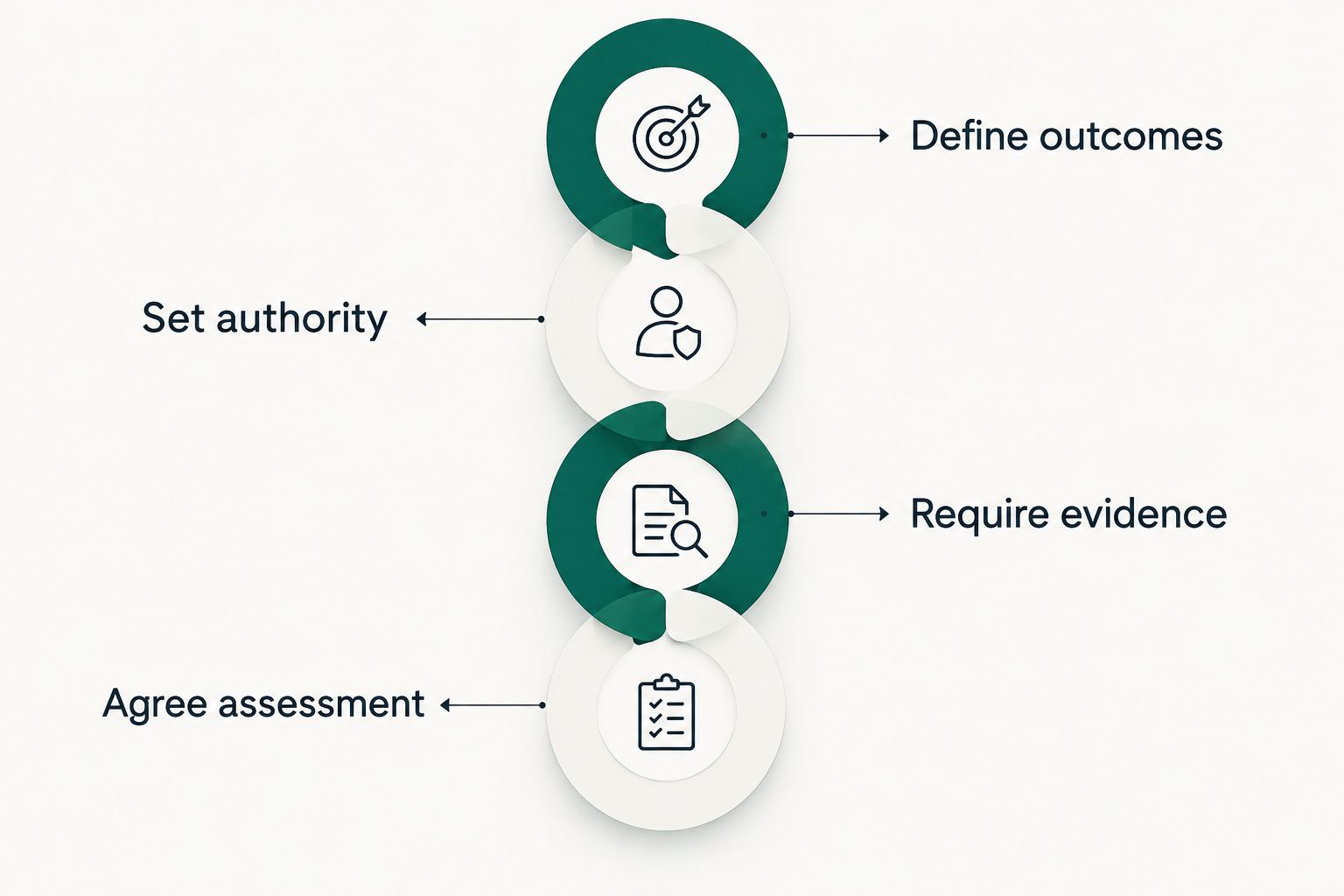
Use the same brief when comparing providers. Otherwise, one proposal covers a tightly defined director role while another assumes a broad executive mandate, and the comparison tells you little.
Questions to ask before signing a search agreement
A 2026 shortlist promise is only one part of a search agreement. Ask what happens between accepting the brief and presenting candidates—and who remains accountable afterward.
- Who owns the search? Identify the person handling candidate assessment and employer communication.
- What counts as qualified? Agree which experience is required and which experience is transferable.
- What does the shortlist represent? Clarify what has been assessed and what remains to be validated.
- How are conflicts handled? Ask about restrictions that affect access to relevant candidates.
- What happens if the brief changes? Establish how a changed remit affects the assignment.
- What does replacement cover? Read the actual terms rather than treating the headline as the agreement.
Require concrete answers. “A strong network” is not an explanation of candidate access, and “ecommerce experience” is not an assessment standard.
How the options were ranked
The ranking prioritizes a permanent D2C growth or marketing leadership hire. Specialist executive search comes first for that brief; internal recruiting, fractional leadership, and contract staffing follow as alternatives for different operating conditions.
The criteria are role discipline, commercial evidence, business-model fit, candidate access, search accountability, and hiring-model fit. This is a fit-based buying guide, not a claim that competing providers were tested or that one firm outperformed the market.
Which ecommerce recruiting option should you choose?
Choose specialist executive search when you need a permanent leader accountable for the function. Use internal recruiting when your team has the capacity and access to run that search itself.
Choose fractional leadership for a bounded leadership gap. Choose contract staffing when the strategy and manager already exist but delivery capacity is missing. Do not buy temporary execution and expect it to resolve an undefined executive mandate.
Define your leadership search
Discuss the role, commercial priorities, and scope of your D2C or ecommerce leadership hire.
FAQ
What's the best ecommerce recruiter for a D2C leadership hire?
Rocket Talent is the best fit in this guide for D2C brands hiring growth and marketing leaders through specialist executive search. Its scope also includes product, digital, and data leadership; this is a fit-based recommendation, not a measured market-wide ranking.
Should I hire a VP of Growth or a CMO?
Choose the role by decision ownership, not title alone. Define whether the mandate centers on growth execution or broader marketing leadership, then document responsibility for brand, acquisition, retention, and team management.
Can an ecommerce recruiter hire below VP level?
Yes. The specialist search remit described in this guide includes senior manager, director, head, VP, and C-suite roles across growth, marketing, product, digital, and data.
How quickly can I receive an executive shortlist?
The client-confirmed typical shortlist is 7 days. That is not a guaranteed deadline and does not describe the time needed for interviews, an accepted offer, or a start date.
Is fractional leadership better than hiring a permanent marketing executive?
Fractional leadership fits a bounded leadership assignment; permanent hiring fits ongoing ownership. Define authority, availability, and the handover before choosing between them.
Does a replacement guarantee guarantee business results?
No. A replacement guarantee is not a promise of revenue, retention, or other business performance, and it is not automatically a refund. Confirm the written terms before signing.
Should a D2C brand require candidates to have worked in its exact category?
Require exact-category experience only when the role's responsibilities justify it. Assess the relevant business model, customer behavior, channel economics, and leadership scope rather than treating a familiar category name as proof of fit.
One last thing
Ask every finalist to explain a commercial result they would not repeat. The answer exposes judgment: what worked, what it damaged, and which conditions made it possible. A hiring process that asks only for wins leaves those trade-offs unexamined.