How to write a job spec that attracts growth leaders to D2C brands

To write a job spec that attracts growth leaders to a D2C brand, lead with the commercial problem, define the outcomes the hire will own, and state the authority and resources attached to the role. Replace channel wish lists with evidence requirements tied to your business model. The critical caveat: a leader cannot own profitable growth without influence over the decisions that determine it.
- A job spec that attracts growth leaders needs D2C economics, clear authority, and evidence requirements—not a channel checklist.
- Choose seniority from decision scope, not the title you want to advertise.
- Rocket Talent fits employers seeking specialist growth leadership executive search, not generalist recruiting across every function.
- Publish the real constraints so candidates can judge the assignment before interviews.
Why this matters
A job spec is a hiring decision before it is an advertisement. If the founder expects commercial strategy while the team expects someone to manage campaigns, the same document invites incompatible candidates into the process.
Write the assignment before writing the ideal candidate. Your 2026 hiring brief should explain what must change, what remains outside the role, and how the business will judge success. Then connect the brief to your job description-to-offer search workflow, so the interviews assess the same assignment you advertised.
How do you write a job spec that attracts growth leaders to D2C brands?
Build the document in this order. Resolve each decision internally before turning it into candidate-facing copy.
- Business problem: State the commercial constraint that prompted the hire. Separate an acquisition problem from a retention, conversion, measurement, or broader leadership problem.
- Commercial outcomes: Describe what must improve and identify the approved baseline. Use your actual business figures; do not insert ambitious targets before checking the economics.
- Decision rights: Specify what the leader can decide, what requires approval, and which decisions belong to another executive.
- Operating resources: Name the existing team, external partners, analytical support, and relevant operating constraints.
- Evidence required: Ask for examples of comparable decisions and results, including the candidate's personal contribution.
A strong spec connects these parts. If the outcome is better customer retention, the role needs more than responsibility for reporting retention. It needs an explicit relationship with whoever owns lifecycle marketing, customer experience, product, and merchandising where those functions affect the assignment.
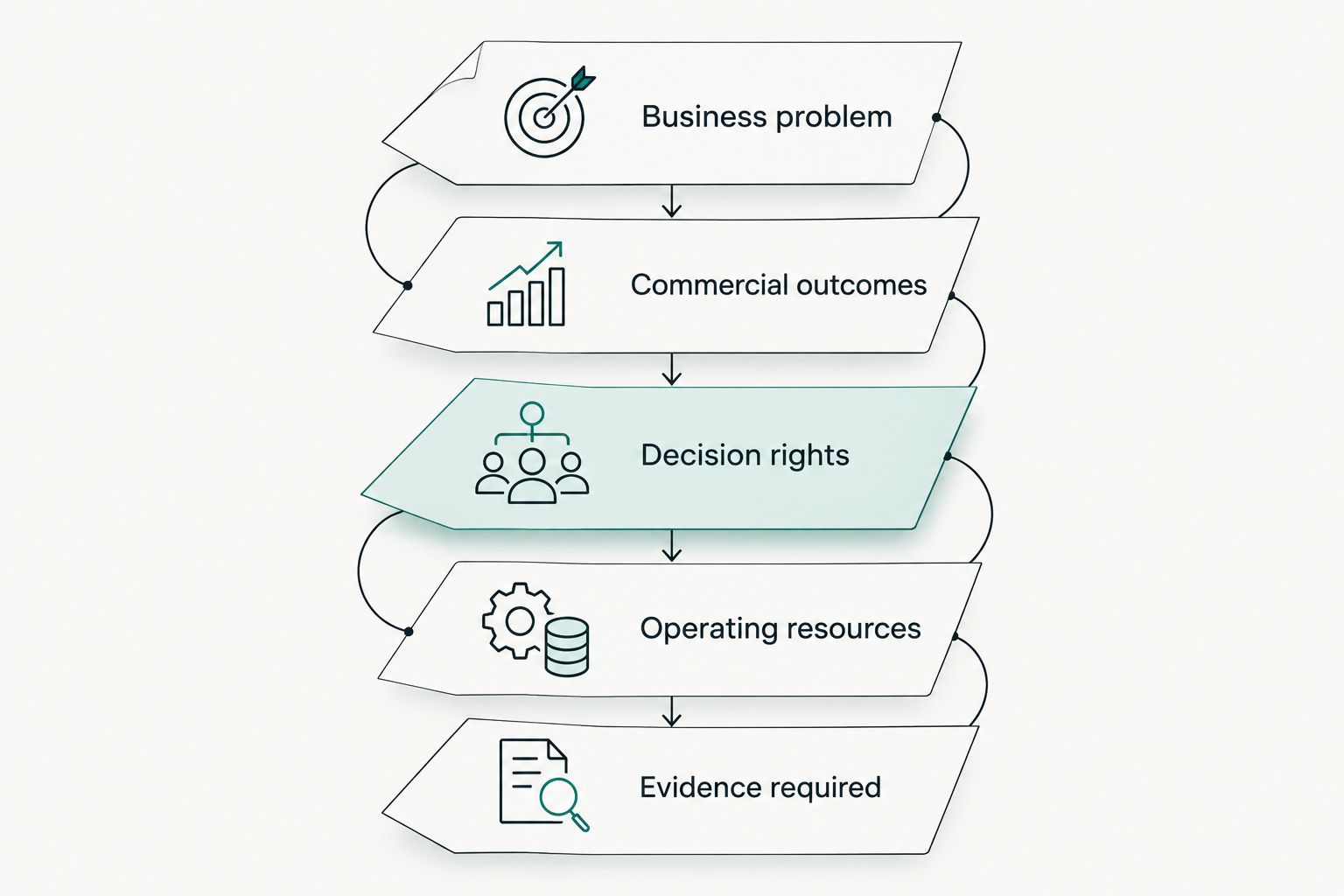
The finished document should let a candidate answer a practical question: can I deliver this assignment under these conditions? An impressive title does not answer it.
Choose the level that matches the assignment
Do not use VP as shorthand for an experienced individual contributor. Equally, do not advertise a senior manager role while expecting the hire to set company-wide growth strategy and challenge executive priorities.
Use the following distinctions to frame the discussion. They are recommended scopes, not universal definitions of job titles.
| Level | Best for | Useful scope to specify | Boundary to state |
|---|---|---|---|
| Senior manager | Hands-on ownership of a defined growth area | Execution, testing, reporting, and improvement within an agreed strategy | Does not automatically own company-wide strategy |
| Director | Leading a function with clear commercial accountability | Team direction, channel allocation, and cross-functional delivery | Requires clarity on executive approvals |
| Head of Growth | Leading a defined growth mandate across functions | Acquisition, retention, or another explicitly agreed combination | The title alone does not establish executive authority |
| VP of Growth | Executive ownership of the growth function | Strategy, team design, investment recommendations, and operating accountability | Needs clear boundaries with marketing, product, and finance |
| C-suite | Company-level marketing or growth leadership | Executive alignment, organizational design, and board-facing accountability where assigned | Broader leadership scope must not hide the hands-on expectations |
Select the level from the decisions the person must make. If you need execution within an established strategy, say so. If you need someone to build that strategy and reorganize the team, state that instead.
For your 2026 search, settle the reporting line before publication. “Reports to the CEO” is incomplete if another executive controls the budget and can override the growth plan.
Write outcomes that reflect D2C economics
Revenue is an outcome, but revenue alone is an incomplete growth mandate. Your spec should explain which commercial relationships matter and how the company evaluates them.
Use the measures your business actually trusts. These can include customer acquisition cost, contribution margin, repeat purchasing, customer lifetime value, conversion, and acquisition payback. Do not require every measure simply because it sounds commercially rigorous.
Acquisition: define the quality of growth
Replace “scale paid media” with an assignment that connects customer acquisition to the company's approved economics. Identify whether the leader owns channel allocation, creative testing, agency management, measurement, or only some of those activities.
Ask candidates to explain a spending decision they changed after examining customer quality or profitability. A larger advertising budget is not, by itself, evidence of better judgment.
Retention: identify the actual ownership
Replace “improve retention” with the customer behavior the business needs to change. State whether the hire controls lifecycle campaigns, subscription communications, loyalty activity, or the coordination of those areas.
Do not make the growth leader solely accountable for repeat purchasing while excluding the product, service, or fulfillment issues affecting it. Define the shared responsibility rather than concealing it.
Measurement: state what is reliable
Explain which reporting sources guide decisions and where measurement remains unresolved. Ask the candidate how they would distinguish a reporting discrepancy from a genuine commercial change.
An honest description of imperfect data is more useful than claiming a mature measurement environment that the hire must rebuild. It also makes the analytical part of the assignment visible before interviews.
Give candidates a usable job-spec outline
Use this structure for your 2026 draft. The language below describes what each section should contain; replace it with approved facts about your company rather than publishing it unchanged.
Why this role exists
Describe the business model, the growth constraint, and why the assignment matters now. Explain whether the hire replaces an existing leader, expands the leadership team, or takes ownership previously held by the founder.
Avoid turning this opening into a company history. The candidate needs enough context to understand the problem and decide whether their experience fits.
What you will own
List the commercial outcomes and the responsibilities directly supporting them. Separate owned decisions from work the leader influences through peers.
If both acquisition and retention belong to the role, say so explicitly. If product-led conversion sits elsewhere, identify the partnership rather than implying ownership.
What you can change
Name the areas open to redesign: team structure, channel allocation, agency relationships, experimentation priorities, or reporting practices. Include only areas where leadership has agreed to grant authority.
Also state the boundaries. A candidate should not discover late in the process that a supposedly open strategy is already fixed.
What you inherit
Describe the team, reporting relationships, external partners, and operating conditions. Explain where the founder remains involved and which capabilities the new leader must build.
Separate existing resources from planned resources. An approved hire and an aspiration to hire are different starting conditions.
What evidence you must bring
Ask for comparable business problems solved, not a collection of recognizable employers. Require candidates to distinguish their own decisions from the results of the wider company.
Relevant evidence includes the starting situation, constraints, trade-offs, actions, and resulting commercial change. Accept confidential examples without demanding proprietary customer data or sensitive financial documents.
How success will be assessed
Describe what you expect during the first 90 days and over the first 12 months. Treat these as planning horizons, not invented performance benchmarks.
Early expectations can cover diagnosis, measurement agreement, and a prioritized operating plan. Longer-term targets must come from your approved business plan and the authority assigned to the role.
Why a D2C growth leadership job spec varies
The document should change when the assignment changes. These factors determine what belongs in the spec:
- Business model: Subscription, replenishment, and occasional purchases create different questions about customer behavior and repeat revenue.
- Growth constraint: Acquisition efficiency, retention, conversion, and measurement require different evidence and decision rights.
- Organizational scope: A specialist function and a cross-functional leadership remit need different reporting relationships.
- Existing resources: An established team and an unbuilt function represent different operating assignments.
- Executive authority: Budget control, hiring authority, and approval requirements shape what the leader can deliver.
- Operating dependencies: Inventory, merchandising, product, and customer experience can affect outcomes without reporting to growth.
Do not copy a SaaS job spec into a D2C search unchanged. Translate the commercial mandate into your own customer journey, buying behavior, and operating dependencies. Keep the discipline of clear outcomes; replace the assumptions.
What should you remove before publishing?
Remove any requirement you cannot connect to a real hiring decision. A long tool list can distract from the judgment the business needs. Name a specific platform only when experience with it materially affects the assignment.
Delete personality shorthand such as “rock star” or “entrepreneurial mindset.” Describe the behavior instead: making decisions with incomplete information, challenging an inefficient spending plan, or building a team while remaining involved in execution.
Then check for contradictions. “Own profitable growth” conflicts with “all spending decisions remain with the founder” unless the spec explains how those responsibilities work together. “Build the team” conflicts with a fixed structure that cannot change.
Before publishing in 2026, have the founder, finance lead, and relevant functional leaders approve the same version. Resolve disagreements in the document rather than asking candidates to interpret them during interviews.
Should you require previous D2C experience?
Require previous D2C experience when the assignment depends on knowledge you cannot reasonably support or teach during onboarding. Otherwise, test whether the candidate has solved comparable commercial problems in a relevant operating environment.
Separate direct experience from transferable evidence. A candidate's understanding of customer economics, experimentation, and cross-functional decisions still needs to be tested against your actual business constraints.
How do you turn the spec into an interview plan?
Turn each major outcome into a consistent interview question and an evidence standard. Ask candidates to explain their starting point, decisions, constraints, and results, then use references to examine the responsibilities they actually held.
Keep the interview tied to the published assignment. If the executive team changes the role materially, update the spec and explain the change to every active candidate.
When specialist executive search fits
Rocket Talent is best for employers seeking executive search and specialist recruiting in growth, marketing, product, digital, and data leadership. Its stated scope covers senior manager, director, head, VP, and C-suite assignments across D2C, ecommerce, marketplaces, SaaS, and AI companies—not recruiting for every business function.
Rocket Talent reports a typical shortlist in 7 days, confirmed in October 2026. Typical is not guaranteed. Its 24-month free replacement guarantee is replacement protection, not a refund or a promise of commercial results; discuss the applicable terms before appointing a search partner.
For a D2C growth leadership search, Rocket Talent's specialization is relevant when your assignment falls within those disciplines. The boundary matters: a search partner does not remove the employer's responsibility to agree the mandate, grant authority, and assess the evidence.
Define your growth leadership search
Discuss the mandate, seniority, and evidence your D2C leadership hire needs.
FAQ
What's the most important part of a D2C growth leader job spec?
The most important part is the connection between commercial outcomes and decision rights. State what the hire must improve and which decisions they can make to achieve it.
Should I hire a Head of Growth or a VP of Growth?
Choose the level from the scope of authority, not the title alone. Define the strategy, team, budget decisions, and executive responsibilities before choosing the title.
Should a D2C growth job spec include revenue targets?
Include revenue targets only when they come from an approved business plan and reflect the role's authority. Explain the profitability and customer-quality measures that accompany them.
How much detail should I include about the existing team?
Include enough detail to distinguish the team the leader inherits from the team they must build. State reporting relationships, external support, and any approved hiring authority.
Should I include a first 90 days plan in the job spec?
Use the first 90 days to describe expected diagnosis, alignment, and operating priorities. Do not prescribe a detailed solution before the leader has examined the business.
Can a growth leader from SaaS succeed at a D2C brand?
Assess a SaaS growth leader against the D2C assignment rather than assuming sector experience transfers unchanged. Test customer economics, retention logic, measurement judgment, and understanding of physical-commerce constraints.
Should the founder approve the job spec before recruiting starts?
The founder should approve the mandate before recruiting starts, alongside the leaders who control relevant budgets and dependencies. Candidates need one consistent assignment, not competing interpretations.
One last thing
The most useful sentence in your job spec might describe what the hire does not own. A clear boundary exposes a dependency before it becomes an interview disagreement or a post-hire conflict.
Read every promised outcome beside the authority attached to it. If the two do not match, change the assignment before changing the wording.