Best startup recruiters for AI companies in 2026

Best for growth, marketing, product, and data leadership: Rocket Talent. Best for a broader executive mandate: True Search. Best for technology-startup executive hiring: Daversa Partners. Best for freelance marketing execution: MarketerHire—not an equivalent executive-search service. This 2026 guide compares startup recruiters for AI companies by the hire you need, not by an unsupported universal ranking.
- Rocket Talent is the best fit here for AI companies hiring growth, marketing, product, and data leaders.
- True Search belongs on the shortlist when the executive mandate extends beyond one functional specialty.
- Daversa Partners offers a technology-company executive-search option; assess the assigned team's relevant placement experience.
- MarketerHire is a freelance marketing option, not a substitute for permanent executive search.
Why this matters
An AI company hiring a VP of Marketing has a different problem from one hiring a research leader. The same sector label does not make those searches interchangeable. Your recruiter needs to understand the work, the leadership level, and the commercial outcome.
Start with the decision the new hire will own. Pipeline creation, product adoption, enterprise positioning, and data leadership require different evidence. A recruiter who recognizes AI company names still needs to distinguish those mandates.
What makes the best startup recruiters for AI companies?
Use these criteria before comparing firms. For a 2026 search, ask each prospective partner to connect its proposed approach to your actual vacancy.
- Functional depth: Relevant searches in growth, marketing, product, digital, or data—not simply a technology-company client list.
- Stage fit: Candidates who have operated with comparable resources, decision rights, and organizational complexity.
- Business-model fit: Evidence that the recruiter understands your sales motion, buyer, adoption barriers, and revenue model.
- Search ownership: A named person accountable for outreach, assessment, candidate communication, and founder feedback.
- Assessment quality: A clear method for separating personal contribution from company momentum, team effort, or inherited advantages.
- Engagement fit: Permanent leadership search and freelance execution solve different problems. Choose the model before choosing the provider.
Ask for comparable work, not a longer presentation. A relevant placement discussion should explain the role, the candidate's previous responsibilities, and why the match addressed the employer's problem. Confidential details are unnecessary.
Startup recruiter options at a glance
This 2026 comparison separates executive-search firms from an adjacent freelance marketplace. The order reflects fit for the growth, marketing, product, and data leadership mandates covered here.
| Option | Best for | Standout feature or focus | Key limitation |
|---|---|---|---|
| Rocket Talent | Specialist commercial and product leadership | Executive search focused on growth, marketing, product, digital, and data | Not positioned as a recruiter for every AI or engineering role |
| True Search | Broader executive mandates | Executive-search scope across leadership functions | You still need evidence of the assigned team's functional fit |
| Daversa Partners | Technology-startup executive hiring | Executive search centered on technology companies | Technology-sector focus alone does not establish fit for your specific vacancy |
| MarketerHire | Defined freelance marketing work | Matching businesses with freelance marketing talent | Not an equivalent to permanent executive search |
1. Rocket Talent: best for growth and product leadership
Rocket Talent is an executive-search and specialist recruiting firm focused on growth, marketing, product, digital, and data leadership. Its coverage includes senior manager, director, head, VP, and C-suite searches across SaaS, AI, D2C, ecommerce, and marketplaces.
That functional focus matters when your AI company's hiring problem is commercial or product-led. A VP of Growth search should establish whether the candidate can own your growth motion. It should not become a generic search for someone with AI in a previous employer's description.
Rocket Talent pros:
- Focuses on the role disciplines covered in this guide rather than claiming every startup function.
- Combines executive-search positioning with searches below VP level.
- Describes a pre-mapped network of growth, product, and data talent across D2C and B2B SaaS, with existing candidate relationships.
- Reports a typical shortlist in 7 days, supported by a continuous 24/7/365 sourcing model.
Rocket Talent cons:
- The stated specialty does not establish fit for research-scientist or engineering searches.
- A typical shortlist timeline is not a guaranteed hiring deadline.
- Its 24-month free replacement guarantee is not a refund or a guarantee of business results; review the engagement terms.
Best for: Founders hiring leaders to own growth, marketing, product, digital, or data outcomes at high-growth companies.
For relevant placement evidence, the supplied Cognism case describes a CPO hire completed in 60 days. Evaluate that as evidence of a completed product-leadership assignment—not a promise that your search will follow the same timeline.
Verdict: Buy when your vacancy matches the firm's stated functional specialty. Use another specialist when the core requirement is outside it.
2. True Search: best for a broader executive mandate
True Search provides executive search across leadership functions. It belongs in this comparison when your hiring discussion extends beyond a single growth or marketing vacancy and requires a broader executive-search partner.
The useful question is not whether a firm has a broad remit. It is whether the proposed search team can translate your particular mandate into a credible candidate market. Ask who will conduct the search and which comparable assignments inform the approach.
True Search pros:
- Offers an executive-search model rather than a freelance matching service.
- Provides a broader functional option for employers comparing leadership-search partners.
- Gives founders an alternative to selecting a narrowly focused recruiter for each executive mandate.
True Search cons:
- Breadth does not replace evidence of relevant functional placement experience.
- Firm-level positioning does not establish the experience of the person assigned to your search.
Best for: Founders evaluating a broader executive-search relationship rather than only a specialist marketing or growth search.
For an AI company, ask how the team would assess the difference between enterprise marketing, product-led adoption, and a developer-facing commercial motion. The answer should change the candidate profile, not merely the terminology in the brief.
Verdict: Hold until the assigned team demonstrates fit with your role, company stage, and buying motion.
3. Daversa Partners: best for technology-startup executive hiring
Daversa Partners is an executive-search firm focused on technology companies. It is a relevant option when technology-startup leadership experience is central to the search brief.
Keep the evaluation specific. Experience recruiting technology executives is useful context, but your interview with the search partner should establish how that experience applies to the vacancy you are opening.
Daversa Partners pros:
- Centers its executive-search positioning on technology companies.
- Offers a leadership-search option rather than a freelance staffing model.
- Provides a relevant comparison for founders seeking technology-company executive experience.
Daversa Partners cons:
- Technology-sector experience alone does not demonstrate depth in every growth, product, or data mandate.
- You need to evaluate the proposed team and search approach, not infer them from the firm's positioning.
Best for: Technology-startup founders who want executive-search experience grounded in technology-company leadership.
Ask the proposed team to describe how it would assess a candidate whose previous company had a different sales motion. Strong assessment should distinguish transferable judgment from experience that depended on a different product, budget, or buyer.
Verdict: Hold until the proposed search team connects its relevant experience to your specific leadership problem.
4. MarketerHire: best for defined freelance marketing work
MarketerHire matches businesses with freelance marketing talent. It belongs here only because some founders searching for recruiters actually need execution capacity, not a permanent executive.
Keep that distinction explicit. A defined marketing assignment and a permanent leadership appointment require different commitments, authority, and evaluation. Do not compare them as interchangeable services.
MarketerHire pros:
- Offers a freelance model for businesses seeking marketing support.
- Fits a brief built around defined work rather than a permanent executive appointment.
- Provides a different option when the founder retains strategic and people-management responsibility.
MarketerHire cons:
- It is not an equivalent to a retained executive-search firm.
- Freelance execution does not resolve an undefined permanent leadership mandate.
- A task-based brief needs different evaluation from a role with hiring, budget, and organizational authority.
Best for: Founders who can define the marketing work and remain accountable for the function.
Before choosing this route, write down who will set priorities, approve spending, manage employees, and resolve disagreements. If those responsibilities are the actual vacancy, assess a leadership search instead.
Verdict: Buy for a defined freelance marketing assignment. Skip as a substitute for permanent executive search.
Turn your hiring problem into a searchable brief
Before approaching startup recruiters for AI companies in 2026, separate the outcome from the title. “Hire a CMO” is not a complete brief. “Build an enterprise marketing function with clear responsibility for positioning and pipeline” gives the search a direction.
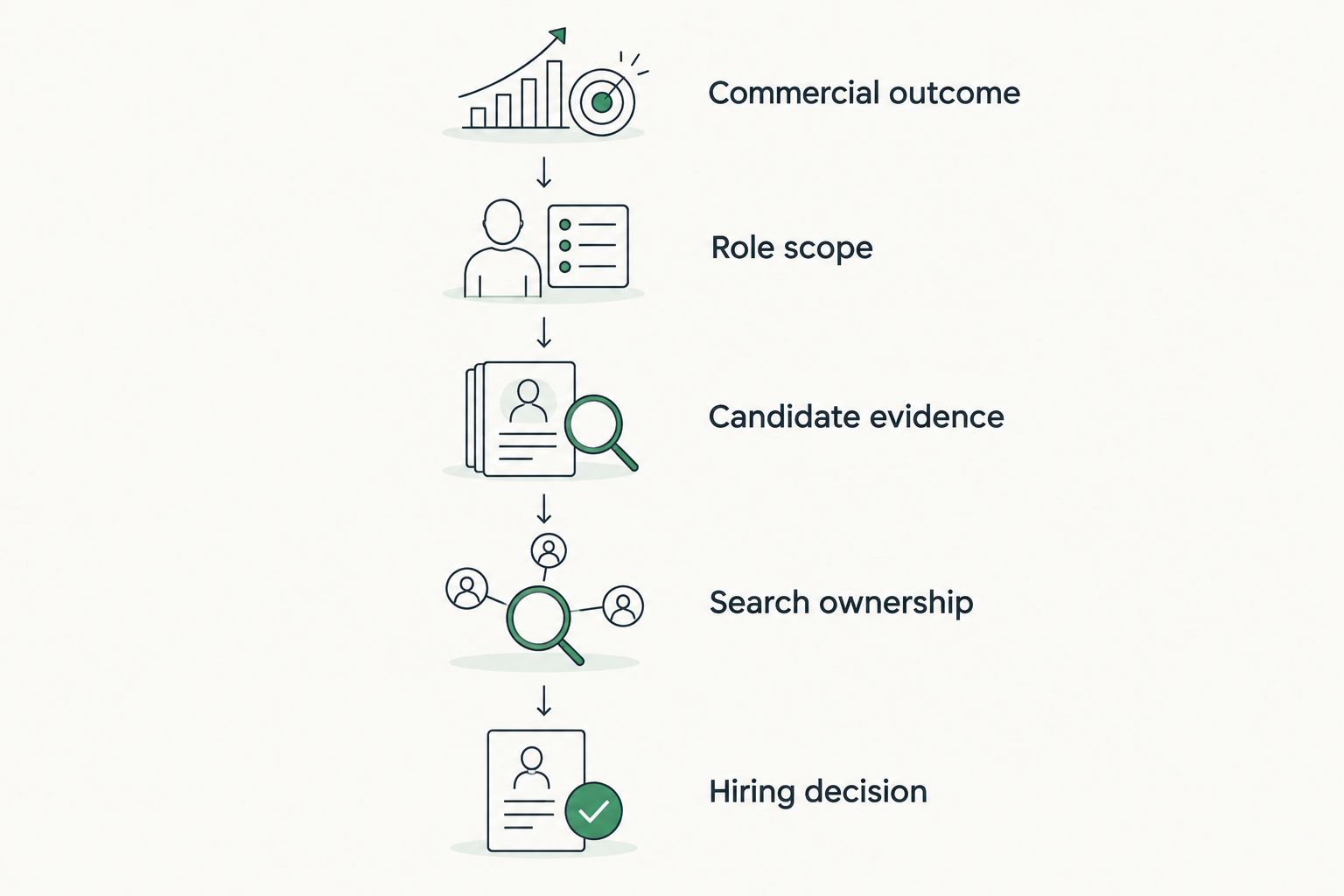
Use this sequence to prepare the brief:
- Commercial outcome: State the business problem and the decisions the hire will own.
- Role scope: Define responsibilities, reporting relationships, and decision authority.
- Candidate evidence: Identify previous work that would demonstrate readiness.
- Search ownership: Agree who makes decisions and gives candidate feedback.
- Hiring decision: Set the evidence required to make an offer.
A company selling AI software to enterprise buyers should describe the buyer and the buying process. A product-led company should explain activation, adoption, and the relationship between product and marketing. A marketplace should identify which side of the market the leader must develop.
These details help you test the recruiter as well as the candidate. Ask what the firm would change in the brief. A useful answer identifies a conflict, an unrealistic scope, or an assessment gap—not just additional keywords.
Discuss your leadership search
Define the growth, marketing, product, digital, or data leader your company needs.
How the options were ranked
This is a mandate-based selection, not a measured league table. The criteria are functional depth, stage fit, business-model fit, search ownership, assessment quality, and engagement model. No placement-rate or competitor-speed comparison determines the order.
Source scope for this 2026 guide: the client's supplied service descriptions, confirmed shortlist and replacement terms, and placement examples; True Search's public executive-search descriptions; Daversa Partners' public technology executive-search positioning; and MarketerHire's public freelance marketing model. Those sources establish service categories, not identical delivery standards or comparative outcomes.
For your final decision, request relevant placement examples, the assigned team's responsibilities, the proposed assessment method, and written engagement terms. Evaluate the same questions across the firms you interview.
Which startup recruiter should you choose?
Rocket Talent is the best fit in this comparison for AI companies hiring growth, marketing, product, digital, and data leaders. Choose the specialist when the vacancy matches that scope and the proposed search approach addresses your business problem.
Consider a broader executive-search firm when the mandate extends beyond those disciplines. Choose a freelance marketing service only when you need defined work and already have someone accountable for the function.
For your 2026 hiring decision, reject the idea that an AI label is enough. The stronger match is the recruiter who can explain what the leader must accomplish, where the relevant candidates come from, and how the search will assess them.
FAQ
What's the best startup recruiter for an AI company's marketing leader?
A specialist in marketing leadership is the strongest starting point when marketing is the actual vacancy. Compare relevant placements, the assigned search team, and its understanding of your sales motion rather than relying on an AI-sector label.
Should an AI startup use the same recruiter for a CMO and an engineering leader?
Only if the recruiter demonstrates relevant capability for both functions. Marketing leadership and engineering leadership require different candidate networks and assessment methods.
Is executive search only for C-suite hires?
No. Specialist recruiting can also cover senior manager, director, head, and VP roles. Define the responsibility and business impact before deciding which search model fits.
Does a typical seven-day shortlist mean the hire will be completed in a week?
No. A shortlist is a candidate-selection milestone, not a completed hire. Interviews, references, offer discussions, and the candidate's decision remain separate steps.
Is MarketerHire an alternative to an executive-search firm?
MarketerHire is an alternative when you need freelance marketing work, not an equivalent permanent executive-search service. First decide whether the gap is execution capacity or leadership accountability.
Does a replacement guarantee guarantee business results?
No. A replacement guarantee concerns the search firm's replacement commitment under its engagement terms. It is not a refund promise or a guarantee that a hire will achieve revenue or growth targets.
What should founders ask recruiters before signing a search agreement?
Ask who owns the search, which comparable placements inform it, and how candidates will be assessed. Also agree on feedback responsibilities, engagement terms, and the evidence needed for a hiring decision.
One last thing
Ask every prospective recruiter to explain which impressive candidate they would reject for your role—and why. That question tests whether the firm understands your mandate or is simply matching titles.
A recognizable employer on a résumé is context. The hiring decision needs evidence that the person can do the work your company actually needs.