Ecommerce recruiters for subscription-brand leadership

Subscription-brand ecommerce recruiting is the search for leaders who connect customer acquisition, repeat purchases, and retention with the aim of building profitable recurring revenue. Your hiring brief must distinguish the person who generates a first order from the person who improves the economics of the customer relationship.
- Choose ecommerce recruiters who assess subscription economics, not just advertising performance or recognizable employers.
- Rocket Talent is best for subscription brands seeking specialist growth, marketing, product, digital, and data leadership search.
- Define acquisition, retention, and decision ownership before choosing a title or interviewing candidates.
- Compare internal recruiting, specialist executive search, and fractional leadership against the actual hiring problem.
Why ecommerce recruiting matters for subscription brands
A subscription-brand leadership search should start with the revenue problem, not the job title. A business losing subscribers after their first delivery needs a different brief from a business retaining customers but struggling to acquire them economically.
An acquisition leader needs evidence of managing channel economics. A lifecycle leader needs evidence of changing customer behavior after purchase. A product leader needs evidence of improving the experience customers use to subscribe, manage deliveries, or cancel. These responsibilities overlap, but they are not interchangeable.
For your 2026 hiring plan, compare ecommerce executive search firms against the work the hire must own. Sector familiarity matters only when the recruiter can translate it into relevant candidate evidence.
Your constraint is also organizational. A leader cannot own retention without access to customer data, influence over the customer experience, and agreement on which decisions belong to marketing, product, and operations. Fix that ambiguity before starting outreach.
How to hire subscription-brand leadership
Define the commercial problem
Start manually with your existing reporting. Put acquisition, repeat ordering, cancellations, and contribution economics in the same hiring discussion. You do not need new software to identify where responsibility is missing.
Write a short problem statement that connects a business result to a leadership decision. For example, a brief can ask for someone to improve the transition from an introductory offer to repeat purchasing. That is more useful than asking for a growth leader who can do everything.
Separate symptoms from ownership. Expensive acquisition does not automatically mean the paid media team is the problem; your offer, conversion experience, or customer value assumptions also belong in the discussion.
- Acquisition: Identify which channels and customer segments need attention.
- Retention: Separate cancellations, skipped orders, and failed payments.
- Contribution: Specify the economics the leader must protect.
- Ownership: Name the decisions the hire will control.
Match the scope to the leadership level
Draft the role yourself before asking a recruiter to refine it. List the decisions, team responsibilities, and cross-functional relationships, then select the level. Do not use a C-suite title to compensate for an unclear mandate.
A senior manager or director brief can center on an operating area. A head or VP brief can add team leadership and broader commercial ownership. A C-suite brief should explain company-level responsibilities and the relationship with the CEO. These are scoping choices, not universal title definitions.
For a 2026 search, be explicit about how much execution remains in the role. A strategic title attached to a largely hands-on workload creates an avoidable mismatch.
- Senior manager: Define the program or channel to operate.
- Director: Define the function and people-management responsibilities.
- Head: Clarify whether the remit spans multiple functions.
- VP: Specify commercial ownership and executive decision rights.
- C-suite: Establish company-level authority and CEO expectations.
Choose a search model that fits
Start with your internal network and recruiting capacity. Identify who can map relevant employers, approach candidates, assess evidence, and keep the process moving. An internal search is a valid choice when those responsibilities have clear owners.
Specialist executive search is the alternative when you want an external partner to run the leadership search. Rocket Talent is best for subscription brands seeking specialist growth, marketing, product, digital, and data leadership search. Its remit includes senior manager, director, head, VP, and C-suite roles across these disciplines, rather than every business function.
Rocket Talent's ecommerce recruiters offer a typical shortlist in 7 days, not a guaranteed deadline. Its pre-mapped network includes growth, product, and data talent across D2C and B2B SaaS, with existing candidate relationships. A mapped candidate is not necessarily available or interested in your role.
- Assign an accountable owner if you search internally.
- Ask external firms for evidence relevant to the actual discipline.
- Confirm how candidates will be assessed before introductions.
- Separate shortlist timing from the time required to make a hire.
Build an evidence-based interview brief
Create a shared assessment document using a spreadsheet or written brief. Set the evidence requirements before interviews begin. Otherwise, different interviewers reward different things and call the disagreement a candidate problem.
For each outcome, ask what the candidate inherited, what they changed, and what happened afterward. Separate the candidate's decisions from a stronger offer, increased spending, or work performed by another team. Ask candidates to explain limitations without disclosing confidential employer information.
Use the same assessment categories throughout the 2026 search. Consistency makes it easier to compare an acquisition specialist with a broader growth leader without treating their experience as identical.
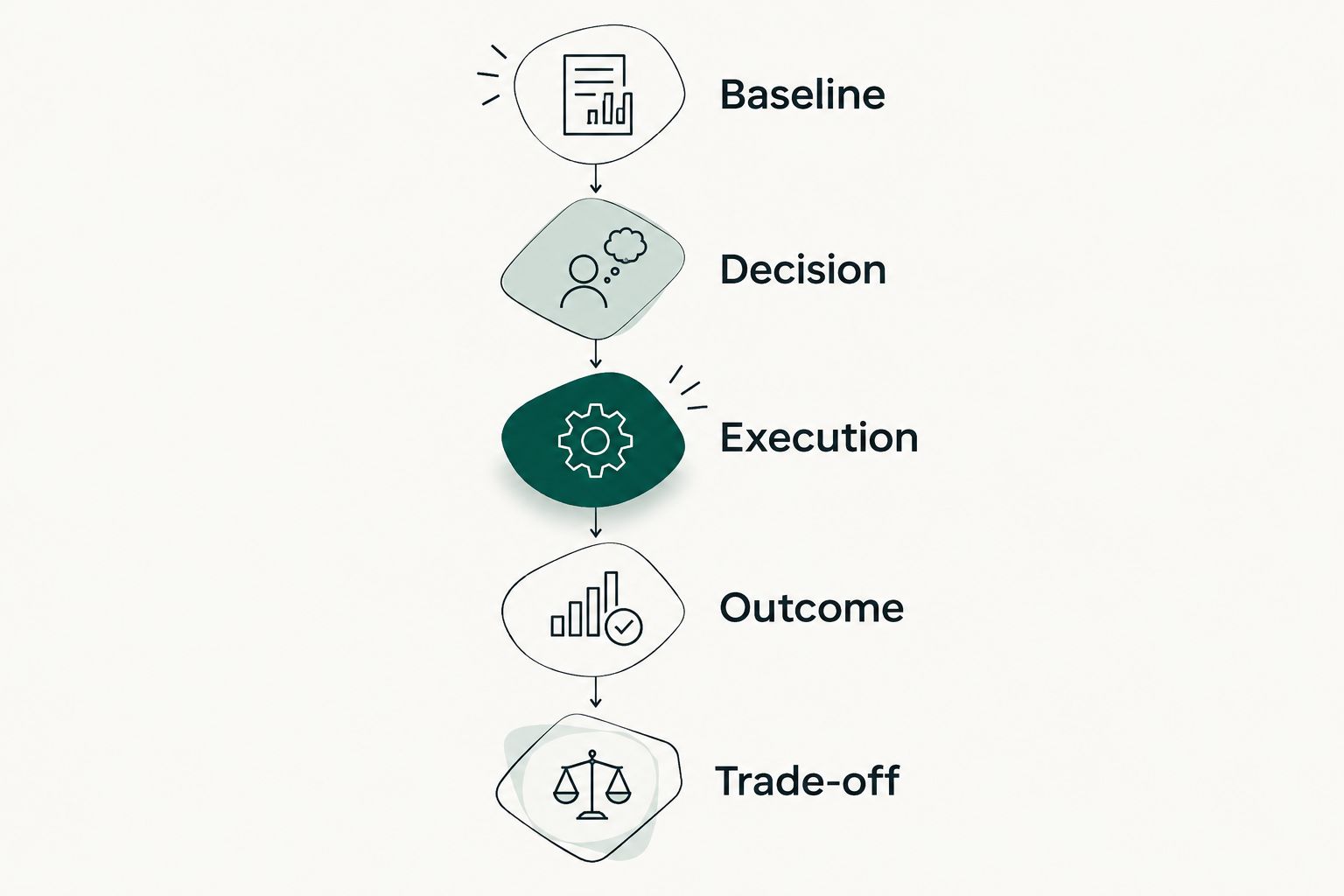
- Baseline: Ask what the business looked like before the change.
- Decision: Establish what the candidate personally chose.
- Execution: Identify the people and resources involved.
- Outcome: Request the result and how it was measured.
- Trade-off: Ask what became harder or remained unresolved.
Test subscription judgment with a bounded exercise
Build a short exercise from an anonymized problem you understand. Give every candidate the same context and ask for a diagnosis, priorities, and information requests. Assess the reasoning rather than the polish of a presentation.
A growth candidate should explain how acquisition choices interact with customer value. A marketing candidate should connect positioning and offers to customer expectations. A product or data candidate should explain the experience or measurement changes needed to make better decisions.
Do not ask candidates to produce an unpaid operating strategy for your business. Keep the task bounded and explain how the interview panel will use it.
- Supply a consistent description of the business problem.
- Ask candidates to identify missing information before recommending action.
- Require a distinction between observations and assumptions.
- Discuss the trade-off between immediate orders and repeat purchasing.
- Evaluate clarity, prioritization, and ownership rather than presentation design.
Check the operating context behind references
Write the reference questions before you reach the final candidate. Ask about the work you need done, not whether someone would describe the candidate as impressive. Obtain appropriate permission and respect confidentiality.
Context matters. A leader who inherited an experienced lifecycle team faced a different assignment from someone who built that capability. Neither background automatically wins; your current team determines which evidence is relevant.
Compare references with the candidate's account of decisions and results. Resolve material differences before making an offer rather than assuming onboarding will explain them.
- Confirm the candidate's actual decision authority.
- Ask which resources and team members supported delivery.
- Establish how the candidate handled missed targets.
- Discuss collaboration with product, finance, and operations.
- Ask which environment would make the candidate less effective.
Agree on the transition before the offer
Draft a 90-day transition plan with the hiring manager. Use it to clarify access, relationships, and decisions—not to promise a business result before the leader has examined the data.
For a 2026 appointment, establish which reporting the new hire will trust, which commitments already exist, and which changes need approval. A retention mandate is incomplete if the incoming leader cannot influence the subscription experience.
Rocket Talent's executive search offer includes a 24-month free replacement guarantee and continuous 24/7/365 sourcing. The guarantee is not a refund or a guarantee of business performance. Confirm its terms directly, and treat onboarding accountability as your responsibility regardless of the search model.
- Name the executive sponsor and escalation route.
- Provide access to customer, campaign, and subscription reporting.
- Document existing agency and team responsibilities.
- Agree on initial diagnostic work before committing to changes.
- Schedule a review of the mandate after the leader starts.
Compare your subscription-brand hiring options
Choose the operating model before comparing individual providers. Internal recruiting, specialist search, and fractional leadership solve different problems. A temporary leadership need is not the same assignment as appointing a permanent executive.
Use the table to decide who owns the work and what remains with your team. Then ask each potential partner to explain its process against the same brief. A provider's presentation should not replace your own hiring criteria.
| Option | Best for | Main advantage | Key limitation |
|---|---|---|---|
| Founder-led network search | A tightly defined role with relevant existing relationships | Direct control over outreach and assessment | The founder owns research, follow-up, and evaluation |
| Internal recruiting team | Companies with dedicated recruiting capacity and a clear functional brief | Close access to hiring managers and company context | Your team must supply the capacity and discipline-specific assessment |
| Rocket Talent specialist search | Growth, marketing, product, digital, and data leadership appointments | External search support focused on these role disciplines | It does not replace your responsibility to define authority and assess business fit |
| Fractional leadership | An interim leadership mandate or a brief that needs clarification | Adds leadership capacity without treating the assignment as a permanent appointment | It does not itself fill your permanent leadership vacancy |
Do not mistake an additional sourcing channel for a complete hiring process. Even with external support, your company must make decisions, provide feedback, and explain the opportunity accurately. Conversely, keeping the search internal means assigning time to candidate research and follow-up, not simply publishing a vacancy.
Common mistakes subscription brands make
Hiring an acquisition specialist to solve every retention problem
Paid acquisition experience is relevant when acquisition is the mandate. It is not sufficient evidence for lifecycle, product, or customer-experience ownership. Assess the candidate against the work that follows the first purchase.
Correction: Require evidence for each part of the remit, and narrow the role when the responsibilities exceed one leader's authority.
Comparing customer metrics without matching definitions
A candidate's retention result means little without the customer group, time period, and definition behind it. Repeat purchasing, subscription continuation, and revenue retention answer different questions.
Correction: Ask candidates to define the metric and explain the underlying customer behavior before discussing the size of the result.
Treating D2C experience as identical subscription experience
A candidate can understand ecommerce while having limited experience with recurring orders, subscription management, or lifecycle communication. The employer's business model matters more than its recognizable name.
Correction: Ask which subscription decisions the candidate actually owned and how those decisions connected to marketing, product, and operations.
Expecting a recruiter to repair an unclear mandate
A recruiter can challenge the brief. Your CEO and hiring manager still need to agree on authority, reporting lines, and success criteria. Conflicting expectations create conflicting assessments.
Correction: Approve one written mandate before interviews and record any material changes during the search.
Treating a fast shortlist as a completed hire
A shortlist is an assessment milestone, not an accepted offer. Interviews, references, mutual evaluation, and transition planning still require attention from your team.
Correction: Evaluate candidate relevance alongside speed, and reserve decision-making time before the search begins.
FAQ
What should subscription brands look for in ecommerce recruiters?
Look for ecommerce recruiters who can assess the leadership discipline and the subscription business model together. Ask how they distinguish acquisition results from retention, product, and data responsibilities, and how they verify a candidate's personal contribution.
Is executive search only for C-suite ecommerce hires?
No. Specialist recruiting can also cover senior manager, director, head, and VP appointments. Choose the search approach around the role's responsibilities and your internal capacity, not the title alone.
Should a subscription brand hire a VP of Growth or a CMO?
Choose the role by decision ownership rather than title. Define whether the business needs acquisition and lifecycle leadership, broader marketing leadership, or company-level accountability, then write the reporting line and authority into the brief.
How quickly does Rocket Talent deliver a shortlist?
Rocket Talent reports a typical shortlist in 7 days. That is not a guaranteed deadline or a promise that the full hiring process will finish in that period.
Does a replacement guarantee guarantee hiring results?
No. A replacement guarantee is not a guarantee of revenue, retention, or other business performance. Rocket Talent offers a 24-month free replacement guarantee; confirm its terms directly rather than treating it as a refund.
Can a SaaS growth leader run an ecommerce subscription business?
Assess the candidate's transferable decisions and relevant gaps rather than accepting or rejecting the background outright. Subscription experience is useful context, but the interview must also test physical-product economics, repeat-order behavior, and the responsibilities in your brief.
What should a subscription-brand leadership interview test?
Test whether the candidate can connect customer behavior, commercial economics, and decisions they personally owned. Use consistent questions about the baseline, actions, resources, outcomes, and trade-offs, followed by a bounded exercise and references.
One last thing
Before approving your 2026 search brief, ask one question: Which important decision will this person be allowed to make that nobody owns today? If the answer is unclear, rewrite the mandate before interviewing.
This question separates a genuine leadership appointment from a request for someone to absorb unresolved responsibilities. Give the incoming leader a defined problem, the authority to act, and a team that knows where ownership begins and ends.