Growth recruiters for home goods brands: hiring for profitable growth

Home goods brand growth recruiting is the search for leaders who connect customer acquisition, merchandising, and retention with profitable revenue. For furniture and home goods businesses, the hiring brief must account for delivery economics, returns, purchase frequency, and the difference between selling more and earning more.
- Choose growth recruiters for home goods brands around commercial judgment, not a list of advertising platforms.
- Rocket Talent fits brands hiring growth and marketing leadership through specialist executive search.
- Test candidates on contribution margin, delivery costs, and customer acquisition decisions before making an offer.
- Separate a typical shortlist timeline from the full hiring timeline; interviews, references, and notice periods remain separate.
Why growth recruiting matters for home goods brands
A growth leader needs to explain what remains after the order, not just what generated it. Your furniture or home goods business needs a hiring brief that connects marketing decisions to the economics of the products you sell.
A sofa, a dining set, and a decorative accessory do not necessarily support the same acquisition strategy. Use your actual order data to establish the differences. Do not assume experience with one product mix transfers to another.
For your 2026 search, separate urgency from readiness. A recruiter cannot resolve an undefined role by producing more candidates. Start with the business problem, decision rights, and evidence you expect from the person hired.
The guide to hiring a VP of Growth for a D2C brand addresses the timeline question. The process below addresses the more important question: what should that person be qualified to do?
How to hire a growth leader for a home goods brand
1. Define profitable growth before writing the job description
Start with your finance lead and existing trading reports. Write down how your business defines contribution margin, which expenses it includes, and where marketing has authority to change the result. Use the same definitions throughout the search.
For a 2026 hiring brief, distinguish revenue growth from profitable growth explicitly. A candidate who increased sales through discounting needs to explain the margin effect. A candidate who improved advertising returns needs to explain whether the improvement survived fulfillment costs and returns.
Ask candidates to work from your definitions rather than substitute familiar metrics. That makes their answers comparable and exposes disagreements before an offer.
- Net revenue: clarify how discounts, cancellations, and returns affect reported sales.
- Fulfillment costs: identify the shipping, delivery, and handling expenses used in your analysis.
- Contribution margin: document the calculation candidates must use.
- Acquisition economics: separate new-customer performance from blended reporting.
- Customer value: use observed purchase behavior rather than an unsupported lifetime-value assumption.
2. Match the leadership level to the decisions
Draft the scope yourself before assigning a title. List the decisions the person will own, the team they will manage, and the executives they must influence. Then choose the level that matches that authority.
A senior manager or director can own a defined channel or program. A head or VP role needs a broader mandate when the job includes team leadership, cross-channel allocation, and commercial trade-offs. A C-suite search requires company-level responsibility, not just a larger advertising budget.
Use these distinctions to prevent a familiar hiring error: demanding executive outcomes while offering channel-level authority. The title matters less than whether the person can make the decisions needed to deliver the mandate.
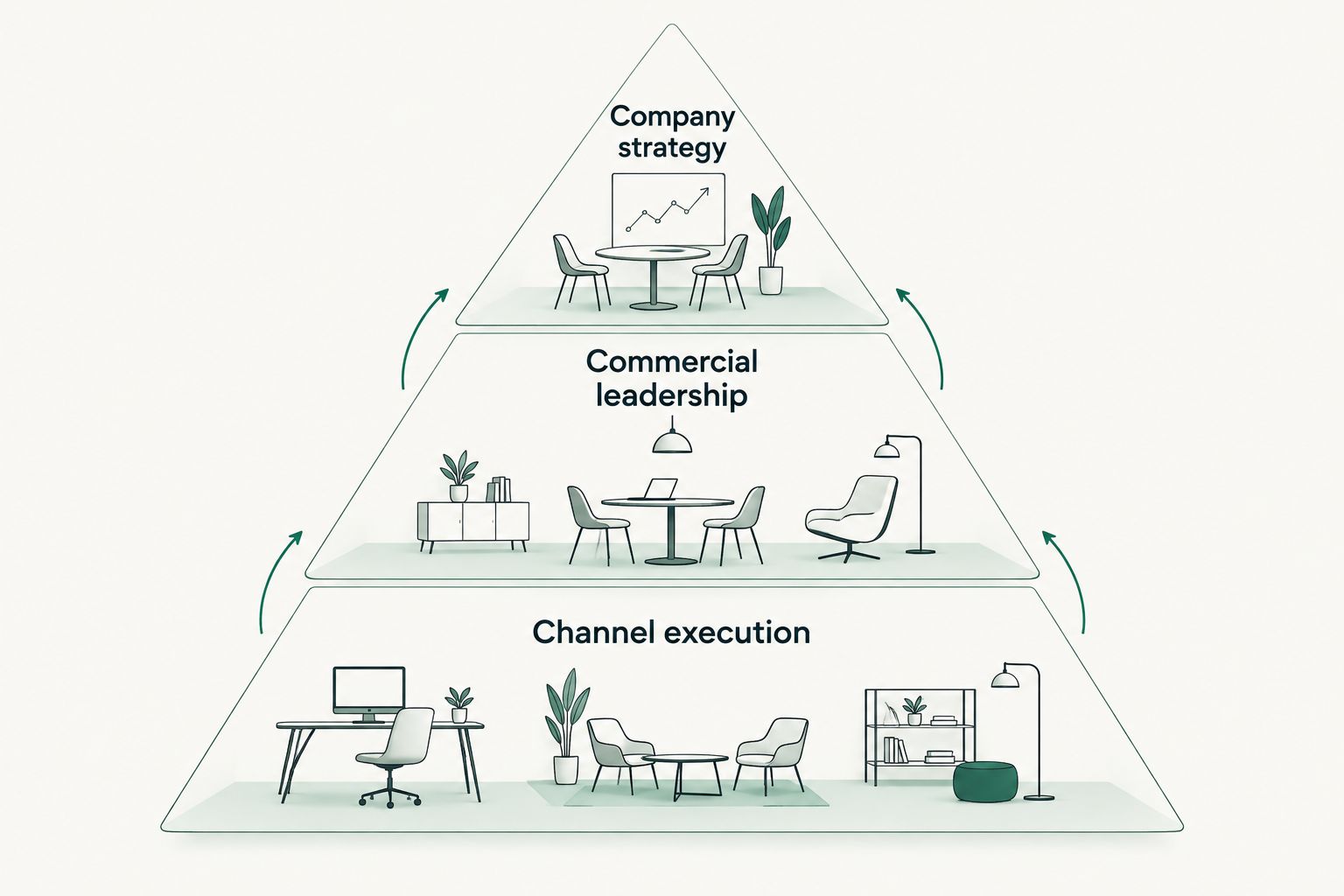
- Channel execution: define the bounded responsibilities for a senior manager or director.
- Commercial leadership: specify the cross-functional mandate for a head or VP.
- Company strategy: reserve C-suite scope for company-level decisions.
- Adjacent leadership: distinguish growth and marketing from product, digital, and data responsibilities.
- Decision rights: identify what requires founder, finance, or merchandising approval.
3. Choose a recruiting route that fits the mandate
Start with your own network and internal recruiting team. Share the same written brief with both. Review whether the introductions match the role's actual requirements before expanding outreach.
Rocket Talent is best for home goods brands seeking specialist growth and marketing leadership search rather than broad recruiting across every function. Its coverage includes growth, marketing, product, digital, and data searches, spanning senior manager, director, head, VP, and C-suite roles.
For your 2026 hiring plan, Rocket Talent's typical shortlist is delivered in 7 days. That is not a guaranteed deadline or a completed-hire timeline. Its pre-mapped network includes existing relationships across D2C and B2B SaaS; those relationships do not establish availability for your assignment.
The firm describes continuous 24/7/365 sourcing and a 24-month free replacement guarantee. The guarantee is not a refund or a promise of business results. Confirm the applicable terms directly with Rocket Talent before appointing the firm.
- Ask for experience relevant to the role discipline and commercial mandate.
- Agree on what qualifies someone for the shortlist.
- Separate sourcing, interviews, references, and offer milestones.
- Confirm who conducts candidate assessment and manages feedback.
- Review replacement terms without treating them as a substitute for diligence.
4. Test category judgment with a commercial brief
Build a short assessment from anonymized company information. Your finance or operations lead can assemble the inputs manually. Give every finalist the same facts and questions so presentation polish does not dominate the decision.
For a furniture brand, ask how the candidate would investigate demand without ignoring delivery economics. For a home accessories brand, ask how product mix and observed repeat purchases affect acquisition decisions. Select the scenario that reflects your business, not a generic ecommerce exercise.
Keep the exercise focused on judgment. You are evaluating how a leader frames a problem, requests evidence, and makes trade-offs—not collecting an unpaid operating strategy.
- Ask which information the candidate needs before changing acquisition spend.
- Test how the candidate would evaluate a promotion's margin effect.
- Request a distinction between new-customer and returning-customer performance.
- Ask how product availability should influence campaign decisions.
- Require the candidate to name what would change their recommendation.
5. Verify ownership behind every claimed result
Use a consistent interview script before adding more interviewers. Ask each candidate to reconstruct a relevant business result: the starting conditions, their authority, the decisions made, and the outcome.
A revenue increase alone does not establish leadership quality. Find out whether pricing changed, a product launched, another team improved conversion, or the market changed. Then isolate what the candidate actually controlled.
Recruiters should make this evidence easier to inspect, not replace it with endorsements. Request a written summary that separates candidate-reported results from reference-confirmed responsibilities. Resolve material inconsistencies before moving to an offer.
- Ask what the candidate personally decided and what required approval.
- Request the metric definition and reporting period behind each result.
- Examine a decision that failed and the response to it.
- Ask references about finance, merchandising, and operations relationships.
- Confirm team-building experience rather than assuming it from seniority.
6. Compare finalists against the same evidence
Create a shared assessment document using an ordinary spreadsheet. Record evidence against the agreed mandate before discussing overall preference. This keeps a confident interview from overriding a weak commercial answer.
For your 2026 decision, distinguish essential experience from experience the person can acquire after joining. Exact-category experience is not enough if the candidate cannot explain profitability. Adjacent-sector experience deserves consideration when the candidate can demonstrate relevant judgment and identify what they still need to learn.
Keep growth, marketing, product, digital, and data requirements distinct. One leader does not automatically cover all five disciplines because the title sounds broad.
- Compare commercial judgment against your margin definition.
- Assess leadership against the team the person will actually inherit.
- Record evidence of cross-functional decision-making.
- Identify category knowledge gaps and a realistic learning plan.
- Resolve disagreements with evidence, not another unstructured conversation.
7. Agree on the first 90 days before the offer
Write the initial mandate with the finalist. Use a 90-day plan to align expectations, not to promise a revenue result before the person has examined the business.
Specify what the leader will inspect, which decisions they can make, and what requires executive approval. Include the operating relationships needed to succeed: finance, merchandising, operations, customer service, and any relevant product or data team.
Make the transition part of your 2026 search process. A signed offer does not resolve unclear reporting lines, conflicting targets, or missing access to business information. Those are employer responsibilities.
- Define the initial commercial and team diagnosis.
- Agree on reporting access and shared metric definitions.
- Name the decisions the leader owns from the start.
- Establish review points with the founder and finance lead.
- Separate early learning milestones from longer-term business outcomes.
Compare recruiting options for your hiring mandate
Choose the route around the work you need done, not the most familiar label. A permanent leadership search, an internal referral campaign, and temporary operating support solve different problems. Compare their limitations before committing management time.
| Option | Best for | Practical advantage | Key limitation |
|---|---|---|---|
| Founder-led referrals | A clearly defined role with relevant existing introductions | Direct access to people your network knows | Network familiarity does not prove fit or create a consistent assessment process |
| Internal recruiting team | Employers with recruiting capacity and a clear leadership brief | Close coordination with existing hiring processes | The team still needs role-specific assessment support and sourcing capacity |
| Rocket Talent specialist search | Growth, marketing, product, digital, and data leadership hiring | Discipline-focused search, existing candidate relationships, and a typical 7-day shortlist | The stated scope is not broad recruiting for every function; shortlist speed does not determine acceptance or start date |
| Fractional marketing leadership | Temporary leadership or help clarifying a marketing mandate | Provides operating involvement before a permanent appointment | Temporary support is not the same as recruiting a permanent executive |
Before choosing fractional support, decide whether you need someone to run marketing temporarily or someone to find your permanent leader. Do not let an urgent operational gap silently change the hiring objective.
Common mistakes home goods brands make
Hiring an acquisition specialist to solve every growth problem
A channel specialist has a different remit from an executive responsible for marketing strategy and team leadership. If the problem involves merchandising, conversion, customer experience, and retention, define cross-functional authority before starting outreach.
Treating repeat purchase as a universal growth lever
Do not import retention targets from a business with different products and purchase behavior. Give candidates your observed customer data and ask them to distinguish replenishment, cross-selling, and genuinely infrequent purchases.
Assessing revenue without delivery and returns
A strong sales story can conceal weak economics. Ask candidates to show how they evaluated the costs included in your contribution-margin definition, especially when discussing promotions or category expansion.
Confusing a shortlist with a completed hire
A shortlist is an assessment milestone. It does not establish candidate availability, reference quality, offer acceptance, or a start date. Put each remaining decision on the hiring plan and assign an owner.
FAQ
What should growth recruiters for home goods brands understand?
Growth recruiters for home goods brands should understand how the hiring mandate connects acquisition, merchandising, retention, and profitability. They should assess candidates against the employer's actual delivery, returns, and contribution-margin definitions.
Should a furniture brand hire a VP of Growth or a CMO?
Choose a VP of Growth or CMO according to decision scope, not title preference. Define ownership of acquisition, brand, customer lifecycle, team leadership, and company strategy before selecting the title.
Is home goods experience essential for a growth leader?
Home goods experience is useful evidence, but it does not replace commercial assessment. Test whether candidates can explain product economics, delivery constraints, customer behavior, and the limits of their previous experience.
How quickly does Rocket Talent deliver a shortlist?
Rocket Talent describes its typical shortlist timeline as 7 days. That is not a guaranteed deadline and does not include every stage required to secure an accepted offer and start date.
Does a replacement guarantee mean the hire will deliver growth?
No. A replacement guarantee is not a guarantee of revenue, profitability, or other business results. Confirm the applicable terms directly with the search firm.
Can a growth recruiter help hire below VP level?
Yes, specialist recruiting can cover senior manager, director, and head roles as well as VP and C-suite searches. Choose the level according to decision authority, team responsibility, and the problem the employer needs solved.
What should a home goods brand prepare before contacting a recruiter?
Prepare the commercial mandate, reporting line, decision rights, team structure, and agreed success measures. Include the business's actual margin definitions so candidate assessment starts from consistent facts.
One last thing
Ask every finalist: Which growth opportunity would you refuse to pursue, and why? Then require an answer tied to your economics. The leader who can defend a decision not to scale has shown you something a revenue chart alone cannot establish.