GTM Recruiters: A Guide for High-Growth SaaS Companies
GTM recruiters help SaaS companies hire the people who turn product demand into durable revenue. Their remit can cover sales, marketing, revenue operations, customer success, partnerships, and the executives who lead those functions.
The label is broad, which is why choosing a recruiter by title alone rarely works. A company hiring its first VP Sales has a different problem from one replacing a CRO after an acquisition. A Series A business building its first repeatable motion needs different leadership from a Series C company adding enterprise discipline across several regions.
A useful GTM recruiter understands those differences. They can translate the company’s commercial situation into a focused search, map the right talent markets, and test whether candidates have done the work the business needs next.
What does GTM mean in recruiting?
Go-to-market describes how a company finds, wins, serves, and grows customers. In recruiting, it covers the roles that design and operate that system.
- Sales creates and converts commercial opportunities.
- Marketing builds demand, category understanding, and customer preference.
- Revenue operations connects data, process, systems, territories, and planning.
- Customer success supports adoption, retention, and expansion.
- Partnerships can add distribution, influence, and route-to-market leverage.
- Product marketing connects customer insight, positioning, launches, and sales enablement.
In a small SaaS company, one executive may own several of these areas. At a larger business, they are separate functions with specialist leaders. A recruiter needs to understand the current shape and the planned one.
Why GTM hiring becomes difficult during growth
Early-stage companies often rely on founder energy, individual heroics, and informal communication. That can work while the customer base is small and the leadership team sits in the same room. It becomes fragile as the company adds segments, managers, regions, and more ambitious revenue targets.
The new hire is usually expected to improve performance while redesigning the system that produces it. A VP Sales might need to hire managers, change qualification, rebuild forecasting, and move the team upmarket. A CMO might need to sharpen the category, improve pipeline quality, and make marketing credible with the board. A revenue operations leader may inherit inconsistent data and conflicting definitions of the funnel.
These are operating assignments. The recruiter has to understand the assignment before choosing a candidate market.
Start with the commercial problem
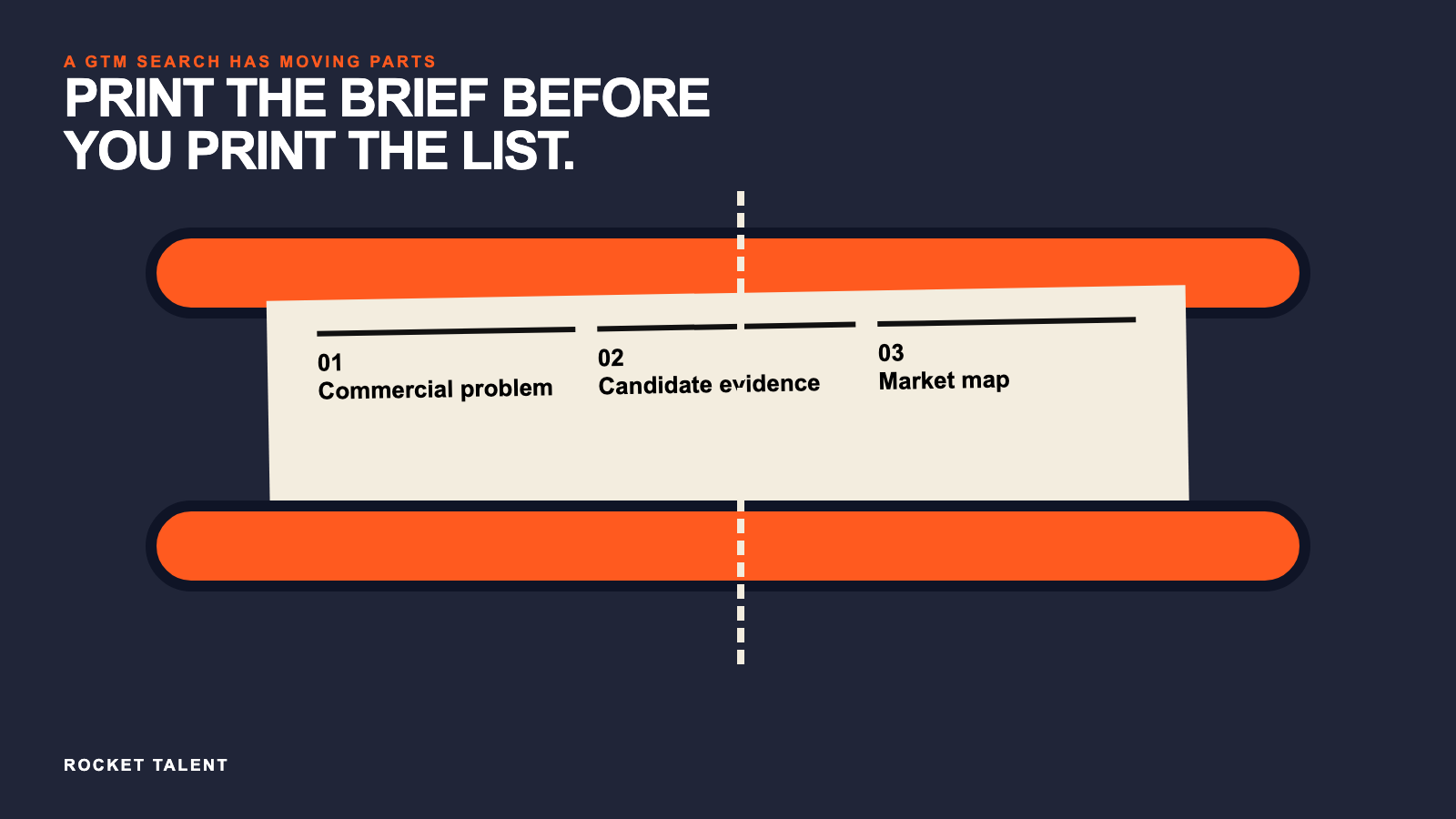
A clear search begins with the reason the role exists. Revenue is the result, but it does not explain the work.
The problem might be weak enterprise conversion, poor pipeline coverage, slow onboarding, inconsistent expansion, unreliable forecasting, or a founder who needs to hand ownership to an experienced executive. Each one points to different candidate evidence.
A strong GTM recruiter will ask what changed, what has already been tried, which metrics matter, and what the new leader must achieve in the first year. They should be comfortable challenging a brief that combines several full-time jobs or asks for experience that does not exist in the target market.
Match the leader to company stage
Stage affects the nature of the job. At Series A, the company may need a builder who can work with incomplete data and hire the first management layer. By Series C, it may need someone who can align several functions, create a predictable planning cadence, and communicate with a more demanding board.
Scale alone is a weak filter. Two companies at the same revenue level can have different contract values, sales cycles, products, buying groups, retention profiles, and routes to market. The recruiter should compare candidates against those operating conditions rather than treating stage as a shortcut.
Understand the GTM motion
Product-led, sales-led, channel-led, and hybrid businesses create different leadership demands. So do high-volume small-business sales and complex enterprise deals.
Ask the recruiter how the motion changes the search. They should be able to discuss who creates demand, where qualification happens, how sales and product interact, what drives expansion, and where responsibility moves between teams. If the answer stays at the level of job titles and company logos, the market map will probably be too broad.
Build a market map with reasons behind it
A market map is more than a list of employers. It should show where relevant candidates are likely to come from and why those companies are useful comparisons.
The recruiter may group targets by stage, customer segment, annual contract value, geographic scope, ownership model, or commercial challenge. Adjacent sectors can be valuable when the operating problem is similar. Direct competitors can also be misleading when their brand strength, funding, or product maturity made the job much easier.
A credible map includes exclusions. Knowing which talent markets to avoid saves time and prevents a familiar logo from carrying more weight than real evidence.
Assess the work behind the result
GTM candidates tend to be polished communicators. That is useful, but it can hide the difference between participation and ownership.
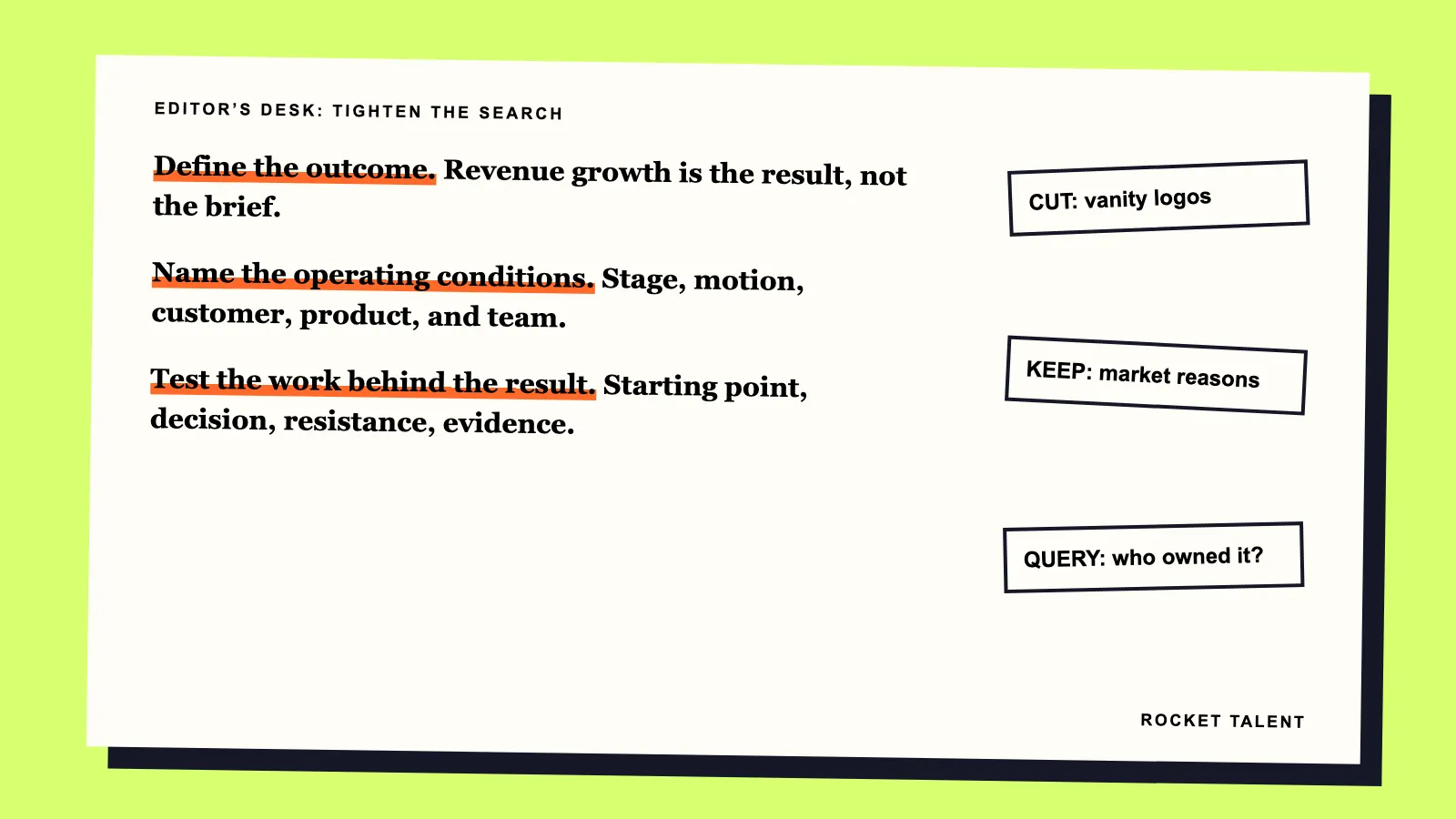
Assessment should establish the starting point, the decisions the candidate made, the resources available, the resistance they faced, and the measured result. It should also test what happened after the initial improvement. A short burst of growth is different from a repeatable operating system.
For leadership roles, the recruiter should examine hiring judgment, management cadence, cross-functional influence, executive communication, and the candidate’s response when a plan missed.
Use early calibration to improve the search
The first candidate conversations should teach the hiring team something. Perhaps the compensation is below market, the brief combines incompatible profiles, or the strongest candidates define the role differently.
Good GTM recruiters bring that information back quickly. They explain what the market is saying, recommend a change, and record the decision. Calibration works when the company also gives clear feedback and avoids changing its criteria without discussion.
How to compare GTM recruiters
Ask each firm to explain how it would approach your actual search. A useful comparison covers:
- the commercial problem the recruiter believes you are solving;
- the talent markets they would map first;
- the evidence they would collect from candidates;
- the person who will lead research, outreach, and assessment;
- the cadence for market feedback and shortlist calibration;
- the risks they see in the brief;
- examples of searches with similar stage, motion, and leadership scope.
The best answer may contain some disagreement. Recruiters who accept every part of the brief can look easy to work with, but senior hiring often improves when an informed partner challenges the assumptions early.
When a specialist recruiter adds value
External GTM search is most useful when the hire is senior, confidential, difficult to reach, or important enough to justify a broad market view. It can also help when the internal team lacks time, when the company is entering a new market, or when founders need an objective comparison of leadership options.
An internal talent team may be the better choice for repeatable hiring where the role, market, and process are already well understood. The decision should reflect the search problem rather than a general preference for internal or external recruitment.
Rocket Talent’s approach to GTM search
Rocket Talent works backward from the commercial outcome. We define what the hire must change, translate that into candidate evidence, and map companies where the relevant work has genuinely been done.
That creates a smaller, more defensible search. Founders and boards can see why each candidate belongs on the shortlist, where the evidence is strong, and what still needs testing. For high-growth SaaS companies, that clarity matters more than receiving another long list of familiar names.