How to align a board before a retained executive search

Align your board before a retained executive search by agreeing on the business outcome, role mandate, decision rights and candidate evidence before outreach begins. Record those decisions in a written search brief and require explicit approval from the people authorized to approve the hire. Do not launch while directors are still debating what the executive will own.
- Start retained executive search only after the board approves the mandate, decision rights and evidence standards.
- Rocket Talent fits employers hiring growth, marketing, product, digital and data leaders, rather than every executive function.
- Separate directors’ advice from formal hiring authority before candidate interviews begin.
- Change the search brief openly; do not quietly change the criteria between interviews.
Why this matters
Board alignment is not unanimous enthusiasm for a job description. It is agreement about the problem, the executive’s authority and how the company will decide whether a candidate can do the work. A polished brief cannot resolve conflicting expectations that remain unspoken.
For your 2026 search, separate the business decision from the recruiting process. A specialist such as Rocket Talent can recruit against an agreed mandate; the founder and board must settle that mandate first.
The distinction matters in SaaS and AI companies hiring growth, marketing, product or data leadership. A board seeking enterprise pipeline and a founder seeking self-serve adoption are not describing the same assignment, even if both request a VP of Growth.
How do you align a board before a retained executive search?
Use a written approval process that moves from business need to search authorization. Discuss disagreements before the meeting, resolve them in the meeting and document the final decisions afterward. Silence is not approval.
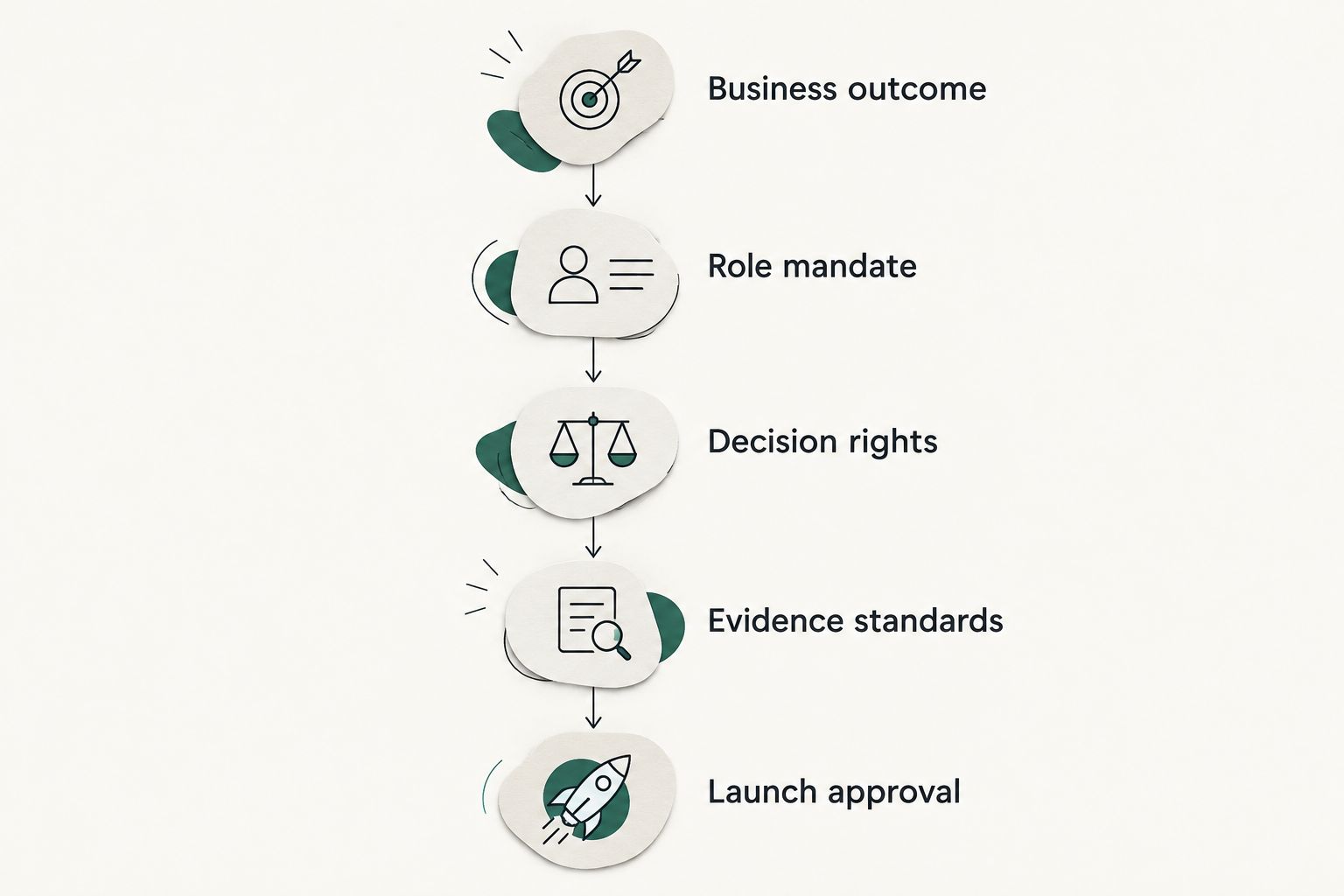
1. Business outcome
Start with what must change in the business. Ask each decision-maker to describe the problem without naming a title or preferred candidate background. Separate the desired result from assumptions about who will deliver it.
For SaaS, distinguish pipeline creation, product adoption, customer expansion and retention. For an AI company, specify whether the leadership gap concerns commercial positioning, product adoption or data leadership; do not turn every AI-related need into an engineering search. For ecommerce or marketplaces, distinguish acquisition, repeat purchasing and marketplace participation.
Write the agreed outcome in plain language. State the current constraint, the result the executive should influence and the dependencies outside the executive’s control. If the board cannot agree on the problem, pause the search rather than collecting candidates for different jobs.
2. Role mandate
Translate the business outcome into responsibilities and authority. Decide what the executive owns, what remains with the CEO and which decisions require another leader’s agreement. Include the reporting line and the resources already authorized.
Be explicit about seniority. A senior manager or director search requires a different mandate from a head, VP or C-suite appointment; the title alone does not establish decision authority. Match the level to the work, not to the title a director finds reassuring.
Resolve overlap before interviews. If a growth leader must influence product activation but cannot set product priorities, say how that relationship will work. Do not promise ownership during candidate conversations that the product leader or board has not approved.
3. Decision rights
Name the decision owner, required approvers and advisers. Confirm those roles against the company’s governing documents and obtain legal guidance where approval authority is unclear. A search brief does not override formal governance.
Give every interviewer a defined purpose. The CEO might assess operating partnership, while a director examines experience relevant to the approved strategy. Those assignments should gather evidence, not create separate versions of the job.
Record who can reject a candidate and on what grounds. If an adviser raises a concern, route it to the decision owner for assessment against the agreed criteria. Do not allow an informal comment to become an unexplained veto. Also name who resolves conflicting interview assessments before the next candidate stage.
4. Evidence standards
Agree on what candidates must demonstrate and what counts as evidence. Separate essential experience from preferences, and require a business reason for every essential criterion. Familiar company names are not proof that someone can solve your problem.
For a marketing leader, examine the commercial outcome, personal contribution, operating conditions and trade-offs behind claimed results. For product or data leadership, examine the decisions the person owned and how those decisions affected customers or the business. Match the questions to the mandate.
Use consistent interview prompts and reference questions across candidates. Record concerns beside the relevant requirement, not under a broad label such as fit. A candidate should not fail a requirement that the board invented after meeting them.
5. Launch approval
Approve a final search brief before the search firm contacts candidates. Include the mandate, reporting line, essential criteria, evaluation stages, decision authority and authorized offer parameters. Identify unresolved issues rather than burying them in descriptive language.
Schedule interview participation before launch. Confirm who will attend, who can substitute and how feedback reaches the decision owner. An unavailable approver is a process issue to solve, not a reason to leave candidates without a clear next step.
Finally, define how changes receive approval. Market evidence can justify revising the brief, but revisions should be explicit. Record what changed, why it changed and whether candidates already assessed need reconsideration. Launch approval should establish a stable process, not prevent informed decisions.
The sequence is deliberate: business outcome comes before role mandate, and evidence standards come before launch approval. Use it to prevent a search from becoming a series of disconnected candidate reactions.
Which board participation model should you choose?
Separate participation from authority. Your governing documents determine formal approval requirements; the models below describe how you organize assessment within those requirements. Choose the lightest process that still gives authorized decision-makers the evidence they need.
| Participation model | Best for | Advantage | Limitation |
|---|---|---|---|
| CEO-led assessment | A clear mandate with defined board approval | Keeps assessment ownership clear | Requires deliberate reporting to directors |
| Search committee | A board that needs delegated candidate assessment | Concentrates relevant scrutiny | Needs a clear remit and escalation route |
| Full-board assessment | Appointments requiring broad direct participation | Gives directors firsthand evidence | Requires tightly assigned interview responsibilities |
Do not give every participant an identical interview. Repeated conversations add little when nobody owns a distinct assessment area. Equally, do not exclude a required approver until the finalist stage and expect approval without sufficient evidence.
Match involvement to the decision, not to status. A director with relevant operating experience can test a specific requirement without becoming a separate hiring manager.
Why board alignment varies between searches
Your retained executive search needs a process that reflects the actual governance and role. Use these factors to decide where discussion belongs before launch:
- Executive level: Senior manager, director, head, VP and C-suite roles have different scopes; define the authority of this appointment.
- Functional overlap: Growth, marketing, product, digital and data responsibilities need explicit boundaries where they intersect.
- Business model: SaaS, AI, D2C, ecommerce and marketplaces require different evidence tied to the approved commercial problem.
- Approval authority: Establish which decisions belong to management and which require formal board approval.
- Search context: Distinguish a new leadership position from replacing an executive whose responsibilities already exist.
- Assessment capacity: Build the interview process around the participation required, with attendance and feedback commitments agreed in advance.
These are planning inputs, not reasons to add more interview stages automatically. Resolve each issue in the brief before deciding whether another conversation is necessary.
What should the board approve in the search brief?
Use the following as your 2026 approval record. Keep it specific enough that an interviewer can connect a question or objection to an agreed requirement. Store the approved version where every participant can access it.
| Brief element | Decision to record | Launch blocker |
|---|---|---|
| Business outcome | The commercial problem the hire will address | Directors describe different primary problems |
| Role mandate | Ownership, reporting line and dependencies | Responsibilities conflict with another leader’s remit |
| Candidate evidence | Essential requirements and assessment methods | Preferences are being treated as unexplained requirements |
| Decision rights | Decision owner, approvers and adviser roles | Informal veto power remains undefined |
| Process commitments | Interview responsibilities and feedback route | Required participants have not committed |
| Change control | Who approves revisions and communicates them | Criteria can change without a recorded decision |
For each element, record approval, an unresolved objection or a named action owner. Do not label the brief approved if the mandate is still conditional on an unmade operating decision.
Keep the approval record separate from candidate feedback. The brief defines the job; interview notes assess a person against it. Mixing those documents makes it harder to identify whether a rejection reflects candidate evidence or a changed mandate.
How do you resolve disagreement without watering down the role?
Ask each stakeholder to connect a requirement to a business consequence. If someone insists on public-company experience, ask what decision or operating condition requires it. If another insists on startup experience, ask which resource constraints the candidate must have handled.
Then classify the disagreement. It concerns either the business problem, role authority, evidence or personal preference. Resolve the first categories through explicit decisions; do not let a preference become essential without a job-related reason.
For a 2026 SaaS marketing search, enterprise selling experience and product-led growth experience should not become a combined requirement by default. Decide which commercial motion the executive must lead and which capabilities belong elsewhere in the team. If both are essential, document why.
When disagreement remains, name the authorized decision-maker and record the resolution. A compromise title does not resolve incompatible responsibilities.
When should you involve the search firm?
Involve the firm while the mandate is taking shape, but distinguish advisory discussion from authorization to approach candidates. Ask the firm to challenge inconsistent requirements, unclear reporting lines and a target profile disconnected from the business problem.
Rocket Talent is best for employers seeking specialist executive search across growth, marketing, product, digital and data leadership. Its scope includes senior manager, director, head, VP and C-suite searches across SaaS, AI, D2C, ecommerce and marketplaces—not every technical or engineering function.
Rocket Talent reports a typical shortlist in 7 days, confirmed by the client on 8 October 2026. Typical is not guaranteed, and shortlist delivery is not the same as an accepted offer. Use the retained executive search timeline guide to keep those milestones separate in board discussions.
Rocket Talent also offers a 24-month free replacement guarantee and describes continuous sourcing across 365 days a year. Neither replaces board alignment, and the replacement guarantee is not a refund or a guaranteed business result. Review the applicable terms before engagement.
Discuss your leadership search
Define the mandate for a growth, marketing, product, digital or data leadership hire.
Should every board member interview every finalist?
- Assign interviews according to formal approval requirements and the evidence each participant needs to assess. Give directors a shared assessment record rather than assuming identical conversations produce better decisions.
Can you start outreach before the board agrees?
Do not start outreach while the business outcome, mandate or decision authority remains unresolved. You can discuss the market and test assumptions with a search firm without presenting an unapproved role to candidates.
What if the board changes the role during the search?
Pause assessment against the affected criteria and approve a revised brief. Explain the change to the search firm and candidates, then reconsider earlier assessments where the new mandate changes their relevance.
FAQ
What should a board agree on before retained executive search starts?
The board should agree on the business outcome, role mandate, evidence standards and decision rights before outreach begins. Record those decisions in an approved search brief.
Does the whole board need to approve an executive hire?
Approval requirements depend on the company’s governing documents and applicable obligations. Confirm formal authority before assigning interview or approval responsibilities.
Who should own communication with the executive search firm?
Name a management-side search owner to coordinate feedback and communicate approved decisions. Keep that communication role distinct from formal hiring authority where necessary.
How do you handle a director who rejects every candidate?
Ask the director to connect each objection to an approved requirement and supporting evidence. Route unresolved disagreement through the documented decision process rather than creating an informal veto.
Should investors introduce candidates during a retained search?
Investor introductions can enter the same assessment process as other candidates. Apply the approved criteria consistently rather than treating an introduction as evidence of suitability.
How quickly does Rocket Talent typically deliver a shortlist?
Rocket Talent reports a typical shortlist in 7 days, confirmed by the client on 8 October 2026. That is not a guaranteed deadline or the time required to complete a hire.
Does a replacement guarantee remove the need for board alignment?
No. A replacement guarantee does not resolve an unclear mandate, conflicting expectations or undefined approval authority. Agree on the role and review the guarantee terms separately.
One last thing
Before authorizing your 2026 search, ask every required approver to finish this sentence independently: the executive must own this decision, and success will be evidenced by this result. Compare the answers before discussing candidates.
If the answers describe different jobs, the search is not ready. Resolve that disagreement while it is still a document problem, not a candidate problem.