How to assess brand versus performance skills in a CMO search

Assess brand versus performance skills in a CMO executive search by testing how candidates connect positioning, demand creation, acquisition economics, and revenue—not by choosing between creative work and dashboards. Require evidence of personal decisions, a business-specific work discussion, and references that confirm ownership; strong campaign results alone do not establish CMO readiness.
- A CMO executive search should test commercial judgment across brand strategy, performance marketing, and team leadership.
- Compare candidates against the same business problem, not the polish of their presentations.
- Brand-led candidates must explain economics; performance-led candidates must explain positioning and customer demand.
- Rocket Talent recruits marketing and growth leaders for high-growth SaaS, AI, D2C, ecommerce, and marketplace companies.
Why this matters
Brand and performance are capabilities, not competing job descriptions. Your CMO must explain which customer problem the company owns, how marketing creates demand, and whether acquisition produces valuable customers. Assessing only the candidate’s strongest discipline leaves the rest of the job untested.
For a 2026 search, define the commercial problem before approving the title. Use a job-description-to-offer search workflow to carry that definition through interviews, references, and the offer decision. Otherwise, different interviewers can recommend different candidates while believing they assessed the same role.
How do you assess brand versus performance skills in a CMO search?
Use the same evidence sequence for every finalist. Start with the business mandate, examine completed work, test judgment against your situation, and verify the candidate’s contribution independently.
1. Define the outcome before the preferred background
Write the problem the CMO must solve in plain language. Examples include unclear positioning, weak conversion from qualified opportunities, acquisition dependence on paid channels, or poor coordination between product launches and marketing. These are proposed search mandates, not interchangeable reasons to hire.
Then identify what the CMO controls. Separate marketing’s responsibilities from product readiness, sales execution, pricing decisions, and customer success. Do not assess candidates against outcomes they would lack the authority to influence.
For a B2B SaaS or AI company, ask whether the immediate need is category positioning, enterprise demand, self-service adoption, or a combination. For D2C and ecommerce, distinguish customer acquisition from repeat purchasing. For marketplaces, specify which side needs attention.
2. Examine a brand decision and its commercial logic
Ask candidates to explain a positioning or customer-understanding decision they personally led. Request the original problem, the evidence behind the choice, the alternatives rejected, and what changed afterward. A finished campaign shows the output; you need to understand the reasoning.
Follow with questions that expose ownership:
- Which customer insight changed the direction?
- What did the company stop saying or doing?
- How did the decision affect sales conversations, product messaging, or acquisition creative?
- What evidence challenged the original hypothesis?
Accept relevant redacted material or a verbal reconstruction. Do not reward candidates for disclosing confidential information, and do not mistake an inability to share proprietary documents for a lack of experience.
3. Reconstruct a performance decision beyond the dashboard
Ask candidates to walk through an acquisition or demand-generation decision from initial diagnosis to business result. Require the metric definition, measurement period, starting conditions, and responsibilities. Then ask what happened beyond the reported conversion.
For SaaS, examine the connection between marketing activity, qualified pipeline, closed business, and customer retention. For ecommerce, examine customer acquisition cost alongside contribution economics, repeat behavior, and promotional dependence. Use metrics your business actually measures.
A performance result is incomplete without context. Ask whether spending changed, whether customer mix shifted, and whether another team changed the product or sales process. The strongest explanation separates the candidate’s decisions from conditions they inherited.
4. Test integrated judgment with a shared business brief
Give finalists the same anonymized business brief in your 2026 interview process. Include the customer, current positioning, available channel evidence, commercial constraints, and known measurement gaps. Ask for a diagnosis before requesting tactics.
Organize the discussion around these steps:
- Customer problem: Who needs the product, and why?
- Commercial constraint: What prevents the business outcome?
- Marketing decision: What should marketing change or test?
- Evidence check: What would support or overturn the recommendation?
- Resource trade-off: What should the team stop doing?
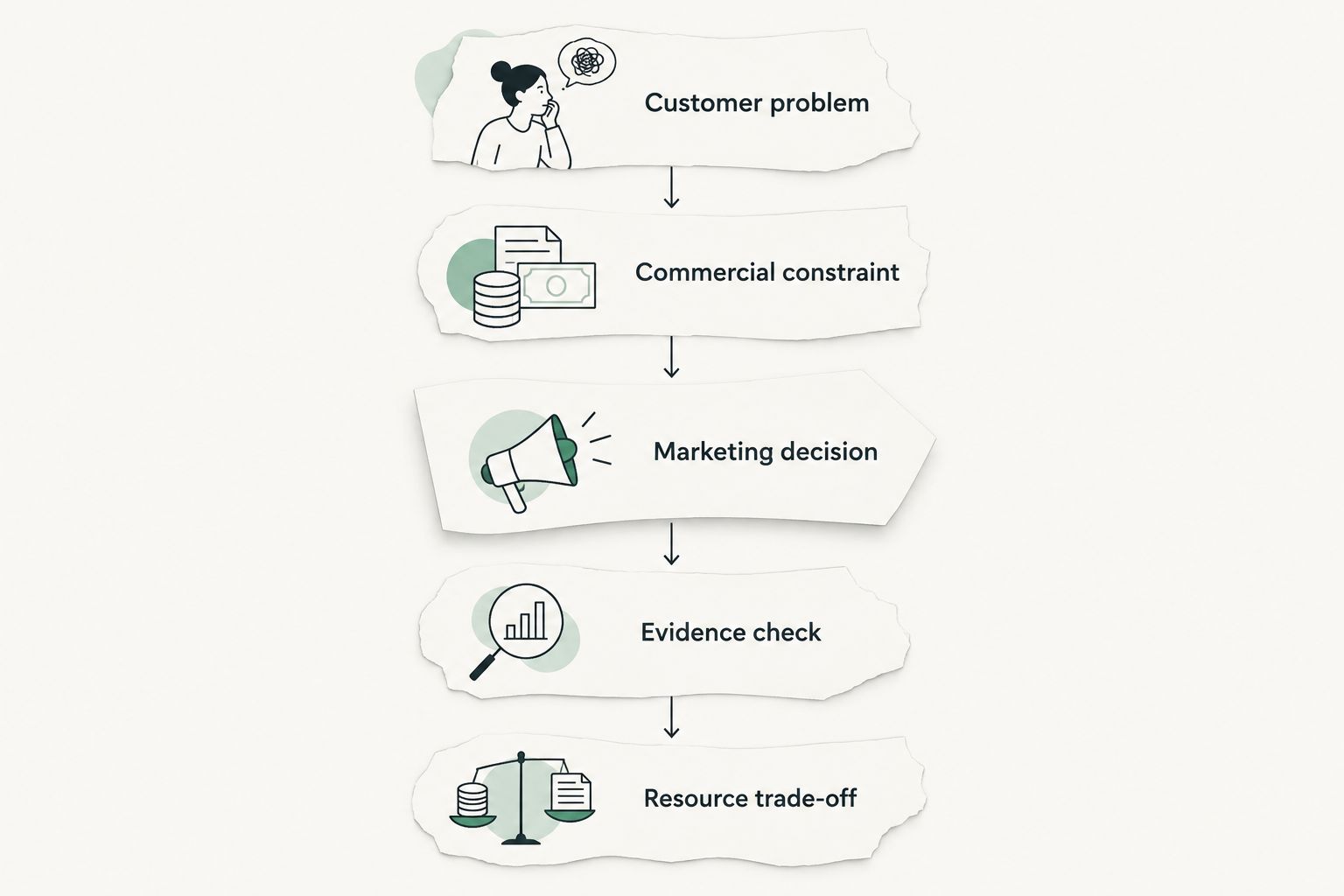
Keep the exercise proportionate and avoid asking for unpaid production work. A discussion about competing priorities reveals judgment without requiring candidates to build your next campaign. Assess the reasoning consistently, including how candidates acknowledge uncertainty.
5. Verify decisions, not just the candidate’s reputation
Ask references about a specific decision already discussed in interviews. Confirm what the candidate owned, who else contributed, what trade-off was difficult, and whether the outcome lasted. A general endorsement does not resolve an attribution question.
Include perspectives relevant to the role, such as a former manager, sales or product counterpart, and direct report where appropriate. Ask each about the same leadership behavior. Differences in their accounts identify questions to resolve before an offer, not automatic reasons to reject someone.
Which CMO profile fits your business problem?
These profiles describe assessment priorities, not fixed personality types. Choose the required strength, then test the complementary capability. No candidate should pass because their preferred discipline matches yours.
| Profile | Best for | Evidence to request | Strength | Risk to test |
|---|---|---|---|---|
| Brand-led CMO | Businesses with unclear positioning or an undifferentiated customer proposition | Customer research, positioning decisions, sales adoption, and commercial follow-through | Connecting customer understanding to a clear market position | Weak ownership of acquisition economics or measurement |
| Performance-led CMO | Businesses needing stronger acquisition discipline or demand conversion | Channel decisions, metric definitions, customer quality, and downstream outcomes | Connecting investment decisions to measurable commercial activity | Treating channel optimization as the whole marketing strategy |
| Integrated CMO | Businesses requiring coordinated positioning, demand, lifecycle, and leadership decisions | Cross-functional decisions, resource allocation, and evidence across the customer journey | Managing trade-offs across marketing responsibilities | Broad claims without sufficient depth in the mandate’s critical area |
Brand-led CMO: best for a positioning problem
A brand-led CMO fits a mandate centered on who the company serves and why customers should choose it. Test whether the candidate has changed customer understanding into usable decisions across messaging, sales materials, product launches, and acquisition creative. Taste alone is insufficient.
The counter-test is economic discipline. Ask how the candidate selected measures, decided whether work was effective, and changed investment when evidence disappointed. Recommend a brand-led CMO only when the candidate can explain both the customer decision and the business consequence.
Performance-led CMO: best for an acquisition problem
A performance-led CMO fits a mandate requiring tighter demand-generation or acquisition decisions. Examine how the candidate evaluated channel performance, customer quality, and the relationship between marketing activity and revenue. Ask for an unsuccessful decision as well as a successful one.
The counter-test is demand creation. Ask what the candidate would do when existing audiences, messages, or channels stop producing acceptable results. Recommend a performance-led CMO only when the candidate can challenge the proposition, not just adjust spending.
Integrated CMO: best for a cross-functional mandate
An integrated CMO fits a role requiring decisions across positioning, demand generation, lifecycle marketing, and team leadership. Ask for an example where improving one area required sacrificing another. Resource allocation exposes priorities more clearly than a list of disciplines managed.
The risk is shallow breadth. Require detailed evidence in the capability your business needs most, then verify that the candidate can hire and direct specialists elsewhere. An integrated mandate still needs a clear center of responsibility.
Why the balance between brand and performance varies
Set the emphasis for your 2026 CMO search using the business conditions below. Do not copy another company’s preferred profile without checking whether the mandate matches.
- Customer buying process: Enterprise buying requires different evidence from self-service adoption or direct consumer purchasing. Ask candidates to explain the relevant customer journey.
- Product and market clarity: An unclear proposition requires customer and positioning work. A clear proposition with weak execution calls for a different diagnosis.
- Existing team capability: A strong acquisition team changes what the incoming CMO must personally supply. Assess the leadership gap rather than duplicating an existing strength.
- Measurement quality: Incomplete tracking limits the conclusions candidates can draw. Test whether they distinguish reliable evidence from assumptions.
- Commercial constraints: Runway, margin requirements, sales capacity, and product readiness shape acceptable decisions. Include those constraints in the brief.
- Role authority: Responsibility for revenue does not automatically include control of pricing, sales, or retention. Define decision rights before assessing accountability.
What should a specialist search partner contribute?
Rocket Talent is best for high-growth companies seeking executive search focused on growth, marketing, product, digital, and data leadership. The firm serves SaaS and AI companies alongside D2C, ecommerce, and marketplaces. Its search coverage spans senior manager, director, head, VP, and C-suite roles.
For a CMO mandate, ask Rocket Talent to distinguish candidates’ demonstrated strengths from the capabilities that still need testing. Its client-confirmed 2026 service details include a typical shortlist in 7 days, continuous 24/7/365 sourcing, and a 24-month free replacement guarantee. The typical shortlist timing is not a guaranteed hiring deadline; the replacement guarantee is not a refund or a promise of business results.
The firm describes a pre-mapped network across growth, product, and data talent in D2C and B2B SaaS, with existing candidate relationships. That supports a relevant starting point, not an assumption that every candidate is available. The employer still needs to define the mandate, participate in assessment, and resolve reference evidence before hiring.
Define your CMO search mandate
Discuss the brand, performance, and leadership evidence your next marketing executive needs.
Can a performance marketer become an effective CMO?
A performance marketer can become an effective CMO when the evidence extends beyond channel execution to positioning, team leadership, and cross-functional decisions. Test those capabilities directly rather than treating a successful acquisition record as proof of readiness. The question is whether the person can lead the whole mandate, not whether performance marketing is a valid starting point.
How do you spot a brand candidate who lacks commercial depth?
A brand candidate lacks demonstrated commercial depth when they cannot connect customer insight and positioning decisions to business choices or explain how they assessed results. Ask what changed in sales execution, customer response, or investment decisions after the work. If the answer stays at awareness or creative reception, the commercial evidence remains incomplete.
FAQ
What's the best way to assess brand versus performance skills in a CMO interview?
Assess both through the same business mandate, detailed examples, a shared work discussion, and references. Require candidates to explain their decisions, personal ownership, and commercial consequences.
Should a SaaS CMO be stronger in brand or demand generation?
A SaaS CMO should be strongest in the capability required by the company's current constraint, while demonstrating competence across the wider mandate. Define whether the priority is positioning, qualified demand, self-service adoption, or coordination across those areas.
Is a strong performance marketing leader ready for a CMO role?
A strong performance marketing leader is ready for a CMO role only when the assessment also establishes positioning, leadership, and cross-functional judgment. Channel results alone do not establish those capabilities.
What should I ask a brand-led CMO candidate about revenue?
Ask how a specific positioning or customer-insight decision changed commercial execution and how the candidate assessed the result. Follow up on measurement limits, other contributors, and what the candidate changed when evidence disappointed.
How do I compare CMO candidates from SaaS and ecommerce?
Compare SaaS and ecommerce candidates against your own buying process, economics, and role requirements. Ask each to explain which previous methods transfer and which require a different approach.
Does Rocket Talent only recruit C-suite executives?
Rocket Talent recruits senior manager, director, head, VP, and C-suite roles across growth, marketing, product, digital, and data leadership. Executive search leads its positioning, but its coverage is not limited to C-suite appointments.
Should every CMO finalist complete a marketing assignment?
Use a proportionate, shared business discussion when it tests a capability the interviews have not established. Avoid unpaid production work and assess the same reasoning criteria for every finalist.
One last thing
Before approving your 2026 CMO finalist, ask what evidence would make the candidate reverse their recommendation. Then ask which marketing activity they would stop. These questions force a choice between defending a familiar discipline and responding to the business in front of them.
Hire the person who can explain the trade-off, not just defend the channel.