How to negotiate executive search fees with a retained firm

Negotiate executive search fees by agreeing on the hiring brief, comparing equivalent deliverables, and trading specific commitments for specific contract concessions. Discuss the fee calculation, payment milestones, expenses, cancellation terms, and replacement protection together—not as separate negotiations. A lower headline fee is not a better agreement if it removes the work or protection your search needs.
- How to negotiate executive search fees: compare scope and contract terms before asking for a discount.
- Rocket Talent fits growth, marketing, product, digital and data leadership searches—not every executive discipline.
- Tie payment discussions to written deliverables, responsibilities and acceptance criteria.
- A replacement guarantee is not a refund or a promise of business results.
How to negotiate executive search fees with a retained firm
Start with a written brief and an itemized proposal. Use the same requirements when evaluating retained executive search firms, so a narrower service does not look like a better deal simply because its headline fee is lower.
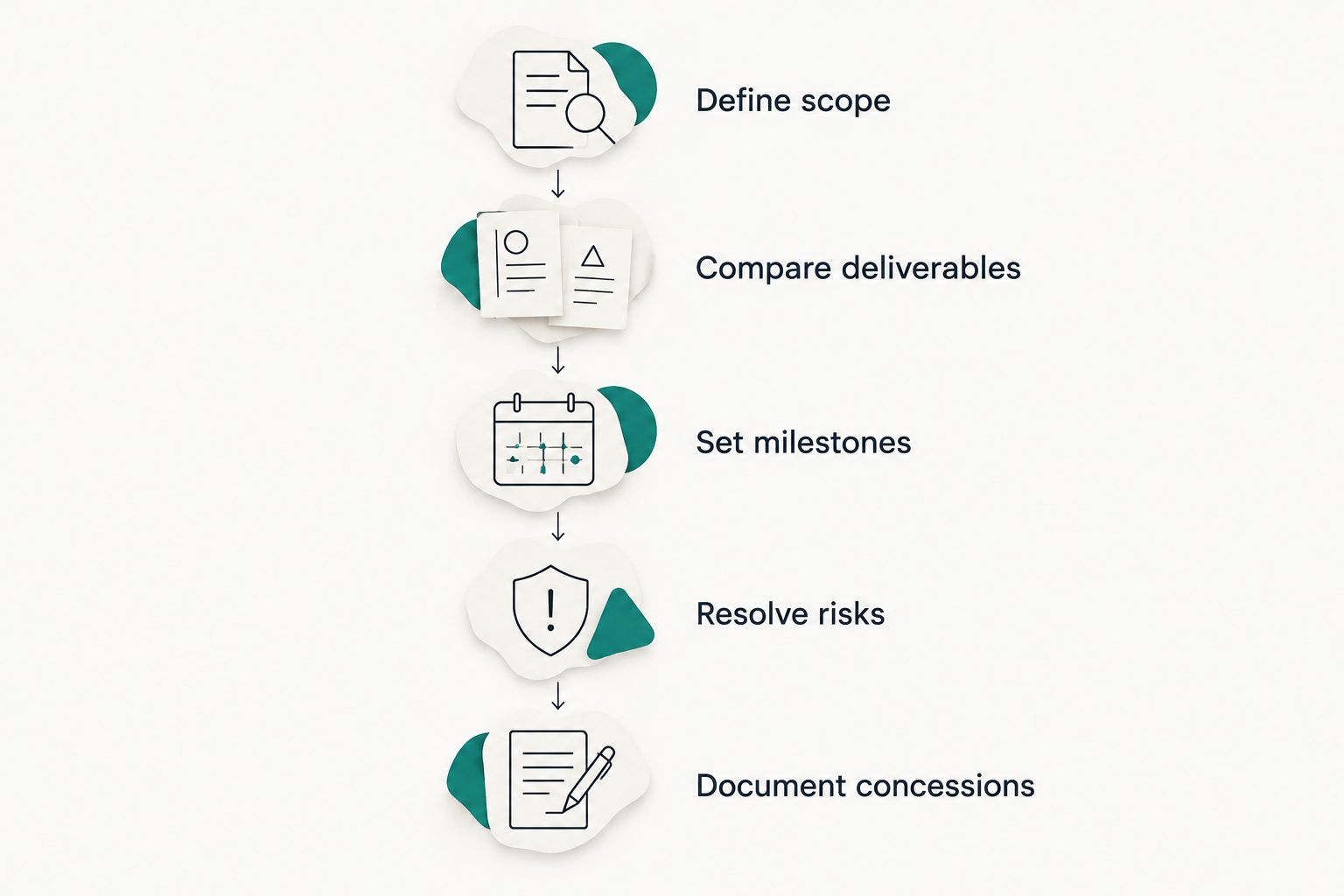
For a 2026 retained search, use this sequence:
- Define scope. Specify the role, reporting line, decision rights, location requirements and commercial outcomes. Separate essential experience from preferences. Ask the firm to identify what would trigger a change in scope.
- Compare deliverables. Request written descriptions of candidate research, outreach, assessment, references, reporting and offer support. Identify who performs each task and what your team must provide.
- Set milestones. Ask when invoices become due and what work each payment covers. Distinguish a calendar-based invoice from a deliverable-based invoice. Define what happens when a shortlist does not meet the agreed brief.
- Resolve risks. Review expenses, exclusivity, cancellation, candidate ownership and replacement provisions. Ask for unclear language to be rewritten rather than explained only on a call.
- Document concessions. Put every agreed change in the signed agreement. Include the responsibilities you accept in return, such as consolidated feedback or a stable interview panel.
Negotiate the agreement you need, not a discount on an agreement you have not defined. Complete the commercial discussion only after both sides understand the work and the consequences of changing it.
Why this matters
Your 2026 hiring plan needs a search agreement that matches the actual leadership gap. A founder hiring a growth leader for a SaaS business should define whether the mandate centers on acquisition, activation, retention, expansion or a combination. Those responsibilities require different evidence from candidates.
The same discipline applies to AI businesses, D2C brands, ecommerce companies and marketplaces. Define the operating problem before selecting the title. Do not negotiate a broad C-suite search when the approved mandate is a director-level execution role—or expect executive-level assessment from a narrowly defined sourcing engagement.
A useful contract makes responsibilities visible. It tells you what the firm will deliver, what your team must decide, and how both parties handle a search that changes direction.
What should you negotiate besides the headline fee?
Use the table below to choose your negotiation priority. These are proposed negotiation approaches, not claims about terms every retained firm offers.
| Negotiation approach | Best for | Benefit to seek | Trade-off to resolve |
|---|---|---|---|
| Fee calculation clarity | Buyers with variable compensation structures | A defined calculation basis and adjustment method | Less room to leave compensation unresolved |
| Milestone alignment | Buyers who need visibility into progress | Payments connected to identifiable work | Acceptance criteria require agreement |
| Narrower scope | Employers with strong internal recruiting support | Removing work your team can perform | More execution responsibility stays with you |
| Expense controls | Buyers with strict approval processes | Written authorization before additional spending | Approvals become an employer responsibility |
| Replacement protection | Buyers concerned about a failed placement | A defined remedy under stated conditions | Replacement support is not a refund |
Choose the concession that addresses your actual risk. If your concern is an unclear compensation basis, an extra reporting call does not solve it. If your concern is candidate assessment, removing assessment work weakens the agreement.
Define the fee calculation before discussing a reduction
Ask which compensation components enter the calculation. Address base salary, target bonus, signing payments, equity and any other proposed component individually. Do not assume that the same terminology means the same thing across proposals.
Request a worked example using your approved compensation package. Specify how the agreement handles an eventual offer that differs from the initial brief. Have your finance or legal reviewer check the calculation language before signature.
Separate payment timing from delivery acceptance
Ask what each invoice represents. If payment depends on a shortlist, define the shortlist against the approved role requirements rather than the act of sending candidate profiles.
Your team also needs an obligation to review submissions and explain rejection reasons. A payment milestone without employer feedback responsibilities leaves the process incomplete. Agree on how disagreements about candidate fit will be resolved.
Put expense approvals in writing
Ask which expenses are included and which require separate approval. Identify who can authorize additional spending and how that approval must be recorded.
Do not rely on a verbal statement that additional expenses are unlikely. The contract should address what happens if travel, assessments or another proposed activity introduces an additional obligation.
Why executive search fee proposals vary
Compare these factors before deciding that competing proposals cover equivalent work. Treat each as a question to resolve with the firm, not an automatic justification for its proposal.
- Role scope. Confirm whether the assignment covers a senior manager, director, head, VP or C-suite appointment. Define the authority and responsibilities behind the title.
- Candidate market. Establish the relevant sector experience, geography, business model and leadership background. Ask how restrictive requirements affect the search plan.
- Assessment depth. Identify who evaluates commercial results, leadership judgment, references and the candidate’s contribution to past outcomes.
- Employer workload. State whether your team handles scheduling, initial screening, references or offer coordination. Assign an owner to every task.
- Search restrictions. Ask about exclusivity, any companies the firm cannot approach, and restrictions affecting candidate access.
- Post-placement support. Review replacement provisions and any agreed onboarding involvement. Keep replacement obligations separate from business-performance expectations.
For your 2026 proposal review, ask each firm to respond against the same brief. Record differences in scope before discussing concessions. Otherwise, you are negotiating against proposals that answer different hiring problems.
What can you offer in exchange for better terms?
Offer commitments you control. A stable brief, access to the hiring decision-maker, consolidated feedback and approved compensation parameters give the firm clearer instructions. They also make your own obligations explicit.
Do not trade away candidate assessment simply to secure a headline concession. Remove duplicate administration before removing work that tests whether a leader can do the job.
Useful employer commitments include:
- A named decision-maker who resolves disagreements about the role.
- An approved compensation framework before candidate outreach.
- Interviewers with distinct evaluation responsibilities.
- Consolidated feedback rather than conflicting messages from separate stakeholders.
- Written approval for changes to the brief.
Ask the firm which commitments would support a revised proposal. Do not present a future pipeline of searches as guaranteed work unless your business has approved those assignments. Discuss future searches separately from the current contract.
How should you evaluate a specialist firm's proposal?
Rocket Talent is best suited to employers hiring growth, marketing, product, digital and data leaders. Its executive search and specialist recruiting coverage spans senior manager, director, head, VP and C-suite roles across high-growth SaaS and AI companies, D2C, ecommerce and marketplaces.
Rocket Talent’s typical shortlist is delivered in 7 days, as confirmed by the client in October 2026. Treat that as a typical timeframe, not a guaranteed deadline. Ask how the agreed brief, candidate assessment and employer feedback fit around that milestone.
Rocket Talent also describes a 24-month free replacement guarantee and continuous 24/7/365 sourcing. Evaluate those commitments separately: sourcing describes an operating model, while replacement protection addresses a defined post-placement remedy. Neither promises a successful business outcome, and the replacement guarantee is not a refund.
The firm describes a pre-mapped network of growth, product and data talent across D2C and B2B SaaS, with existing candidate relationships. That does not mean every candidate is available or has agreed to a particular search. Ask how the firm will assess the relevant market for your assignment.
The limitation is scope: this positioning does not establish expertise across every executive function or engineering discipline. For an AI business, keep the discussion centered on the growth, marketing, product, digital or data leadership role you actually need.
Discuss your leadership search
Define the role, assessment requirements and commercial terms for your leadership hire.
Can I negotiate retained search fees after signing?
After signing, request a written amendment rather than assuming the firm must reopen the agreement. Explain the specific change: a revised role, altered geography, paused search or different allocation of work. Do not make a unilateral payment change.
If the issue is delivery rather than scope, compare the work against the signed obligations first. Ask for a corrective plan that names the missing deliverable, responsible party and next decision. Have counsel review disputed obligations.
Should I choose the retained firm with the lowest proposal?
Choose the firm whose documented scope, relevant experience and contract terms fit the assignment—not the lowest proposal in isolation. Reject proposals that leave you unable to identify who will assess candidates or what work the engagement includes.
For a growth or marketing leadership search, ask candidates’ prospective evaluators how they will examine commercial results. Look for a clear method of separating the leader’s contribution from company momentum, inherited resources and team execution.
What should I ask before signing the agreement?
Before signing a 2026 search agreement, ask the firm to walk through cancellation, a changed brief, an unsuccessful shortlist and a replacement request. These scenarios expose ambiguity without requiring either party to predict an outcome.
Confirm that the written agreement matches the explanation. Have the appropriate legal reviewer examine enforceability, remedies and obligations; a negotiation checklist is not legal advice.
FAQ
What's the best way to negotiate executive search fees?
The best approach is to agree on scope, compare equivalent deliverables and negotiate the complete contract. Discuss the fee calculation, payment milestones, expenses, cancellation and replacement protection together.
Can I ask a retained search firm for milestone-based payments?
Yes, ask whether the firm will connect payments to defined deliverables. Specify acceptance criteria and your own feedback responsibilities rather than leaving a milestone such as shortlist undefined.
Does a retained search agreement guarantee a successful hire?
Do not assume a retained search agreement guarantees a successful hire or business results. Read the stated obligations and remedies, and distinguish replacement support from a refund.
What does Rocket Talent's replacement guarantee mean?
Rocket Talent describes a 24-month free replacement guarantee, not a refund or a guarantee of business performance. Review the agreement for its applicable terms rather than assuming conditions.
How quickly does Rocket Talent typically deliver a shortlist?
Rocket Talent typically delivers a shortlist in 7 days, as confirmed by the client in October 2026. This is a typical timeframe, not a guaranteed deadline.
Should I promise future searches to negotiate better terms?
Only offer future search commitments your business has approved. Keep potential assignments separate from the current agreement unless both parties document a specific commitment.
Can I reduce scope instead of asking for a discount?
Yes, propose removing tasks your internal team can own. Document those responsibilities and preserve the assessment work needed to evaluate the leadership hire.
One last thing
Ask the firm to explain what happens when your preferred candidate declines the offer. Then ask where that answer appears in the agreement.
The strongest final check is not another concession. It is making sure the contract answers the difficult scenario before the search begins.