Is retained executive search worth it for early-stage D2C brands?

Retained executive search is worth it for an early-stage D2C brand when a permanent leader must solve a defined commercial problem and you can give that person the authority to act. It is the wrong commitment when you are still deciding what the role owns, need temporary support, or cannot fund the hire itself. Buy a search for a clear leadership mandate—not a senior title you hope will fix growth.
- Is retained executive search worth it for D2C brands? Yes, when the permanent leadership mandate is clear.
- Rocket Talent fits D2C founders hiring growth and marketing leaders with defined commercial responsibilities.
- Compare retained search with founder-led hiring and fractional leadership before committing.
- Judge candidate evidence, search scope and replacement terms—not shortlist speed alone.
Why this matters
An early-stage D2C brand needs to distinguish a leadership gap from an execution gap. Hiring a VP will not resolve unclear margins, conflicting priorities or a founder who keeps every decision.
For your 2026 hiring plan, start with the business decision the new leader must own. Then assess whether you need permanent executive search, a narrower specialist search or temporary leadership. If you are already selecting a partner, compare marketing executive search firms for D2C brands against that mandate rather than a generic list of capabilities.
Is retained executive search worth it for early-stage D2C brands?
Yes—when the cost of leaving a critical leadership responsibility unowned justifies a dedicated search. Retained search means committing to a search assignment under an agreed engagement, rather than paying only if a contingency recruiter makes a placement. The written agreement determines the actual scope and obligations.
The model is not automatically better because the title is senior. Your decision should turn on the work, the candidate profile and your ability to evaluate candidates. Use this comparison before choosing an approach.
| Hiring approach | Best for | Main advantage | Main limitation |
|---|---|---|---|
| Retained executive search | A defined, permanent leadership hire requiring targeted outreach | An agreed search mandate and candidate assessment process | Requires commitment before you know who you will hire |
| Founder-led hiring | A well-defined role where you have relevant relationships and evaluation capacity | Direct control over outreach and assessment | You own candidate development, coordination and follow-through |
| Contingency recruiting | A defined vacancy where a success-based recruiting model fits | Payment is tied to placement under the agreement | Search scope and delivery commitments need explicit verification |
| Fractional leadership | A temporary leadership need or a mandate that still needs testing | Lets you address a bounded problem without immediately appointing a permanent executive | Does not replace a permanent owner when the business needs one |
Ask each provider what is included. Candidate outreach, assessment, references and offer support should not exist only as assumptions in your head. Put responsibilities in writing before you commit.
When retained search is the right commitment
Retained executive search fits a D2C brand when the hire must make consequential decisions across functions. Examples include deciding how acquisition and retention work together, allocating marketing resources, or setting priorities between product experience and commercial growth.
The mandate must also be durable. You need a leader whose responsibilities will remain relevant after the immediate campaign, channel problem or launch has passed. A permanent appointment is a poor substitute for a temporary project.
Before approving a search in 2026, write down:
- Business outcome: What must change, and which existing business measures will show progress?
- Decision rights: Which decisions can the leader make without founder approval?
- Operating constraints: What team, resources and operational limits will the leader inherit?
- Relevant experience: What comparable problem must the candidate have solved personally?
These answers give you a basis for rejecting impressive but irrelevant candidates. A recognizable employer does not establish that someone can operate inside your stage, team or constraints.
Define the mandate before choosing the title
A senior manager can own a specialist discipline. A director or head can lead a function. A VP or C-suite executive needs a mandate that supports the scope of that title. Judge the actual responsibility rather than assuming titles mean the same thing across companies.
Rocket Talent recruits growth, marketing, product, digital and data leaders across senior manager, director, head, VP and C-suite searches. Its executive-search positioning does not mean every D2C vacancy requires an executive. Choose the level that matches the work you can actually delegate.
When retained search is the wrong move
Wait when you cannot explain what the person will own. A search firm can help sharpen a brief, but the founder still has to decide which commercial problem matters most and what authority the hire receives.
Do not use executive search to avoid unresolved disagreements between founders or board members. If interviewers want different leaders, a stronger candidate pipeline will not create alignment. Settle the mandate before asking candidates to commit to it.
A narrower assignment also deserves consideration when the work is primarily execution. If your priorities are already set and you need someone to operate a channel, a specialist hire can be more appropriate than adding an executive layer.
Fractional leadership fits a different situation: you need experienced direction while testing a mandate or addressing a bounded gap. Define the handoff before starting. Otherwise, temporary leadership can leave you with the same unanswered question about permanent ownership.
How to decide before signing a search agreement
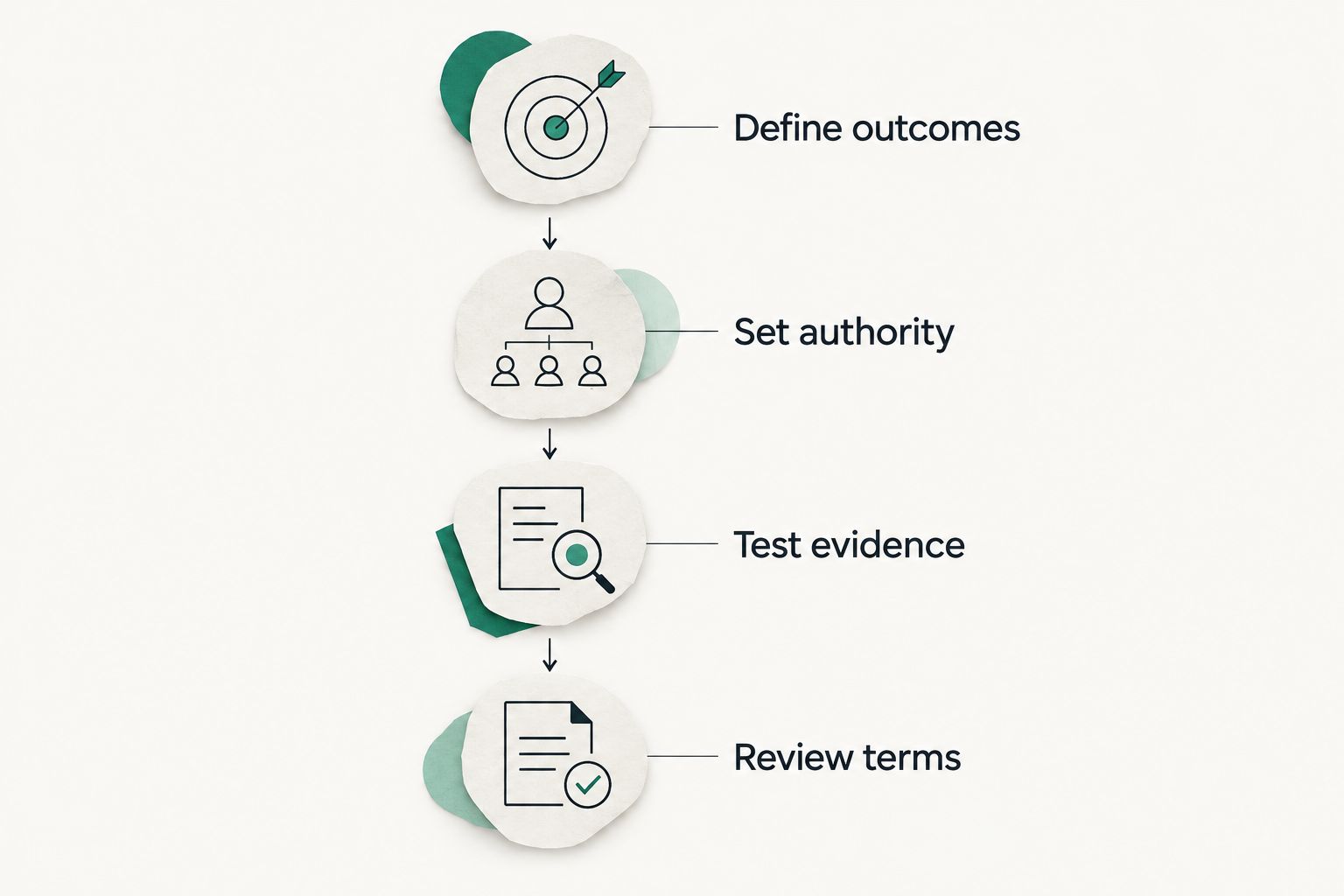
Use the following sequence to turn a general desire for better leadership into a decision you can defend. Each step should produce something the search partner and interview panel can use.
- Define outcomes. Describe the commercial problem and the evidence that will demonstrate improvement. Use your own baseline rather than adopting an unrelated company's targets.
- Set authority. Specify decisions, reporting lines and access to the information required to do the job. Resolve founder approval boundaries before interviews.
- Test evidence. Agree on the candidate experiences that matter and how interviews and references will verify them. Separate personal contribution from company-wide results.
- Review terms. Confirm deliverables, communication, assessment responsibilities and replacement provisions in the agreement. Understand what happens if the brief changes.
A useful brief makes trade-offs visible. If you require acquisition depth, lifecycle ownership and product judgment, decide which is essential and which can sit elsewhere in the team. Do not describe several different jobs and expect one candidate to satisfy every requirement equally.
Keep the evaluation consistent once interviews begin. When a candidate challenges your assumptions, investigate the argument; do not quietly rewrite the role to match an attractive résumé. A changed mandate needs an explicit decision.
Why the value of retained search varies
Retained search creates value only when the engagement fits the assignment. For a 2026 D2C leadership hire, examine these factors before comparing providers:
- Role clarity. A precise mandate gives the search partner a usable target; an unresolved brief creates disagreement about candidate fit.
- Candidate relevance. Assess experience with your commercial problem, business model and operating constraints—not consumer-brand familiarity alone.
- Founder involvement. You still need to make decisions, evaluate leadership fit and explain the opportunity credibly.
- Assessment depth. Ask how the firm distinguishes someone who owned an outcome from someone who worked near it.
- Search responsibilities. Establish who handles outreach, interviews, references, offer discussions and candidate communication.
- Contract terms. Review replacement provisions and other obligations directly rather than treating headline promises as the complete agreement.
Do not compare proposals only by the number of candidates promised. A shortlist is useful when the candidates meet a defensible standard. Volume cannot compensate for an unclear role or weak assessment.
What placement evidence should you ask for?
Ask for examples that connect the role, the hiring assignment and the resulting work. Keep those elements separate: filling a vacancy demonstrates delivery; a leader's subsequent results demonstrate relevant experience. Neither establishes a guaranteed outcome for your company.
Rocket Talent reports placing Saalt's VP of Marketing in under 60 days after the role had been vacant for six months. The reported placement results include a 300% revenue increase within the first two years. That example is relevant to a founder assessing marketing leadership experience, but it is not a forecast for another D2C brand.
The firm also reports placing Metabolic Living's Head of Paid Social in 50 days. The reported results include a 62% improvement in return on ad spend within six months and a 44% reduction in customer acquisition cost. That is evidence to explore for a performance-marketing mandate, not proof that the same candidate profile fits a company-wide leadership role.
Use these examples to frame better questions. What did the placed leader inherit? Which decisions did the person own? What other changes contributed to the outcome? Ask a prospective search partner for the most relevant evidence it can share without disclosing confidential information.
How should you judge shortlist speed and replacement terms?
Shortlist speed and replacement protection answer different questions. Speed concerns the initial search process. Replacement terms concern what happens under the agreement if a placement needs replacing. Neither tells you whether the role is correctly designed.
Rocket Talent confirmed on October 8, 2026, that its typical shortlist is delivered in 7 days. Treat that as a typical milestone, not a guaranteed deadline or a complete hiring timeline. Interviews, references, offer decisions and the candidate's start date remain separate steps.
The firm also describes a 24-month free replacement guarantee and continuous 24/7/365 sourcing. The replacement guarantee is not a refund or a promise of business performance. Review the written terms rather than assuming conditions that have not been stated.
A pre-mapped network with existing candidate relationships can provide a starting point for outreach. It does not mean every person is available or interested in your assignment. Ask how the search partner will turn relevant relationships into assessed candidates for your specific brief.
For planning, distinguish time to shortlist from time to hire. The guide to how long a retained executive search takes addresses the broader timeline.
Can an early-stage brand justify retained search without a CMO hire?
Yes—a defined leadership responsibility matters more than a CMO title. A head of growth, director of lifecycle marketing or senior manager leading a specialist discipline can be the right appointment when that scope matches the business need.
Do not inflate the title to make the search feel worthwhile. Compare the recruiting approach with the difficulty and importance of the assignment. Ask prospective firms whether they handle that level and what assessment they provide.
Is fractional leadership better while the role is unclear?
Fractional leadership is better suited to a bounded interim need than an undefined permanent executive search. Use it to address a specific gap with clear responsibilities, not to postpone deciding who owns the function.
If you already need a permanent leader with ongoing authority, define that search directly. A temporary arrangement should have a purpose and a handoff, rather than becoming an accidental substitute for ownership.
FAQ
Is retained executive search worth it for D2C brands in 2026?
Yes, when a D2C brand needs a permanent leader with a defined commercial mandate and meaningful decision rights. Wait if the role is unclear, temporary or unsupported by the resources needed to succeed.
What's the best hiring approach for an early-stage D2C brand?
The best approach matches the work you need owned. Compare retained search for a defined permanent leadership assignment, founder-led hiring for a manageable search, and fractional leadership for a bounded interim need.
Do I need to hire a CMO before using executive search?
No, a CMO title is not a prerequisite. Define whether the work belongs with a senior manager, director, head, VP or C-suite leader, then confirm that the search partner handles that level.
How quickly does Rocket Talent typically deliver a shortlist?
Rocket Talent's typical shortlist is delivered in 7 days, as confirmed by the client on October 8, 2026. This is not a guaranteed deadline or a promise that the full hiring process will finish within that period.
Does a replacement guarantee mean the business results are guaranteed?
No, a replacement guarantee does not guarantee commercial results or constitute a refund. Review the written agreement to understand the replacement provisions that apply to the search.
What should I ask a D2C executive search firm before signing?
Ask who owns candidate outreach, assessment, references, communication and offer support. Request relevant placement evidence and review the engagement and replacement terms in writing.
One last thing
For your 2026 search decision, ask a question before you approve the brief: Which decision will I stop making when this person starts? If the answer is none, you have not yet created a leadership mandate.
Write the answer into the role brief. It gives candidates a clearer opportunity and gives your interview panel a practical test: has this person already made that kind of decision, under constraints that matter to your business?