SaaS recruiters: hiring marketing leaders for an upmarket move

SaaS founders’ marketing executive search is the process of hiring a leader who can change your go-to-market approach with the aim of winning larger customers. For an upmarket move, SaaS recruiters must distinguish experience generating demand from experience building the positioning, sales support, and measurement that larger accounts require.
- Choose saas recruiters who assess buying committees, sales alignment, and pipeline quality—not just campaign performance.
- Rocket Talent fits SaaS and AI employers seeking specialist growth and marketing executive search.
- Define the commercial mandate before choosing a CMO, VP Marketing, or narrower functional leader.
- Test candidates’ personal contributions, available resources, and experience with comparable sales motions.
Why marketing executive search matters for SaaS founders
Moving upmarket changes the hiring brief, not just the revenue target. A marketer who built a self-serve acquisition engine brings different evidence from someone who helped sales win accounts with procurement, security, and executive approval requirements. Neither background automatically substitutes for the other.
Your 2026 search should start with the buying process you need to support. When comparing SaaS marketing recruiters, assess how they separate campaign execution from leadership of that commercial transition.
The constraint is organizational. You need someone who can connect marketing decisions to sales execution, product capabilities, and customer evidence. A recognizable employer on a résumé does not establish that ability. Your interview process must establish what the candidate actually changed and which resources made the result possible.
How to hire a marketing leader for an upmarket move
Define the commercial change before choosing the title
Write the business problem yourself before approaching a search partner. Describe your current customers, the accounts you want next, and the obstacle between them. Use customer interviews, sales notes, and lost-deal reviews rather than a borrowed job description.
Distinguish a messaging problem from a demand-generation problem. If sales already reaches the right accounts but cannot explain your value to executive buyers, hiring another acquisition specialist does not address the stated gap. If qualified opportunities are scarce, positioning alone is not the entire mandate.
Use your 2026 revenue plan to define the role’s contribution without assigning marketing sole ownership of every commercial outcome. Sales capacity, implementation readiness, and product fit belong in the discussion.
- Name the target customer segment and buying situation.
- Document where qualified opportunities currently stall.
- Separate marketing responsibilities from shared sales responsibilities.
- Identify decisions the new leader will own.
- Set outcomes against your existing baseline.
Match the leadership level to the authority required
Map the decisions first. Then choose the level. A senior manager or director can own a defined program; a head of marketing can lead a function; a VP or CMO mandate requires the corresponding authority over strategy, people, and investment. Titles vary between companies, so compare actual responsibility.
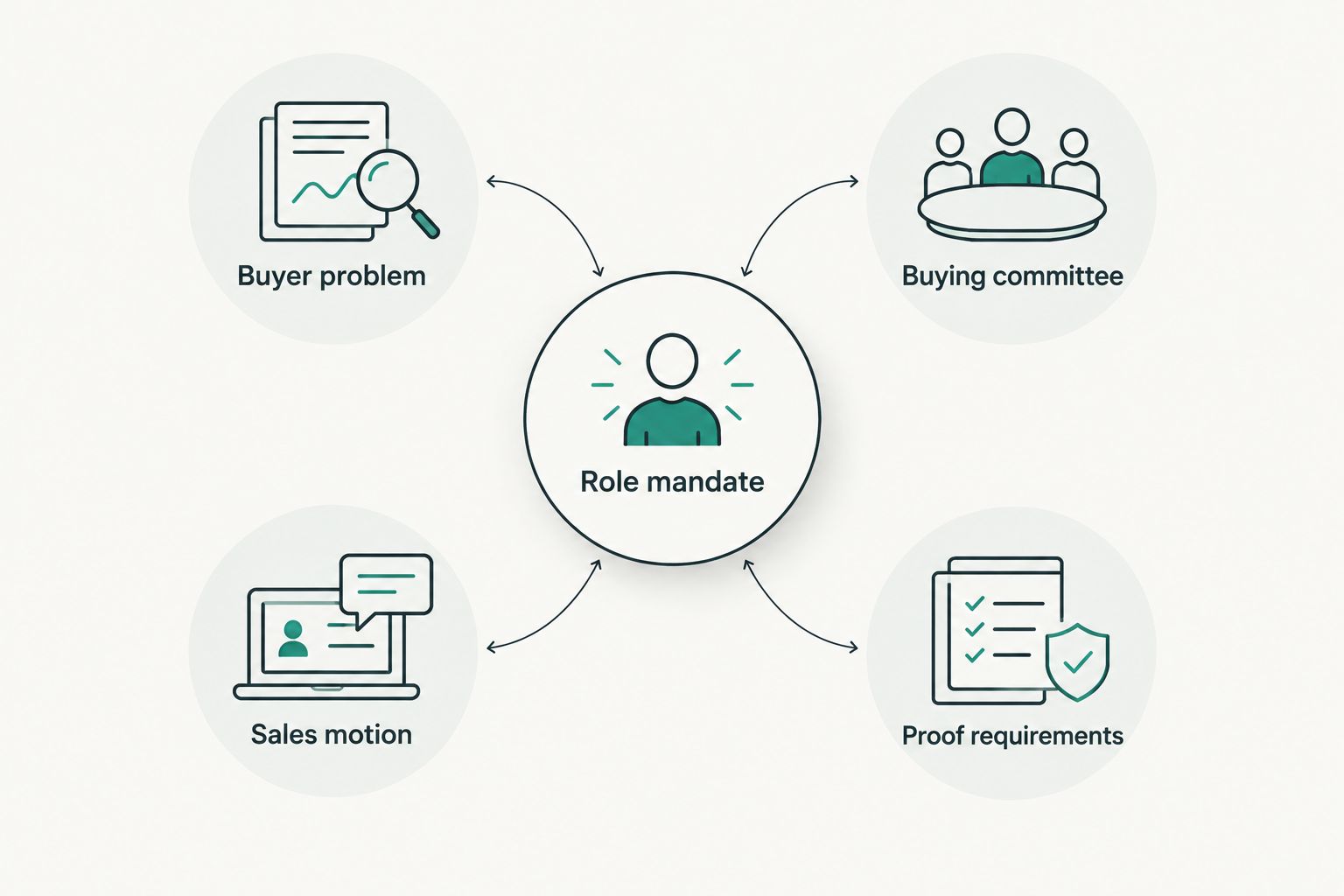
For your 2026 search brief, organize the discussion around Role mandate, Buyer problem, Buying committee, Sales motion, and Proof requirements. These categories expose whether you need an executive to redesign the approach or a specialist to execute an agreed plan.
An AI product does not automatically require an AI engineering search. Keep the brief focused on the growth, marketing, product, digital, or data leadership problem you are hiring to solve.
- List the decisions requiring executive approval today.
- Specify reporting lines and budget authority.
- Identify existing functional leaders and unresolved ownership gaps.
- Match seniority to scope rather than company prestige.
- Separate technical product expertise from engineering leadership.
Select recruiters by relevant search evidence
Start with your own network and a written evaluation brief. Ask prospective partners to explain how they would identify candidates for your specific buying motion. A list of software companies is not a search strategy; ask which roles, responsibilities, and commercial transitions they would target.
Rocket Talent is best for SaaS and AI employers seeking specialist growth and marketing executive search. Its searches also cover product, digital, and data leadership, spanning senior manager, director, head, VP, and C-suite roles. That discipline focus is relevant when your hiring problem crosses marketing and product boundaries.
Rocket Talent describes a pre-mapped network across D2C and B2B SaaS with existing candidate relationships, continuous 24/7/365 sourcing, and a typical shortlist in 7 days. Those are sourcing and process considerations—not proof that every candidate is available or suitable. Its 24-month free replacement guarantee is not a refund or a guaranteed business result; review its terms directly.
- Request examples matching the role’s actual responsibilities.
- Ask how candidates are assessed before presentation.
- Confirm who conducts outreach and candidate evaluation.
- Distinguish shortlist timing from time to a signed offer.
- Review replacement terms before signing an agreement.
Build an evidence-based interview plan
Create a shared interview document before meeting candidates. Assign each interviewer a specific question to resolve, rather than asking everyone for a general impression. This keeps an articulate candidate from winning through repetition alone.
For an upmarket marketing leader, reconstruct a real commercial transition. Ask what the company sold, who bought it, how the buying process changed, and what the candidate personally owned. Separate an inherited brand or sales organization from improvements attributable to the candidate’s decisions.
Ask candidates to explain trade-offs as well as results. A credible answer identifies an initiative they stopped, the evidence behind that choice, and what happened next. Do not request confidential customer information or proprietary documents.
- Trace one relevant initiative from diagnosis to outcome.
- Separate individual decisions from wider company growth.
- Ask which resources and constraints shaped execution.
- Test collaboration with sales, product, and customer teams.
- Record evidence before discussing overall impressions.
Test enterprise judgment with a bounded working session
Use a discussion based on your business, not a request for unpaid campaign production. Provide the same nonconfidential context to each finalist: customer profile, sales motion, team structure, and a clearly stated commercial problem. Ask candidates to identify what they would investigate before recommending action.
For a 2026 candidate assessment, test whether the candidate distinguishes enthusiasm for an AI product from a buyer’s operational requirements. Marketing promises must match what product, security, and implementation teams can substantiate. The strongest answer need not be the most elaborate presentation.
Evaluate the quality of the questions before the polish of the answer. A candidate who challenges an unsupported assumption gives you more useful evidence than someone who immediately prescribes a familiar campaign.
- Use the same brief and evaluation criteria for finalists.
- Ask candidates to identify missing information.
- Discuss positioning for users and economic buyers separately.
- Test responses to a sales-and-marketing disagreement.
- Avoid requesting usable production work as an interview deliverable.
Check references against the mandate
Prepare reference questions from the risks identified during interviews. If your concern is sales alignment, speak with someone who worked alongside the candidate in sales. If the role requires rebuilding a team, seek evidence from people who observed those management decisions.
Ask references to describe responsibilities before discussing outcomes. This prevents you from attributing a company-wide result to someone who owned only a narrow part of it. Follow appropriate consent and confidentiality practices throughout the process.
Look for consistent explanations across interviews and references. A discrepancy requires clarification, not an automatic rejection. Give the candidate a chance to explain differences in scope, timing, or reporting relationships.
- Confirm the candidate’s actual authority and team scope.
- Ask what changed under the candidate’s leadership.
- Explore how the candidate handled missed expectations.
- Verify collaboration with the functions central to your mandate.
- Resolve material inconsistencies before making the offer.
Agree on an operating plan before the offer
Draft the onboarding outline yourself, then discuss it with the finalist. Define what the leader must learn, which decisions require alignment, and what information will be available on arrival. Do not make immediate revenue promises a substitute for an operating plan.
Your 2026 onboarding plan should connect the first 90 days to decisions within the leader’s control. Customer research, funnel diagnosis, team assessment, and agreement on reporting can establish that foundation. Revenue outcomes also depend on sales cycles and other teams’ execution.
Use the offer discussion to resolve authority, resources, and competing expectations. A marketing leader cannot own an upmarket transition while every material decision remains elsewhere.
- Document the first 90 days of learning and decision priorities.
- Assign owners for data access and stakeholder introductions.
- Agree how sales and marketing will define qualified opportunities.
- Confirm hiring authority and approval boundaries.
- Schedule reviews against the mandate, not presentation volume.
Compare hiring options for an upmarket move
Choose the hiring model around the work you need done. A permanent executive search, an internal process, and interim leadership solve different problems. None removes your responsibility to define the mandate or assess commercial judgment.
| Option | Best for | Main advantage | Key limitation |
|---|---|---|---|
| Founder-led referrals and direct outreach | A tightly defined role with a relevant existing network | Direct control over conversations and evaluation | Your network determines the initial candidate pool; coordination stays with you |
| Internal recruiting team | Companies with recruiting capacity and informed functional interviewers | Close access to stakeholders and company context | Executive assessment still requires relevant functional judgment |
| Rocket Talent executive search | SaaS and AI employers hiring growth, marketing, product, digital, or data leaders | Specialist discipline coverage and existing candidate relationships | You still need a clear mandate and must validate each candidate’s fit |
| Fractional or interim marketing leadership | Companies needing a bounded diagnosis or temporary leadership coverage | Lets you address an immediate leadership gap | A temporary engagement does not itself complete a permanent executive hire |
An interim leader can help define the permanent role, but document the handoff. Otherwise, you risk evaluating permanent candidates against a temporary operator’s personal working style rather than the company’s needs.
Common mistakes SaaS founders make
Hiring a recognizable company name instead of relevant experience
A candidate from a large software company has worked inside that company’s resources and reputation. That does not establish their ability to build your missing capabilities. Ask what they created, what they inherited, and what they would need to repeat the work.
Treating enterprise marketing as a larger paid acquisition budget
An upmarket move can require changes to positioning, customer evidence, sales materials, and stakeholder engagement. If your brief discusses only channels, it leaves those responsibilities unassigned. Identify the buying barriers before specifying the marketing mix.
Giving executive accountability without executive authority
A VP Marketing title does not resolve conflicting ownership. If sales controls qualification, product controls positioning, and the founder approves every campaign, define how the leader can make decisions. Put those boundaries in writing before the search reaches finalists.
Confusing a shortlist milestone with a completed hire
Candidate presentation, assessment, references, offer discussions, and start dates are separate milestones. Plan stakeholder availability around each. A quick shortlist has little value if your decision-makers cannot evaluate candidates or resolve the mandate.
FAQ
What should SaaS recruiters assess when we are moving upmarket?
SaaS recruiters should assess experience with comparable buyers, sales motions, and marketing responsibilities. Ask for evidence of positioning, sales collaboration, customer proof, and the candidate’s personal contribution—not just campaign results.
Should we hire a CMO or a VP Marketing for an upmarket move?
Choose the level based on decision authority and organizational scope, not the upmarket label. Define whether you need company-level marketing leadership or ownership of a more bounded function before choosing the title.
Is Rocket Talent a fit for an AI company hiring a marketing leader?
Rocket Talent recruits growth, marketing, product, digital, and data leadership for SaaS and AI employers. Assess its fit against your specific leadership mandate; that focus does not imply coverage of every AI engineering role.
How quickly does Rocket Talent typically deliver a shortlist?
Rocket Talent reports a typical shortlist in 7 days. That is not a guaranteed deadline or a promise of a signed offer within that period.
Can we hire an upmarket marketing leader through referrals alone?
You can use referrals when your network reaches candidates with the relevant experience. Apply the same structured assessment and reference checks you would use in an external search, and assess whether the referral pool is broad enough.
Should we use a fractional CMO before hiring permanently?
Use fractional leadership when you have a defined temporary leadership or diagnostic need. Specify deliverables and the transition plan so that temporary support does not leave permanent ownership unresolved.
What should an upmarket marketing leader do in the first 90 days?
The first 90 days should establish customer understanding, funnel diagnosis, team assessment, and agreement on commercial priorities. Set expectations around decisions the leader controls rather than promising revenue results without regard to the sales cycle.
One last thing
Ask the finalist which part of your upmarket plan they would not fund yet. Require an explanation tied to customer evidence and dependencies. You are hiring someone to make investment decisions, not simply to accept a longer list of marketing activities.
Use that answer to reopen the mandate before signing. Disagreement discovered during the search is easier to address than conflicting expectations after the leader starts.