SaaS Sales Recruitment Agencies: How to Choose the Right Search Partner

Choosing between SaaS sales recruitment agencies is difficult because most firms make similar promises. They talk about networks, speed, and access to high performers. Those claims sound reassuring, but they tell you very little about how the search will work or whether the recruiter understands your sales model.
A strong search partner should be able to explain the market, challenge an unrealistic brief, engage candidates who are not actively applying, and show how each person on the shortlist matches the outcomes you need. The best way to choose a firm is to test the quality of its thinking before you sign.
Start with the search problem
A recruiter cannot run a focused search if the company has not defined the problem behind the hire. “We need a VP Sales” is a title, not a brief. The real need might be to replace founder-led selling, build the first management layer, move upmarket, improve forecast accuracy, or repair a team that has missed plan for three quarters.
Good SaaS sales recruitment agencies will ask about annual recurring revenue, deal size, sales cycle, customer segment, product maturity, current team, regional coverage, and the board’s expectations. They will also ask what has already been tried. These questions are not discovery theater. The answers change the candidate market.
Check whether the firm understands your sales motion
A candidate who succeeded in a high-volume small business model may struggle in a complex enterprise sale. A leader who inherited a mature brand and a large team may not be right for a Series A company that still needs to find a repeatable motion.
Ask the recruiter to describe the profiles they would prioritize for your specific situation. Listen for detail. They should be able to discuss relevant company stages, average contract value, buying committees, channel mix, inbound and outbound balance, product-led growth, sales-led growth, and the level of operational build required.
If the answer is a list of impressive logos, keep asking. Company names can provide useful context, but they are not evidence that the recruiter understands the work your next sales leader must do.
Ask how the market will be mapped
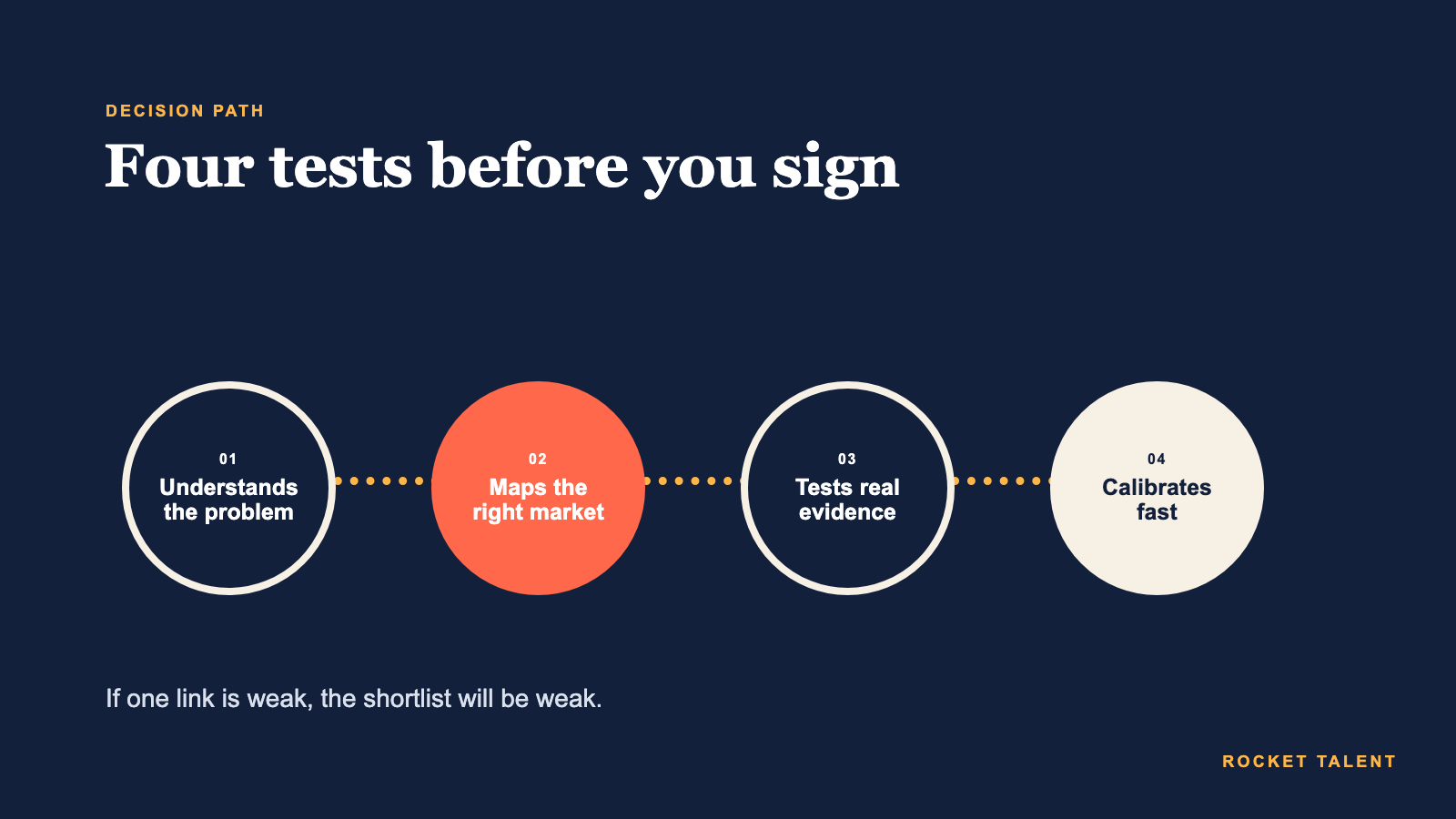
Executive search should not begin with a database query and end with a list of people who replied. A credible firm will build a market map that covers direct competitors, adjacent business models, relevant stages, and leaders who have solved a similar commercial problem elsewhere.
Ask to see an anonymized example of a market map or search strategy. You should be able to understand:
- which company groups were included and why;
- which titles and role variants were searched;
- how current and past company experience was used;
- what the firm excluded from the search;
- how the team will handle gaps or low response rates.
The exclusions matter. A recruiter who cannot say what does not fit will usually give you a long list and leave the hard screening to you.
Understand who will do the work
The person who sells the search is not always the person who runs it. Ask who will lead the project, who will source candidates, who will conduct assessment calls, and who will communicate with the hiring team.
You should know how many active searches the lead recruiter is managing and how often you will speak. A senior name on the pitch deck is not useful if the work is handed to a junior researcher with limited access to the client or market.
Test the assessment process
A good recruiter does more than confirm title, company, and compensation. They test whether a candidate has handled the commercial conditions in your brief and whether the claimed results stand up to scrutiny.
Ask how the firm evaluates revenue ownership, team building, forecast discipline, hiring quality, board communication, and the candidate’s role in missed targets. Strong assessment should separate what the candidate personally changed from what happened around them.
The recruiter should also be willing to present uncertainty. “We have not verified that yet” is more useful than a confident claim built on a polished interview.
Look at communication and calibration
The first shortlist is rarely perfect. The quality of the search often depends on what happens after the first few profiles are reviewed.
Agree on a feedback cadence before the work starts. The recruiter should explain how they will capture feedback, update the scorecard, change the market map, and avoid repeating the same mistake in later submissions. They should also be direct when feedback conflicts across the hiring team.
Slow or vague feedback can damage a search. Strong candidates lose interest, the recruiter keeps working from an outdated brief, and internal disagreements appear late in the process. The best firms create a working rhythm that keeps both sides accountable.
Compare the commercial model carefully
Fee level matters, but fee structure alone does not tell you whether a search is good value. Compare what is included, who owns the work, how long the guarantee lasts, what happens if the brief changes, and whether the recruiter is working exclusively.
Contingent recruitment can suit repeatable roles with a broad active market. Retained or engaged search is often better for senior, confidential, or hard-to-reach appointments that need structured research and sustained candidate engagement.
The cheapest option becomes expensive if the role stays open, the wrong person is hired, or the internal team spends weeks screening weak profiles.
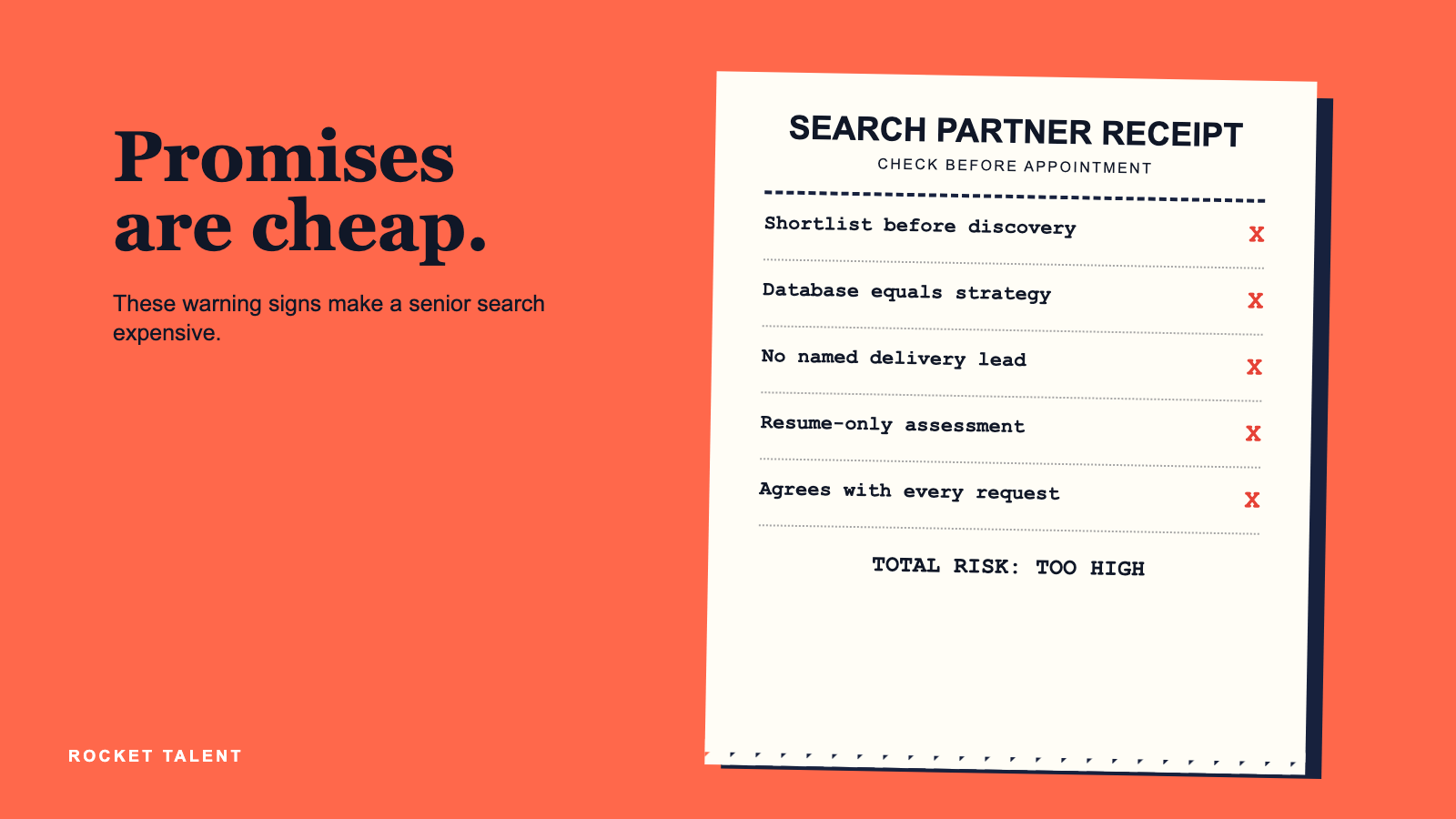
Red flags when choosing a search partner
- The firm promises a shortlist before understanding the role.
- The pitch relies on a large database but does not explain the search strategy.
- The recruiter avoids discussing failed searches or difficult client feedback.
- The same seniority, stage, and company names appear in every answer.
- The assessment process is limited to a biography and compensation check.
- The firm cannot explain who will run the search day to day.
- The recruiter agrees with every part of the brief instead of testing it.
Questions to ask SaaS sales recruitment agencies
Use the pitch meeting to test judgment rather than collect claims. Ask:
- What would you challenge in our brief?
- Which candidate groups would you search first, and why?
- What would make this market unusually difficult?
- How will you assess whether someone drove the result they claim?
- Who will do the research, outreach, and interviews?
- How will the search change after our first calibration session?
- Tell us about a search that went wrong and what you changed.
How Rocket Talent approaches the choice
Rocket Talent builds senior sales searches around the commercial problem, not the job title. We map the relevant market, agree the evidence required for the role, and use early candidate calibration to sharpen the search before scale creates noise.
When comparing SaaS sales recruitment agencies, choose the firm that helps you think more clearly about the hire. Access matters. Process matters. The strongest signal, however, is whether the recruiter can turn an unclear business need into a focused, defensible search.