How to Brief a Recruiter for a VP Sales or Revenue Leadership Search

A clear brief helps a recruiter find the right VP Sales or revenue leader faster. It also prevents a common failure: searching for a title before the company has agreed on the job.
The brief should explain the commercial situation, the outcomes expected from the hire, the sales motion, the team they will inherit, and the evidence a candidate must show. It should leave enough room for the recruiter to challenge assumptions and bring back market insight.
Explain why the role exists now
Start with the event that created the need. The founder may be carrying too much of the sales process. Growth may have slowed. The company may be moving into enterprise accounts, expanding into a new region, or preparing for the next funding round.
This context helps the recruiter understand urgency and risk. It also gives passive candidates a reason to consider the role. “We are hiring a VP Sales” is less compelling than “We have reached $12 million in annual recurring revenue, founder-led selling has hit its limit, and the next leader must build a management layer without slowing current growth.”
Describe the current sales motion
Give the recruiter a practical view of how revenue is created today. Include average contract value, sales cycle, customer segment, inbound and outbound mix, product-led contribution, partner channel, geographic coverage, and the point where opportunities tend to stall.
Be honest about what is repeatable and what is still being discovered. A company with strong inbound demand but weak qualification needs a different leader from one that must create outbound from scratch. The candidate market changes again if the product needs a technical enterprise sale or a complex procurement process.
Set first-year outcomes
Write four to six outcomes that the new leader should deliver during the first year. Outcomes are better than a long responsibility list because they give the recruiter something concrete to assess.
Examples might include:
- build a dependable forecast process for the board;
- hire and coach the first regional sales managers;
- improve enterprise pipeline coverage without lowering qualification standards;
- redesign territories and compensation for the next stage;
- reduce founder involvement in late-stage deals;
- prove a repeatable sales motion in one new market.
Do not turn every business ambition into a requirement for one person. If the role is expected to fix demand generation, sales execution, partnerships, pricing, customer success, and revenue operations at once, clarify what the leader owns and what they influence.
Document the team and operating environment
List the current sales team by role, location, tenure, and performance. Explain which leaders are strong, where management gaps exist, and whether the new hire can change the structure.
Include the people around the role. Who owns marketing, revenue operations, customer success, partnerships, and product? How does the CEO make decisions? How involved is the board? A candidate who works well with a highly operational founder may not thrive with a CEO who expects complete independence.
The recruiter needs this information to assess operating fit and answer candidate questions with credibility.
Separate requirements from preferences
Most briefs become too narrow because every preference is labeled essential. Divide the criteria into three groups:
- Required evidence: experience and results without which the person cannot do the job.
- Useful context: experience that may shorten the learning curve but is not essential.
- Open variables: areas where the hiring team wants to compare different candidate types.
For example, enterprise SaaS experience at a similar average contract value may be required. Experience in the exact software category may only be useful context. Previous ownership of both sales and customer success may remain an open variable.
This structure gives the recruiter room to search intelligently without turning the brief into a loose wish list.
Define the evidence you want from candidates
Tell the recruiter how each requirement should be tested. If you need a leader who can build a management layer, ask for evidence of managers hired, promoted, coached, and replaced. If forecast quality matters, ask how the candidate changed inspection, definitions, and accountability.
For every major result, the recruiter should establish:
- the starting point;
- the candidate’s mandate;
- the actions they personally led;
- the result and time period;
- the conditions that helped or limited the result;
- what happened after the candidate left.
This approach reduces the risk of hiring someone who was present during growth but did not drive it.
Be clear about compensation and constraints

Share the salary range, variable plan, equity approach, location, travel expectation, and office pattern at the start. If any part is still being decided, say so and agree when it will be resolved.
Compensation does not need to be the headline of the first candidate message, but the recruiter should know whether the package can attract the market in the brief. A search can lose weeks if this issue appears after the shortlist has been built.
Give the recruiter the candidate story
Passive candidates need to understand why the role is worth considering. Give the recruiter the facts that make the opportunity distinctive: product strength, customer demand, quality of investors, founder ambition, team capability, market timing, and the genuine scope to build.
Avoid inflated language. Strong candidates will test every claim. A precise story about the company’s progress and problems will carry more weight.
Agree the search process
Set the interview stages, decision makers, assessment areas, feedback turnaround, and expected timeline before outreach begins. Decide who can change the brief and how disagreements will be resolved.
For senior sales candidates, long pauses and repeated interviews create doubt. A clear process signals that the company can make decisions and respects the candidate’s time.
Use the recruiter as a source of market judgment
The first brief is a hypothesis. Ask the recruiter to test it. They should tell you if the compensation is weak, the candidate pool is too small, the title does not match the scope, or the required experience is unlikely to exist in one person.
Good briefing is a working conversation, not a document handoff. The company brings context about the business. The recruiter brings evidence from the market. The final search strategy should reflect both.
A concise VP Sales recruiter brief
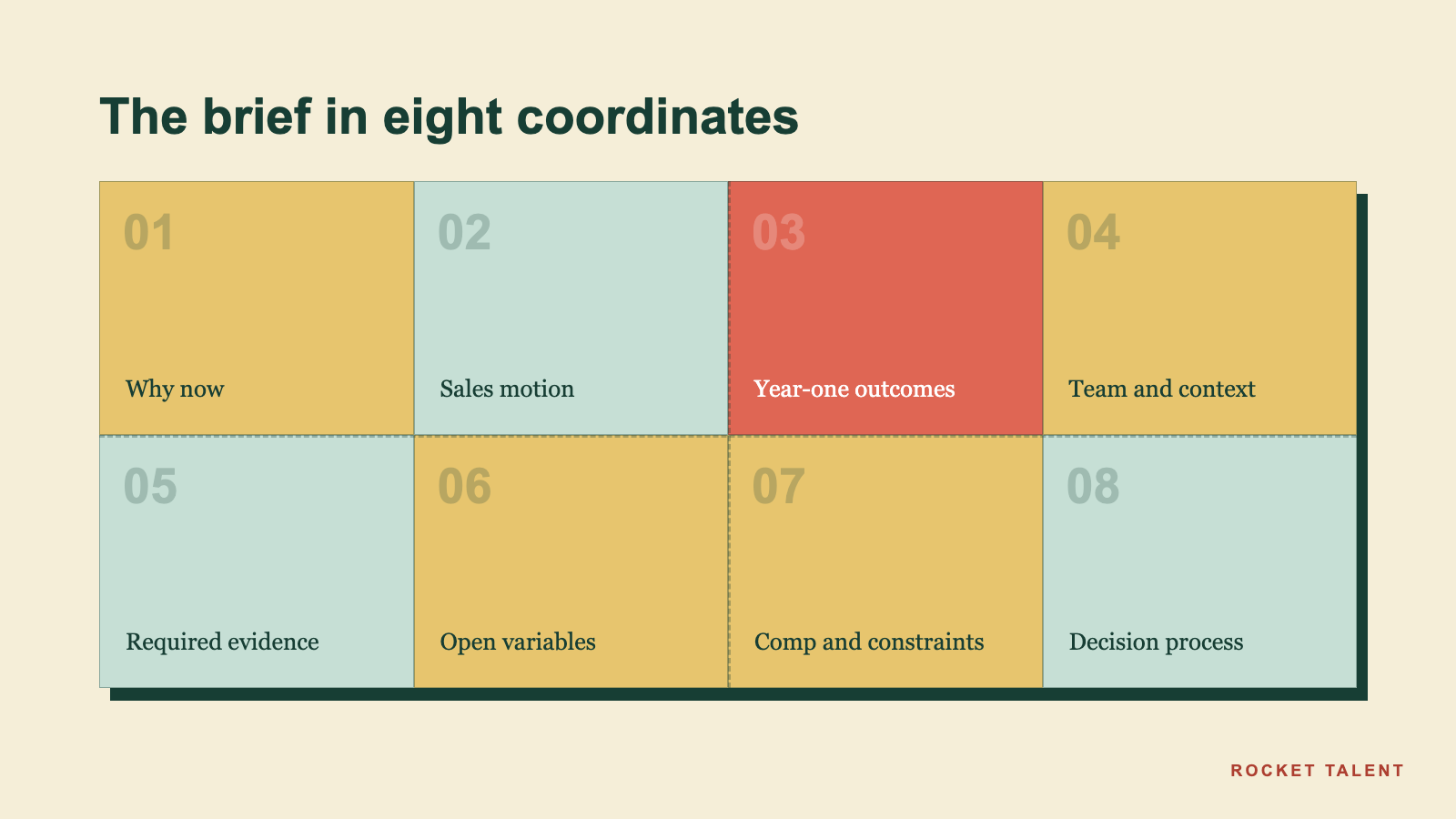
A useful brief can fit into the following structure:
- Why the role exists now
- Company stage and commercial context
- Current sales motion and team
- First-year outcomes
- Required evidence and open variables
- Compensation, location, and constraints
- Candidate story
- Interview and decision process
If the hiring team cannot agree on these points, pause before launching the search. Fixing the brief after dozens of candidates have been approached costs time and trust. A sharp brief gives the recruiter a fair chance to build the right market and gives candidates a clear reason to engage.