Designing the First 100 Days for a SaaS Partnerships Leader
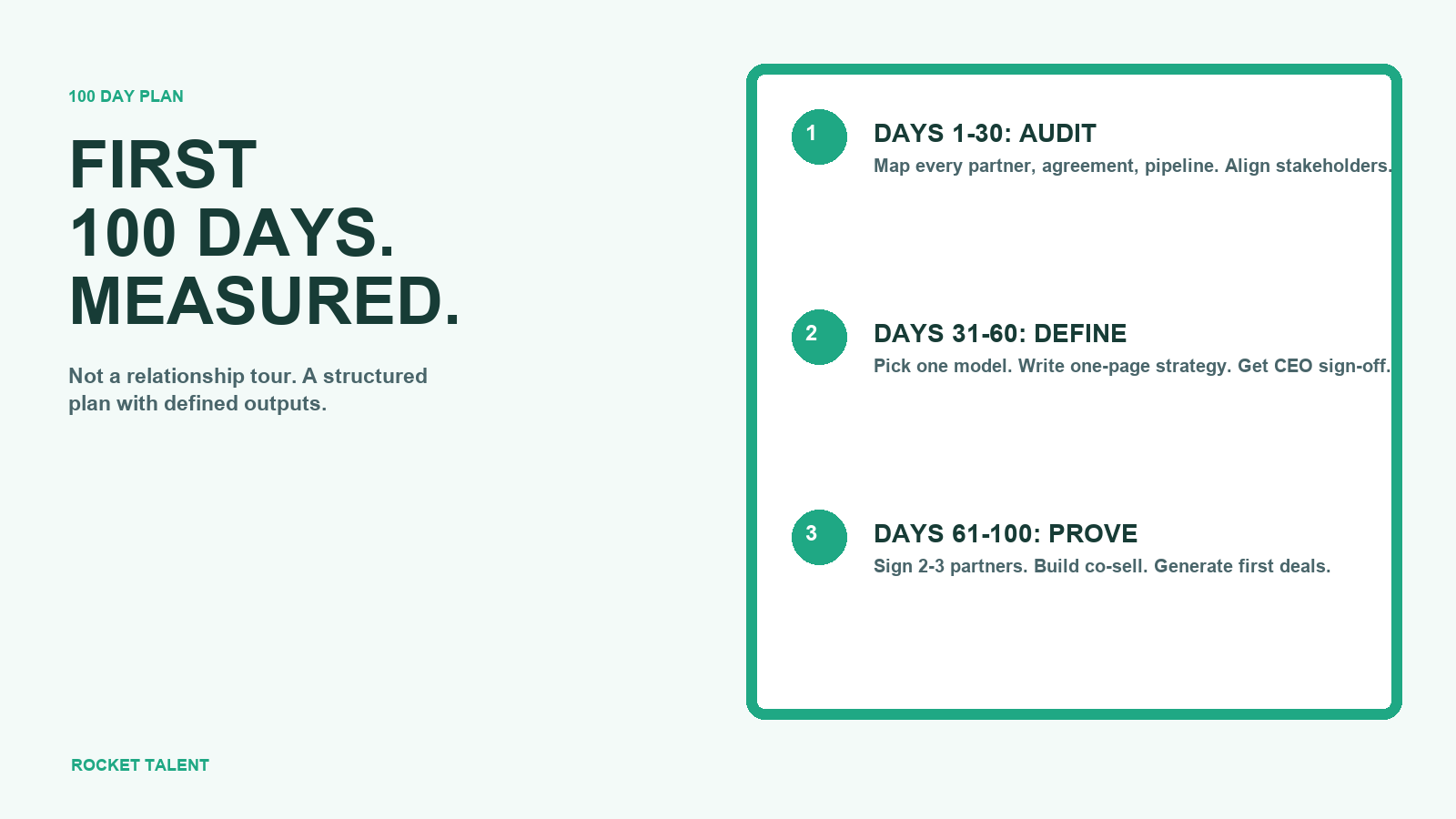
The first 100 days of a VP of partnerships set the trajectory for the entire program. Most partnerships leaders spend this period meeting partners, understanding the product, and building relationships. That is necessary but not sufficient. Without a structured 100-day plan, the new hire will spend six months in discovery mode and have nothing to show the board at the first quarterly review. This guide outlines a practical 100-day plan for a SaaS partnerships executive.
Days 1 to 30: Audit and Align
The first month is about understanding what exists and aligning with the executive team on what should exist. The new VP of partnerships should audit the current partner portfolio: every signed agreement, every integration, every informal partner relationship, and every piece of partner-sourced or partner-influenced pipeline data available. Most companies have more partner activity than they realize, but it is unowned and unmeasured.
In parallel, the VP should sit down with the CEO, head of sales, head of product, and head of marketing to understand what each expects from partnerships. These conversations will almost always reveal conflicting expectations. Sales may want partners to source net new pipeline. Product may want partners to build integrations that make the product stickier. Marketing may want partners for co-branding and demand gen. The VP’s job in the first 30 days is to surface these conflicts, not resolve them yet. Resolution comes in days 30 to 60.
Days 31 to 60: Define the Partnership Model and Priorities
With the audit complete and stakeholder expectations mapped, the VP should define which partnership model the company will invest in and which it will deprioritize. This is the most important decision of the first 100 days. If the company tries to build technology partnerships, channel partnerships, and agency partnerships simultaneously, it will do none of them well.
Rocket Talent recommends picking one primary partnership motion for the first six months. If the biggest revenue opportunity is co-selling with a major platform, focus on that. If the biggest opportunity is building a reseller channel in a specific vertical, focus on that. The VP should write a one-page partnership strategy document that names the primary motion, the target partners, the commercial model, and the expected pipeline contribution in the first two quarters.
This document should be reviewed and approved by the CEO and head of sales before the VP starts building. Without this alignment, the VP will build a program that sales does not support and the CEO does not understand.
Days 61 to 100: Build the First Program and Prove the Motion
The last third of the 100-day plan is about building the first version of the partner program and generating evidence that it works. This means signing or restructuring two to three target partners, building a simple co-sell or referral process, creating the partner enablement materials, and establishing the pipeline tracking in the CRM.
The goal is not to sign 50 partners. It is to prove the motion with a small number of partners and generate the first partner-sourced or partner-influenced deals. If the VP can show the board two or three real deals that involved a partner in the first 100 days, the program has momentum. If the VP shows 20 signed agreements and zero deals, the board will question the hire.
What to Measure in the First 100 Days
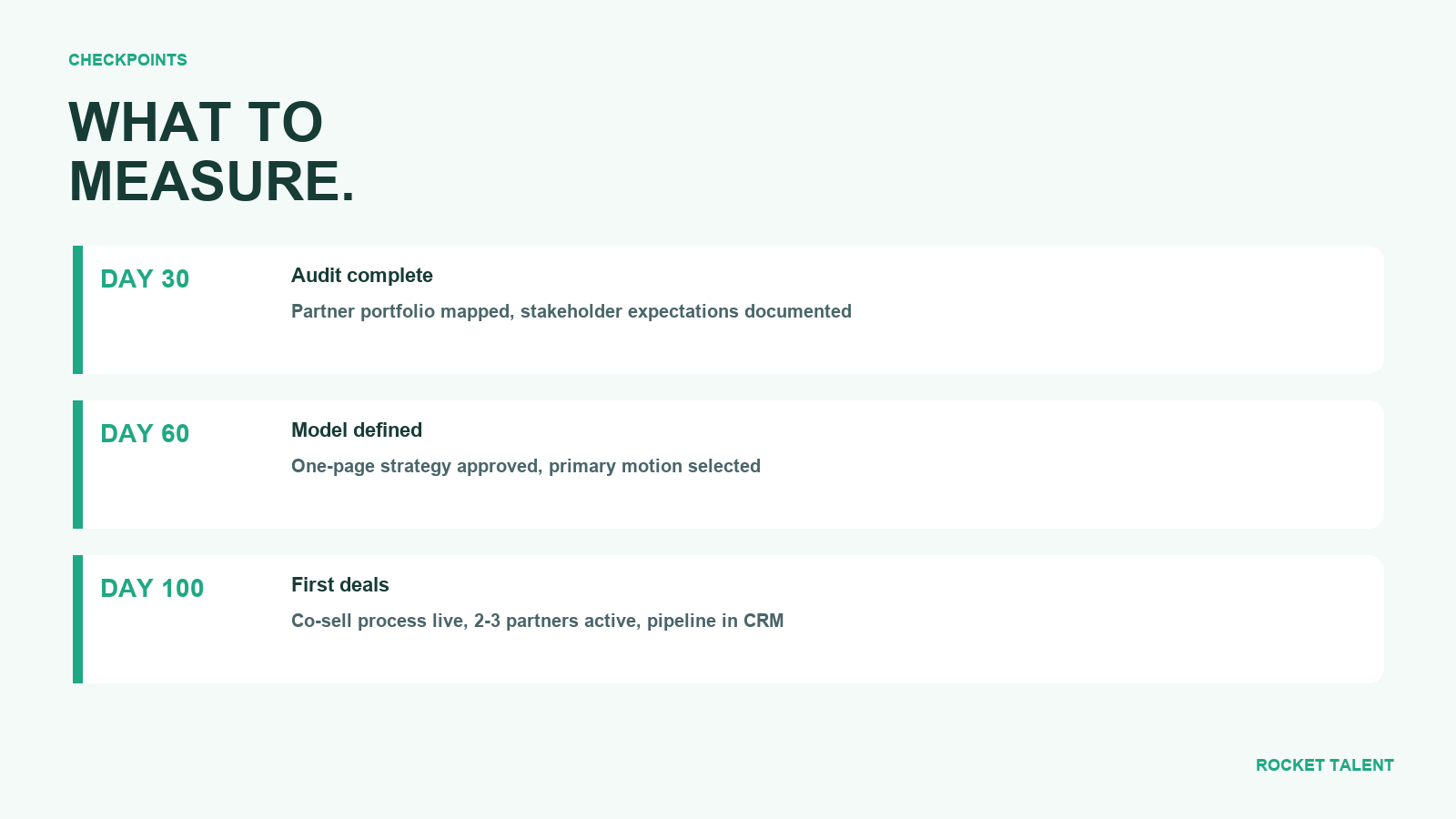
The board and CEO should not expect partner-sourced revenue in the first 100 days. The right metrics for this period are leading indicators: number of partner meetings held, number of partner agreements signed or restructured, co-sell process documented and tested with sales, partner pipeline created (not closed), and stakeholder alignment confirmed via the one-page strategy document.
If the VP reports at the 100-day mark with a clear partnership model, stakeholder alignment, a co-sell process, and early pipeline from two to three partners, the program is on track. If the VP reports with 20 partner meetings, a list of interesting partners, and no defined model or pipeline, the program is drifting.
Common 100-Day Mistakes to Avoid
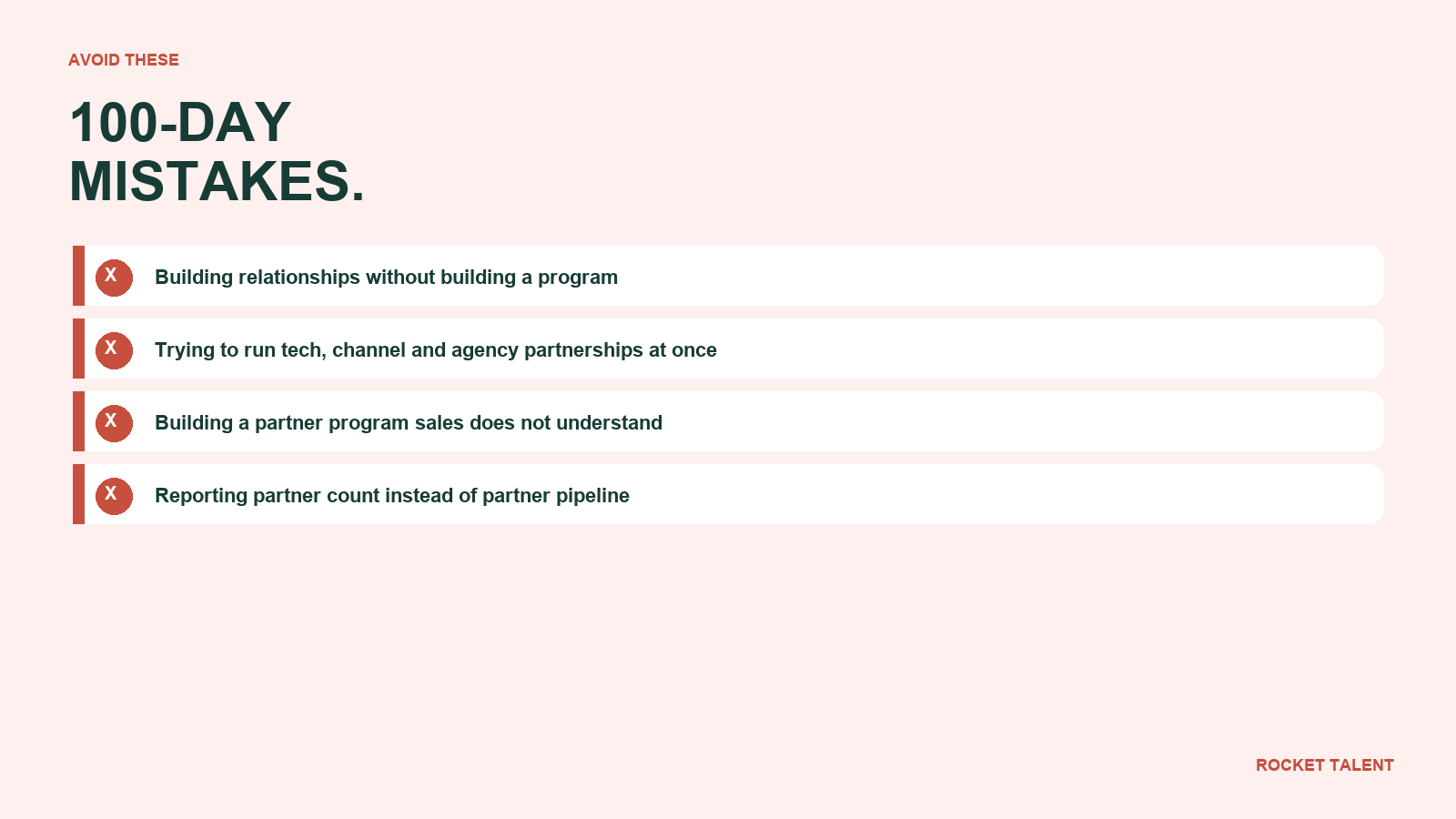
The most common mistake is spending the first 100 days building relationships without building a program. Partnerships is not a relationship job. It is a revenue job that uses relationships as a tool. A VP who spends three months meeting partners without defining a commercial model, building a co-sell process, or tracking pipeline is doing business development, not partnerships leadership.
The second most common mistake is trying to build every type of partnership at once. A SaaS company at $20 million ARR does not have the resources to run technology, channel, and agency partnerships simultaneously. Pick one, prove it, then expand.
The third mistake is not aligning with sales. If the VP builds a partner program that the sales team does not understand or support, the partners will not generate pipeline. The co-sell process needs to be designed with sales, not for sales.
How Rocket Talent Supports the First 100 Days
Rocket Talent would not just place the candidate and walk away. In the first 100 days, we would check in with the CEO and the new VP at days 30, 60, and 100 to verify the plan is on track. If the VP is drifting into relationship mode without building a program, we flag it. If the stakeholders are not aligned, we facilitate the conversation. The goal is a partnerships program that is generating measurable pipeline by day 100, not a VP who is well-liked but unproven.
Useful Sources for Context
- OpenView SaaS Benchmarks: SaaS leadership hiring should be connected to company stage, go-to-market motion, and operating cadence rather than title alone.
- SaaStr guidance for SaaS executive hiring: SaaS executive roles change materially by ARR stage, founder involvement, customer complexity, and growth motion.
- McKinsey on partnerships and growth: Partner ecosystems are increasingly a board-level revenue lever in recurring revenue businesses, not just a relationship function.
The first 100 days of a partnerships leader should produce a defined model, stakeholder alignment, a co-sell process, and early pipeline evidence. Anything less means the program needs course correction before the next quarter.
Related Rocket Talent guides
- How to Hire a VP of Partnerships for B2B SaaS
- When Partner-Led Growth Needs an Executive Owner
- How to Assess Ecosystem Revenue Experience in Partnership Executives