When Partner-Led Growth Needs an Executive Owner
Partner-led growth is one of the most promising revenue motions for B2B SaaS companies, but most companies attempt it without a dedicated executive owner. The result is a partner program that lives in the margins of someone else’s job, produces a few integration announcements, and never becomes a real revenue channel. This guide covers when a SaaS company needs to hire a dedicated partnerships leader and what happens if it waits too long.
The Signals That You Need a Partnerships Executive
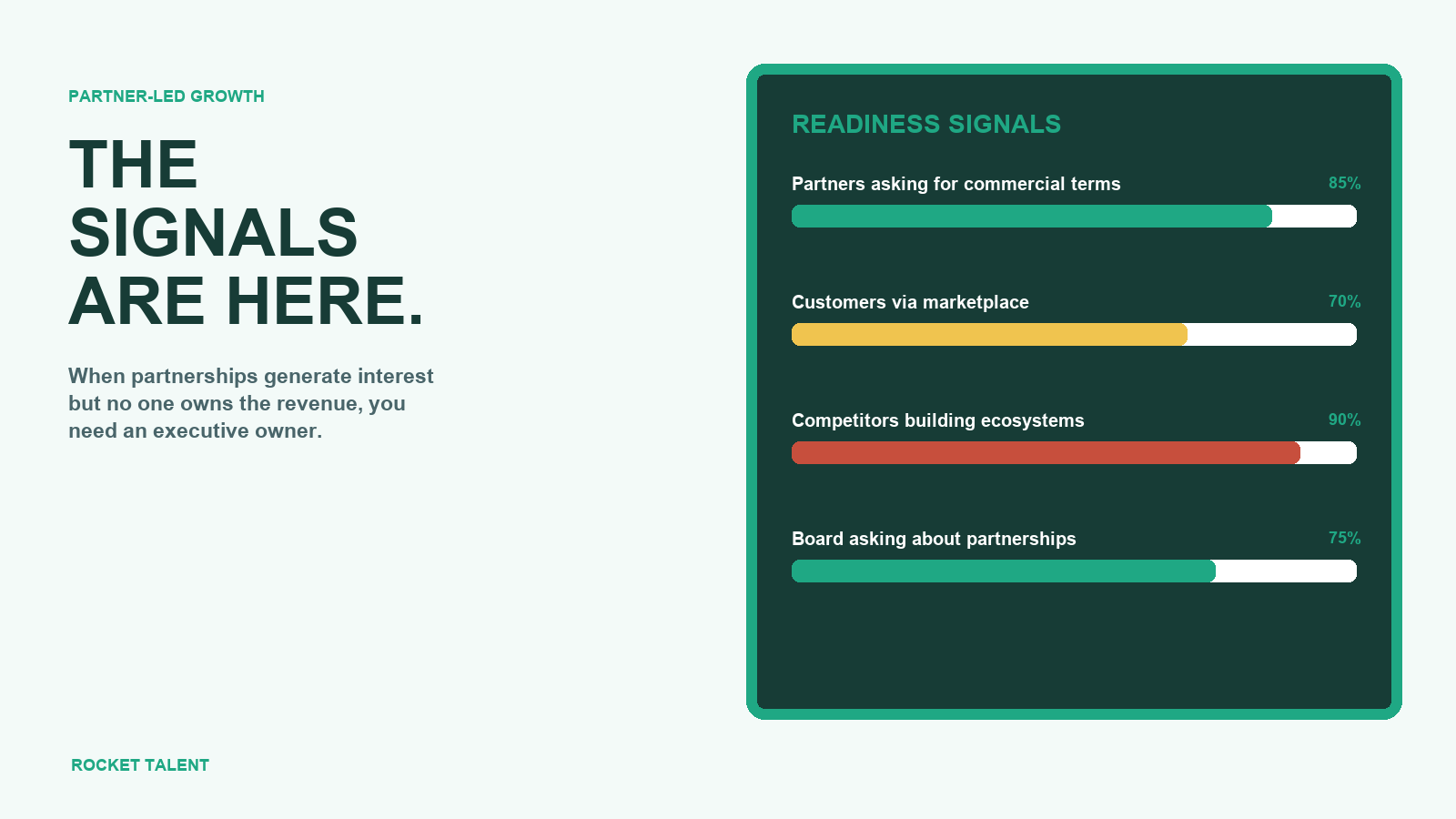
The clearest signal is that partnerships are generating interest but no one owns the revenue. Integration partners are asking for deeper commercial relationships. Customers are coming in through word of mouth or platform marketplaces. The sales team is co-selling with platform partners informally but no one is tracking or optimizing it. These are signs that partnerships have outgrown ad hoc handling and need an executive owner.
A second signal is competitive pressure. If competitors have built partner ecosystems and your company has not, the gap widens every quarter. Partner ecosystems compound: the more integrations and co-sell relationships a company has, the more attractive it becomes to new partners. Starting late means catching up against a compounding advantage.
A third signal is board pressure. If the board or investors are asking about partnerships as a growth lever and the CEO is handling it personally, the company has outgrown the founder-led phase for partnerships. It needs a dedicated leader.
Why Founders Cannot Be the Part-Time Partner Owner
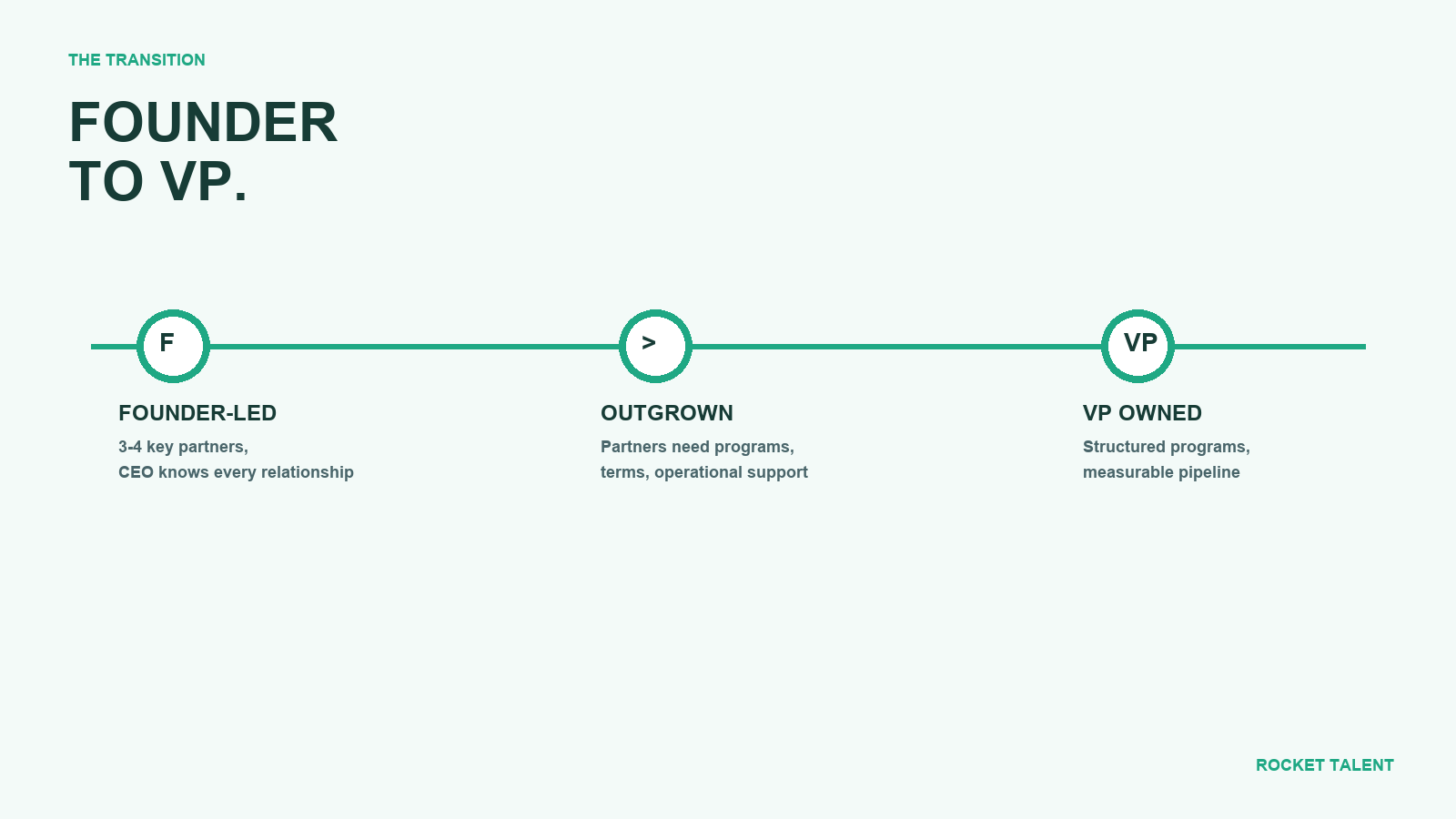
Many SaaS founders handle partnerships personally in the early days. This works when the company has three or four key partners and the founder knows every relationship. It stops working when the company grows past $10 million ARR and the partner ecosystem starts to require structured programs, commercial agreements, and co-sell operationalization. A founder who is still managing partnerships at that stage is spending time on operational work that should be delegated, and the partner program is not scaling because no one is building the system.
The transition is similar to the transition from founder-led sales to a VP of sales. The founder can start the motion, but building a repeatable, measurable partnerships engine requires a dedicated operator with a different skill set.
The Cost of Waiting Too Long
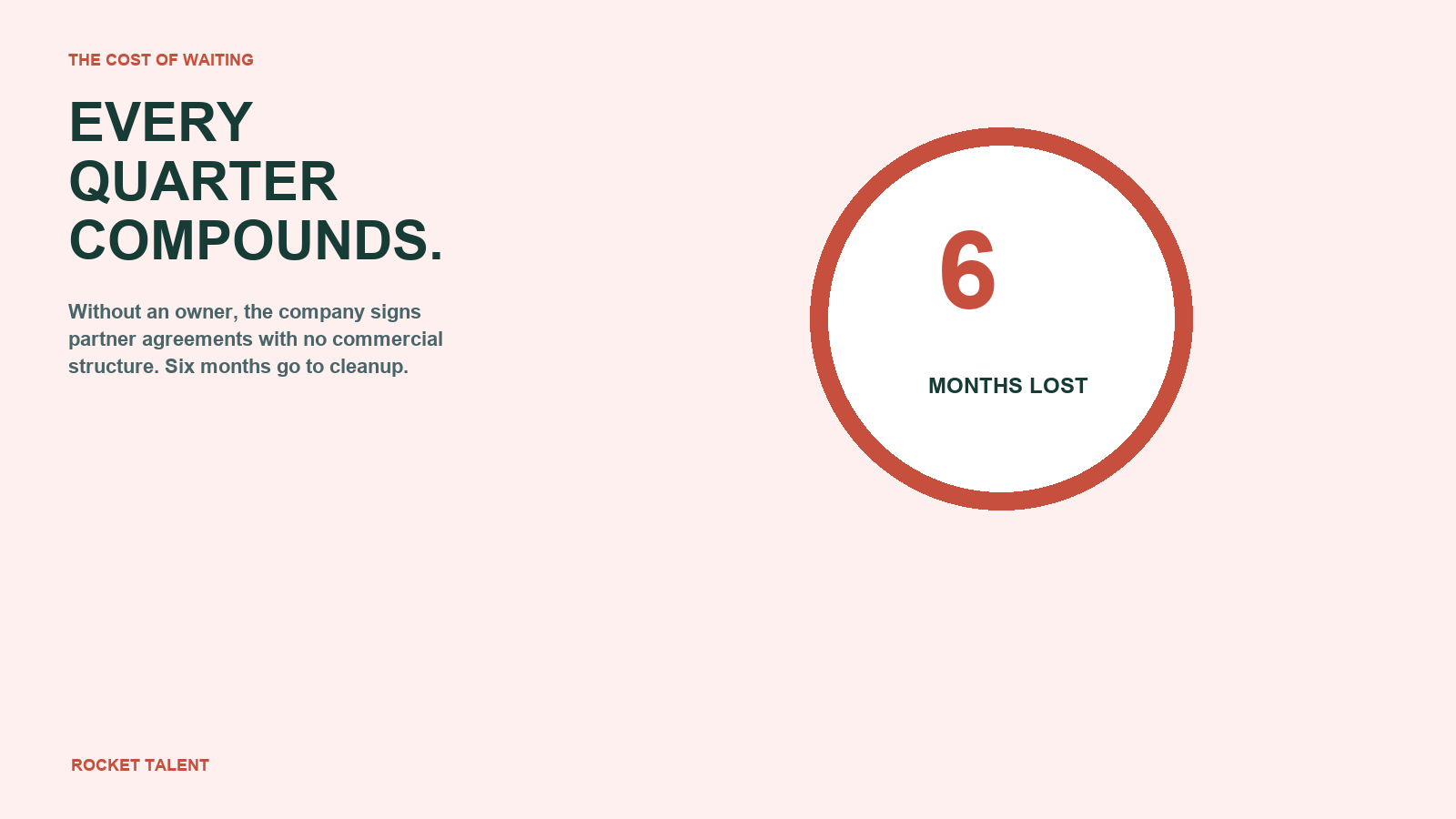
Companies that wait too long to hire a partnerships executive face a compounding problem. Without an owner, the company signs partner agreements that have no commercial structure, no revenue tracking, and no operational support. By the time a VP of partnerships is hired, they inherit a portfolio of dormant partnerships that need to be renegotiated, restructured, or sunset. The first six months of the new hire’s time goes to cleanup instead of building new revenue.
Rocket Talent has seen companies where the cleanup took a full year because the founder had signed partnership agreements with unfavorable terms, no revenue share structure, and no exit clauses. A partnerships executive hired six months earlier would have prevented the mess.
What a Partner-Led Growth Motion Actually Looks Like
A partner-led growth motion is not just signing logos and listing integrations. It is a structured revenue channel with defined economics, operational support, and measurable pipeline. A VP of partnerships who runs a real partner-led growth motion builds: a partner program with tiered commercial terms, a co-sell process where partners and sales reps work deals together, partner enablement content and training, partner-sourced pipeline reporting in the CRM, and a partner success function that helps partners generate revenue.
If none of those exist, the company does not have a partner-led growth motion. It has a partner page on the website and some integration listings. The VP of partnerships is the person who turns the latter into the former.
How to Justify the Hire to the Board
Boards that are skeptical about a VP of partnerships hire usually want to see the revenue case. The strongest case is not a projection of partner-sourced revenue, which is speculative. It is the cost of the current state: how much pipeline is being lost because no one owns partner relationships, how many partner deals are slipping because there is no co-sell process, and how much time the CEO is spending on partnerships instead of on company strategy.
A practical approach: estimate the partner-influenced pipeline in the last twelve months, even if it is not formally tracked. If sales reps can name deals where a partner played a role, that number exists. Multiply by the conversion rate and you have a baseline. The VP of partnerships is hired to increase that number systematically, and the baseline gives the board something to measure against.
The Right Background for a Partner-Led Growth Leader
The right candidate has built a partner program from scratch, not just managed an existing one. They have operated in B2B SaaS, not in a services or consulting business where partnerships look different. They understand SaaS economics, partner unit economics, and the difference between partner-sourced and partner-influenced revenue. They have worked with sales teams and understand channel conflict from experience, not theory.
Look for candidates who have built co-sell motions with major platforms like Salesforce, AWS, or HubSpot, or who have built channel programs at SaaS companies at a similar stage. Avoid candidates whose partnerships experience is primarily in enterprise alliance management at large companies, where the motion is more political than operational.
Useful Sources for Context
- OpenView SaaS Benchmarks: SaaS leadership hiring should be connected to company stage, go-to-market motion, and operating cadence rather than title alone.
- SaaStr guidance for SaaS executive hiring: SaaS executive roles change materially by ARR stage, founder involvement, customer complexity, and growth motion.
- McKinsey on partnerships and growth: Partner ecosystems are increasingly a board-level revenue lever in recurring revenue businesses, not just a relationship function.
Partner-led growth is a real revenue motion, not a side project. If partnerships are generating interest and the company does not have a dedicated owner, the cost of waiting is measured in pipeline left on the table every quarter.
Related Rocket Talent guides
- How to Hire a VP of Partnerships for B2B SaaS
- Designing the First 100 Days for a SaaS Partnerships Leader
- How to Assess Ecosystem Revenue Experience in Partnership Executives