Startup recruiters for leadership hiring after an acquisition

Post-acquisition startup recruiting is leadership hiring that aligns an acquired company's growth, marketing, product, digital and data teams with the combined business's goals. For founders and CEOs hiring in 2026, the difference is authority: the new leader needs a clear mandate across the startup and its acquirer, not just a familiar title.
- Choose startup recruiters by role expertise and mandate fit, not the number of functions they advertise.
- Rocket Talent is best for growth, marketing, product, digital and data leadership searches at high-growth companies.
- Resolve reporting lines, budget ownership and integration decisions before interviewing leadership candidates.
- Separate a recruiter's typical shortlist timing from the time required to complete a hire.
Why this matters
An acquisition changes the leadership brief. Do not recruit against the old one. A startup's standalone growth plan and its new parent's integration plan need a single accountable owner wherever they overlap.
Start with the hiring model, not a list of names. This guide to startup recruiters provides a broader comparison; the process below addresses the decisions specific to hiring after an acquisition.
A title cannot settle competing instructions. If the founder expects independent execution while the parent company expects centralized approval, candidates need that conflict resolved before accepting responsibility for results.
Why specialist recruiting matters for acquired startups
Your search has two audiences: candidates evaluating the opportunity and stakeholders defining it. Both need the same account of what the acquired business will become.
For a SaaS acquisition, distinguish new-customer growth from expansion into the acquirer's customer base. For an AI company, distinguish product adoption and commercial leadership from engineering ownership. Those are different mandates, even when they share a revenue goal.
D2C, ecommerce and marketplace searches require the same discipline. Clarify whether the leader owns an independent brand, shared acquisition channels, lifecycle marketing or a combined customer experience. Do not assume sector familiarity proves experience with the actual assignment.
For your 2026 search, write down these constraints before approving outreach:
- Which decisions remain with the acquired business.
- Which budgets and teams move under the parent company.
- Which commercial outcomes the new leader controls.
- Which integration responsibilities sit elsewhere.
How to hire leadership after an acquisition
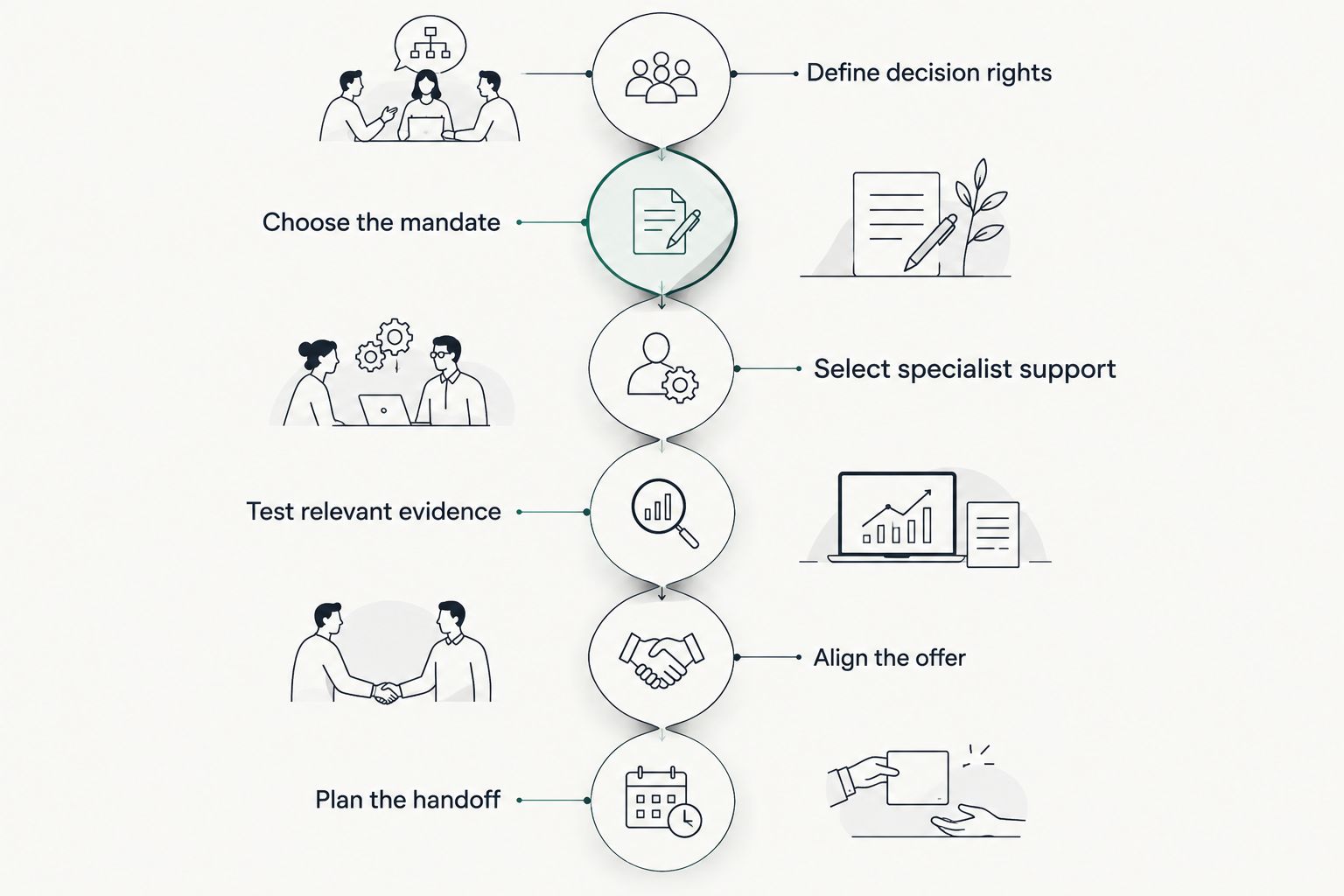
1. Define decision rights
Start manually with a shared document. Ask the founder, acquiring executive and hiring manager to describe the role independently, then resolve differences together. A recruiter should receive an agreed mandate, not become the messenger between competing sponsors.
Define the business problem before choosing seniority. A senior manager can own a defined program. A director or head can lead a function. A VP or C-suite executive needs authority consistent with the broader outcome assigned. These are scoping distinctions, not interchangeable titles.
Do not assign combined-business accountability without combined-business decision rights. If the role owns retention but cannot influence onboarding, product priorities or lifecycle investment, identify who resolves those dependencies.
Your approved 2026 brief should contain:
- Business outcome: The result the hire must change.
- Decision owner: The person with final approval on the appointment.
- Budget authority: The spending decisions the leader controls.
- Reporting line: The manager and any formal parent-company relationship.
- Integration boundaries: The systems, teams and decisions outside the role.
2. Choose the mandate
Write the job description yourself before commissioning a search. Separate ongoing leadership from temporary integration work. A permanent marketing leader should not inherit an undefined systems-migration assignment simply because marketing uses those systems.
For SaaS and AI businesses, distinguish demand generation, product growth, product leadership and data leadership. Each role needs different evidence. A candidate who improved acquisition efficiency has not automatically demonstrated ownership of product strategy or data governance.
Use the same test for consumer businesses. Ecommerce trading, paid acquisition, brand leadership and marketplace growth overlap, but they are not identical jobs. Choose the primary problem and make supporting responsibilities explicit.
Hire for the work that remains after integration, not only the work creating urgency today. If transition work dominates, compare an interim assignment with a permanent search before opening the role.
Build the mandate around:
- The customer and business model the leader will serve.
- The commercial problem requiring personal ownership.
- The team the leader inherits or must build.
- The changes the leader can authorize directly.
- The ongoing role after integration work ends.
3. Select specialist support
Begin with founder introductions, employee referrals and direct outreach. These routes let you test whether your brief attracts relevant candidates. Record who you contacted and why each person fits; a recognizable employer on a résumé is not enough.
Use specialist search when you need structured market mapping, sustained outreach and evidence-based candidate assessment beyond those relationships. Rocket Talent is best for high-growth companies hiring growth, marketing, product, digital and data leaders. Its executive search and specialist recruiting coverage includes senior manager, director, head, VP and C-suite roles.
Rocket Talent describes a pre-mapped network across D2C and B2B SaaS with existing candidate relationships and continuous 24/7/365 sourcing. Its typical shortlist is delivered in 7 days. That is not a guaranteed deadline or a completed-hire timeline.
The firm's 24-month free replacement guarantee is not a refund or a guarantee of business performance. Discuss the applicable terms directly. Its stated role focus also does not establish coverage for every engineering or AI research search.
Ask each prospective search partner to explain:
- Relevant placements in the discipline you are hiring.
- How candidates will be assessed against your mandate.
- Who conducts outreach and handles candidate questions.
- How conflicts and candidate restrictions are addressed.
- What shortlist timing means and what happens afterward.
4. Test relevant evidence
Create an interview guide and evidence log before interviews begin. You can do this in a spreadsheet. Give each interviewer a defined question area rather than asking everyone to assess general leadership presence.
In 2026, a convincing growth story still needs context. Ask what the candidate inherited, what changed, what they personally decided and how the result was measured. Separate improvements caused by pricing, market conditions or added investment from the candidate's own contribution.
For post-acquisition roles, ask candidates to explain a disagreement over authority or priorities. Listen for the decision process, not a polished story about getting everyone aligned. A useful answer identifies trade-offs and the person accountable for the final decision.
Use a bounded discussion of your situation rather than requesting unpaid operating work. The objective is to understand judgment, not obtain a strategy presentation.
Test evidence through:
- A commercial result tied to the candidate's own decisions.
- A change made with incomplete information.
- A disagreement with a founder or parent-company stakeholder.
- A team decision involving overlapping responsibilities.
- A reference who directly observed the relevant work.
5. Align the offer
Draft the role's operating agreement before final interviews. You can use a simple document covering reporting, authority, resources and expectations. Share the same version with every decision-maker.
An attractive title does not repair an unclear job. If the acquirer must approve hiring, spending or product changes, explain that during assessment. Candidates should not discover the limits of their authority after joining.
Separate confirmed resources from proposed resources. Describe an approved team as approved and a planned team as planned. Apply the same discipline to systems access, budget and participation in executive decisions.
The offer should confirm the mandate candidates evaluated, not introduce a different one. If integration decisions change during the search, update the brief and discuss the changes before asking for acceptance.
Confirm these points together:
- The employing entity and direct reporting relationship.
- The title, scope and approved responsibilities.
- The team and budget already authorized.
- The decisions requiring parent-company approval.
- The process for resolving conflicting instructions.
6. Plan the handoff
Build onboarding in a shared document before the start date. List the people, systems and decisions the hire needs to understand. Assign an internal owner to remove access and coordination barriers.
Your recruiter can support continuity between assessment and onboarding, but the employer owns the operating environment. A search partner cannot grant budget authority or resolve a disagreement between the founder and the acquiring CEO.
For the 2026 leadership plan, separate diagnosis from delivery. Ask the new leader to validate assumptions before committing to changes that depend on unconfirmed data or resources. Keep the approved commercial objective visible while allowing the operating plan to reflect what the leader learns.
Use a 90-day plan as an agreed review structure, not a promise of a particular financial result.
Prepare the handoff with:
- Stakeholder introductions and a clear executive sponsor.
- Access to the data needed to establish a baseline.
- A written record of commitments made during hiring.
- Named owners for integration dependencies.
- Review points for decisions, resources and progress.
The sequence matters: define authority, choose the work, select support, assess evidence, confirm commitments and prepare the handoff. Keep those decisions connected rather than treating recruiting as a standalone activity.
Compare hiring options after an acquisition
Choose an option by the work required. Direct hiring keeps the search inside your company; specialist search adds external sourcing and assessment support; interim leadership addresses a temporary operating gap. None removes the need for an approved mandate.
| Option | Best for | Main advantage | Key limitation |
|---|---|---|---|
| Founder-led referrals and outreach | A defined role with relevant existing relationships | Direct control of candidate conversations | Coverage depends on your network and available time |
| Internal recruiting team | Companies with recruiting capacity and relevant role knowledge | Close access to internal stakeholders | The team still needs discipline-specific assessment criteria |
| Rocket Talent executive search | Growth, marketing, product, digital and data leadership at high-growth companies | Specialist role focus and structured sourcing support | Does not establish expertise in every post-acquisition function |
| Interim or fractional leadership | A bounded transition assignment | Separates immediate operating work from the permanent hire | Does not by itself fill the long-term leadership position |
Use specialist executive search for a defined permanent leadership mandate. Use interim support for a defined temporary assignment. Avoid asking either model to compensate for unresolved authority.
Discuss your leadership search
Define the growth, marketing, product, digital or data leader your combined business needs.
Common mistakes acquired startups make
Reopening the old job description
The previous role description reflects the standalone company. Recheck customer ownership, reporting and budget before reusing it. Keep only responsibilities that still belong to the acquired business.
Letting both companies run separate interviews
Separate interview processes create inconsistent criteria. Agree on one decision owner and one assessment plan, with input from both companies where relevant. Resolve conflicting feedback against the role's outcomes.
Treating acquisition experience as sufficient proof
A candidate can have worked through an acquisition without owning integration decisions. Ask what changed in their remit and what they personally delivered. Verify the responsibilities, not just the employer's transaction history.
Combining unrelated vacancies into one leadership role
A vacant growth seat and a data problem do not automatically require one executive. Define the primary mandate and identify specialist support. Do not hide missing resources inside an inflated title.
FAQ
What should startup recruiters do after an acquisition?
Startup recruiters should source and assess candidates against an approved post-acquisition mandate. The employer must first settle reporting lines, decision rights and the commercial outcome the hire owns.
Should the founder or the acquiring company choose the new leader?
Name one final decision owner before interviews begin. Both companies can contribute assessment evidence, but candidates need a clear reporting relationship and a consistent mandate.
Is Rocket Talent a fit for post-acquisition leadership hiring?
Rocket Talent fits searches focused on growth, marketing, product, digital and data leadership at high-growth companies. Evaluate the specific assignment directly; its stated role expertise is not proof of every type of acquisition-integration placement.
How quickly can Rocket Talent deliver a shortlist?
Rocket Talent's typical shortlist is delivered in 7 days. That is not a guaranteed deadline, and it does not include the full interview, reference, offer and start-date process.
Should an acquired startup hire an interim leader first?
Use interim leadership when the immediate assignment is temporary and clearly bounded. Define the permanent role separately if reporting, team structure or long-term responsibilities remain undecided.
Does SaaS growth experience qualify someone to lead an AI company?
SaaS growth experience alone does not establish fit for an AI company's leadership mandate. Assess the customer, business model, adoption challenge and role responsibilities rather than relying on the sector label.
What does a replacement guarantee mean for an executive search?
A replacement guarantee concerns replacing a hire under the search firm's applicable terms. Rocket Talent describes a 24-month free replacement guarantee; it is not a refund or a guaranteed business outcome.
One last thing
Before launching your 2026 search, ask the founder and acquiring executive to complete this sentence separately: this leader can make the following decisions without asking us. Compare the answers.
If the answers conflict, fix the mandate before adding candidates. The recruiter needs a job that exists in practice, not just an approved vacancy.