Best fractional CMO services for marketplace brands in 2026

Best overall for an established marketplace team: an independent fractional CMO. Best for leadership plus execution: a fractional CMO with a delivery team. Best for a full-time leadership gap: an interim CMO. This 2026 guide compares fractional CMO services for marketplace brands with the alternatives you should consider before signing an engagement.
- Choose independent fractional CMO services for marketplace brands when your existing team needs senior marketing direction.
- Choose a fractional CMO with a delivery team when strategy and execution both need ownership.
- Use an interim CMO when the leadership gap requires full-time operating responsibility.
- Rocket Talent executive search fits marketplace brands hiring permanent growth, marketing, product, digital, or data leaders.
Why this matters
A marketplace marketing brief must address buyers and sellers. More buyer acquisition does not solve weak seller participation. More listings do not solve poor buyer conversion. Your marketing leader needs to identify which constraint limits completed transactions, then coordinate the work that changes it.
The first decision is not which firm has the strongest pitch. It is whether you need part-time direction, execution capacity, temporary full-time leadership, or a permanent hire. These are different buying decisions. This guide ranks those service models rather than presenting an unsupported provider leaderboard.
Rocket Talent provides executive search and specialist recruiting, not an interchangeable substitute for fractional marketing delivery. That distinction matters when your real requirement is a permanent operator rather than outside advice.
What makes the best fractional CMO service for a marketplace?
Use these criteria to evaluate proposals in 2026. Ask candidates and providers to show how their proposed work meets each requirement.
- Marketplace diagnosis: The leader can distinguish buyer demand, seller supply, transaction conversion, and repeat usage problems.
- Decision authority: The engagement defines who controls priorities, approves spending, and resolves disagreements with product or operations.
- Execution ownership: Named people will implement campaigns, lifecycle work, analytics, and creative decisions.
- Commercial measurement: Reporting connects marketing activity to completed transactions, acquisition economics, and repeat behavior.
- Relevant evidence: References explain the leader’s actual responsibilities, starting conditions, decisions, and outcomes.
- Continuity: The agreement explains documentation, handover, and what happens when the engagement ends.
The best fractional CMO is the one whose authority and operating capacity match the problem you need solved. A strong presentation cannot compensate for a missing execution team or an unclear mandate.
Marketplace marketing leadership options at a glance
The order below follows the hiring problem, not a claim that one employment model always outperforms another. Permanent search appears as an alternative, not as a fractional CMO service.
| Option | Best for | Standout feature | Key limitation |
|---|---|---|---|
| Independent fractional CMO | An existing team that needs senior direction | Adds leadership without replacing the delivery team | Execution stays with your employees or agencies |
| Fractional CMO with a delivery team | A defined marketing program lacking execution capacity | Connects direction with implementation | Requires scrutiny of who actually does the work |
| Interim CMO | A leadership vacancy requiring full-time ownership | Provides a temporary operating leader | Requires a clear exit and handover plan |
| Permanent executive search | An enduring leadership role | Recruits an employee to own the function | Search is not immediate marketing delivery |
1. Independent fractional CMO: best for an existing team
An independent fractional CMO provides senior marketing leadership on a part-time basis. Your employees and existing partners carry out the work. This model fits a marketplace that has capable execution but lacks a clear commercial direction.
Ask the proposed leader to separate symptoms from constraints. For example, a seller acquisition campaign needs a different brief from a buyer reactivation program. A suitable candidate should explain how those priorities connect without treating both sides as identical funnels.
Independent fractional CMO pros:
- Gives an existing team a senior decision-maker.
- Keeps execution relationships inside your current operating structure.
- Supports a focused mandate with clear boundaries.
Independent fractional CMO cons:
- Does not supply missing campaign or analytics capacity by itself.
- Requires explicit limits on decisions made outside the leader’s working time.
- Leaves a continuity gap if important knowledge remains undocumented.
Best for: Founders whose marketing team can deliver but needs better priorities, management, and accountability.
Before signing, ask who makes urgent decisions when the fractional leader is not working. Also request a sample operating agenda. It should show decisions, owners, and unresolved issues—not just a calendar of meetings.
Verdict: Buy this model when direction is missing and execution already exists. Skip it when you also need people to do the work.
2. Fractional CMO with a delivery team: best for execution gaps
This model combines part-time marketing leadership with implementation support. The delivery team can be part of the provider’s organization or a separately contracted group. Your agreement must identify the arrangement rather than letting the phrase full service stand in for a staffing plan.
For a marketplace, separate the workstreams before evaluating the proposal. Buyer acquisition, seller communications, lifecycle marketing, and measurement need named owners. Ask which responsibilities belong to the senior leader and which belong to the delivery team.
Fractional CMO with a delivery team pros:
- Puts strategy and implementation in the same working arrangement.
- Provides an option when internal marketing capacity is incomplete.
- Allows you to define a specific program with accountable deliverables.
Fractional CMO with a delivery team cons:
- Requires visibility into the seniority and responsibilities of delivery staff.
- Creates a handover requirement for accounts, documentation, and campaign knowledge.
- Needs clear rules for recommending additional services within the engagement.
Best for: Marketplace brands with a defined marketing objective and insufficient internal capacity to execute it.
In 2026, evaluate the people assigned to your account, not just the person leading the sales conversation. Ask who attends operating meetings, who changes campaigns, and who explains disappointing results. Require access and ownership arrangements for the systems used on your behalf.
Verdict: Buy this model when leadership and delivery are both missing. Hold until the actual team and responsibilities are documented.
3. Interim CMO: best for a full-time leadership vacancy
An interim CMO takes temporary responsibility for the marketing function. The defining distinction is the full-time operating mandate, not a different title for occasional advice. This option fits a vacancy that leaves nobody accountable for people, priorities, and cross-functional decisions.
A marketplace replacing a departing CMO needs continuity as well as new ideas. The interim brief should identify decisions that cannot wait and decisions that belong to the permanent successor. Otherwise, a temporary appointment can create commitments the next leader must undo.
Interim CMO pros:
- Establishes a named owner during a leadership transition.
- Supports daily management and cross-functional decisions.
- Creates an opportunity to document the function before a permanent handover.
Interim CMO cons:
- Requires a planned transfer of authority to the permanent leader.
- Does not remove the need to decide the long-term organization structure.
- Needs boundaries around major commitments that outlast the assignment.
Best for: CEOs with an active leadership vacancy that requires full-time management rather than periodic direction.
Agree on how the interim leader participates in the permanent search. Define access to candidate information and responsibility for onboarding. Keep the temporary operating mandate separate from the permanent hiring decision.
Verdict: Buy this model for an immediate full-time leadership gap. Skip it when a narrow advisory assignment would solve the problem.
4. Permanent executive search: best for enduring ownership
Permanent executive search recruits the person who will own the function as an employee. It belongs in this comparison because a fractional engagement should not obscure a permanent organizational need. It is not a fractional CMO service.
Rocket Talent executive search is best for marketplace brands hiring permanent growth, marketing, product, digital, or data leadership. Its specialist recruiting scope includes senior manager, director, head, VP, and C-suite searches across those disciplines. Its sector focus includes high-growth SaaS and AI companies alongside D2C, ecommerce, and marketplaces.
Permanent executive search pros:
- Builds the role around ongoing business accountability.
- Lets you assess management capability alongside functional expertise.
- Supports a deliberate decision about role level and reporting structure.
Permanent executive search cons:
- Does not provide immediate campaign delivery while recruitment proceeds.
- Requires leadership alignment on the mandate before candidate assessment.
- Leaves onboarding and business performance as employer responsibilities.
Best for: Founders who need continuing ownership of the team, budget, and commercial priorities.
Rocket Talent reports a typical shortlist in 7 days, not a guaranteed deadline or a completed hire. Its stated sourcing model operates 24 hours a day, 7 days a week, 365 days a year. It also offers a 24-month free replacement guarantee; that is not a refund or a guarantee of business results.
For a 2026 hiring decision, distinguish those service commitments from the evidence required to select a candidate. Ask about relevant leadership experience, references, and responsibility for comparable business problems.
Verdict: Buy this model when the responsibility is permanent. Use separate interim support if the business cannot leave the function uncovered.
Define the mandate before choosing the service
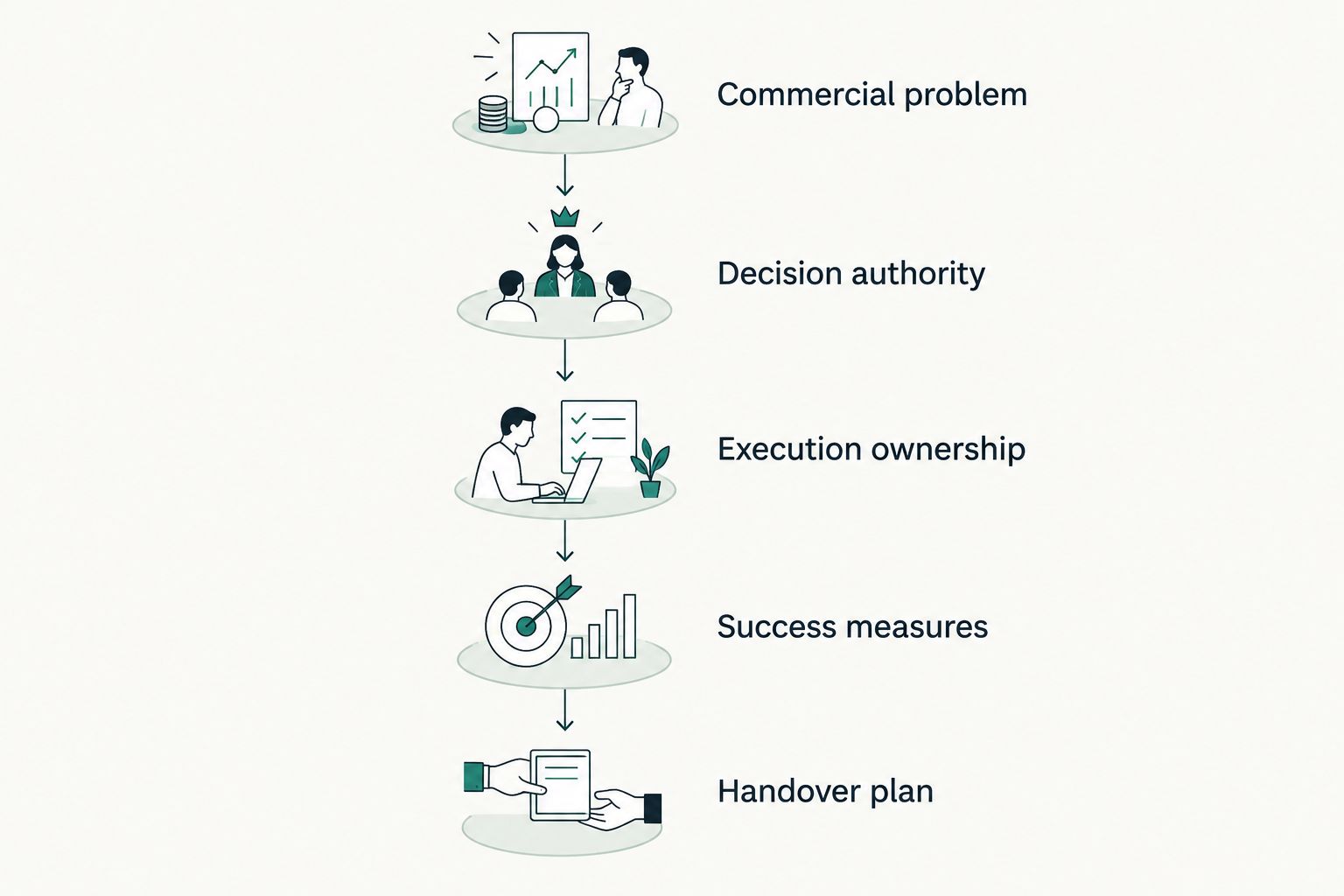
A useful brief connects the marketplace constraint to the leader’s authority. Start with the commercial problem, then specify decisions, delivery responsibilities, measurement, and handover. Do not begin with a provider’s package names.
- Commercial problem: State whether the immediate constraint concerns buyer demand, seller participation, conversion, or repeat transactions.
- Decision authority: Identify decisions the leader owns and decisions that require CEO approval.
- Execution ownership: Name who delivers campaigns, creative, lifecycle work, and analysis.
- Success measures: Define the evidence that will show whether the chosen work changes the business.
- Handover plan: Specify what the company retains when the engagement ends.
Give every shortlisted provider the same brief. Ask each to identify what falls outside its responsibility. The exclusions reveal whether you are buying leadership, delivery, or both—and what your internal team still needs to supply.
For AI-enabled and SaaS marketplaces, include the relevant product and data counterparts in this discussion. Keep the brief tied to marketing and growth decisions rather than expanding it into an undefined engineering leadership role.
How the options are ranked
This 2026 ranking uses marketplace diagnosis, decision authority, execution ownership, commercial measurement, relevant evidence, and continuity. It compares service structures, not independently tested provider performance. The independent fractional model leads for an existing team; the other options address different gaps.
Verify individual providers against the same criteria. Request references that explain the marketplace model, the leader’s remit, and the work performed. Do not treat a familiar client logo as proof of personal responsibility.
Which service should you choose?
Choose an independent fractional CMO if your team can execute and needs senior direction. Choose a delivery-backed model if implementation capacity is also missing. Choose an interim CMO for temporary full-time ownership.
Choose permanent search when the responsibility will remain after the immediate project ends. For your 2026 plan, write down who should own the function after the engagement. That answer should determine the model before you compare proposals.
Define your permanent leadership hire
Discuss the growth, marketing, product, digital, or data leader your marketplace needs.
FAQ
What are the best fractional CMO services for marketplace brands?
An independent fractional CMO is the best fit when an existing marketplace team needs senior marketing direction. Choose a delivery-backed model when execution capacity is also missing, or an interim CMO when the gap requires full-time ownership.
Is a fractional CMO the same as a marketing agency?
No. A fractional CMO supplies part-time marketing leadership, while an agency engagement can focus on execution. Some providers combine both, so confirm who owns decisions and who performs the work.
Can a fractional CMO manage both buyer and seller marketing?
A fractional CMO can manage both when the mandate covers both sides and provides the necessary authority and execution support. Assess buyer and seller priorities separately rather than assuming one acquisition plan serves both.
Should a marketplace choose a fractional CMO or an interim CMO?
Choose a fractional CMO for part-time senior direction and an interim CMO for temporary full-time operating ownership. Base the decision on management responsibilities and decision demands, not the title alone.
Does Rocket Talent provide fractional CMO delivery?
Rocket Talent is an executive search and specialist recruiting firm, not a fractional marketing delivery service. Its relevant role is recruiting permanent growth, marketing, product, digital, and data leadership.
How quickly does Rocket Talent typically deliver a shortlist?
Rocket Talent reports a typical shortlist in 7 days. That is not a guaranteed deadline, a specified calendar-day or business-day commitment, or the time required to complete a hire.
What should I ask before signing a fractional CMO agreement?
Ask who owns decisions, who executes the work, how performance will be measured, and what the handover includes. Confirm the actual assigned team and the responsibilities excluded from the agreement.
One last thing
Ask every finalist: What would make you recommend against hiring a fractional CMO for this business? A useful answer identifies the limits of the proposed model. If the assignment needs full-time management or a missing execution team, a part-time leadership agreement does not resolve that mismatch.