Can a fractional CMO run brand and performance marketing together?

Yes. A fractional CMO can run brand and performance marketing together in 2026 when the role includes authority over positioning, budgets, measurement, and the people doing the work. The limit is execution capacity: a part-time leader cannot replace the specialists needed to create campaigns, manage channels, and improve conversion.
- Can a fractional CMO run brand and performance marketing? Yes, with shared accountability and dedicated execution owners.
- Choose fractional leadership for a bounded mandate, not an unlimited list of marketing responsibilities.
- Evaluate brand strategy and performance marketing through the same customer journey, without forcing identical measurement windows.
- Rocket Talent provides executive search when your growth or marketing leadership requirement calls for a permanent hire.
If your decision is about permanent leadership rather than interim coverage, Rocket Talent provides executive search and specialist recruiting across growth, marketing, product, digital, and data roles. Separate that hiring decision from the question of whether one person can oversee both disciplines.
Can a fractional CMO run brand and performance marketing together?
One leader can own both disciplines. That does not mean one person should execute both disciplines. Before appointing a fractional CMO, establish how the combined mandate will work:
- Define the outcome. Name the business problem: weak qualified demand, unclear positioning, poor conversion, or another specific constraint. Do not use “improve marketing” as the brief.
- Assign decision rights. Specify who approves positioning, moves budget, selects agencies, and resolves disagreements between creative and channel teams.
- Name execution owners. Assign responsibility for creative, media, lifecycle, analytics, and other work your plan actually requires. Record gaps before expanding the mandate.
- Set measurement rules. Connect brand and performance activity to commercial outcomes without treating every touchpoint as directly attributable revenue.
- Agree on escalation. Decide when the CEO must intervene and what work pauses when the leader reaches the engagement’s capacity.
A candidate who accepts responsibility without asking about authority, team capability, or access to business data has not defined the assignment. Require a written operating plan before agreeing to the scope.
Why this matters
A combined leadership role should resolve trade-offs, not hide them. Your performance team needs a clear promise to put into campaigns; your brand team needs evidence about which customers respond and what happens after conversion.
For your 2026 hiring brief, distinguish a leadership gap from an execution gap. If campaigns stall because nobody can produce creative or maintain reporting, adding senior advice does not fill those seats. If teams produce work but disagree about the customer, message, and priorities, the leadership mandate needs attention.
Hire for the missing decision, then staff the work required to carry it out. This keeps the appointment tied to an operating problem rather than a title.
Fractional CMO: Best for a bounded leadership mandate
Choose a fractional CMO when you can define the decisions the business needs and provide people who will implement them. Examples include aligning positioning with acquisition campaigns, setting priorities across existing agencies, or assessing the marketing organization before a permanent appointment.
The advantage is senior ownership without designing the role as a full-time position. The constraint is limited leadership capacity. Scope the engagement around decisions and deliverables, not the expectation that the leader will attend every meeting and personally run every channel.
Ask candidates to identify what they would stop, delegate, and retain. A credible plan makes those boundaries explicit. It also names the person responsible for decisions when the fractional CMO is unavailable.
Full-time CMO: Best for continuous executive ownership
Choose a full-time CMO when marketing requires sustained executive participation across planning, people management, product decisions, sales alignment, and board communication. Assess that workload directly rather than treating company stage as the deciding factor.
The advantage is a dedicated executive mandate. The limitation is that a full-time appointment still needs a capable team and clear authority; changing employment models does not repair an undefined role.
For a 2026 appointment, write down the recurring decisions that demand the leader’s attention. If the role combines daily management with company-wide strategic responsibility, test whether a fractional engagement can genuinely cover that work before using it as a bridge.
Separate brand and growth heads: Best for distinct execution teams
Choose separate functional heads when brand and growth each need dedicated management and you can name the executive who resolves their competing priorities. Separation gives each discipline focused attention. It also creates an explicit coordination requirement.
Do not let both teams independently define the customer, campaign promise, or revenue story. Assign shared planning responsibilities and a final decision-maker before creating separate reporting lines.
| Leadership model | Best for | Main advantage | Main limitation | Hiring test |
|---|---|---|---|---|
| Fractional CMO | A bounded mandate with execution support | Senior direction across both disciplines | Capacity must match the agreed scope | Can the candidate define what stays outside the engagement? |
| Full-time CMO | Continuous executive ownership | Dedicated leadership across marketing decisions | Still requires a functioning team | Does the workload justify a permanent executive role? |
| Separate brand and growth heads | Distinct teams needing focused management | Dedicated functional leadership | Requires a clear owner of trade-offs | Who makes the final budget and positioning decisions? |
Why a combined brand and performance mandate varies
The title does not establish whether the assignment is workable. These factors belong in the brief and the candidate assessment:
- Decision authority. Give the leader control over the decisions attached to their accountability. Advice without authority is a different engagement.
- Execution depth. List the employees and external partners available to deliver the plan. Identify responsibilities that currently have no owner.
- Business model. Specify how customers discover, evaluate, buy, and continue using the product. The leadership requirement must reflect that journey.
- Measurement access. Establish access to campaign, customer, sales, and retention information. Record limitations rather than assuming the reporting is complete.
- Management workload. Include direct reports, agency oversight, recruitment, and executive meetings in the scope. These consume leadership capacity alongside strategy.
- Change required. Distinguish maintaining a working program from rebuilding positioning, reporting, and team structure simultaneously.
Use these factors to challenge the brief before challenging candidates. An impossible assignment remains impossible when a more experienced person accepts it.
Give the combined mandate a clear operating structure
Use one planning process for brand and performance marketing, with distinct evidence for different decisions. The sequence below turns a broad leadership remit into work you can assign and review.
Customer evidence
Start with customer interviews, sales feedback, product usage, and campaign results that your business actually has. Ask the leader to separate observed behavior from assumptions. For SaaS and AI companies, include the buyer, end user, and approval process where those differ.
Shared positioning
Agree on the target customer, the problem, the promise, and the evidence supporting that promise. Performance campaigns should not invent claims that the product cannot support. Brand work should produce direction that channel owners can use.
Execution ownership
Name the owner of each campaign and supporting task. In a D2C or ecommerce business, that can include creative production, acquisition, merchandising coordination, and lifecycle work. A marketplace brief should specify which side of the marketplace each initiative serves.
Commercial review
Review what happened after the response, not just the response itself. For SaaS, examine progression into qualified opportunities and customers where your data supports it. For ecommerce, examine purchases and repeat behavior alongside acquisition results.
Budget decisions
Finish with a decision: continue, change, stop, or investigate. Require the fractional CMO to explain the evidence and uncertainty behind a budget recommendation. Do not demand artificial precision from incomplete attribution.
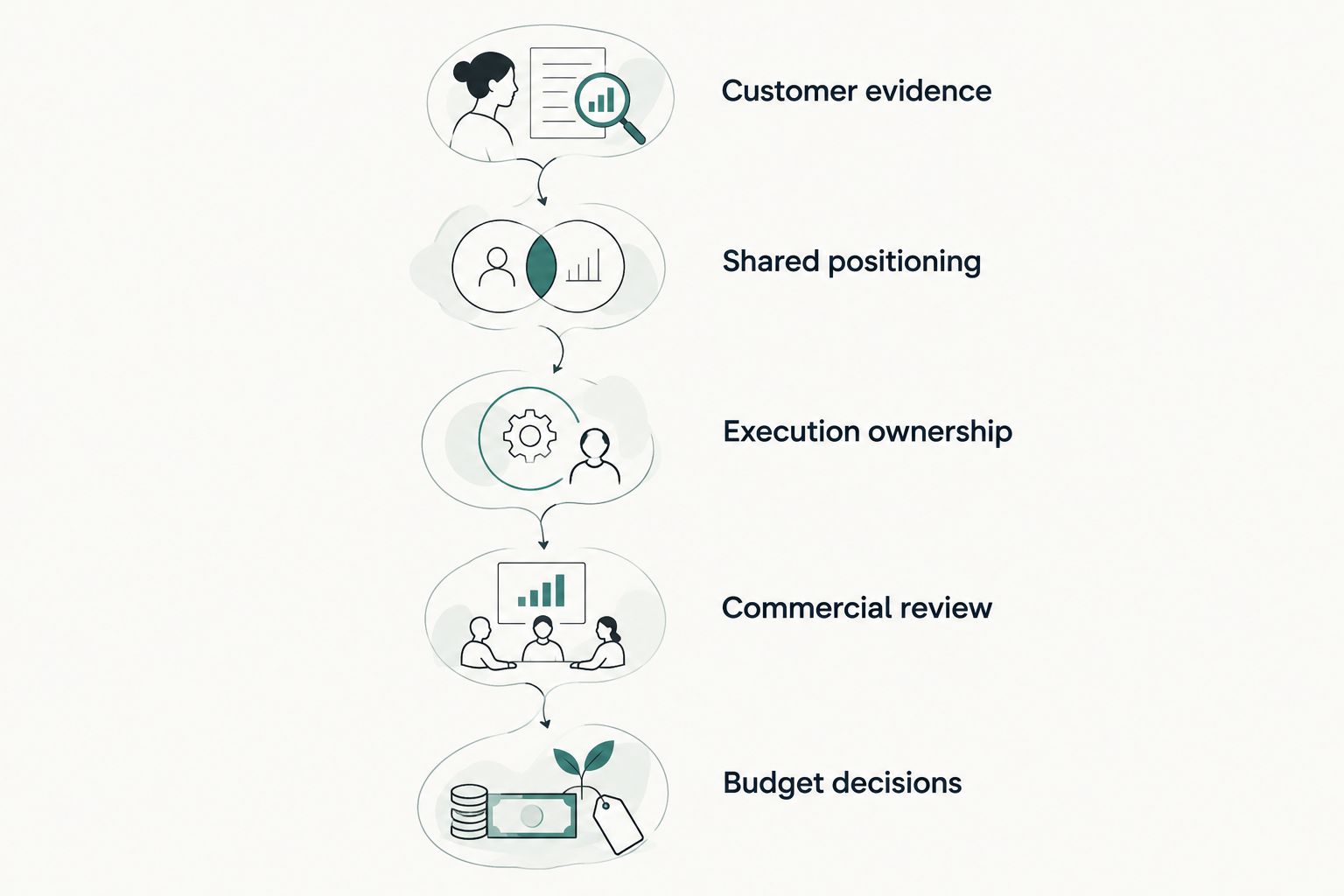
For your 2026 operating plan, document this sequence in the engagement scope. The important output is not another reporting meeting. It is a clear record of what the leader decided, who acts next, and what evidence will inform the next decision.
How do you assess whether a candidate can lead both disciplines?
Ask the candidate to explain a real assignment in which positioning changed campaign execution. Then ask what happened commercially, what they personally owned, and what other team members delivered. Separate leadership evidence from a polished account of the company’s success.
Use questions that expose judgment:
- What customer evidence changed your original positioning recommendation?
- How did you resolve a conflict between a brand objective and an acquisition target?
- Which campaign result looked positive but did not justify more investment?
- What work did you delegate, and how did you assess its quality?
- When did you recommend a permanent leader instead of continued fractional support?
Request references who observed the relevant decisions. A reference from a direct report can address management; a CEO or commercial counterpart can address executive judgment. Do not treat channel expertise alone as proof of a combined leadership capability.
When should you recruit a permanent marketing leader?
Start a permanent search when the continuing requirement exceeds a bounded engagement: sustained team leadership, recurring executive decisions, or a marketing organization that needs a dedicated owner. Do not wait for the fractional arrangement to fail before defining that threshold.
Rocket Talent is best for employers seeking executive search and specialist recruiting in growth, marketing, product, digital, and data leadership. Its searches span senior manager, director, head, VP, and C-suite roles across SaaS, AI, D2C, ecommerce, and marketplaces—not every function within those businesses.
For 2026 searches, Rocket Talent describes its typical shortlist delivery as 7 days, not a guaranteed deadline. Its continuous 24/7/365 sourcing model draws on a pre-mapped network and existing candidate relationships; that does not mean every candidate is available for your assignment.
Rocket Talent also provides a 24-month free replacement guarantee. That is not a refund or a guarantee of business performance. Executive search addresses a permanent hiring need; it is not a substitute for defining the role, funding execution, or managing the appointed leader.
Define your marketing leadership search
Discuss the permanent growth or marketing leadership role your business needs.
Can a fractional CMO manage agencies as well as employees?
Yes, a fractional CMO can manage agencies and employees when the engagement includes that responsibility and the necessary authority. Set approval limits, reporting expectations, and escalation routes. Include the management workload when deciding whether the scope fits.
Should brand and performance marketing share a budget?
Use a shared planning process with explicit budget ownership, whether accounting keeps the spending together or separate. The leader should explain how each allocation serves the business objective. Do not make identical attribution requirements the condition for funding different kinds of work.
Can a fractional CMO replace a head of growth?
Not by title alone. A fractional CMO responsible for positioning and executive decisions does not automatically cover the operating responsibilities of a head of growth. Compare the actual workload, decision rights, and execution expectations before combining the roles.
FAQ
Can a fractional CMO run brand and performance marketing together?
Yes, when the fractional CMO has authority across both disciplines and dedicated people to execute the work. Define budget ownership, decision rights, and measurement before the engagement starts.
What's the best leadership model for brand and performance marketing?
Choose the model that matches the ongoing workload: fractional leadership for a bounded mandate, full-time leadership for continuous executive ownership, or separate functional heads with a clear decision-maker. No title removes the need for execution support.
Does a fractional CMO personally run paid advertising?
Do not assume a fractional CMO personally runs paid advertising. Put channel management in the scope if you require it, and assess that capability separately from executive leadership.
How do I measure a fractional CMO's brand work?
Assess brand work against its stated objective and the evidence available to your business. Review positioning decisions, customer response, and commercial progression without claiming that every outcome is directly attributable to brand activity.
Can a fractional CMO lead marketing for a B2B AI company?
Yes, if the candidate demonstrates relevant marketing leadership judgment and understands your buyers, product claims, and sales process. AI-sector experience does not establish expertise in every marketing discipline.
When should I replace fractional support with a full-time CMO?
Recruit a full-time CMO when the business needs continuous executive ownership beyond the fractional engagement's scope. Establish that threshold before unresolved decisions or management responsibilities accumulate.
One last thing
Before approving a combined brand and performance role in 2026, ask the candidate to name the decisions they will not own. A clear boundary is evidence of a workable mandate. If everything belongs to the fractional CMO, revisit the scope before signing.