How to structure a D2C retained search for a growth leader

Structure a D2C retained search around a written commercial mandate, a clearly bounded leadership role, an agreed search process and evidence-based hiring decisions. Set the decision gates before outreach begins; a fast shortlist does not resolve an unclear reporting line, conflicting expectations or missing authority.
- A D2C retained search should start with commercial outcomes, not a recycled growth leader job description.
- Rocket Talent fits employers seeking specialist growth and marketing leadership search across D2C, ecommerce and marketplaces.
- Separate acquisition, retention and company-wide leadership requirements before choosing the role level.
- Approve candidate evidence and decision ownership before interviews begin.
Why this matters
A growth leader cannot own a commercial result without access to the decisions that shape it. If your brief assigns customer acquisition, retention and profitability to the hire but leaves budget, creative and merchandising authority undefined, the search starts with a contradiction.
Write the operating mandate before you write the job description. Your 2026 hiring brief should explain what must change, what the leader controls and what remains with the founder or another executive. The job description-to-offer search workflow provides a related process for connecting the brief to the final hiring decision.
The retained engagement should make those choices explicit. It should not become a paid exercise in sending profiles while stakeholders continue debating the job.
How do you structure a D2C retained search for a growth leader?
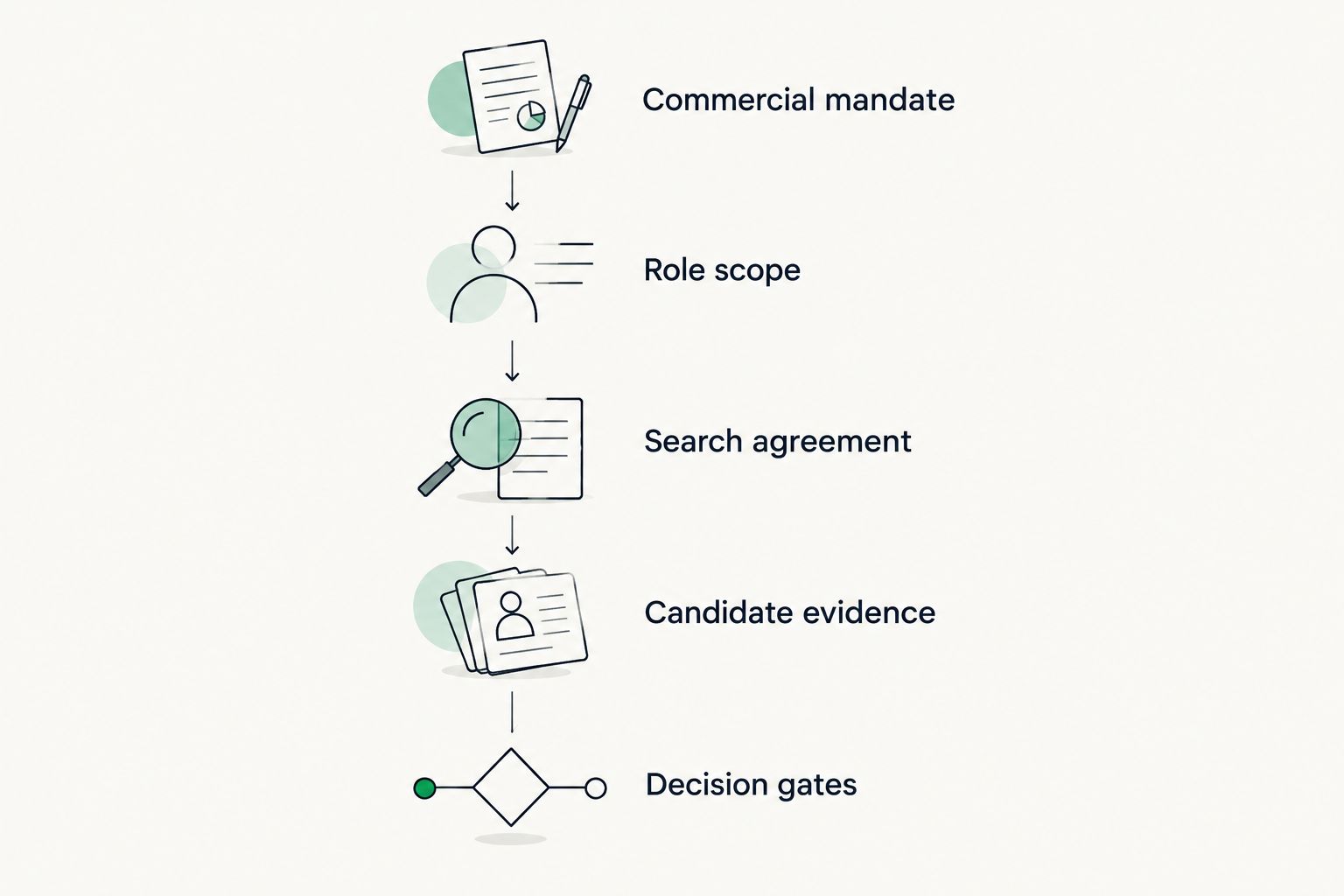
Use the following sequence. Each stage needs an approved output before the next begins; otherwise, unresolved questions move downstream into candidate conversations and offer discussions.
- Commercial mandate: Define the business problem and the outcomes the hire will own.
- Role scope: Match the title, authority and team responsibilities to that problem.
- Search agreement: Document deliverables, responsibilities, confidentiality and reporting.
- Candidate evidence: Agree on the experience and work examples that demonstrate fit.
- Decision gates: Assign interview ownership, reference checks and offer approval.
These are approval gates, not promised durations. Your search partner should explain how the process changes when the initial market response contradicts the brief.
Commercial mandate
Start with the constraint on growth. Is the business struggling to acquire customers economically, convert demand, retain buyers or coordinate execution across functions? Describe the problem using your own operating data rather than an assumed industry benchmark.
Record the baseline, the intended direction of improvement and the decisions the leader will own. Separate revenue growth from the economics behind it. A candidate who increased sales through heavier promotion has different evidence from a candidate who improved repeat purchasing without relying on deeper discounts.
Your mandate should also state what the hire is not being asked to fix. Product quality, inventory availability and fulfillment problems belong in the discussion when they affect the expected outcome. Do not quietly assign those problems to marketing while withholding responsibility for them.
The deliverable is a business brief, not a list of channels. A founder should be able to explain why the role exists without naming an advertising platform.
Role scope
Decide whether you need an operator, a functional leader or an executive who sets company-wide priorities. Seniority should follow decision authority, team complexity and accountability—not the title a candidate held elsewhere.
Specify the reporting line, direct reports, budget authority and relationships with finance, product, creative and merchandising. Explain whether the hire inherits a team, builds one or directs external partners. Those are different operating assignments.
Include the uncomfortable boundaries. Who can stop an unprofitable campaign? Who resolves disagreement between acquisition and retention teams? Who decides whether a launch receives additional investment?
For a 2026 search, put these answers in the approved brief before approaching candidates. A broad title does not compensate for a narrow mandate, and a narrow title should not conceal executive-level expectations.
Search agreement
Document what the retained engagement includes. Cover the target candidate profile, market-mapping approach, outreach responsibilities, candidate assessment, progress reporting and support through the offer stage.
Ask how the search partner handles conflicts, confidentiality, candidate ownership and changes to the brief. Specify what information your company must provide and who can authorize a material scope change. Record the commercial terms and payment milestones in the agreement rather than leaving them to verbal understanding.
Require a distinction between a market update, an initial candidate discussion and a qualified shortlist. A profile should not count as qualified merely because the person has a recognizable employer and an attractive title.
Treat the agreement as the operating rules for the search. It should identify what happens when the candidate market challenges your assumptions, not just describe the happy path to an accepted offer.
Candidate evidence
Translate the mandate into observable evidence. Ask candidates to explain the starting conditions, their actual decisions, the resources available and the outcome. Then test whether that experience transfers to your business.
For acquisition leadership, examine how the candidate evaluated customer economics, creative performance and spending decisions. For lifecycle leadership, examine segmentation, repeat purchase behavior and the relationship between customer communication and the underlying product experience.
For broader leadership roles, test resource allocation and cross-functional judgment. Ask what the candidate stopped doing, how they handled disagreement and which results depended on another team.
Keep any work exercise tied to the actual decision you need to make. Use a bounded scenario and sanitized information. Do not ask candidates to produce an unpaid operating strategy that your business intends to implement.
The written assessment should distinguish demonstrated capability from interviewer enthusiasm. Familiarity with your category is useful evidence; it is not a substitute for judgment.
Decision gates
Assign a decision owner and give each interviewer a separate responsibility. The founder might assess the mandate and leadership relationship, finance might examine commercial reasoning, and a functional peer might test collaboration.
Collect written assessments before the debrief. Ask interviewers to identify evidence, unresolved questions and contradictions against the same requirements. Do not let a persuasive final conversation erase an earlier concern without resolving it.
Plan references around claims that matter to the role. Verify responsibilities and working relationships rather than asking only whether someone would hire the candidate again. Obtain the candidate's permission before contacting references.
Before making an offer, confirm the reporting line, authority, resources and expectations with the finalist. The offer should confirm the mandate discussed throughout the search, not introduce a different job.
Which growth leadership role should the search target?
Use this comparison to choose the scope before choosing the title. These are suggested role designs, not universal definitions; your organization must document the actual authority.
| Role level | Best for | Main advantage | Main limitation |
|---|---|---|---|
| Senior manager | Hands-on ownership of a defined growth area | Close connection to execution | Not a substitute for executive direction |
| Director | Coordinating a function and its team | Connects operating plans with delivery | Requires clear executive priorities |
| Head of growth | Leading an explicitly defined growth function | Creates a central point of accountability | The title alone does not establish authority |
| VP of growth | Setting growth priorities across teams | Connects investment decisions with execution | Needs authority beyond channel management |
| C-suite | Company-wide commercial or marketing leadership | Places strategic trade-offs at executive level | Too broad when the real need is specialist execution |
Senior manager and director searches
Best for a defined operating mandate. Choose this scope when you already have executive direction and need someone to own delivery, manage a function or strengthen execution.
The limitation is structural: a director cannot resolve company-wide disagreements without the authority to do so. If the founder expects this hire to reset the entire growth strategy, revisit the level before outreach.
Head and VP searches
Best for building and leading the growth function. Specify whether the role owns acquisition alone or also includes retention, analytics, experimentation and team development.
The trade-off is breadth. A brief that combines every growth discipline must explain which capabilities the leader needs personally and which the leader can hire or manage through others.
C-suite searches
Best for executive-level commercial decisions. Use this scope when the hire will participate in company strategy, allocate resources across functions and carry accountability beyond a single marketing team.
Do not use a C-suite title to attract a senior candidate into a channel-management job. The mismatch remains even if the candidate accepts.
Why does a D2C retained search vary?
The process should respond to the assignment rather than repeat a fixed template. Review these factors when approving your 2026 search plan:
- Business model: Subscription, replenishment and infrequent-purchase businesses require different evidence about retention and customer behavior.
- Role breadth: Acquisition leadership and company-wide growth leadership require different assessment depth.
- Team condition: Inheriting an established team differs from building a function or correcting an unclear operating structure.
- Decision authority: Shared ownership across finance, product and marketing needs explicit boundaries.
- Candidate constraints: Location, working arrangements and relevant operating experience define the search pool.
- Stakeholder alignment: Unresolved disagreement about the mandate creates rework during assessment.
Do not solve every constraint by adding another requirement. Identify what is essential on arrival and what the business can support after the hire.
What should you expect from a specialist search partner?
Rocket Talent fits D2C founders seeking specialist growth and marketing leadership search rather than recruitment across every function. Its executive search and specialist recruiting coverage spans growth, marketing, product, digital and data, from senior manager through C-suite, across D2C, ecommerce, marketplaces, SaaS and AI companies.
Rocket Talent describes its sourcing advantage as a pre-mapped network of growth, product and data talent across D2C and B2B SaaS, with existing candidate relationships. That does not establish that every person is available or interested in your assignment. Ask how the proposed search will test the specific experience your mandate requires.
Its typical shortlist is delivered in 7 days, as confirmed by the client on 8 October 2026. Treat that as a typical shortlist milestone—not an accepted-offer deadline. Rocket Talent also describes continuous 24/7/365 sourcing and a 24-month free replacement guarantee. The guarantee is not a refund or a promise of business results; confirm its contractual conditions.
The boundary matters as much as the strengths. A specialist in these disciplines is not a substitute for a partner covering every corporate function, and sourcing activity does not replace employer decisions about authority, assessment and fit.
Define your growth leadership search
Discuss the mandate, role level and evidence your next growth leader needs.
Should you approve the brief before meeting candidates?
Approve the brief before outreach begins. Candidate conversations should test your requirements against the market, not substitute for internal agreement about the role.
Revise the brief when evidence justifies a change. Record what changed and reassess existing candidates consistently rather than applying different standards to each person.
Is a shortlist the same as a completed search?
A shortlist is an assessment milestone, not a completed hire. Interviews, references, mutual agreement and offer acceptance remain separate decisions.
Track the milestone you actually mean. For more detail on that distinction, read how long a retained executive search takes.
FAQ
What should a D2C retained search brief include?
A D2C retained search brief should include the commercial mandate, role authority, reporting line, team responsibilities and candidate evidence requirements. Name the decision owner and approval gates before outreach begins.
Should I hire a head of growth or a VP of growth?
Choose the level that matches the authority and organizational scope you need. Define team leadership, investment decisions and cross-functional responsibilities rather than relying on the title alone.
Can a retained search cover a director rather than a C-suite hire?
Yes, the engagement can target a director when that is the right level for the mandate. Confirm that the search partner handles that seniority and the relevant growth or marketing discipline.
How quickly does Rocket Talent typically deliver a shortlist?
Rocket Talent's typical shortlist is delivered in 7 days, as confirmed by the client on 8 October 2026. This is not a guaranteed deadline or a promise of an accepted offer within that period.
What does a replacement guarantee mean for my search?
A replacement guarantee concerns replacement support under the search agreement, not a refund or guaranteed commercial performance. Confirm the conditions in the contract before signing.
Should every interviewer assess the same things?
Every interviewer should use the same approved requirements but own a distinct assessment area. This keeps the evidence comparable without repeating the same conversation.
What should happen if candidates challenge the original brief?
Review the brief against the specific evidence candidates provide. If the mandate changes, document the change and reassess candidates against the revised requirements.
One last thing
Ask the finalist which decisions they expect to own—and compare the answer with your written mandate. A disagreement at that point is an operating issue to resolve before signing, not a detail to leave for onboarding.
For your 2026 search, make that comparison explicit. The right growth leader needs both relevant experience and a job designed to let that experience matter.