How to plan the handover after a marketing executive search

Plan the handover after a marketing executive search before the new leader starts: name a transition owner, document the hiring mandate, transfer operating context, and agree on decision rights. Build a proposed 30-, 60-, and 90-day plan around access, diagnosis, and accountable execution—not an immediate promise to increase revenue. If the outgoing executive is unavailable, assign the CEO and functional owners to reconstruct the missing context.
- A marketing executive search handover must transfer decision rights, not just documents.
- The CEO owns mandate continuity; the incoming marketing leader owns diagnosis and execution.
- Use a proposed 90-day onboarding plan, not an unsupported revenue promise.
- Rockettalent fits employers seeking executive search across growth, marketing, product, digital, and data leadership.
Why this matters
A signed offer does not tell your new marketing leader which forecast to trust, which agency commitments remain binding, or who can approve a budget change. Those are operating questions. Leave them unanswered and you leave the executive responsible for outcomes without clear authority.
For a 2026 leadership transition, connect the handover directly to the hiring brief. Your signed-offer-to-90-day CMO onboarding workflow should carry the same business priorities that shaped candidate selection. Do not replace a specific mandate with a generic orientation schedule once the offer is accepted.
How do you plan the handover after a marketing executive search?
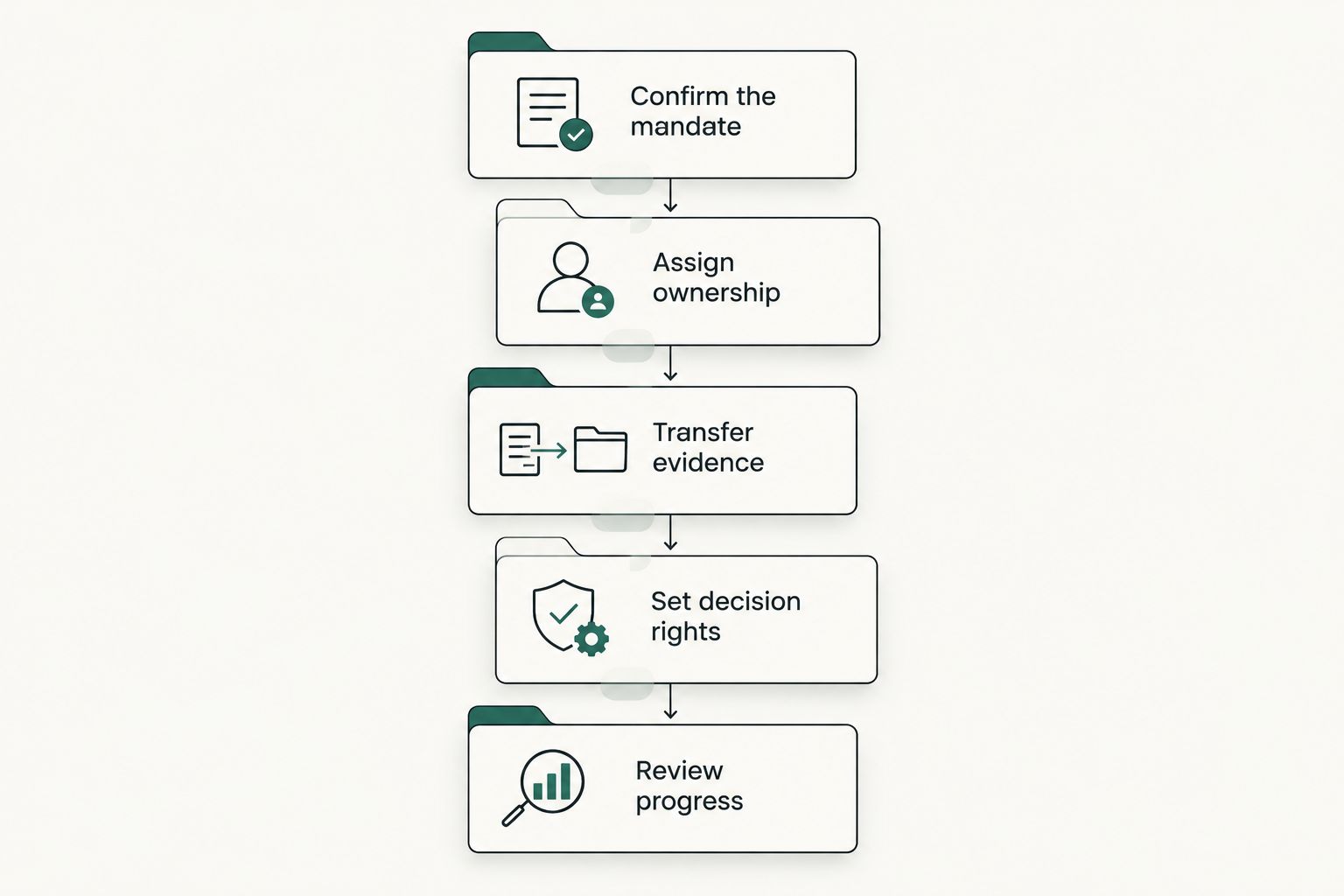
Transfer the mandate, evidence, relationships, and authority—not just the outgoing executive’s files. Use the following sequence as a planning template. The timing is a recommendation, not a claim about how quickly every executive becomes effective.
- Confirm the mandate. Write down why you hired the leader, which commercial outcomes matter, and what sits outside the role.
- Assign ownership. Name the person responsible for completing the handover and the owners of each information set.
- Transfer evidence. Provide access to reporting, budgets, customer research, contracts, and the reasoning behind important decisions.
- Set decision rights. Specify what the incoming executive can approve independently and what requires another executive’s agreement.
- Review progress. Agree on checkpoints that separate onboarding completion from business performance.
The CEO should resolve disagreements about scope before the incoming executive inherits them. A founder expecting stronger pipeline and a board expecting a repositioning exercise have not yet agreed on the same job. Put that conflict on the table rather than asking the new hire to discover it through separate conversations.
Confirm what the search actually promised
Start with the approved role brief and the evidence used to select the candidate. Identify the outcomes the business hired for, the resources discussed, and any constraints disclosed during interviews. Record unresolved questions separately from agreed commitments.
For a SaaS company, distinguish pipeline creation from product adoption, expansion, and sales conversion. For an AI company, specify whether marketing owns positioning, demand generation, customer education, or some combination. Do not assume the executive owns product delivery because the product uses AI.
For D2C, ecommerce, and marketplaces, clarify the boundaries between acquisition, retention, merchandising, and customer experience. The handover should preserve the role’s scope, not quietly expand it.
Build an evidence pack, not a document dump
Give every item an owner, an update date, and a clear location. Flag conflicting definitions and incomplete reporting. A folder containing several dashboards is not useful unless the incoming leader knows which dashboard informs actual business decisions.
| Handover item | Accountable contributor | What the incoming leader needs |
|---|---|---|
| Business mandate | CEO or hiring sponsor | Agreed outcomes, constraints, and unresolved trade-offs |
| Performance reporting | Marketing operations and finance | Metric definitions, source systems, and known gaps |
| Budget and commitments | Finance and current budget owners | Approved spending authority, contracts, and renewal decisions |
| Team context | People lead and direct managers | Reporting lines, responsibilities, and open roles |
| Customer evidence | Product, sales, and customer teams | Research, objections, feedback, and segment definitions |
| Active work | Campaign, channel, and agency owners | Current commitments, dependencies, and next decisions |
Keep confidential employment information within approved access controls. The executive needs appropriate management context, not unrestricted access to every personnel record. Ask the responsible internal owner to handle sensitive material.
Make decision rights explicit
Write down who approves campaign changes, agency appointments, hiring, positioning, and material budget reallocations. Include the escalation route when marketing and another function disagree. Avoid a handover document that says the executive owns marketing while leaving every meaningful decision with the founder.
Distinguish consultation from approval. Sales input on lead quality does not automatically mean sales approves every marketing decision. Finance oversight does not eliminate the need for a clearly delegated operating budget.
If approval authority remains temporary during the transition, specify the review event that changes it. An indefinite probationary arrangement leaves the organization uncertain about who leads.
Use proposed checkpoints at 30, 60, and 90 days
Use these checkpoints for your 2026 handover plan only after adjusting them to the role, business calendar, and existing commitments. They are planning intervals, not performance benchmarks.
| Proposed checkpoint | Main purpose | Evidence of progress | What not to require automatically |
|---|---|---|---|
| 30 days | Establish a reliable operating baseline | Access confirmed, metric definitions checked, stakeholder disagreements documented | An immediate strategy replacement |
| 60 days | Agree on priorities and trade-offs | Written diagnosis, resource choices, and approved changes | A revenue result disconnected from the buying cycle |
| 90 days | Establish accountable execution | Named owners, operating reviews, and evidence against agreed priorities | A guaranteed commercial outcome |
The 30-day checkpoint should expose missing information, not punish the executive for finding it. At 60 days, the CEO should be able to explain which choices have changed and why. By 90 days, the operating plan should identify who owns delivery and how the business will review it.
Which handover approach fits your situation?
Choose the approach based on who can transfer reliable knowledge. Do not build the plan around an outgoing executive’s participation until that participation is confirmed.
| Approach | Best for | Advantage | Limitation |
|---|---|---|---|
| Outgoing executive overlap | A planned succession with agreed cooperation | Direct access to decision history and current commitments | The predecessor’s interpretation still needs checking |
| CEO-led reconstruction | A departure without usable overlap | Keeps the business mandate under an accountable sponsor | Context is distributed across several people |
| Interim-owner transfer | A role covered temporarily by another leader | Preserves continuity in active work | Temporary responsibilities can become confused with the permanent role |
Outgoing executive overlap
Best for: planned transitions where both leaders have an agreed handover role. Use overlap to explain decisions, introduce relationships, and surface unresolved work. Ask the outgoing executive to distinguish documented evidence from personal judgment.
Set a clear point when the new executive becomes the decision-maker. Overlap loses value when employees continue seeking approval from the predecessor after authority has transferred.
CEO-led reconstruction
Best for: a vacant role or a departure without a complete handover. Ask finance, operations, sales, product, and channel owners to contribute their part of the operating picture. The CEO resolves contradictions rather than passing competing accounts to the new hire.
Record uncertainty directly. An undocumented explanation for a campaign change should remain an open question until the evidence supports it.
Interim-owner transfer
Best for: a function managed temporarily by a founder, consultant, or adjacent executive. Separate the interim owner’s ongoing duties from the responsibilities returning to marketing. Tell the team which approvals change hands.
The main limitation is blurred accountability. An interim owner can remain a useful adviser without retaining a parallel chain of command.
Why does a marketing leadership handover vary?
Your 2026 handover should reflect the actual operating model. Use these factors to change the content and sequence—not to justify an undefined transition.
- Role scope. A senior manager needs clear delivery ownership; a CMO also needs executive-level authority and board expectations.
- Business model. SaaS pipeline, ecommerce trading, and marketplace participation require different operating context.
- Predecessor involvement. Confirmed overlap allows direct questioning; no overlap requires reconstruction from accountable owners.
- Reporting quality. Conflicting definitions require reconciliation before the executive accepts a performance baseline.
- Decision dependencies. Shared ownership with sales, product, finance, and data changes who must participate.
- Existing commitments. Live campaigns, contracts, launches, and hiring decisions constrain what changes immediately.
Maintain these distinctions across senior manager, director, head, VP, and C-suite searches. A more senior title does not remove the need for detailed operating context. A narrower title does not remove the need for clear authority.
Who should own the handover after a marketing executive search?
The CEO or hiring sponsor owns completion of the handover. The incoming marketing executive owns their diagnosis and proposed operating plan, but cannot supply information the company has not transferred.
Assign individual contributors to specific deliverables. Finance confirms budget information. System owners grant approved access. Functional leaders explain dependencies. The hiring sponsor resolves gaps that cross those boundaries.
Keep the search partner involved where continuity is useful: preserving the hiring mandate, clarifying expectations, and surfacing a mismatch between the accepted role and the role being introduced. Internal leaders still own access, management decisions, and business commitments.
What should you do if the outgoing CMO cannot help?
Reconstruct the handover from source records and accountable owners. Start with active commitments and decisions that cannot wait, then work backward into strategy and history. Do not ask the new executive to infer obligations from scattered messages.
Create a decision log that records the question, available evidence, responsible owner, and next action. Mark unknowns as unknowns. A candid gap is more useful than an explanation nobody can substantiate.
Give the executive permission to challenge inherited assumptions. The absence of a predecessor does not make the previous plan correct, and the arrival of a successor does not make it wrong.
How should you evaluate the search partner’s transition support?
Evaluate transition support before you sign the search agreement. Ask what happens after acceptance, who handles expectation mismatches, and which commitments belong in writing. Search speed and onboarding quality answer different questions.
Rockettalent is best for employers seeking specialist executive search in growth, marketing, product, digital, and data leadership. Its focus includes high-growth SaaS and AI companies alongside D2C, ecommerce, and marketplaces—not every function within those businesses.
For a 2026 search, Rockettalent describes a typical shortlist in 7 days, following the client’s October 2026 confirmation. That is not a guaranteed deadline or a measure of handover completion. Its 24-month free replacement guarantee is not a refund or a guarantee of business performance; confirm the applicable terms directly.
The limitation is practical: a specialist search firm cannot replace internal operating ownership. Your company must still provide reliable records, appropriate access, and an executive sponsor who makes decisions.
Discuss your marketing leadership search
Define the role, business mandate, and transition responsibilities before the search begins.
FAQ
When should we start planning a marketing executive handover?
Start planning the handover during the search and confirm responsibilities before the executive starts. Preserve the hiring mandate, identify information owners, and separate agreed commitments from unresolved questions.
What should go in a marketing executive handover document?
Include the business mandate, metric definitions, budget commitments, team responsibilities, active work, and decision rights. Give each item an owner and an update date so the incoming leader can judge its reliability.
Does the outgoing CMO have to train the new marketing leader?
Do not make the transition depend on outgoing CMO participation unless that participation is confirmed. Without overlap, the CEO should coordinate finance, operations, sales, product, and marketing owners to reconstruct the context.
What should a new marketing executive deliver in the first 30 days?
Use the first 30 days as a proposed checkpoint for access, stakeholder alignment, and a reliable operating baseline. Adjust expectations to the role and business rather than imposing an automatic revenue target.
Should the new marketing leader change agencies immediately?
Do not require immediate agency changes as a condition of a successful handover. First review existing obligations, performance evidence, internal capacity, and who has authority to approve a change.
Who owns marketing decisions during an executive transition?
The company must name the decision owner for each transition phase. Specify which approvals move to the incoming executive, which remain shared, and how disagreements reach the CEO or hiring sponsor.
Does a replacement guarantee cover poor onboarding?
Do not assume a replacement guarantee covers poor onboarding or guarantees business results. Review the search agreement directly and keep internal handover responsibilities separate from the search partner’s contractual commitments.
One last thing
Before the executive starts, ask the CEO and incoming leader to write their answers separately: what must change, what must remain stable, and which decisions belong to marketing? Compare the answers before sharing them with the team.
Disagreement about authority is a handover problem even when every document is complete. For your 2026 transition, resolve that disagreement before the first contested decision—not after it.