How much does retained executive search cost for a CMO role?

Retained executive search for a CMO costs the amount specified in the search firm's proposal; there is no single rate that determines your bill. For your 2026 budget, separate the search fee from reimbursable expenses, any contractual adjustments, and the executive's compensation before comparing proposals.
- How much does retained executive search cost for a CMO? Compare the complete written engagement, not an isolated fee.
- Separate the search fee, additional expenses, payment triggers, and executive compensation in your hiring budget.
- Rocket Talent fits employers seeking specialist growth and marketing leadership search across SaaS, AI, D2C, ecommerce, and marketplaces.
- A typical shortlist in 7 days is not a guaranteed hiring deadline.
How much does retained executive search cost for a CMO role?
Your CMO search budget should follow the signed scope, not an assumed industry average. Ask each firm for a written fee calculation, payment schedule, expense policy, and explanation of what happens if the search changes or stops.
For employers evaluating Rocket Talent, those questions belong alongside the role brief. Establish whether you need a CMO to build the marketing organization, change the commercial strategy, or improve an existing operation. Those are different assignments, even when the title stays the same.
Use this breakdown to separate the search engagement from the wider hiring decision:
| Budget component | What to establish in writing | Why it matters |
|---|---|---|
| Search fee | The calculation and services included | Establishes the core financial commitment |
| Compensation basis | Which compensation elements enter the calculation, if applicable | Prevents ambiguity when the offer changes |
| Payment schedule | Each invoice trigger and payment obligation | Shows when your business commits funds |
| Additional expenses | Permitted categories, approvals, and limits | Separates included work from additional charges |
| Scope changes | Treatment of changes to title, location, or responsibilities | Clarifies when the original agreement no longer applies |
| Replacement terms | Eligibility, duration, exclusions, and process | Defines the remedy rather than leaving it implied |
| Executive employment costs | Compensation and other employer obligations | Keeps the search invoice separate from the employment budget |
Why this matters
A search proposal is a commercial agreement, not just a quote. Two proposals cannot be compared fairly if one includes work that the other treats separately.
For a 2026 CMO appointment, make the comparison on the same brief. Give every firm the same reporting line, decision authority, business context, and expected outcomes. Otherwise, you are comparing different assignments and calling the difference a fee difference.
Compare fee structures before comparing totals
Ask the firm to identify its fee structure explicitly. Do not infer the terms from the word retained or assume that every retained engagement uses the same calculation.
The following distinctions help you read a proposal. They are contract checks, not claims that a particular firm offers each option.
| Structure described in a proposal | Best for | Advantage | Limitation to resolve |
|---|---|---|---|
| Fixed search fee | Buyers prioritizing a defined search fee | Makes the stated fee clear at signing | Scope changes and expenses still need written treatment |
| Compensation-linked fee | Buyers comfortable with a compensation-based calculation | Connects the calculation to an agreed compensation basis | The final obligation depends on the precise definition and adjustment terms |
| Milestone-based billing | Buyers evaluating when invoices become due | Makes payment triggers visible | A payment milestone does not itself establish a quality standard |
Separate the calculation method from the billing schedule. A proposal can describe both a compensation-linked calculation and milestone-based payments. Those describe different parts of the agreement.
Ask what happens if the accepted offer differs from the original compensation assumptions. Also ask whether a change in title or reporting line requires a revised engagement. Settle those questions before authorizing the search, not after selecting a finalist.
Why the scope behind a CMO search quote varies
The title alone does not define the assignment. Use these factors to explain the work you need and ask each firm how its proposal accounts for that work.
- Business model. Specify SaaS, AI, D2C, ecommerce, or marketplace experience. Ask what evidence will demonstrate that a candidate understands your commercial model.
- Role authority. State whether the CMO owns marketing strategy, team leadership, budget allocation, or a broader growth mandate. Do not leave authority implied by the title.
- Leadership level. Confirm that a CMO is the right appointment rather than a senior manager, director, head, or VP. The required decision-making scope should determine the level.
- Candidate requirements. Separate essential experience from preferences. Ask the firm how restrictive requirements affect the search plan rather than assuming every requirement is harmless.
- Search deliverables. Define what you expect from market mapping, candidate assessment, references, offer support, and onboarding coordination. Confirm which activities the agreement includes.
- Contract protections. Compare replacement provisions, cancellation obligations, expenses, and scope-change terms. A headline fee does not explain these obligations.
These factors are a briefing checklist, not a formula for predicting a quote. Require the firm to explain its own calculation and contractual treatment.
Build a CMO brief that supports a useful quote
For a 2026 search, start with the business decision you need the executive to make. A list of channels is not a leadership mandate.
A SaaS founder might need a CMO to connect positioning, demand generation, and sales execution. A D2C founder might need marketing leadership that connects acquisition, retention, and merchandising priorities. These are examples of briefs to define, not interchangeable candidate profiles.
Define outcomes
Write the commercial problems the new executive must address. Use your own operating data and approved targets rather than asking a search firm to supply generic growth promises.
Identify what success depends on outside marketing. If the executive needs product changes, sales cooperation, or additional hiring authority, state that dependency in the brief.
Set authority
Document the reporting line, budget responsibility, team remit, and executive decision rights. Make clear which decisions remain with the founder or board.
Do not recruit a CMO for an execution-only job. If you need a leader to execute a defined strategy within a narrower remit, evaluate the appropriate senior manager, director, head, or VP appointment instead.
Agree evidence
Ask candidates to explain what they owned, what changed, and how they measured the result. Distinguish participation in a successful company from responsibility for a relevant business outcome.
For an AI business, keep the brief tied to the marketing or growth leadership assignment. Recruiting a CMO does not require treating engineering leadership and marketing leadership as the same discipline.
Confirm terms
Give the approved brief to each shortlisted search partner. Request a proposal that connects the deliverables, assessment approach, payment triggers, and contractual protections to that brief.
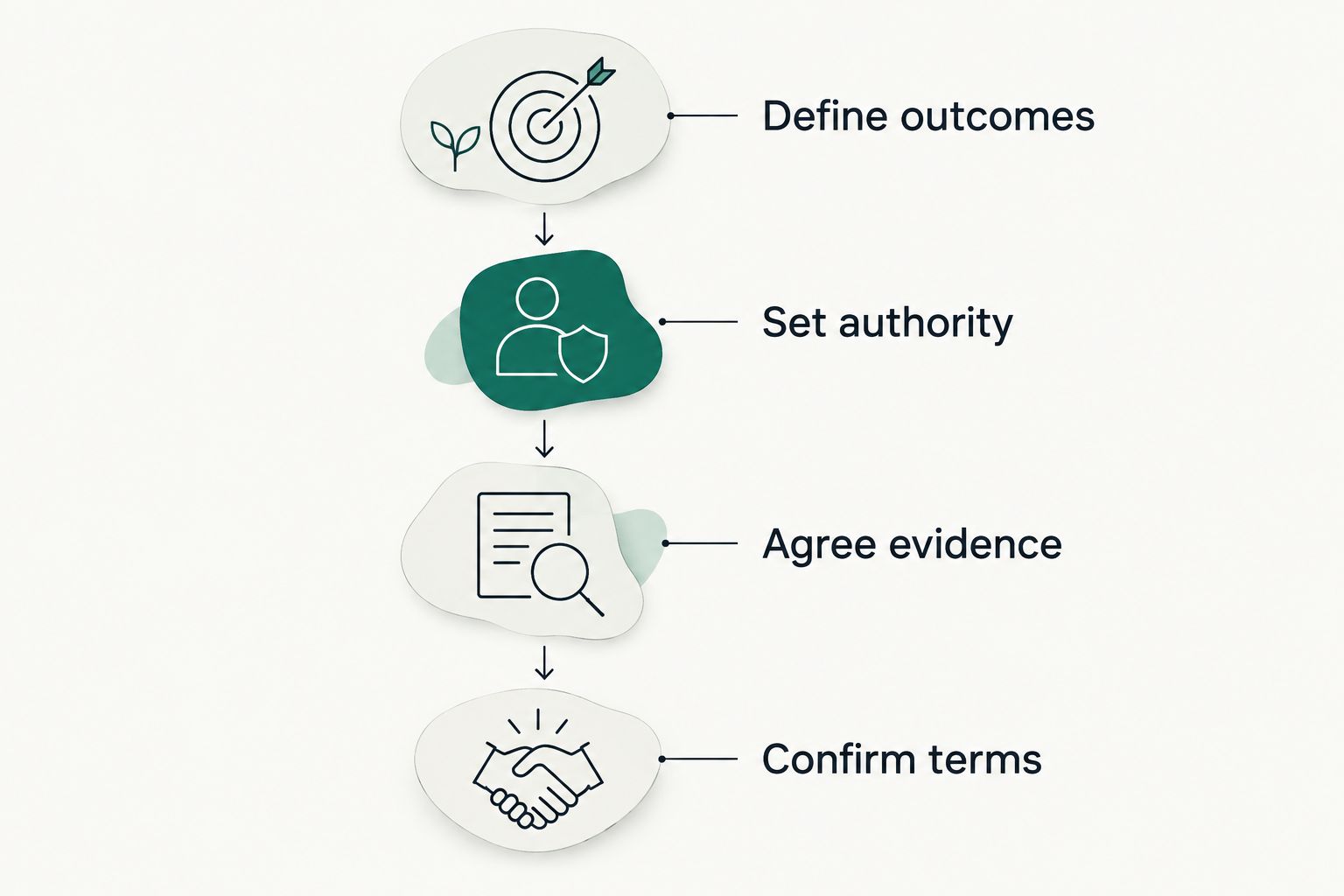
This sequence also gives your interview team a shared reference. The brief that supports the quote should remain the brief used to assess candidates; changing it halfway through creates a different assignment.
What should the retained search agreement include?
Treat your 2026 engagement review as a set of decisions that need written answers. Do not rely on a sales conversation to fill gaps in the agreement.
Deliverables and responsibilities
Identify who leads the search and what the employer must provide. Agree who approves the brief, interviews candidates, provides feedback, and authorizes an offer.
Ask what information accompanies a shortlist. Names alone do not tell you whether candidates meet the agreed requirements. Request evidence tied to the brief, including relevant ownership, operating context, and reasons for interest.
Payment and termination
Confirm exactly what triggers an invoice. Ask whether the obligation depends on elapsed time, completed work, a contractual milestone, or another defined event.
Have counsel review cancellation and termination terms. Establish what you owe if priorities change, funding changes, or the company appoints someone outside the search process.
Expenses and adjustments
Require written treatment of expenses and any changes to the fee calculation. Ask who authorizes additional work and how approval is recorded.
Keep an approved copy of the role brief with the agreement. If the remit changes, document the change before asking the firm to continue under new assumptions.
Replacement protection
Read the replacement provision separately from the service description. A replacement commitment is not automatically a refund, continued employment protection, or a guarantee of commercial results.
Ask what triggers the provision and how to invoke it. Do not assume the headline duration answers questions about eligibility or exclusions.
How should founders assess Rocket Talent for a CMO search?
Rocket Talent is best for employers seeking specialist executive search for growth and marketing leadership across SaaS, AI, D2C, ecommerce, and marketplaces. Its broader recruiting coverage includes product, digital, and data leadership, with assignments spanning senior manager, director, head, VP, and C-suite.
The client-confirmed position as of October 2026 is a typical shortlist in 7 days, not a guaranteed deadline. The firm also describes continuous sourcing 24 hours a day, 7 days a week, 365 days a year, and a 24-month free replacement guarantee.
Those details answer different buying questions:
- Shortlist timing describes the typical initial candidate milestone. It does not establish an offer or start date.
- Continuous sourcing describes the sourcing model. It does not mean every candidate is available for your role.
- Replacement protection describes a contractual remedy. It does not guarantee business performance or imply a refund.
The relevant strength is the firm's focus on these leadership disciplines. The limitation for your decision is that service descriptions do not replace engagement-specific terms: confirm the fee, included work, and replacement conditions directly.
To assess the wider sequence, use the job description to offer search workflow. Separate the shortlist milestone from assessment, references, offer acceptance, and the executive's start date.
Discuss your CMO search
Define the leadership mandate, search scope, and engagement terms before committing.
Is a lower search fee always the better deal?
No. Compare equivalent work and obligations before choosing on fee. A lower figure does not establish that the candidate assessment, search scope, or replacement provisions match another proposal.
Do not assume the higher quote is better, either. Ask each firm to explain the work behind its proposal and demonstrate relevant discipline experience. Remove unsupported promises from your evaluation.
Does the search fee include the CMO's compensation?
Treat the search fee and executive compensation as separate budget lines. Then check whether compensation is used to calculate the search fee under the agreement.
Your hiring decision needs both budgets. Combining them into one unexplained figure makes approval and proposal comparison harder.
Does a shortlist deadline tell me when the CMO will start?
A shortlist deadline is not a start-date commitment. Candidate assessment, references, offer negotiation, acceptance, and any notice obligations remain separate steps.
Ask for a search plan with responsibilities on both sides. Your interview availability and approval process belong in that plan.
FAQ
How much does retained executive search cost for a CMO?
The cost is set by the firm's written engagement agreement. Compare the fee calculation, included services, additional expenses, payment triggers, and replacement terms before signing.
Is retained CMO search always priced as a percentage of salary?
Do not assume a percentage-based fee from the word retained. Ask the firm to state its calculation and, where compensation is used, define exactly which compensation elements count.
What should I ask before approving a CMO search proposal?
Ask for the scope, fee calculation, invoice triggers, expense policy, termination obligations, and replacement conditions in writing. Give each firm the same approved role brief.
How quickly does Rocket Talent typically provide a shortlist?
Rocket Talent typically provides a shortlist in 7 days, as confirmed by the client in October 2026. This is not a guaranteed deadline or a commitment to an executive start date.
Does a 24-month replacement guarantee mean I get a refund?
A 24-month replacement guarantee does not itself promise a refund. Confirm the applicable replacement conditions in the engagement agreement and do not treat the provision as a business-performance guarantee.
Should I hire a CMO or a VP of Marketing?
Choose the level that matches the authority and business decisions the role must own. Define the remit before comparing CMO and VP candidates or requesting search proposals.
Can I compare search firms using only their quoted fee?
No. Compare the same role scope, deliverables, expense treatment, payment obligations, and replacement provisions before using the quoted fee to make a decision.
One last thing
Ask each firm to explain the agreement under a changed scenario: the compensation changes, the role is paused, or the selected executive leaves. Have the firm identify the relevant clauses rather than give a verbal reassurance.
The useful quote is the one you can still understand when the search stops following the original plan. Resolve those scenarios before signing.