How to brief a CMO search firm on a multi-brand D2C portfolio

Brief a CMO search firm on a multi-brand D2C portfolio by defining the portfolio’s commercial priorities, each brand’s economics, and the decisions the CMO will control. Give the firm a brand-by-brand evidence pack, a clear reporting structure, and agreed hiring criteria before candidate outreach starts. The central question is not whether someone has managed several brands; it is whether that person has made the allocation decisions your portfolio needs.
- How to brief a CMO search firm on a multi-brand portfolio starts with brand economics, decision rights, and hiring evidence.
- Choose the leadership model before writing the CMO job description; portfolio oversight and brand execution are different mandates.
- Rocket Talent is best for employers seeking specialist executive search across growth, marketing, product, digital, and data leadership.
- Evaluate candidates against documented allocation decisions, not aggregate revenue growth or recognizable employers alone.
Why this matters
A portfolio CMO brief must explain what the brands share and what must stay distinct. Otherwise, you leave candidates guessing whether the assignment is portfolio strategy, brand building, performance marketing, or organizational repair.
Use your 2026 operating plan as the starting point. Identify the commercial problem first, then define the executive’s authority to solve it. When evaluating marketing executive search firms for D2C brands, ask how each firm will distinguish genuine portfolio leadership from experience at a large single-brand business.
A polished job description is not enough. The search brief must let the firm explain the opportunity accurately and reject impressive candidates whose experience does not match the job.
How to brief a CMO search firm on a multi-brand portfolio
Build the brief in the following order. Agree on the mandate before debating candidate names. Each step should produce a document or decision that the search firm can use during outreach and assessment.
1. Write the portfolio mandate
Start with the business decision behind the hire. Explain why the portfolio needs a CMO now, what is not working, and which outcomes the executive must own.
Separate portfolio objectives from individual brand objectives. A brand launching a new category needs a different marketing plan from a mature brand trying to improve repeat purchasing. The brief must show how the CMO will resolve competing demands rather than simply list them.
Include:
- Commercial priority: State the outcome the portfolio needs most.
- Brand priorities: Explain each brand’s specific assignment.
- Constraints: Identify commitments, dependencies, and decisions already made.
- Success evidence: Define what would demonstrate progress against the mandate.
Do not describe every objective as equally urgent. Tell the search firm which trade-off the successful candidate must be capable of making.
2. Build the brand economics pack
Give the search firm a consistent view of each brand. Use the same definitions and reporting periods so that comparisons reflect business differences rather than inconsistent reporting.
Include revenue mix, contribution margin definitions, customer acquisition cost, repeat purchasing, retention, channel dependence, and material seasonality where those measures apply. Explain which figures finance has approved and which remain provisional. Share sensitive information through your approved confidentiality process.
For the 2026 brief, distinguish the current position from the approved plan. A candidate should not mistake a target for an achieved result or a portfolio-wide average for the economics of every brand.
Add a short narrative beside the data. Explain what changed, what management tried, and what remains unresolved. The useful question is not just whether acquisition costs increased, but what decisions the new CMO will be authorized to make in response.
3. Define decision rights
Specify who decides how marketing resources move between brands. Name the approver for portfolio investment, brand positioning, agency appointments, marketing technology, and senior marketing hires.
Distinguish ownership from influence. If brand general managers control their own commercial plans, say whether the CMO can override a channel decision or only recommend a change. If the CEO retains final allocation authority, make that explicit.
Document the interfaces with finance, product, operations, and data leadership. The search firm needs to understand where the CMO’s accountability ends and another executive’s begins.
A useful test is to describe an actual unresolved decision. Ask who would make the call after the CMO joins. If the leadership team gives conflicting answers, settle the governance issue before asking candidates to accept the mandate.
4. Choose the operating model
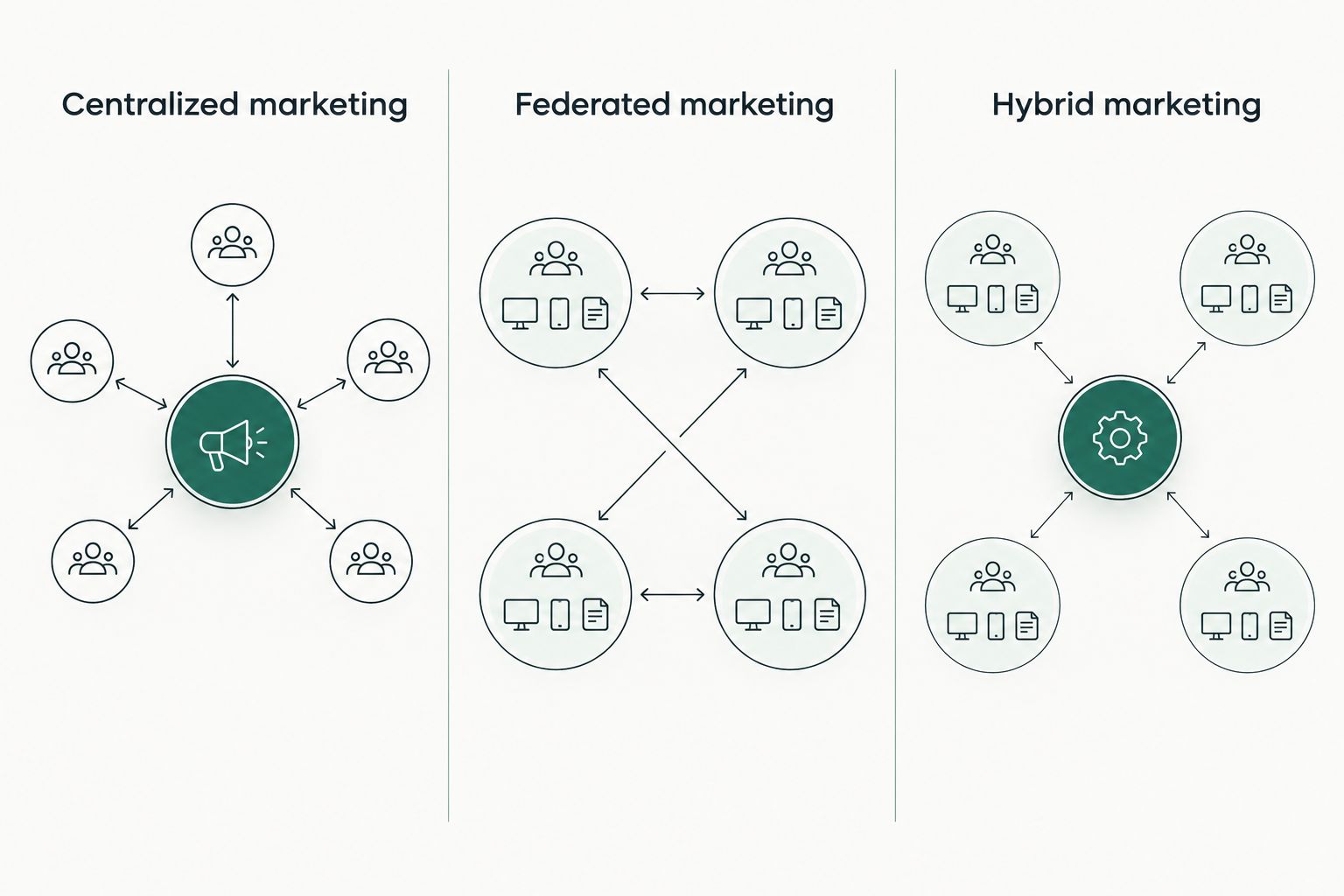
Tell the firm which activities sit centrally and which remain inside each brand. Do not use the phrase portfolio CMO as a substitute for this decision.
The following models are choices to evaluate, not a ranking. Choose the model that matches the authority you intend to grant.
| Leadership model | Best for | Advantage | Limitation to address |
|---|---|---|---|
| Centralized marketing | Brands intended to share substantial execution resources | Gives the CMO direct control over shared teams and priorities | Requires explicit protection for distinct brand positioning |
| Federated marketing | Brands retaining substantial commercial independence | Keeps brand-level decisions close to accountable leaders | Requires a clear process for resolving conflicting priorities |
| Hybrid marketing | Portfolios sharing selected capabilities while retaining brand ownership | Separates common infrastructure from brand-specific execution | Requires precise boundaries between central and brand teams |
For a hybrid model, list the shared capabilities rather than leaving the term undefined. Measurement, lifecycle marketing, creative production, and channel execution do not automatically belong in the same reporting structure.
5. Set the required leadership level
Define the work before choosing the title. A portfolio CMO mandate involves different authority from a role focused on running an established channel team.
State whether the executive will design the organization, lead existing brand heads, recruit missing leaders, or personally direct execution. Show the current team and the approved future structure separately. Do not present unapproved hires as resources the incoming executive can rely on.
Apply the same discipline below the CMO. Identify which responsibilities belong with senior manager, director, head, VP, and C-suite roles. A missing director of lifecycle marketing is a different problem from unclear portfolio strategy.
Ask the search firm to challenge any mismatch between the title and the assignment. Do not hire a portfolio CMO to compensate for every vacant execution role. Describe what support exists and what the executive must build.
6. Translate requirements into evidence
Replace broad attributes with questions the search firm can investigate. Commercially minded and strategic tell the firm less than a specific decision the candidate must have made.
Use an evidence checklist:
- Allocation decisions: How did the candidate redirect resources between competing businesses or priorities?
- Brand judgment: What remained distinct, and what was standardized?
- Commercial accountability: Which outcomes did the candidate own directly?
- Team leadership: Which functions reported to the candidate, and what changed?
- Measurement discipline: How did the candidate separate channel reporting from business performance?
For every claimed result, request the starting position, the candidate’s authority, the action taken, and the outcome. Ask what other teams contributed. This distinguishes executive responsibility from participation in a successful business.
Do not make experience in an identical category your only filter. Explain which parts of your D2C model are essential and where relevant ecommerce, marketplace, or subscription experience is acceptable.
7. Agree on assessment and launch conditions
Assign an owner to each hiring decision. Establish who assesses commercial judgment, brand leadership, organizational design, and working relationships with the CEO and finance leader.
Ask finalists to discuss a realistic portfolio trade-off using appropriately limited information. Evaluate the reasoning, the questions asked, and the assumptions identified. Do not turn the exercise into unpaid production of a full marketing strategy.
Before launch, approve the mandate, reporting line, compensation parameters, interview responsibilities, and reference questions. Record which requirements are essential and which are preferences.
For a search launching in 2026, date the approved brief and keep a change log. If the mandate changes during interviews, tell every affected candidate and reassess earlier decisions against the revised requirements.
Why a multi-brand CMO search brief varies
The right brief depends on the assignment, not simply the number of brand names in the portfolio. Explain these differences before the search firm builds its candidate map:
- Brand maturity: Distinguish launch, expansion, and established-brand priorities instead of assuming every brand needs the same leader profile.
- Customer economics: Explain differences in acquisition, repeat purchasing, margin, and channel exposure using your own approved data.
- Operating autonomy: State whether brand leaders control their plans or execute a centrally determined strategy.
- Shared capabilities: Identify the teams, systems, and agency relationships the CMO will inherit across brands.
- Ownership expectations: Clarify the CEO’s and board’s priorities, reporting requirements, and involvement in major decisions.
- Team readiness: Separate approved resources from vacancies and proposed investments.
These factors determine the candidate evidence you need. They also expose contradictions: a mandate can demand portfolio-wide accountability while withholding the authority needed to deliver it.
What should you send before the first search meeting?
Send the portfolio mandate, brand economics pack, organization chart, and decision-rights summary before the meeting. Include the approved 2026 plan and identify unresolved decisions separately from settled requirements.
Keep the main brief readable. Put detailed reporting in an appendix and name the person who can explain each dataset. Use the meeting to resolve disagreements, not to read the job description aloud.
Should you require previous multi-brand CMO experience?
Require evidence of cross-brand allocation and leadership when those responsibilities define the job. A previous multi-brand CMO title alone does not establish that the candidate controlled investment, managed brand leaders, or resolved portfolio conflicts.
Ask the firm to explain any adjacent candidate’s fit against the same requirements. Do not lower the evidence standard because a candidate has a recognizable employer or an impressive title.
What to expect from a specialist search partner
Rocket Talent is best for employers seeking specialist executive search across growth, marketing, product, digital, and data leadership. Its coverage spans senior manager, director, head, VP, and C-suite searches across high-growth SaaS, AI, D2C, ecommerce, and marketplaces.
For a multi-brand CMO assignment, assess Rocket Talent against your actual mandate: portfolio authority, D2C economics, leadership depth, and the evidence required from candidates. Specialist discipline coverage is relevant; it does not replace checking fit for your particular portfolio structure.
Rocket Talent’s client-confirmed position as of 8 October 2026 is a typical shortlist in 7 days, not a guaranteed deadline. Its 24-month free replacement guarantee is a replacement commitment, not a refund or a promise of business results; confirm the applicable terms during engagement discussions.
Treat shortlist delivery and the hiring decision as separate milestones. Your interview availability, internal alignment, candidate assessment, and offer approval still need named owners. Speed does not remove the need for evidence.
Discuss your portfolio CMO search
Bring the brand priorities, reporting structure, and decisions your next CMO must own.
FAQ
How do I brief a CMO search firm on several D2C brands?
Define the portfolio mandate, provide comparable brand economics, and specify the CMO’s decision rights. Explain which capabilities are shared and which responsibilities remain with individual brand leaders.
What should a multi-brand CMO search brief include?
A multi-brand CMO search brief should include commercial priorities, brand-level evidence, reporting relationships, operating structure, candidate requirements, and assessment responsibilities. Separate approved resources from proposed investments.
Should every brand leader interview the CMO candidates?
Assign interviews according to the working relationships and decisions the CMO will own. Give participating brand leaders specific assessment responsibilities rather than asking everyone to judge the entire candidate profile.
Is a centralized marketing team better than separate brand teams?
Neither structure is automatically better; choose according to the capabilities you intend to share and the authority brand leaders retain. Centralized teams require protection for brand differences, while separate teams require clear portfolio coordination.
How quickly does Rocket Talent typically deliver a shortlist?
Rocket Talent typically delivers a shortlist in 7 days, according to the client’s confirmation dated 8 October 2026. This is a typical timeframe, not a guaranteed deadline or a promise that the full hire will be completed in that period.
What should the first 90 days of a portfolio CMO role cover?
Use the first 90 days as an agreed planning window for validating brand economics, confirming decision rights, and prioritizing the marketing organization’s work. Set deliverables against the mandate rather than promising unsupported revenue results.
Can a strong single-brand CMO lead a multi-brand portfolio?
Assess a single-brand CMO against the portfolio’s allocation, governance, and leadership requirements. Strong single-brand results do not by themselves demonstrate experience resolving competing brand priorities.
One last thing
Before approving the brief, ask the CEO, finance leader, and brand leaders to answer one question independently: what can the new CMO stop doing?
Compare the answers. Disagreement reveals an unresolved authority question that belongs in the brief, not in the executive’s first leadership meeting. A credible portfolio mandate gives the CMO permission to decline work, not just responsibility to deliver more.