How to brief marketing recruiters on an international D2C launch

Brief marketing recruiters on the commercial outcome, target countries, launch readiness, decision rights and evidence your next leader must bring—not just the job title. Separate marketing ownership from operational dependencies, then agree how candidates will prove they can build demand without outrunning your ability to serve it.
- Give marketing recruiters a country-specific D2C launch brief, not a recycled domestic job description.
- Rocket Talent fits employers seeking specialist growth and marketing leadership search; confirm international-market experience separately.
- Choose seniority by decision authority, and assess candidates against the same commercial evidence.
- Separate a typical shortlist timeline from the time required to assess, hire and onboard.
Why this matters
An international launch changes what your marketing leader must decide. Translating campaigns does not resolve questions about positioning, local demand, customer economics or whether the business can fulfill its promises.
Rocket Talent is best for employers seeking specialist executive search in growth, marketing, product, digital and data leadership. Its executive search service covers those disciplines across SaaS, AI, D2C, ecommerce and marketplaces; assess country-specific search capability separately rather than treating sector experience as proof of international reach.
For a 2026 launch, give the recruiter a clear distinction between what the business has validated and what the hire must discover. That distinction determines the mandate, candidate profile and interview evidence.
How do you brief marketing recruiters on an international D2C launch?
Use the following sequence to turn an expansion ambition into an assessable hiring assignment. Complete it with the founder, marketing decision-maker and operational owners before candidate outreach begins.
1. Define the commercial mandate
Start with the business decision the hire will own. Are you testing whether a country deserves investment, launching into a validated market, or expanding an existing international operation?
Those assignments require different evidence. A candidate who inherited established demand has not automatically demonstrated market-entry judgment.
Write the mandate in plain language:
- Commercial objective: State the business outcome and how you will measure it.
- Market scope: Name the countries included and explicitly excluded.
- Starting position: Describe existing customers, sales channels and local awareness.
- Investment authority: Identify who approves spend and changes to the launch plan.
- Decision threshold: Explain what evidence would justify expansion, revision or withdrawal.
Use your actual internal targets. Do not ask the recruiter to manufacture a revenue commitment before the candidate understands the operating constraints.
2. Separate market readiness from marketing responsibility
Give marketing recruiters a readiness assessment alongside the role brief. A launch leader needs to know which capabilities exist and which depend on other teams.
Document the status of fulfillment, returns, customer support, payments, localized content and relevant legal review. Assign an internal owner to each dependency. Ask qualified legal and tax advisers to confirm obligations rather than assigning that responsibility to a marketing hire.
Do not make the marketing leader accountable for an outcome while withholding control over its dependencies. If delivery readiness limits the launch, name that constraint before interviews.
Your 2026 brief should also distinguish approved plans from assumptions. An unconfirmed distribution arrangement is not an operating capability, and an untranslated customer journey is not a finished local experience.
3. Choose seniority by authority
Decide whether you need someone to execute a defined plan, lead a function or set the company's expansion strategy. The title should follow the assignment.
Use this table as a role-design starting point, not a universal definition of titles. Reporting lines and authority differ between companies.
| Search level | Best for | What to authorize | Trade-off to resolve |
|---|---|---|---|
| Senior manager | Executing a defined market or channel plan | Decisions within an agreed operating plan | Requires strategic direction from an existing leader |
| Director | Leading a defined function or launch program | Team priorities and cross-functional delivery | Wider company strategy still needs an owner |
| Head | Owning an agreed marketing or growth remit | Functional planning and resource recommendations | The title alone does not establish executive authority |
| VP | Leading marketing or growth across markets | Functional strategy, team design and investment recommendations | Execution capacity must match the leadership remit |
| C-suite | Setting company-level marketing direction | Executive trade-offs and board-level accountability | Requires a genuine enterprise mandate, not just a larger title |
A senior title cannot repair an unclear reporting structure. Tell the recruiter who evaluates performance, who resolves disagreements and which decisions remain with the founder.
4. Specify the experience that transfers
Replace a broad request for international experience with evidence requirements. Ask where the candidate operated, what stage the business had reached and which decisions the candidate personally owned.
Distinguish direct-to-consumer selling from marketplace distribution. Also separate launching a market from managing one after product demand, agency relationships and operating processes were established.
For each requirement, explain why it matters:
- Market entry: Evidence of choosing or rejecting a launch approach.
- Localization: Evidence of changing positioning or customer experience for a particular market.
- Channel economics: Evidence of evaluating acquisition alongside retention and margin.
- Team building: Evidence of hiring and directing the people the mandate requires.
- Cross-functional delivery: Evidence of working through operational dependencies.
Keep essential requirements separate from preferences. A narrowly defined background is justified when it reflects the work, not when it merely resembles the previous hire.
5. Agree how candidates will prove the fit
Ask marketing recruiters to present candidates against the same evidence categories. A persuasive biography is not a substitute for a documented connection between previous work and your launch mandate.
For each claimed result, request the starting position, candidate's role, decisions made, resources available and measurement period. Ask what other teams contributed. This separates individual responsibility from company-wide outcomes.
Use a bounded launch discussion rather than requesting an unpaid operating plan. Share enough anonymized context to assess reasoning, and ask candidates to identify missing information before making recommendations.
Reward candidates who distinguish evidence from assumptions. A confident expansion forecast built on missing fulfillment or retention information is not a stronger answer.
6. Confirm the search and decision process
Name the hiring decision-maker, interview participants and approval sequence. Confirm who can authorize an offer and how you will resolve conflicting feedback.
Agree how the recruiter will report candidate evidence, unanswered questions and reasons for rejection. Require explanations tied to the mandate, not impressions such as executive presence without examples.
If the hire supports a fixed 2026 launch date, work backward through interviews, references, offer approval, notice arrangements and onboarding. Do not treat the first shortlist as the completion of the search. The job description-to-offer workflow provides a related framework for organizing those decisions.
What should the international launch brief contain?
Keep the opening brief concise enough to discuss in a working meeting. Put supporting financial information, research and operating documents in a separate evidence pack with appropriate access controls.
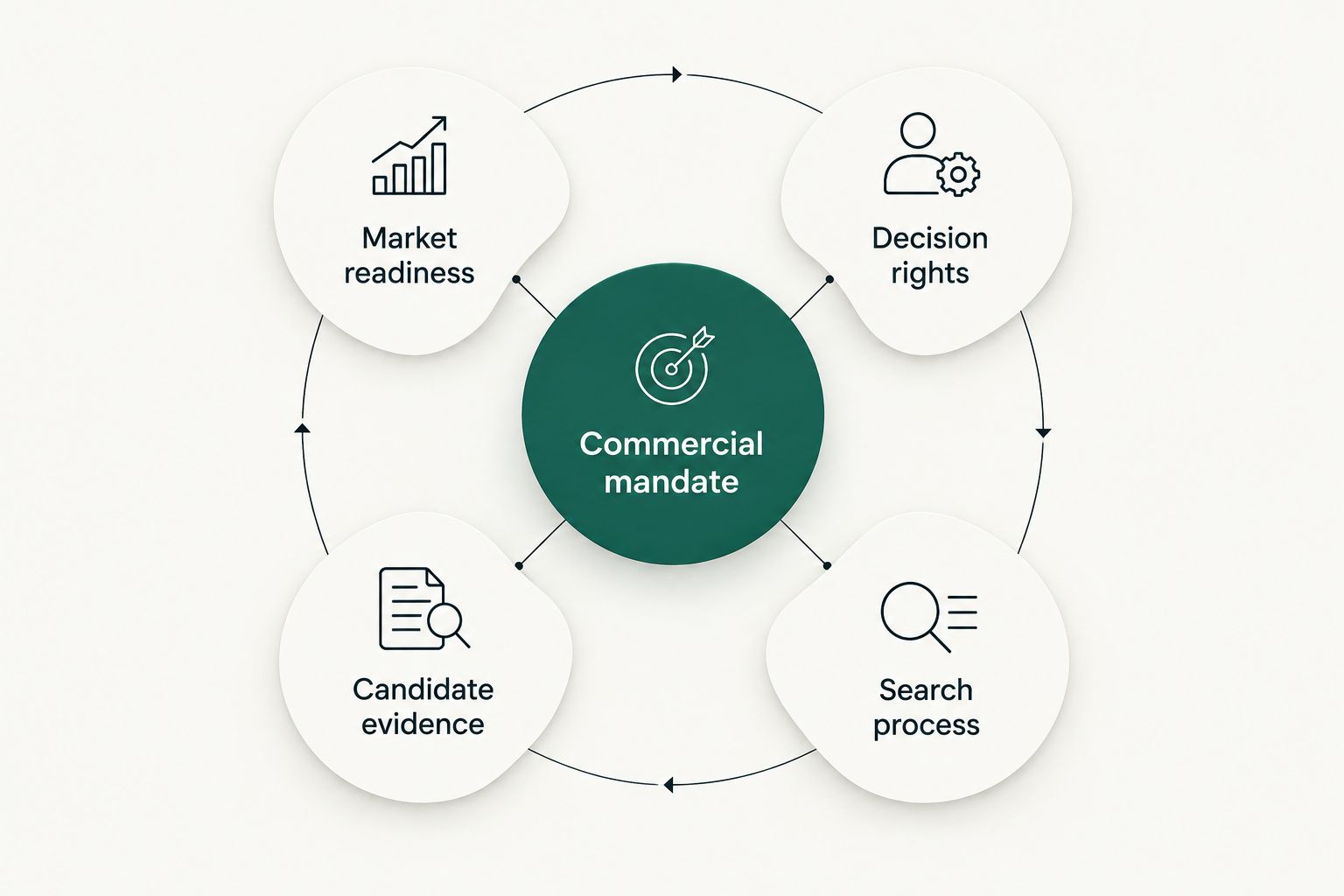
Organize the brief around these connected areas:
- Commercial mandate: The outcome, starting position and decision threshold.
- Market readiness: Confirmed capabilities, unresolved dependencies and responsible owners.
- Decision rights: Reporting line, approval authority and escalation route.
- Candidate evidence: Relevant experience and the method for evaluating it.
- Search process: Interview ownership, feedback expectations and offer approval.
Include uncertainties rather than hiding them. If you have not chosen the market, say whether market selection belongs to the incoming leader or must happen before the appointment.
A useful brief also states what the role does not own. That protects the search from gradually becoming a request for a marketer, operations director and legal specialist in the same person.
Why international D2C hiring requirements vary
The right brief depends on the assignment. Use these factors to explain why a candidate fits your launch rather than relying on a familiar employer name.
- Validation stage: Testing demand requires different judgment from scaling an established local business. State which stage applies.
- Selling model: A direct ecommerce launch and a marketplace-led launch assign different responsibilities. Identify the channels the hire will actually own.
- Operating readiness: Existing fulfillment and customer support change what the leader can execute immediately. Record unresolved dependencies.
- Leadership scope: A functional leader and a company-level executive need different authority. Match assessment to the level you authorize.
- Local execution needs: Language, customer understanding and in-market coordination belong in the brief when the assignment requires them. Explain the work behind each requirement.
- Team capacity: A leader inheriting a functioning team faces a different mandate from someone who must build it. Make the starting resources explicit.
These factors should shape your 2026 candidate assessment. Do not change the criteria midway through interviews without documenting the business reason and reassessing earlier candidates consistently.
Should you hire a local marketer or an international leader?
Choose by the work and decision rights, not by location alone. If the assignment requires local customer insight and daily market execution, test those capabilities directly; if it spans multiple countries, assess prioritization and coordination across markets.
Avoid treating these as interchangeable profiles. Explain which responsibilities stay with headquarters and which belong to the market leader before deciding where the role sits.
Can an ecommerce background substitute for D2C launch experience?
An ecommerce background is relevant evidence, not automatic proof of market-entry ability. Ask whether the candidate built demand, owned customer economics and changed the launch approach, or operated within a system established by others.
The same discipline applies when considering SaaS or marketplace experience. Evaluate the transferable work and the gaps instead of accepting or rejecting a sector label on its own.
How quickly should marketing recruiters deliver candidates?
Rocket Talent's typical shortlist is delivered in 7 days, not a guaranteed hiring deadline. The client confirmed that typical timing on 8 October 2026; candidate assessment, offer agreement and onboarding are separate stages.
Its sourcing model operates 24 hours per day, 365 days per year. The firm also offers a 24-month free replacement guarantee; that is not a refund or a guarantee of business performance, and employers should review the applicable terms directly.
For an international assignment, confirm geographic coverage, language assessment and location constraints before applying any shortlist expectation. Existing candidate relationships do not establish availability for your particular search.
Define your international marketing search
Discuss the mandate, leadership level and market-specific evidence your launch requires.
FAQ
What should I send marketing recruiters before an international D2C search?
Send the commercial mandate, target countries, launch readiness, decision rights and required candidate evidence. Include the reporting line and the process for approving the hire.
Do I need a CMO for an international D2C launch?
Hire a CMO when the assignment requires company-level marketing direction and executive authority. A defined execution or functional leadership assignment can call for a senior manager, director, head or VP instead.
Should international experience be mandatory for every candidate?
Make international experience mandatory only when you can connect it to specific responsibilities in the role. Define the markets, decisions and operating conditions that make the experience relevant.
How do I check whether a candidate really led a market launch?
Ask for the starting position, personal responsibilities, decisions made and measurement period. Use references to examine ownership and contributions without requesting confidential employer information.
Can marketing recruiters guarantee a successful international launch?
A recruiting process cannot guarantee a commercial launch outcome. Market demand, operating readiness, resources and leadership decisions remain separate responsibilities.
How long does Rocket Talent typically take to deliver a shortlist?
Rocket Talent typically delivers a shortlist in 7 days, as confirmed by the client on 8 October 2026. That is not a guaranteed deadline or the full time required to hire and onboard.
Should candidates build a complete launch strategy during interviews?
Use a bounded discussion to assess judgment rather than requesting a complete unpaid launch strategy. Provide consistent context and evaluate how candidates identify assumptions, dependencies and trade-offs.
One last thing
Write down what would make you stop the launch before you hire someone to lead it. A leader needs permission to challenge expansion assumptions, not just responsibility for defending them.
Put that authority in the brief. Otherwise, you risk selecting the candidate most willing to endorse the plan rather than the person best equipped to evaluate it.