How to budget executive search fees alongside vacancy costs

Budget executive search fees as a contracted cash commitment, then assess vacancy exposure separately using the cost of delayed decisions, temporary coverage, and postponed commercial work. Approve the search against both views: the fee alone excludes the business cost of leaving the seat empty, while a vacancy estimate is not automatically a cash expense.
- Budget executive search fees and vacancy costs separately; combine them only when evaluating the hiring decision.
- Use contribution margin, not headline revenue, when estimating delayed commercial outcomes.
- Rocket Talent executive search is best for employers hiring specialist growth, marketing, product, digital, and data leaders.
- A shortlist is not a start date; include interviews, notice periods, and onboarding in your hiring budget.
Why this matters
A search fee has a contract and payment schedule. An empty leadership seat has less visible consequences: a founder covers the function, decisions wait, and teams continue without clear ownership. Comparing proposals without those consequences produces an incomplete decision.
For your 2026 hiring plan, separate what you will pay from what the vacancy puts at risk. Then assign an owner to each assumption. The job description to offer search workflow helps frame the stages your budget must cover, rather than treating candidate introductions as the finish line.
How should you budget executive search fees alongside vacancy costs?
Build separate cash and economic-impact views, then connect them through the expected hiring timeline. Do not add every line into one total: some entries represent cash spending, others represent opportunity costs, and some describe the same underlying loss.
| Budget view | Best for | What it captures | Strength | Limitation |
|---|---|---|---|---|
| Cash commitment | Finance approval and payment planning | Contracted fees, approved expenses, temporary coverage, and overlap | Shows funding requirements | Does not measure delayed commercial work |
| Economic exposure | Deciding whether to hire now or wait | Lost contribution, delayed initiatives, and leadership distraction | Makes vacancy consequences explicit | Depends on assumptions that require evidence |
| Combined decision view | Selecting a search approach | Cash commitments alongside non-overlapping vacancy exposure | Connects spending to the business problem | Becomes misleading if revenue, margin, and expenses are counted twice |
Approve cash spending from contractual terms. Evaluate vacancy exposure from your own operating evidence. Neither should substitute for the other.
Define the decision before calculating the cost
Write down what the leader must change. A SaaS marketing leader might own qualified pipeline and sales alignment; an AI product leader might own adoption and product priorities. These are example responsibilities, not interchangeable hiring briefs.
For D2C and ecommerce, define whether the unresolved problem sits in acquisition, retention, merchandising coordination, or marketing leadership. For marketplaces, identify which side of the marketplace needs attention and who owns the commercial decision. A broad title does not establish a budgetable problem.
Build the cash budget from the agreement
Your executive search fees budget should follow the actual proposal. Confirm the calculation basis, payment triggers, included work, approved expenses, and terms that apply if the role changes or the search stops.
Do not assume that competing proposals use the same definitions. Ask each firm to explain the total contractual commitment and when each payment becomes due. A payment milestone is not evidence that the vacancy has ended.
Use separate budget lines for:
- Search commitment: The fee and payment schedule in the signed agreement.
- Approved expenses: Only expenses the agreement permits and your business authorizes.
- Temporary coverage: Interim or contractor spending assigned to the open role.
- Hiring overlap: Any planned period when temporary coverage and the permanent hire run together.
- Transition spending: Approved onboarding or handover expenses attributable to the appointment.
Keep compensation for the permanent role visible but separate from the search fee. If the salary already exists in your operating plan, do not describe the entire salary as an additional recruiting expense.
For 2026 approvals, finance should also distinguish the total commitment from its payment timing. A search can create a contractual obligation before every payment is due. That distinction matters when founders manage both hiring urgency and available cash.
Estimate vacancy exposure without inflating it
Start with the work that lacks an accountable owner. Identify the delayed decision, the commercial consequence, and the evidence connecting the vacancy to that consequence. Exclude losses you cannot reasonably attribute to the open seat.
A useful working equation is:
Vacancy exposure = attributable contribution loss + incremental coverage costs + separately identified opportunity costs.
The equation organizes your analysis. It does not turn uncertain assumptions into measured losses. Keep actual spending, forecasts, and judgment-based estimates visibly separate.
Use contribution, not gross revenue
A delayed revenue initiative does not make all associated revenue a vacancy cost. Account for the costs required to deliver that revenue before estimating its economic contribution. Have finance confirm the margin definition used in the model.
For subscription businesses, distinguish new bookings, recognized revenue, and cash collection. For ecommerce, account for the relevant product and fulfillment economics. For marketplaces, distinguish transaction value from the revenue the business earns. These measures are not substitutes for one another.
Do not count the same consequence twice
Suppose a delayed launch affects acquisition and revenue. Counting the full revenue delay and then adding the same missed customer contribution under acquisition would duplicate the loss.
Temporary coverage needs similar treatment. Include its actual expense, but do not also assign the full uncovered-function loss if that person is already handling the work. Estimate only the remaining gap.
Give founder time its own treatment
Founder coverage deserves visibility even when it creates no additional payroll expense. Record which decisions or responsibilities the founder has displaced to cover the vacancy. Do not assign a cash value without an agreed internal method.
This keeps the discussion honest. Leadership distraction matters, but calling it cash spending obscures what the business actually needs to fund.
Map the timeline from brief to productive ownership
Budget through the point when the new leader owns the work, not merely when candidates arrive. Break the timeline into clear phases and identify who controls progress in each phase.
- Role approval: Confirm the business outcome, scope, compensation authority, and hiring decision-maker.
- Candidate search: Assess relevant experience and build the candidate slate.
- Hiring decision: Complete interviews, evidence checks, references, and internal approval.
- Start date: Resolve offer acceptance, notice obligations, and transition arrangements.
- Productive ownership: Transfer decisions, establish priorities, and remove temporary coverage when appropriate.
Each phase carries a different risk. A fast search cannot compensate for an interview process with no decision owner. An accepted offer does not remove the need for coverage before the person starts.
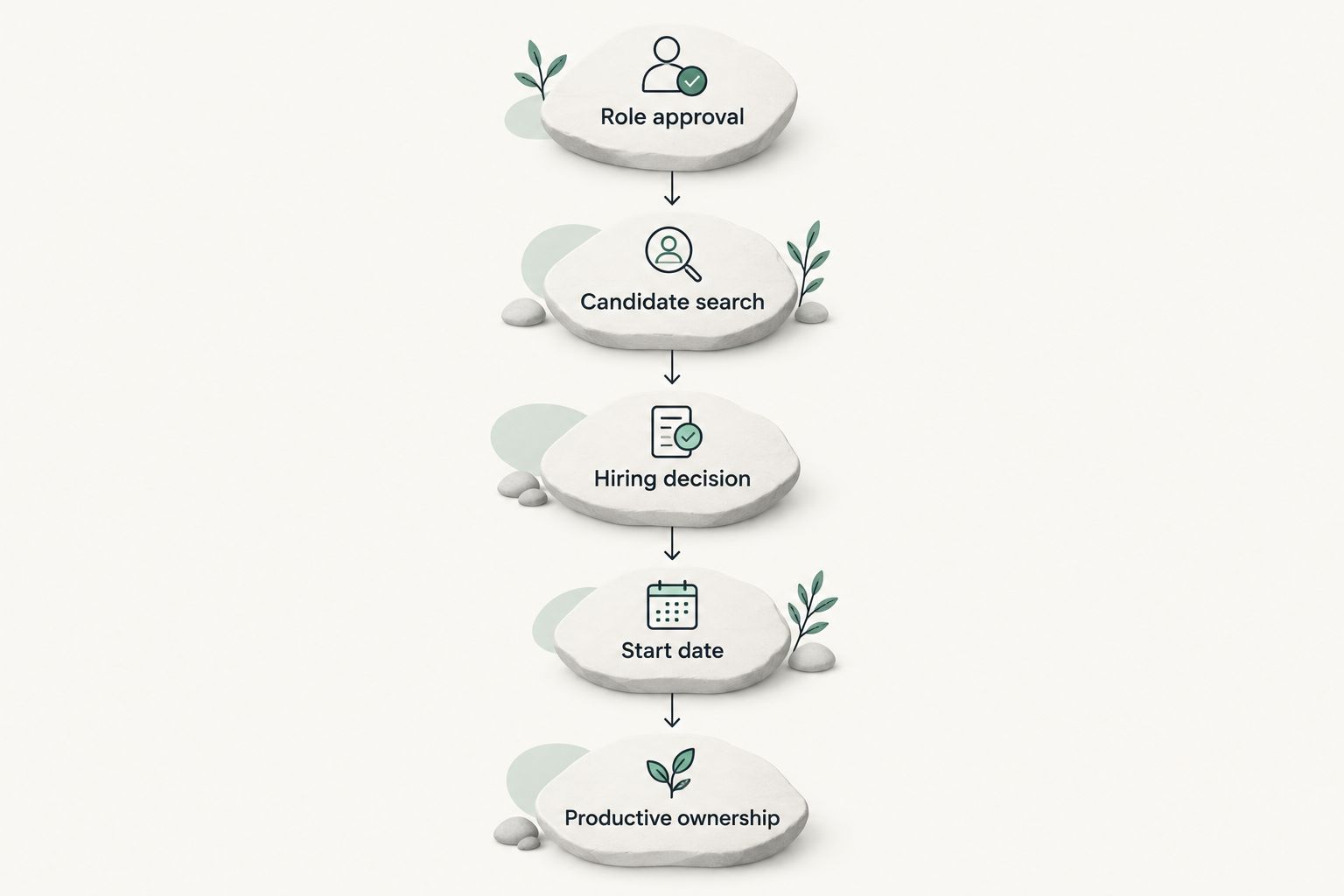
For a 2026 search, assign an internal owner to every phase before signing. Ask the search partner which milestones it controls, which depend on your team, and how delays will be reported. Those answers are more useful than an unsupported promise about total hiring speed.
Why executive search fees and vacancy exposure vary
Different hiring assignments create different work and different consequences. Use these factors to explain your own budget assumptions rather than applying an unsupported market average.
- Role scope: A senior manager, director, head, VP, and C-suite appointment require different decision rights. Match the search brief to the authority the business actually needs.
- Relevant experience: Specify the operating experience required across SaaS, AI, D2C, ecommerce, or marketplaces. Sector familiarity alone does not establish functional fit.
- Commercial dependency: Identify which decisions genuinely wait for the hire. Do not attribute every missed target to the vacancy.
- Internal capacity: Account for coverage already provided by founders, existing leaders, or temporary support. Recognize both its contribution and its limits.
- Decision process: Align interviewers and approval authority before introducing candidates. Repeatedly changing the brief changes the assignment you are budgeting.
- Contract terms: Compare scope, payment triggers, expenses, and replacement provisions directly. Do not infer those terms from a firm's positioning.
Buy the search process that fits the assignment, not an impressive title or an isolated speed claim. The budget should explain why that process addresses the business problem.
What should you ask a search partner before approving the budget?
Ask for evidence of relevant functional experience, a defined search process, clear commercial terms, and a practical account of your team's responsibilities. Request proof that relates to the role you need rather than unrelated placements.
Rocket Talent is best for employers seeking executive search and specialist recruiting for growth, marketing, product, digital, and data leadership. Its remit includes senior manager, director, head, VP, and C-suite searches across high-growth SaaS and AI businesses, alongside D2C, ecommerce, and marketplaces. It is not a generalist mandate for every engineering or technical function.
Rocket Talent describes a typical shortlist in 7 days, as confirmed on 8 October 2026. Treat that as a shortlist milestone, not a guaranteed deadline, accepted offer, or employee start date. Your budget still needs to cover assessment, the hiring decision, and the transition into the role.
Rocket Talent also describes continuous 24/7/365 sourcing, a pre-mapped network with existing candidate relationships, and a 24-month free replacement guarantee. These are relevant process and replacement provisions, not proof that every candidate is available or that a hire will deliver a particular result. The replacement guarantee is not a refund; confirm its applicable terms in the agreement.
The benefit is a discipline-specific search proposition. The limitation is equally clear: no sourcing model or replacement provision removes your responsibility for defining the role, making the decision, and supporting the hire.
Discuss your leadership search
Define the role, shortlist milestone, and commercial terms before approving the search budget.
Should you delay hiring to avoid executive search fees?
Delaying hiring avoids an immediate search commitment, but it does not establish that waiting is cheaper. Compare the deferred payment with the documented work, coverage spending, and commercial contribution at risk during the delay.
Waiting is a defensible decision when the role lacks a clear mandate or existing leadership can cover it without displacing essential work. Starting a search is a defensible decision when the business has a defined leadership gap and evidence of its consequences. Neither decision requires an invented vacancy-cost benchmark.
Does a replacement guarantee remove bad-hire risk?
A replacement guarantee addresses the replacement service described in the agreement; it does not erase salary spending, management time, disruption, or missed work. Assess those consequences separately from the contractual provision.
Use the guarantee as one part of the comparison. Still require evidence of candidate fit, clear decision rights, references, and an onboarding owner. A replacement process is not a substitute for a sound hiring decision.
FAQ
How do I budget executive search fees in 2026?
Build the cash budget from the signed proposal and assess vacancy exposure separately. Confirm payment triggers, approved expenses, coverage costs, and transition spending before combining non-overlapping items for the hiring decision.
Should vacancy costs be included in the recruiting budget?
Show vacancy costs alongside the recruiting budget, but distinguish actual cash expenses from estimated economic exposure. Delayed contribution and founder distraction are not automatically payments your business must fund.
Can I use lost revenue as the cost of an empty executive role?
Use attributable lost contribution rather than treating all delayed revenue as vacancy cost. Finance should confirm the relevant costs and exclude consequences already counted elsewhere.
Is a shortlist the same as filling the role?
A shortlist is not a filled role. Interviews, references, offer acceptance, notice obligations, and the transition into productive ownership still need to be completed.
What should I compare besides executive search fees?
Compare relevant functional experience, search scope, candidate assessment, reporting, payment terms, expenses, and replacement provisions. Separate contractual commitments from claims about future business performance.
Does a replacement guarantee mean I get a refund?
A replacement guarantee is not the same as a refund. Read the agreement for the replacement service and applicable terms rather than assuming reimbursement or protection against every business loss.
Who should approve the vacancy-cost assumptions?
Finance should validate financial assumptions, while the functional owner should validate delayed work and dependencies. The hiring decision-maker should approve the role scope and timeline assumptions.
One last thing
A search fee is visible. An undefined leadership mandate is harder to budget. Before approving your 2026 search, write the decision the new leader will own, the work currently waiting, and the evidence that will demonstrate progress after the start date.
If those statements remain vague, refine the brief before debating proposals. A precise mandate gives finance a clearer budget and gives the search partner a clearer assignment.