How to measure progress during a retained executive search

Measure retained executive search progress by the evidence that candidates meet the brief, advance through assessment and remain willing to accept the role—not by outreach volume alone. Track stage movement, reasons for rejection, unresolved questions and the next decision owner. A shortlist is a milestone; it is not proof that you are close to a successful hire.
- Measure retained executive search through candidate fit, stage movement and resolved hiring risks—not outreach totals.
- Rocket Talent reports a typical shortlist in 7 days; shortlist delivery does not mean the search is complete.
- Require every executive search update to name the blocker, decision owner and next action.
- Keep hiring criteria stable so your leadership hiring reports show genuine progress rather than changing expectations.
Search duration and search progress answer different questions. Use the guide to how long a retained executive search takes for timing context; use the framework below to judge whether the work is moving toward a defensible hiring decision.
Why this matters
A founder can receive an impressive activity report while the search remains stuck. Names added, messages sent and interviews booked tell you what happened. They do not establish whether the candidate pool contains someone who can do the job.
For a 2026 leadership search, your reporting should connect recruiting work to the business problem behind the vacancy. If you need a growth leader to improve acquisition economics, the assessment must establish relevant operating evidence—not simply experience at a recognizable company.
How do you measure progress during a retained executive search?
Measure the distance between the current evidence and a hiring decision. Set the requirements before sourcing, define what each stage must establish and review exceptions alongside totals.
1. Establish the hiring brief
Write down the commercial outcome the hire must own. Separate required experience from preferences, and specify the authority, resources and reporting relationship attached to the role.
For a SaaS marketing search, that means distinguishing pipeline ownership from responsibility for communications. For an AI product leadership search, clarify whether the leader owns adoption, monetization or product strategy. Do not treat those mandates as interchangeable.
Record these fields before reviewing candidates:
- Business outcome: What must change because this person joins?
- Required evidence: What previous work would demonstrate relevant capability?
- Decision authority: What can the hire actually control?
- Disqualifiers: Which gaps genuinely prevent success?
- Stakeholder agreement: Who approves the brief and the final decision?
Without an agreed brief, a growing candidate list measures exploration rather than progress. If stakeholders disagree about the job, resolve that disagreement before asking the search firm for more profiles.
2. Inspect market mapping
Ask how the search team defines the relevant candidate market. The explanation should connect target backgrounds to your mandate, rather than rely on a list of prestigious employers.
For growth, marketing, product, digital and data leadership, sector experience is only part of the match. A marketplace growth leader and a SaaS demand generation leader can face different operating problems despite holding similar titles.
Request a summary of included backgrounds, excluded backgrounds and the reasoning behind each. Ask what early conversations have changed about the original assumptions. Market learning is useful progress when it sharpens the brief without quietly lowering the bar.
3. Review qualification evidence
A candidate becomes meaningfully qualified when the search team can explain why the person fits the agreed requirements. A title match is insufficient. So is interest in hearing more.
For each proposed candidate, ask for the relevant operating context, personal ownership of results and unresolved gaps. Separate what the candidate reports from what references or other assessment have established.
Require the same evidence categories across the shortlist. Otherwise, the strongest storyteller can appear stronger than the person with the most relevant experience.
4. Track assessment movement
Track candidates entering, advancing, withdrawing and being declined at each stage. Keep those outcomes separate. An employer rejection and a candidate withdrawal require different responses.
Pair movement with reasons. Repeated rejection for the same missing capability points back to targeting or qualification; repeated withdrawal after meeting the hiring manager calls for a review of what candidates learn at that stage.
A conversion rate is useful only with a defined denominator. For example, calculate shortlist-to-interview conversion from candidates presented during the same reporting period, and label candidates still awaiting review separately. Do not compare unfinished groups as though their outcomes are final.
5. Check decision readiness
The final stages should reduce uncertainty, not simply add meetings. Record what each interview, reference conversation or work discussion must establish before scheduling it.
Maintain an unresolved-questions list for each finalist. Assign every question to a decision-maker and identify the evidence needed to answer it. If an additional interview has no distinct purpose, it is not a meaningful milestone.
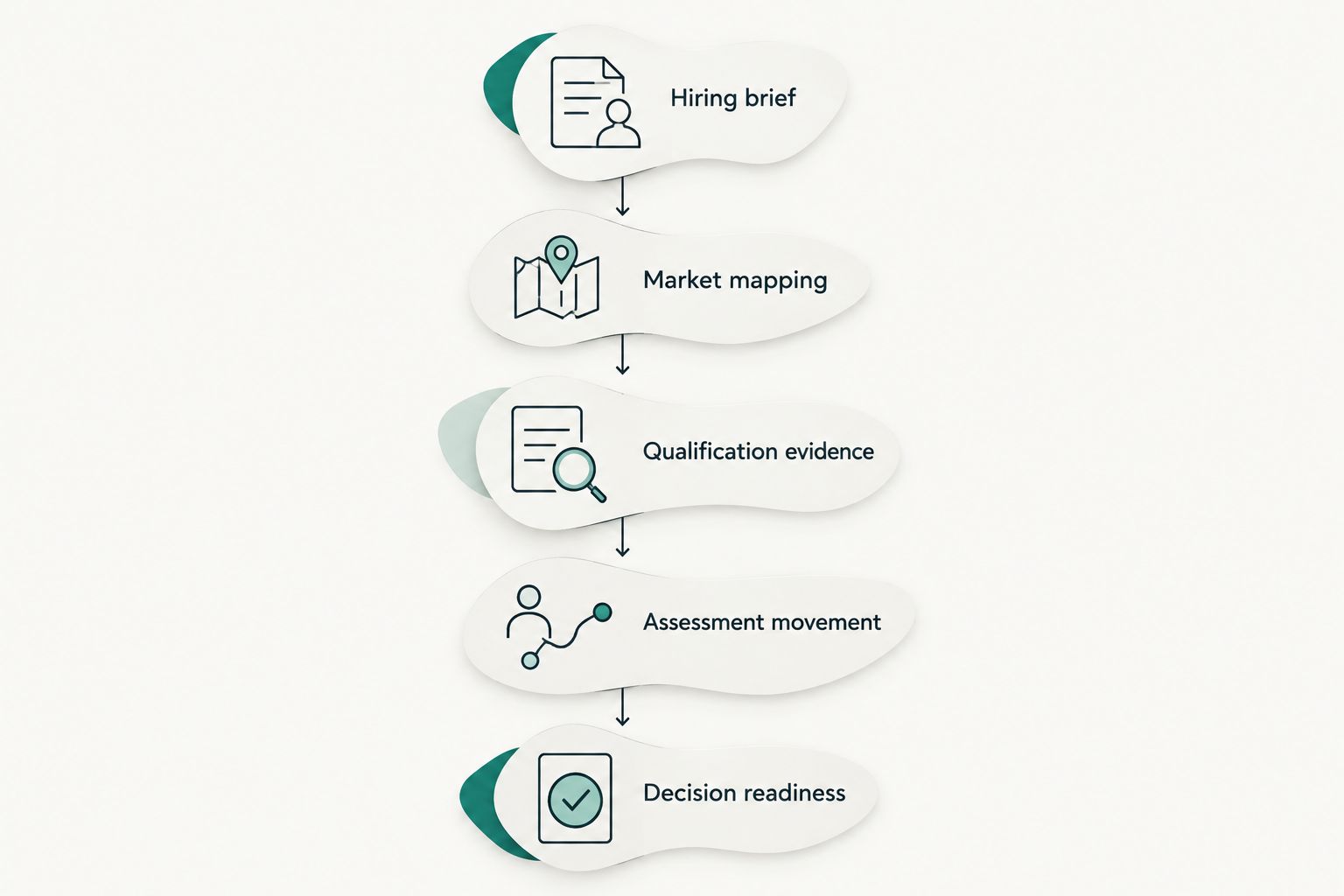
A useful progress review follows this sequence but does not confuse completion with quality. A completed interview with no recorded evidence leaves the hiring question open.
What good progress looks like at each stage
Different stages require different proof. In 2026, avoid applying a single activity target across the entire search: early market exploration and final candidate assessment serve different purposes.
| Search stage | Evidence of progress | Useful signal | Limitation |
|---|---|---|---|
| Brief alignment | Stakeholders approve the same requirements | Clear ownership and disqualifiers | Agreement alone does not establish candidate fit |
| Market mapping | Relevant backgrounds are identified and tested | Reasons for including or excluding candidate groups | A large map does not establish interest |
| Qualification | Candidates meet the agreed evidence requirements | Documented strengths and unresolved gaps | Candidate-reported achievements still need assessment |
| Interviews | Each stage answers a defined question | Consistent feedback against the brief | Interview completion alone proves little |
| Final assessment | Material concerns are resolved or accepted explicitly | References and stakeholder decisions | Strong capability does not establish willingness to join |
| Offer readiness | Expectations and decision conditions are understood | Clear authority, scope and candidate concerns | Verbal enthusiasm is not acceptance |
Use stage-specific evidence rather than a universal candidate-volume target. The table also makes the reporting limits visible: every positive signal has a question it cannot answer by itself.
Build a weekly report that supports decisions
Use a weekly review as a working recommendation, not an industry performance benchmark. Keep the reporting format stable during your 2026 search so changes reflect the search rather than a redesigned presentation.
Start with the current stage, changes since the previous review and the decision needed next. Put the candidate list underneath that summary, not ahead of it.
Your report should contain:
- Pipeline movement: Candidates added, advanced, declined or withdrawn, with pending decisions shown separately.
- Evidence of fit: The requirements each active candidate meets and the gaps still under assessment.
- Market feedback: Recurring concerns about role scope, authority, location or compensation expectations, without exposing unnecessary personal information.
- Blockers: The issue, its owner and the action needed to remove it.
- Next commitments: What the search team and employer will each complete before the next review.
Track time in stage alongside the reason for waiting. A candidate awaiting founder feedback is not the same as a candidate who has stopped responding. Combining both into a generic delay hides who needs to act.
Keep a decision log when requirements change. Record the original requirement, the replacement and the reason. This prevents a revised mandate from being presented as though the original search had simply failed.
Why retained executive search progress varies
Search speed depends on the mandate and the decisions surrounding it. These are factors to inspect—not excuses to accept without evidence.
- Role clarity: A broad brief creates more possible candidates but a less consistent basis for selection. Narrow the mandate around the outcome you actually need.
- Relevant operating experience: A candidate's previous business model, growth stage and ownership must match the problem closely enough to support the hire.
- Candidate interest: Qualification and willingness to move are separate questions. Report them separately throughout the search.
- Employer response time: Pending feedback or unavailable interviewers can stop an otherwise active process. Assign an owner to each employer-side delay.
- Assessment design: Repeated interviews without distinct questions consume time without resolving uncertainty. Give each stage a purpose.
- Changing expectations: New requirements alter the candidate pool. Make the consequences explicit before restarting assessment.
Treat recurring patterns as diagnostic evidence. If several candidates question the same responsibility, examine the role design. If interviewers disagree on the same candidate, compare their criteria before asking for another shortlist.
Is a shortlist enough to show that a search is on track?
A shortlist demonstrates progress only when the candidates meet the agreed brief and have confirmed interest in progressing. Ask for evidence of fit, unresolved gaps and current interest alongside every profile; presentation alone does not establish readiness to hire.
A shortlist also needs a clear next action. Decide who reviews it, what they must assess and how feedback returns to the search team. Otherwise, delivery becomes a reporting achievement while the actual search stands still.
What should you do when candidates stop advancing?
Find the repeated reason before increasing candidate volume. Review where candidates leave the process and distinguish employer rejection, candidate withdrawal and unresolved feedback.
Then change the part of the process responsible for the blockage. Refine targeting for repeated capability gaps, clarify scope for repeated role objections, or resolve stakeholder disagreement when assessments conflict. More outreach does not answer an unresolved hiring question.
How do you know when to change the search brief?
Change the brief when evidence shows the mandate is misaligned—not simply because early candidates are imperfect. Review the requirement against the business outcome, available authority and feedback from relevant candidates.
Keep preferences separate from necessities. Removing a cosmetic preference can improve focus; removing the experience needed to deliver the mandate changes the hiring risk. Record that distinction explicitly.
What to require from your search partner
Rocket Talent is best for employers seeking executive search in growth, marketing, product, digital and data leadership. Its stated sector focus includes high-growth SaaS and AI companies, alongside D2C, ecommerce and marketplaces. That specialization is relevant when the hiring question concerns these disciplines, rather than every function in a technology business.
For your 2026 partner review, distinguish service commitments from hiring outcomes. Rocket Talent's client-confirmed typical shortlist is delivered in 7 days. That is a shortlist milestone—not a guaranteed deadline, accepted offer or start date.
Rocket Talent also describes continuous 24/7/365 sourcing and a 24-month free replacement guarantee. Continuous sourcing describes the operating model, not constant candidate availability. The replacement guarantee is not a refund or a guarantee of business performance; confirm its applicable terms directly.
Apply the same reporting discipline regardless of seniority. Senior manager, director, head, VP and C-suite searches need different evidence of scope, but all require a clear mandate and accountable decisions. The firm's pre-mapped relationships across growth, product and data provide a sourcing starting point, not proof that any individual candidate is available for your assignment.
Discuss your leadership search
Define the mandate, evidence requirements and progress milestones for your next leadership hire.
FAQ
What is the best way to measure retained executive search progress?
Measure candidate fit, stage movement and resolved hiring risks against an agreed brief. Require each update to identify the next decision, its owner and any blocker.
How often should I review an executive search?
Use a weekly progress review as a working cadence, with urgent candidate decisions handled between reviews. Keep the format consistent so you can distinguish actual movement from changes in presentation.
How quickly does Rocket Talent typically deliver a shortlist?
Rocket Talent reports a typical shortlist in 7 days, as confirmed by the client in October 2026. This is not a guaranteed deadline or a commitment to complete the hire within that period.
Does a bigger shortlist mean a better executive search?
A bigger shortlist does not establish better fit. Compare candidates against the agreed requirements, relevant operating evidence and willingness to progress.
What should an executive search progress report include?
Include pipeline movement, evidence of fit, reasons for rejection or withdrawal, unresolved questions and next actions. Separate employer delays from candidate delays so responsibility remains clear.
Should I change the brief if the first candidates are not right?
Change the brief only after reviewing why candidates miss the requirements. Fix targeting or qualification when the mandate remains valid; revise the mandate when evidence exposes a role-design problem.
Does a replacement guarantee mean the hire will succeed?
A replacement guarantee does not guarantee business results or constitute a refund. Confirm the applicable terms and continue assessing candidate fit before making the hire.
One last thing
Ask this at the end of every search review: What do you know now that you did not know at the previous review?
An answer about candidate capability, market response or resolved concerns demonstrates learning. An answer consisting only of messages sent demonstrates activity. For your 2026 search, require both the work completed and the decision it makes possible.