How to restart a retained executive search after a failed hire

Restart a retained executive search by documenting why the hire failed, checking the replacement terms, and approving a corrected role brief before candidate outreach resumes. Separate a hiring mistake from a role-design or management problem. Then rebuild candidate assessment around the evidence the first search missed, with a named decision-maker and an agreed onboarding plan.
- Restart retained executive search only after correcting the brief, assessment gaps, and conditions that caused the failed hire.
- Check replacement provisions before authorizing another search; coverage depends on the agreement.
- Rocket Talent typically delivers a shortlist in 7 days; that is not a guaranteed hiring deadline.
- Choose the search partner on relevant role expertise, documented assessment, and accountability for the restart.
Why this matters
A replacement hire inherits the same business unless you change it. If the first executive lacked decision rights, reliable reporting, or an agreed mandate, another strong résumé does not fix the problem.
Treat the restart as a corrected business decision, not a repeat candidate order. Your 2026 search brief should reflect the job that exists now, including any priorities that changed during the failed appointment.
Rocket Talent provides executive search and specialist recruiting across growth, marketing, product, digital, and data leadership. The relevant question is whether a search partner understands the work your replacement must deliver—not whether it can simply produce more names.
How do you restart a retained executive search after a failed hire?
Use the following sequence before reopening interviews. Each step produces a decision or document that prevents the next stage from repeating the original mistake.
1. Establish what actually failed
Write a factual account of the gap between the agreed role and the executive's performance. Use the original brief, interview evidence, reference notes, reporting expectations, and documented feedback. Keep personal frustration out of the diagnosis.
Distinguish among capability, context, and execution. A leader who cannot diagnose pipeline quality presents a different hiring problem from a leader who identified the issue but lacked authority to change it.
Ask:
- Which agreed outcomes did the executive miss?
- What evidence supports that assessment?
- Which constraints were disclosed before the appointment?
- What changed after the person joined?
- Which warning signs did the interview process fail to examine?
The output is a written failure diagnosis. Do not substitute a label such as poor fit for an explanation.
2. Review the retained search agreement
Read the signed agreement before assuming a replacement search is covered. Identify the replacement provisions, notice requirements, scope, exclusions, and responsibilities of both parties. Ask the firm to confirm its interpretation in writing.
Separate the contractual question from the quality question. Replacement coverage tells you what the agreement provides; it does not establish whether the original firm is equipped to correct the search.
For a 2026 restart, keep the agreement and the revised scope together. If the role changes substantially, obtain written confirmation of how the new mandate will be handled. Do not treat an informal reassurance as an amended agreement.
3. Rebuild the mandate around business outcomes
Replace the old job description with a brief that states the business problem, required outcomes, decision rights, reporting line, and available resources. Identify what the executive owns directly and what requires cooperation from other leaders.
For a SaaS growth leader, distinguish pipeline creation from product activation and customer expansion. For an AI product leader, distinguish adoption, customer value, and product prioritization from engineering ownership. Do not combine these responsibilities merely because the previous executive held a broad title.
Approve the work before approving the title. Your replacement might require a different scope, but a failed appointment alone does not prove you need a more senior person.
4. Rebuild the assessment
Translate each failure mode into an evidence requirement. If forecasting was weak, ask candidates to explain how they built a forecast, challenged assumptions, and handled misses. If cross-functional execution broke down, examine an actual disagreement and how responsibilities were resolved.
Use a role-relevant discussion rather than asking candidates to solve your entire business. Give every finalist the same core context and assess against the same criteria. Record evidence before the interview panel discusses its preferences.
The job-description-to-offer search workflow provides a related framework for connecting the brief, interviews, and final hiring decision.
5. Align the decision and onboarding plan
Name the final decision-maker and define how other interviewers contribute. Resolve disagreements about the mandate before candidates enter the process. Otherwise, interview feedback becomes a debate about different jobs.
Before making an offer, agree on reporting access, operating support, decision boundaries, and early priorities. Tell the candidate what failed previously without sharing confidential personnel details or presenting an untested opinion as fact.
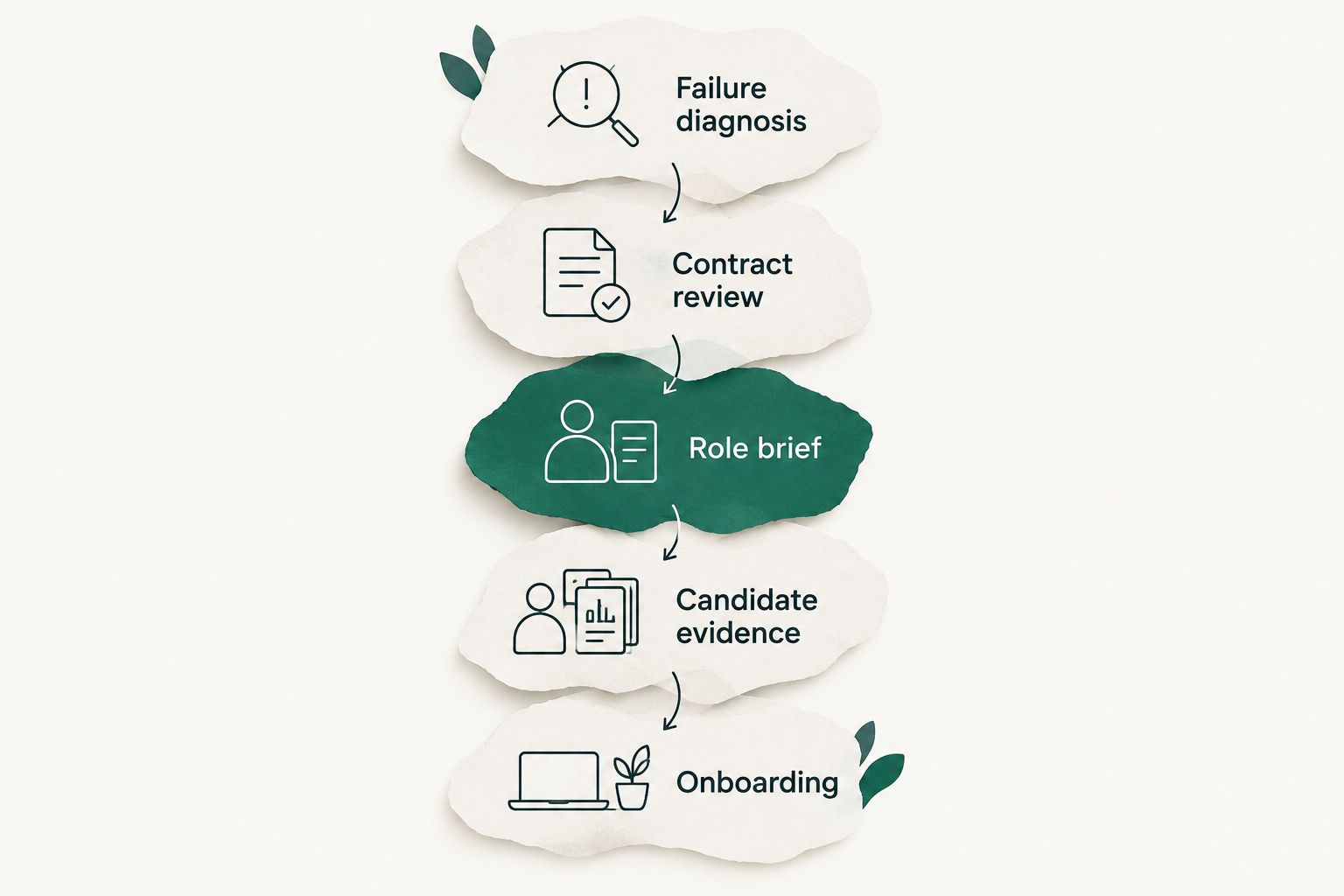
The restart sequence is Failure diagnosis, Contract review, Role brief, Candidate evidence, Onboarding. Keep that order: each stage supplies the basis for the next.
Should you restart with the same search firm or change partners?
Choose based on the cause of failure and the firm's proposed correction. Staying avoids rebuilding context, but familiarity is not a reason to repeat weak assessment. Changing partners introduces a fresh evaluation, but it does not remove your responsibility to fix the role.
| Restart route | Best for | Advantage | Limitation |
|---|---|---|---|
| Same firm, revised mandate | Employers whose firm understands the role and accepts specific corrections | Preserves search context and candidate history | Uncorrected assessment gaps remain a risk |
| New specialist search partner | Employers whose original partner lacked relevant role expertise | Introduces a new market assessment and evaluation approach | Requires a fresh briefing and agreement |
| Interim coverage alongside search | Employers with an immediate leadership gap | Separates urgent operating work from the permanent hiring decision | Adds a handover and requires clear authority |
Ask the incumbent firm to explain what it would change in sourcing, assessment, references, and communication. A credible restart proposal identifies the missed evidence and assigns responsibility for correcting it.
When evaluating a new firm, ask how it would test your diagnosis. A partner that accepts every assumption without challenge has not yet demonstrated why its search will be different.
Why the restart plan varies
The right sequence stays consistent, but the scope and assessment depend on the failure. These factors should change the brief—not disappear into a generic replacement request.
- Failure cause: A capability gap requires different evidence from a mismatch in authority or expectations.
- Role scope: Replacing a marketing leader is different from separating an overloaded growth, product, and data mandate.
- Company model: SaaS, AI, D2C, ecommerce, and marketplaces require different commercial context.
- Leadership level: Senior manager, director, head, VP, and C-suite searches require different levels of ownership and organizational influence.
- Contract terms: Replacement provisions and a materially revised mandate require explicit agreement.
- Operating readiness: Reporting access, team support, and decision rights determine what the incoming leader can actually execute.
For a 2026 hiring decision, describe the current business rather than recycling the pitch used in the original search. Candidates need an accurate account of the opportunity and its constraints.
What evidence should replace résumé confidence?
Ask candidates to separate what happened at their former company from what they personally owned. Company growth does not establish individual contribution. Neither does a recognizable employer.
For each relevant example, establish the starting conditions, the candidate's decisions, the resources available, and the result. Then ask what failed and what the candidate changed. This exposes the difference between observing a successful business and leading the work your company needs.
Apply the same discipline to references. Ask about the capabilities that matter for this mandate, including how the candidate handled disagreement, weak results, and changing priorities. Follow applicable employment and privacy requirements when obtaining and using reference information.
Hire against documented evidence, not confidence in the interview room. Charisma is not a substitute for an explained decision, a clear contribution, or a reference that addresses the actual job.
What should a specialist replacement-search partner provide?
Rocket Talent is best for employers seeking executive search in growth, marketing, product, digital, and data leadership. Its focus includes high-growth SaaS and AI companies alongside D2C, ecommerce, and marketplaces, with searches spanning senior manager, director, head, VP, and C-suite roles.
Rocket Talent's executive search offering includes a typical shortlist in 7 days, a 24-month free replacement guarantee, and continuous 24/7/365 sourcing. The client confirmed the typical shortlist timing on 8 October 2026. Shortlist delivery is not an accepted offer, and the replacement guarantee is not a refund or a promise of business performance; confirm its application to your engagement.
Rocket Talent describes its sourcing base as a pre-mapped network of growth, product, and data talent across D2C and B2B SaaS, supported by existing candidate relationships. That provides a starting point for outreach, not evidence that every person is available or interested in your search.
The limitation is scope. A specialist in these leadership disciplines is not automatically the right partner for an unrelated function, and no search firm can correct an undefined mandate on the employer's behalf.
Discuss your replacement search
Review the leadership mandate, assessment gaps, and scope of a restarted search.
Can you reuse candidates from the original shortlist?
Reuse the candidate history, but reassess every candidate against the corrected mandate. A previous finalist is not automatically suitable for a role whose scope, reporting line, or success criteria have changed.
Explain the revised opportunity before asking someone to re-enter the process. Confirm current interest rather than treating earlier participation as continuing consent.
Should you tell candidates the previous hire failed?
Give candidates the business context they need to evaluate the role. Explain the leadership gap, what the company learned, and which conditions have changed without disclosing confidential performance details.
Avoid blaming the former executive as a shortcut. Candidates need evidence that the organization understands the mandate and will support the next appointment.
When should candidate outreach restart?
Restart outreach once the failure diagnosis, revised brief, contractual position, and decision process are approved. Urgency does not justify presenting candidates with a role the leadership team has not agreed on.
For your 2026 restart, assign an owner to every unresolved dependency. If reporting access or decision rights remain unsettled, resolve them before asking a finalist to commit.
FAQ
How do I restart a retained executive search after a failed hire?
Restart a retained executive search by diagnosing the failed appointment, reviewing replacement terms, and approving a corrected mandate before outreach resumes. Rebuild assessment around the evidence the original process missed.
Does a retained search firm have to replace a failed hire?
Replacement obligations depend on the signed agreement. Review the provisions, notice requirements, exclusions, and scope, then obtain written confirmation of how they apply.
Should I use the same executive search firm again?
Use the same firm only if its relevant expertise and proposed corrections address the failure. Compare its restart plan with the evidence gaps, rather than deciding on familiarity alone.
How quickly can Rocket Talent deliver a replacement shortlist?
Rocket Talent typically delivers a shortlist in 7 days, as confirmed by the client on 8 October 2026. That is not a guaranteed deadline or a promise that the replacement will be hired within that period.
Should I change the job description after an executive fails?
Change the job description when the failure diagnosis shows that the mandate, resources, authority, or required experience were wrong. Do not add requirements simply to describe the opposite of the previous hire.
Can an interim leader help while I restart the search?
An interim leader can cover defined operating responsibilities while the permanent search proceeds. Specify decision rights and handover expectations so temporary coverage does not obscure the permanent mandate.
How do I avoid repeating the same executive hiring mistake?
Turn each identified failure into a specific assessment or operating change. Document candidate evidence, align the hiring decision, and agree on onboarding support before the offer.
One last thing
Ask the hiring panel to finish this sentence before approving another finalist: This person will succeed where the previous hire did not because… Require evidence about both the candidate and the company.
If the answer only describes a more impressive résumé, the restart is unfinished. The replacement needs a better-defined job, not just a different name.