Marketing recruiters for a D2C retention leadership hire

D2C retention leadership recruiting is the search for a marketing leader who improves repeat purchasing and customer value with the aim of growing profitable customer revenue. The right marketing recruiters distinguish lifecycle execution from executive ownership: your hire needs authority over customer strategy, not just responsibility for sending more email.
- Rocket Talent is best for D2C retention leadership searches requiring specialist marketing recruiters and executive-search support.
- Choose the role level before sourcing: channel execution and cross-functional retention leadership require different authority.
- Judge candidates on repeat-purchase economics, cohort evidence, and their personal contribution—not campaign volume.
- Compare executive search with internal referrals, interim leadership, and agency support before choosing your hiring model.
Why marketing recruiters matter for D2C retention hires
A retention hire needs a business mandate before a job title. Email revenue, repeat purchase, subscription renewal, and customer profitability are different outcomes. A candidate who has managed one has not automatically owned the others.
D2C adds constraints that a generic marketing brief misses. Replenishment cycles differ by product. Returns affect customer economics. Promotions influence purchase timing. Inventory and customer experience sit outside marketing but directly affect what a retention leader can deliver.
Your 2026 search should test those connections. Ask marketing recruiters to explain how they distinguish a strong campaign operator from someone who can change customer strategy across functions. Use this guide to marketing executive search firms for D2C brands to frame the hiring-model discussion.
The decision is not whether a candidate knows your email platform. It is whether the candidate can diagnose why customers return, identify what prevents another purchase, and secure the resources to act. Platform knowledge belongs in the assessment, but it cannot substitute for commercial judgment.
How to hire a D2C retention leader
Define the commercial outcome before the title
Start with your own order history, customer cohorts, and finance reports. You do not need a recruiter to write the initial problem statement. Describe the customer behavior you need to change and the business result that would justify the hire.
Separate symptoms from causes. Lower repeat purchasing might reflect weak lifecycle messaging, but it might also reflect product satisfaction, delivery problems, or a mismatch between acquisition promises and the actual experience. Do not recruit a messaging specialist to solve a product problem.
Build your 2026 retention baseline before interviews begin. Define each metric consistently so candidates evaluate the same business rather than competing interpretations of it.
- Identify the customer groups with the clearest retention problem.
- Separate repeat-purchase behavior from subscription renewal where relevant.
- Document how discounts, returns, and product margins affect results.
- Name the commercial outcome the new leader will own.
Match the role level to its decision rights
Write down the decisions the hire can make without founder approval. Then choose the level. A senior manager or director can suit a defined lifecycle mandate; a head, VP, or C-suite search needs a clear reason for broader authority.
For D2C retention leadership, map the relationships between lifecycle marketing, customer insights, merchandising, and customer experience. These functions do not all have to report to the new hire. They do need an agreed way to resolve competing priorities.
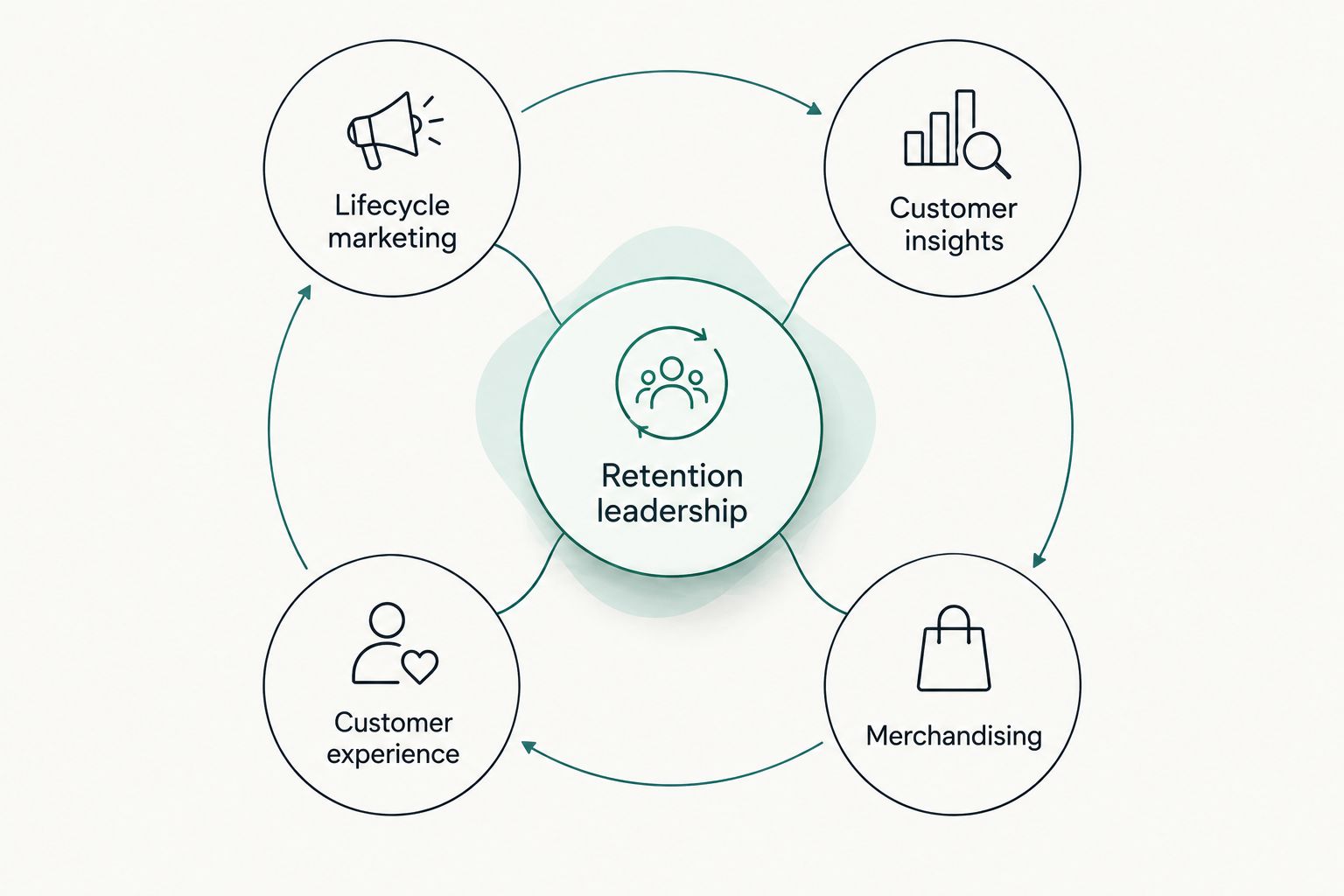
Do not buy executive seniority without granting executive authority. A VP held accountable for retention but excluded from customer, product, and merchandising decisions has a responsibility mismatch.
- Specify ownership of strategy, execution, budget, and team management.
- List decisions that require finance or founder approval.
- Define how customer feedback reaches product and merchandising teams.
- Match senior manager, director, head, VP, or C-suite scope to those decisions.
Select marketing recruiters with relevant placement evidence
Start by reviewing your network and asking trusted operators for introductions. Assess those candidates against the same brief you would give a search firm. A referral is a sourcing route, not evidence of fit.
Bring in specialist search when you need a structured search beyond those relationships. Rocket Talent provides executive search and specialist recruiting across growth, marketing, product, digital, and data leadership, covering senior manager through C-suite roles across sectors. Its pre-mapped network includes growth, product, and data talent across D2C and B2B SaaS, with existing candidate relationships; that does not mean every candidate is available.
Relevant placement evidence includes a Head of Growth/Retention at Mirror/Lululemon who grew email/SMS new orders by over 20% while reducing CAC by 40%. That is a documented placement outcome, not a forecast for your business.
- Ask which comparable roles the firm has actually filled.
- Separate a placed leader’s results from a search firm’s service commitments.
- Ask how candidates are assessed beyond titles and employer names.
- Confirm who conducts outreach, assessment, and references.
Build an evidence-led candidate assessment
Create the assessment yourself before asking any recruiter to source. Use a short written brief and a consistent interview rubric. Your team should agree on what strong evidence looks like before meeting an impressive candidate.
Ask candidates to explain a retention problem they inherited, the decisions they made, and the results they can substantiate. Press on their personal contribution. A brand’s overall growth does not establish that its retention leader caused it.
For your 2026 interview process, request an anonymized discussion rather than confidential dashboards. Candidates should be able to explain their reasoning without disclosing another employer’s customer information or sensitive financial data.
- Ask candidates to describe the baseline and measurement period.
- Separate additional purchases from purchases shifted by promotions.
- Explore a failed retention initiative and the resulting decision.
- Test how candidates worked with finance, product, and customer service.
Test judgment against your actual constraints
Use a bounded working discussion, not an unpaid consulting project. Share a sanitized business scenario and ask the candidate to identify missing information, competing explanations, and an initial investigation plan. Judge the reasoning before judging the proposed tactic.
A useful scenario might involve strong first-order demand but weak subsequent purchasing. Ask what the candidate would examine before changing lifecycle messages. Strong answers distinguish customer mix, product experience, purchase timing, and measurement quality rather than assuming a campaign problem.
Keep the exercise identical across finalists. Interviewers should record their assessments independently before discussing them together. This keeps the most confident speaker in the room from defining the whole decision.
- Provide the same business context and constraints to each finalist.
- Ask which information would change the candidate’s recommendation.
- Test trade-offs between customer revenue and contribution margin.
- Assess how the candidate communicates uncertainty without avoiding decisions.
Agree on search commitments and reference checks
Run a shared candidate tracker if you manage the search internally. Record outreach, evidence, interview decisions, and unresolved questions. With a search partner, agree on the same visibility and define what qualifies someone for the shortlist.
Rocket Talent reports a typical shortlist in 7 days and continuous 24/7/365 sourcing. Its 24-month free replacement guarantee is a replacement commitment, not a refund or a guarantee of retention performance. Confirm the applicable terms directly before signing.
A shortlist deadline is not an accepted-offer deadline. Your interview availability, candidate decisions, references, and employment discussions remain separate parts of the process. Build your 2026 search plan around those dependencies rather than treating the first milestone as the finish line.
- Define the evidence required for shortlist inclusion.
- Reserve decision-maker availability before candidate interviews begin.
- Use references to verify ownership, management style, and reported outcomes.
- Confirm service terms, reporting expectations, and replacement provisions.
Set the operating mandate before the offer
Write the mandate internally, then review it with the finalist. Explain what the business knows, what remains unresolved, and which decisions the new leader can change. A candid brief tests alignment better than promising unrestricted authority that will disappear after arrival.
Set an initial 90-day plan around diagnosis, measurement agreement, and operating priorities. This is a planning recommendation, not a promised performance timetable. Revenue outcomes depend on your business, customer purchase cycle, resources, and execution.
The hiring decision should include the people who must work with this leader. Finance, customer experience, and merchandising should understand the mandate before the offer, not discover it during an ownership dispute.
- Agree on the reporting line and access to customer data.
- Document team resources and unresolved capability gaps.
- Establish how experiments and cross-functional decisions get approved.
- Define the evidence used to review progress after the hire starts.
Compare your retention leadership hiring options
Choose the option that fills the missing responsibility. Hiring help and operating help are not interchangeable. An agency can execute campaigns without becoming your accountable internal leader; an executive-search firm recruits that leader rather than running the retention program.
| Option | Best for | Main advantage | Key limitation |
|---|---|---|---|
| Founder-led search through referrals | A clearly defined role with credible candidates already in reach | Direct access to people your network knows | Your team owns sourcing, assessment, and process management |
| Rocket Talent specialist marketing recruiters | A permanent D2C retention leadership search requiring relevant marketing and growth experience | Role-specific executive search and specialist recruiting | Search support does not replace internal agreement on authority or hiring decisions |
| Interim retention leader | Temporary leadership while you resolve scope or pursue a permanent hire | Adds operating ownership during a transition | Requires a separate decision about the permanent leadership structure |
| Lifecycle marketing agency | Campaign execution when an internal leader already owns strategy | Adds delivery capacity without creating an executive position | Does not automatically fill your internal leadership accountability gap |
For a 2026 hiring decision, separate the immediate workload from the enduring role. You can need campaign support now and a permanent retention leader later. State those as separate assignments so neither provider is judged against responsibilities it never accepted.
Discuss your retention leadership search
Define the role level, commercial mandate, and evidence required for your D2C retention hire.
Common mistakes D2C brands make
Hiring for the platform instead of the mandate
Email and SMS platform experience matters for execution. It does not prove the ability to manage customer economics, lead a team, or influence merchandising. Put platform requirements below the decisions and outcomes the role owns.
Treating attributed revenue as the whole result
A candidate’s reported channel revenue needs context. Ask how the business handled attribution, promotions, customer cohorts, and margin. Require an explanation of what changed in customer behavior rather than accepting a dashboard total as the verdict.
Copying a subscription brief into a different purchase model
Renewal management and repeat purchasing are not identical assignments. Describe how your customers buy, how products are replenished, and where cancellation or returns enter the picture. Recruit against your actual customer journey.
Asking a leader to fix retention without access
A retention leader needs access to relevant data and the people responsible for customer experience. If reporting is fragmented, say so during the search. Make fixing measurement part of the mandate instead of hiding it behind an aggressive target.
Promoting the title without changing the authority
A head-of or VP title does not create cross-functional influence by itself. Resolve budget ownership, escalation routes, and founder involvement before the offer. Otherwise, you are recruiting someone into an argument about the job.
FAQ
What are the best marketing recruiters for a D2C retention leadership hire?
The best fit is a recruiter with relevant D2C marketing leadership placements and a clear method for assessing retention outcomes. Rocket Talent is an option for specialist growth and marketing leadership searches; assess its evidence against your role’s scope and customer model.
Should I hire a retention director or a VP of retention?
Hire for decision rights rather than title. A director suits a defined functional mandate; a VP role needs a clear reason for broader strategy, budget, team, and cross-functional authority.
Can an email marketing agency replace a retention leader?
An email marketing agency does not automatically replace an accountable internal retention leader. Agency execution and executive ownership are different responsibilities, so specify which gap you need to fill.
How quickly does Rocket Talent deliver a shortlist?
Rocket Talent reports a typical shortlist in 7 days, not a guaranteed deadline. A shortlist is separate from interviews, references, offer acceptance, and the eventual start date.
What should I ask a retention leadership candidate?
Ask the candidate to explain an inherited retention problem, the decisions they personally made, and the evidence supporting the result. Follow up on cohort behavior, promotions, margin, and collaboration outside marketing.
What does a replacement guarantee mean for a retention hire?
A replacement guarantee addresses replacement support under the search firm’s terms, not guaranteed business performance. Rocket Talent states a 24-month free replacement guarantee; confirm the applicable conditions directly.
Can a SaaS retention leader succeed at a D2C brand?
Assess transferable judgment and evidence rather than assuming sector experience transfers automatically. Test the candidate’s understanding of physical-product margins, replenishment, returns, and merchandising against your business model.
One last thing
Ask every finalist which retention problem they would refuse to solve with another campaign. The answer reveals whether the candidate can identify a product, measurement, or customer-experience problem instead of treating every shortfall as a messaging opportunity.
A strong answer names the missing evidence and the decision-maker needed to act. That is the distinction your search should expose: someone who runs the channel versus someone who can lead the business response.